Softbox vs Umbrella: Choose by Size, Spill, and Working Space
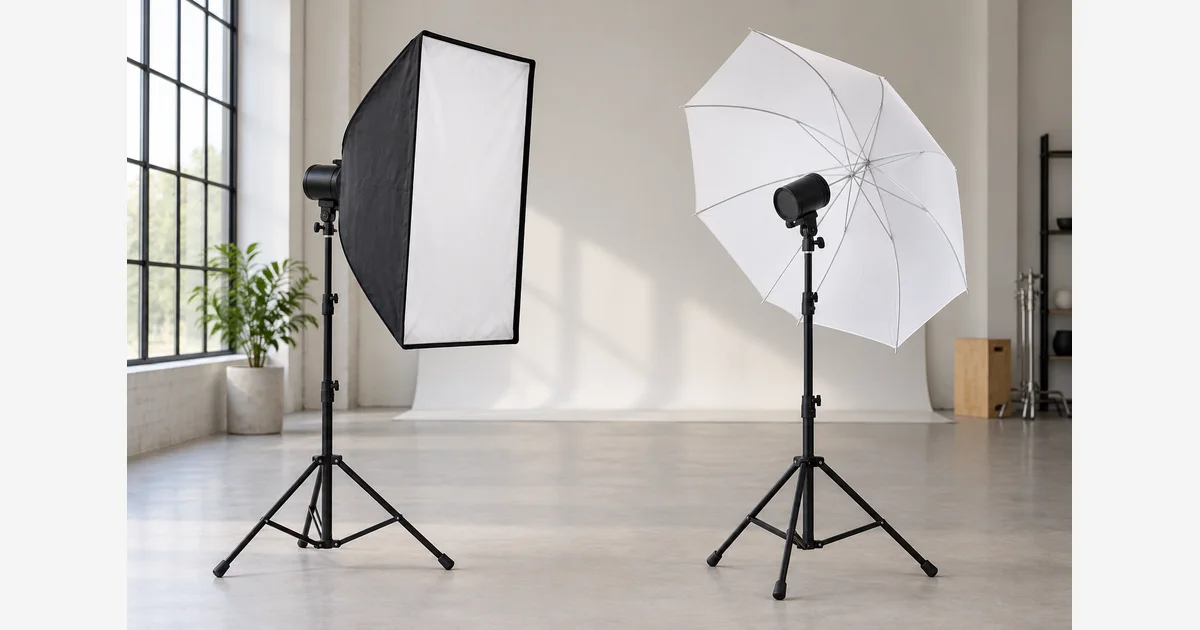
Choose a softbox when you need a defined light-emitting surface and useful spill-control options; choose an umbrella when its setup speed, coverage, and particular fabric suit the job. Compare actual size, distance, construction, and accessories rather than assuming every softbox is soft and every umbrella is uncontrolled.
Both can produce flattering light. The more useful question is which one can put the intended light on the subject without unwanted light on the background, walls, or lens in your available space.
Softbox vs umbrella: the decisions that matter
| Requirement | Softbox considerations | Umbrella considerations |
|---|---|---|
| Control light on the background | Recessed fronts, grids, and flags can help, depending on design. | Fabric, depth, backing, and accessories change spill; inspect the actual setup. |
| Fast location setup | Quick-opening designs differ from rod-and-speedring designs. | Many open quickly, but still require compatible mounting and secure support. |
| Wide coverage | Choose dimensions and distance for the group or object. | Shallow/translucent designs can distribute light broadly. |
| Reflective products | A defined rectangular or strip surface can create a useful reflected shape. | Ribs, source placement, and fabric may affect the visible reflection. |
| Restricted room | Check depth, stand footprint, and working clearance. | Check open diameter, shaft projection, and reflected spill. |
Profoto distinguishes white, silver, and translucent fabrics, plus deep and shallow shapes. A diffuser or backing panel can change the behavior further. Treat “umbrella” as a family of configurations, not one fixed lighting effect.
Compare the source as the subject sees it
Softness is strongly connected to the apparent size of the illuminated source from the subject's position. A small modifier far away and a large one close by are different experiments. Moving a modifier also changes coverage and exposure; correct for those changes before judging a portrait.
For a useful comparison, record the actual illuminated face dimensions, source-to-subject distance, light position, and diffusion layers. A nominal product diameter does not prove that every inch is evenly illuminated. Look at the shadow transition, catchlight or product reflection, and background spill separately.
A grid can restrict spread without turning the entire setup into a different source-size comparison. A reflector card can open shadows without requiring another powered light. The one-light product guide shows how to evaluate these controls one at a time.
Run a fair trial in your own room
- Place a stationary textured subject with a neutral background. Mark subject and camera positions.
- Choose comparable apparent source sizes and a consistent lighting direction where practical. Record unavoidable differences rather than hiding them.
- Make a reference exposure and keep subject brightness comparable between modifiers. Record power and camera changes.
- Inspect four areas: shadow edge, highlight shape, background brightness, and unwanted spill.
- Repeat with your real constraint: a wall close behind, a wider group, or a glossy object.
- Record setup time, packed size, clearance, and support needs. A small optical difference may matter less than a setup you can reliably fit.
Check mount, heat limits, and the complete supported load
Confirm the light mount, speedring/adapter, umbrella shaft fit, and manufacturer-approved use. Profoto's softbox family chart, for example, documents different adapters and heat restrictions across its own ranges. Similar-looking modifiers are not therefore interchangeable.
Use a stand and head suitable for the complete assembly, including the modifier's leverage. Follow the equipment's support, ballast, clearance, and temperature instructions; an indoor arrangement does not establish outdoor wind suitability. Keep children and pets away from stands during setup.
Download the modifier trial and fit checklist (.txt)
Compare softboxes and photography umbrellas using those requirements. If the room itself is the limitation, begin with the home-studio space plan.
Sources
Frequently Asked Questions
-
No. Apparent source size, distance, illumination, and configuration matter. Comparing a small distant softbox with a large close umbrella does not isolate modifier type.
-
No. White, silver, translucent, deep, shallow, and accessory-backed configurations behave differently.
-
No. Mounts, speedrings, adapters, weight, and heat limits vary. Check both the light and modifier documentation.
-
Keep subject and camera fixed, record source size and distance, maintain comparable subject brightness, and inspect shadows, highlights, and spill separately.