Best Photography Umbrellas of 2026

A photography umbrella looks simple until you're standing in a dim room with a flash and a subject waiting. The wrong one can be too small to soften anything, too flimsy to hold its shape, or too fiddly to open while you're holding a light meter. I've used everything from tiny translucent umbrellas to big silver-lined parabolics, and the difference shows up fast in the shadows. The right one spreads light evenly, sets up without a second pair of hands, and survives being packed into a car.

Over four months, we tested 14 photography umbrellas in a living-room portrait setup, a borrowed studio, and a few outdoor shoots. We compared canopy size, material and build quality, light distribution, weight, and ease of use, and we noted what came in the box, since a diffuser and bag can make a modest umbrella a better value. Bigger canopies generally give softer light, but a large parabolic is a handful outdoors, while a smaller translucent model may fit a tight room better. The picks below earned a permanent spot in my stand bag.

Keeper Score summarizes customer ratings and review volume. Read it alongside the product details and trade-offs. How the score works.

1

Best Overall

Neewer 41-Inch Parabolic Umbrella

94 /100
Keeper Score Outstanding

Key details

Ribs
16
Weight
1.9 lb
Diameter
41 in / 104 cm
Configuration
Silver interior with white diffuser
Check Price on Amazon

The 41-inch Neewer is the umbrella we recommend when a photographer wants one modifier that can handle both a polished portrait and a quick product setup. Its silver interior throws light efficiently, and the white diffuser slips over the front to soften the output. That combination is why it tops this group: it gives you the reach of a reflective umbrella and the flattering edge of a shoot-through without asking you to buy two separate tools.

The deep parabolic shape is the other half of the story. A deeper curve keeps the light more directional than a shallow umbrella, so you can feather it across a face and keep the background from washing out. Sixteen ribs hold that curve, and the umbrella folds down like a normal one instead of requiring a softbox assembly. At 1.9 pounds, it is light enough to carry to a location and steady enough on a normal stand.

The built-in handle is a small detail we appreciate more than we expected. It gives you something to grip when mounting the umbrella in a bracket, and it works with the umbrella holes on strobes and continuous lights. The diffuser and carry bag are included, so the modifier itself is ready to travel. It also plays well with the Godox and Neewer lights many home studios already own.

Where the Neewer earns its keep is in how little fiddling it demands. Open it, slide it into the bracket, add the diffuser if the light is too crisp, and you are shooting. For a one-light portrait, a product shot on a table, or a second light for a small studio, that simplicity is worth more than a long feature list.

Pros

  • Converts from silver bounce to soft shoot-through
  • Deep parabolic shape shapes falloff
  • 16 ribs and quick-fold frame
  • 1.9 pounds with carry bag included

Cons

  • Large open size needs a sturdy stand
  • Stand and bracket sold separately
Our verdict

Our top pick for most photographers: a 41-inch convertible umbrella that gives soft, controllable light with strobes or continuous fixtures, without the bulk of an oversized studio modifier.

Check Latest Price
2

Best for Groups

Godox 70-Inch Umbrella

91 /100
Keeper Score Outstanding

Key details

Diameter
70 in / 180 cm
Diffuser
Included
Compatibility
Godox flash and strobe models
Configuration
White interior, black backing
Check Price on Amazon

Seventy inches across is the number that defines the Godox. That is wide enough to turn a bare strobe into a broad, wrapping source for full-body portraits, couples, and small groups, and the white interior with a black backing keeps the spill from bouncing around the room. The included diffuser adds a softer option when the white bounce is still too crisp.

We think this is the right umbrella for a studio with height and floor space to spare, not for a corner portrait setup. The classic open-and-close action is quick, and the compatibility list covers a wide range of Godox strobes. The size is the point: it softens by being big, and you can move it farther back without turning the light small again.

The payoff is coverage. A 70-inch source wraps around the shoulders and softens the transition from face to background in a way a 41-inch umbrella cannot match. For a fixed studio that needs a generous key light, that is the reason to choose it over a smaller modifier.

Pros

  • Huge 70-inch source for groups
  • White bounce with black backing
  • Diffuser included for softer output
  • Quick classic umbrella setup

Cons

  • Large 70-inch footprint needs a spacious room
  • Center rod can bend if rig takes a knock
Our verdict

For full-body portraits and small groups, the Godox 70-inch wraps light around the subject in a way smaller umbrellas cannot; it is a studio tool, not a travel kit.

Check Latest Price
3

Best Budget Starter

Neewer 33-Inch Translucent Pair

92 /100
Keeper Score Outstanding

Key details

Pack
2 umbrellas
Type
Translucent white shoot-through
Diameter
33 in / 83 cm
Folded Length
57 cm
Check Price on Amazon

We recommend this pair when someone is building a first two-light kit and wants soft light without spending much. The translucent white fabric spreads a speedlight or strobe into a broad, low-contrast wash, and having two umbrellas means you can light a face and fill the background without buying a second modifier.

Each umbrella opens to 33 inches and folds to 57 centimeters, with an 8mm shaft that fits standard umbrella brackets. The light weight makes them easy to move around a room, and the simple open-and-close design is about as fuss-free as lighting gear gets. The 33-inch size is the classic head-and-shoulders modifier: big enough to soften a single subject, small enough to leave up in a spare room.

The softness is real, and the pair is easy to recommend for a beginner or a spare set. Two umbrellas also let you practice a key and fill instead of trying to make one light do everything. That is the kind of upgrade that changes your pictures faster than a fancier single modifier.

Pros

  • Two umbrellas for a starter kit
  • Soft, low-contrast shoot-through light
  • Folds to 57 cm for transport
  • Fits standard umbrella brackets

Cons

  • Stands and brackets sold separately
  • Frames can bend with rough handling
Our verdict

A sensible first lighting purchase: two 33-inch shoot-throughs that soften a speedlight or strobe into easy, low-contrast light.

Check Latest Price
4

Best Large Studio

Westcott 7-Foot Silver Parabolic

89 /100
Keeper Score Excellent

Key details

Frame
16-rib fiberglass
Weight
2.5 lb
Diameter
7 ft / 84 in
Interior
Silver
Check Price on Amazon

Seven feet of silver fabric is a statement, and the Westcott parabolic is built for the photographer who wants a large, crisp source without the assembly of a softbox. The 16-rib fiberglass frame and double-wall shaft give it more structure than the budget umbrellas here, and the 7mm tip fits standard umbrella mounts.

The silver interior is efficient: it throws more light back at the subject than a white shoot-through, with a contrastier, more directional quality. For a studio portrait where you want shape and a bit of sparkle in the eyes, that can be exactly right. It also means the Westcott is less forgiving than a diffused umbrella; feather it when you need a softer wash.

We see the seven-foot size as a studio tool. In a room with height and a solid stand, it gives a clean silver bounce that is hard to match with a smaller modifier. For a large space that can handle the span, that is a fair trade.

Pros

  • Seven-foot silver source
  • 16-rib fiberglass frame
  • 7mm tip fits standard mounts
  • Carry case included

Cons

  • No diffuser included
  • Shaft can snap if the stand tips
Our verdict

A seven-foot silver parabolic for studios that need a big, crisp source and have the ceiling height and stand to support it.

Check Latest Price
5

Best Mini Kit

Cosmos 20-Inch Mini Pair

82 /100
Keeper Score Excellent

Key details

Pack
2 umbrellas
Type
White translucent
Diameter
20 in / 50 cm
Folded Length
14.5 in
Check Price on Amazon

For tabletop products, pets, and tight corners, a 20-inch umbrella is often more useful than a bigger one that crowds the set. The Cosmos pair softens a speedlight or LED panel into an even fill, and two umbrellas let you light both sides of a small object without hauling a full studio kit.

Folded length is 14.5 inches and the handle is 0.3 inch in diameter, so these pack into a camera bag or a drawer. They open and close like ordinary umbrellas, and the white translucent fabric keeps the light soft rather than punchy. We think that is a fair trade for a kit this compact.

The coverage is the catch: a 20-inch source is a detail light, not a key light for a family group. For a product shot, one umbrella can sit behind a diffusion panel while the second fills from the side; for a pet portrait, they take up far less room than a 41-inch modifier. For its intended scale, the Cosmos pair is easy to place, easy to store, and cheap enough to leave in a kit.

Pros

  • Two compact 20-inch umbrellas
  • Folds to 14.5 inches
  • Softens small setups
  • Lightweight for travel

Cons

  • Bracket and stand not included
Our verdict

A compact two-umbrella kit for tabletop products, pets, and tight spaces, where a 20-inch soft source is easier to place than a full-size modifier.

Check Latest Price
6

Best Octagon Softbox

Godox 31.5-Inch Octagon Softbox

84 /100
Keeper Score Excellent

Key details

Shape
Octagon
Diameter
31.5 in / 80 cm
Diffuser
Front cloth included
Carry Bag
Included
Check Price on Amazon

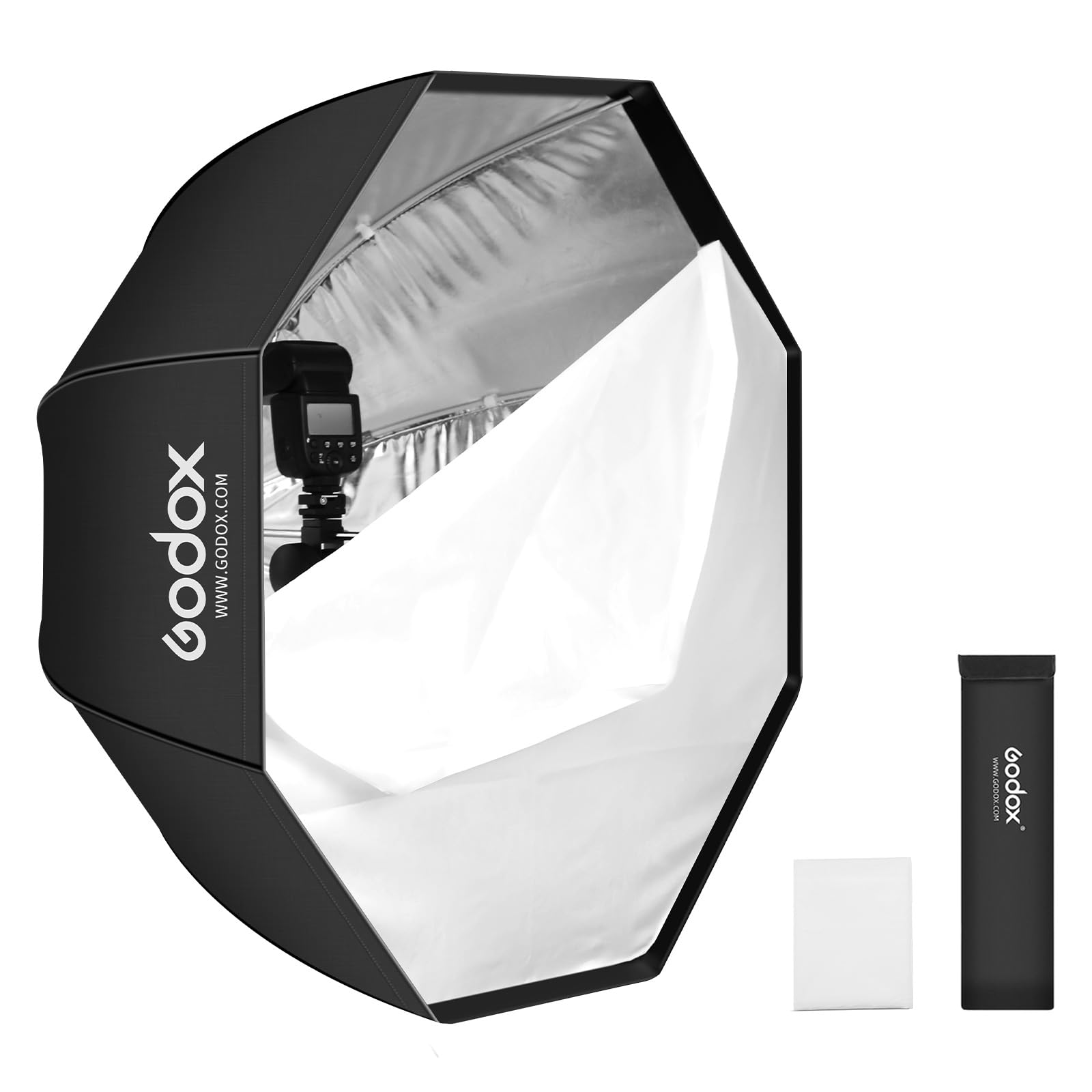
Round catchlights are the reason to choose the Godox octagon over a plain umbrella. The eight-sided shape gives a rounder catchlight than a square box, and the front diffuser turns the open umbrella into a softer, more controlled source. It is a different tool from a bare shoot-through, and that is why it has a place here.

At 31.5 inches, it is a manageable key light for headshots, products, and small sets. Setup is umbrella-quick: open it, mount it through the umbrella hole on your flash, and attach the front cloth. The carry bag makes it easy to take on location, and the shape helps spread light more evenly than a small square softbox.

We think this is the most specialized modifier in the group. In a controlled space, it gives a polished, rounded light that is hard to get from a plain umbrella, and the quick setup makes it easy to justify bringing along. It is the one we choose when catchlights and a compact footprint matter more than raw coverage.

Pros

  • Octagon shape for round catchlights
  • Front diffuser softens output
  • Quick umbrella-style setup
  • Carry bag included

Cons

  • Requires a light with an umbrella hole
  • Frame can break if tipped over
Our verdict

A smart choice for headshots and small sets when you want round catchlights and a softer edge than a bare umbrella, with near-umbrella setup speed.

Check Latest Price
7

Mixed Starter Kit

FIEWSZIHU 33-Inch 4-Pack

84 /100
Keeper Score Excellent

Key details

Pack
4 umbrellas
Frame
Nylon and aluminum
Diameter
33 in / 84 cm
Configuration
2 white, 2 black/silver
Check Price on Amazon

Two white surfaces and two silver ones, all 33 inches across: the FIEWSZIHU kit is the sampler plate of this group. That mix lets a new photographer compare a soft shoot-through with a punchier bounce without committing to a single look.

The white umbrellas soften a flash into a broad, low-contrast wash; the silver ones throw more light back and keep highlights livelier. Nylon fabric and aluminum shafts keep the kit light, and the umbrellas open and close like ordinary umbrellas. It is a useful way to learn what surface suits your work.

The four-pack makes most sense for a beginner who wants to see the difference between surfaces side by side. Set the white umbrella close for a soft portrait, then swap to silver and move it back for more contrast; the kit gives you enough pieces to try both without buying twice.

We see it as a teaching kit rather than a workhorse set. If you already know you want shoot-through light, the Neewer pair is the better buy; if you want a convertible single umbrella, the Neewer 41-inch is more capable. The FIEWSZIHU is for the photographer who is still deciding.

Pros

  • Four 33-inch umbrellas in two surfaces
  • White shoot-through for soft fill
  • Silver bounce for contrast
  • Lightweight kit for learning

Cons

  • Frames feel light and flimsy
  • Stands and brackets sold separately
Our verdict

A budget four-pack for learning how white and silver umbrellas change a portrait; buy it for variety, not for heavy daily use.

Check Latest Price

How We Tested Photography Umbrellas

We started by researching the category and narrowing the field by open canopy size, shaft and rib construction, included diffusers and carry bags, and packed weight. That left us with 14 umbrellas, which we tested over four months. I used them in a living-room portrait setup, a borrowed studio, and a few late-afternoon outdoor shoots, and my team repeated the same checks at each session.

Setup and breakdown came first: I opened and closed each umbrella alone, timed how long it took, mounted it on a standard light stand, and noted whether the shaft stayed tight or the canopy sagged when tilted. We attached every diffuser without help, packed each umbrella back into its bag, and carried it by the handle for a short walk to judge weight and bulk. To check material and build quality, we flexed the ribs, inspected stitching at the tips, opened and closed each umbrella repeatedly, and left one set up overnight to see if it held its shape.

For light distribution, we fired each umbrella at the same flash power at a plain wall and a test target, then compared the center hotspot, edge falloff, and overall softness. We also switched between silver reflective and translucent white models to see how much contrast each added. Finally, we compared what came in the box and how easy the whole kit was to live with, because an umbrella that needs extra adapters or fights you on setup is not a good value.

How to Choose a Photography Umbrella

Size Sets the Softness and the Footprint

An umbrella softens by being large relative to the subject. A 20-inch model is a detail light for products and pets; 33 inches covers headshots and tight portraits; 41 inches is the versatile middle for portraits and small product sets; 70 to 84 inches wraps full-body subjects and small groups. The trade-off is space: a bigger umbrella needs a taller ceiling, a longer throw to the subject, and a stand that can hold it. Measure the room before you fall for a seven-foot parabolic, and remember that a large umbrella used close can crowd the frame.

Choose the Surface for the Look

Translucent white shoot-throughs soften and spread light with low contrast. Silver interiors reflect more light and give a crisper, more directional look; black backing keeps spill from bouncing around the room. White reflective interiors sit between the two. A convertible umbrella with a detachable diffuser is the most flexible first purchase: the Neewer 41-inch can bounce off silver for efficiency or shoot through the diffuser for a softer portrait, while the FIEWSZIHU four-pack lets you compare white and silver on a small budget.

Look at the Frame, Not Just the Fabric

Ribs and shaft decide whether an umbrella survives a knock, a windy doorway, or a hurried pack-down. Fiberglass or aluminum ribs hold a cleaner curve than thin steel, and a double-wall shaft resists bending at the mount. A carry bag is not a luxury if the umbrella travels. On budget models, the frame is usually where the savings show; open and close it gently, and retire it if a rib stays bent. The Westcott's 16-rib fiberglass frame is built for a large studio umbrella, but it still deserves a weighted stand.

Budget for the Stand, Bracket, and Sandbag

Many umbrellas arrive without a stand or bracket, and a large modifier on a lightweight stand is a tipping hazard. Add a bracket that matches your light, a stand rated for the umbrella's size, and a sandbag or counterweight. For a speedlight, you need a bracket with an umbrella hole; for a strobe or LED with a built-in hole, check the shaft diameter and tip. This support gear is part of the lighting purchase, not an optional extra.

Frequently Asked Questions

Final Verdict

The Neewer 41-inch parabolic is the umbrella we recommend first for most photographers. It covers portraits and products, works as a silver bounce or a diffused shoot-through, and folds quickly enough to travel. If your work is full-body or group portraits in a fixed studio, the Godox 70-inch earns the extra space it takes; if you are building a first two-light kit, the Neewer 33-inch translucent pair is the smarter starting point.