Best Variable ND Filters of 2026

A variable ND filter is one ring that does the job of a stack of fixed ones: twist it and you drop two, five, even nine stops of light, enough to blur a waterfall at noon or hold a wide aperture in full sun. The difference between a good one and a bad one shows up at the edges of that range — a magenta cast over the whole frame, a dark X stamped across the corners once you twist past the halfway mark. I've ruined more frames to a cheap VND than to any other piece of glass.

So over the past eight months we've screwed 12 of them onto our own cameras — 67mm up to 105mm, a few combining the ND with a polarizer in the same ring — and shot the same scenes with each. Two things I didn't expect. The stop markings on the ring are usually optimistic, so you learn to read the histogram instead of the numbers. And fit matters as much as the glass: a filter that doesn't match your thread, or one that needs a stack of step-up rings, becomes a vignette and a flare problem fast.

Keeper Score summarizes customer ratings and review volume. Read it alongside the product details and trade-offs. How the score works.

1

Best Overall

NiSi Swift True Color 82mm

91 /100
Keeper Score Outstanding

Key details

Coatings
20-layer nano
Thread Size
82mm
Front Thread
86mm
Density Range
1–5 stops (ND2–ND32)
Check Price on Amazon

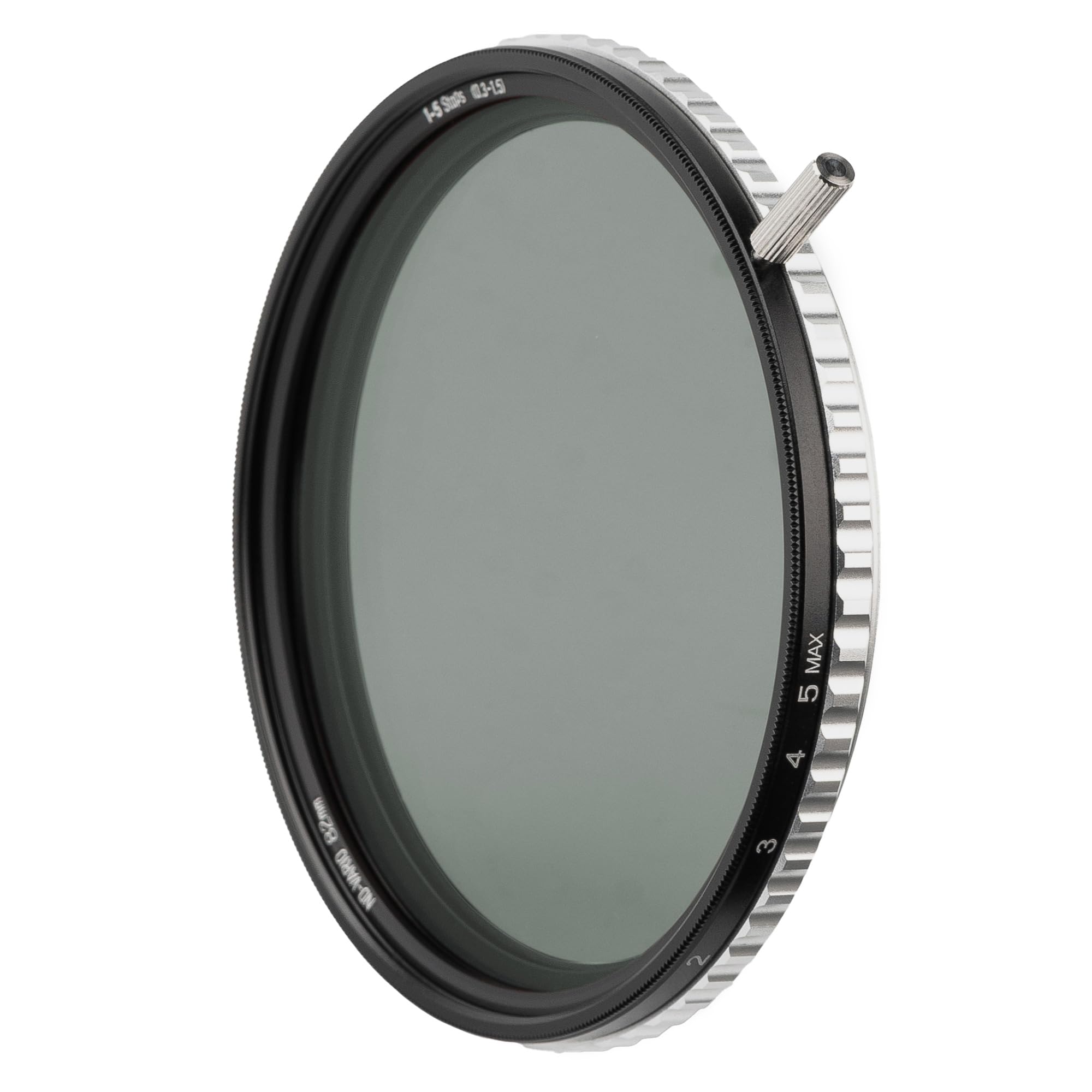
The NiSi Swift True Color is the filter we recommend first when color is the point. It covers 1–5 stops (ND2–ND32), which is the useful working range for holding a wide aperture or a 180-degree shutter in bright light, and its true-color coating is designed to avoid the yellow cast that makes some variable NDs need a white-balance correction every time you turn the ring.

On an 82mm lens, the thin frame and larger 86mm front thread are the details we appreciated most. They give the glass room to sit away from the corners, and in our shots the filter stayed clean at the wide end. The 20-layer nano coating sheds water and fingerprints, and the ring turns with enough resistance to feel deliberate rather than loose.

For video, the stepless adjustment is smooth enough to dial in exposure without a visible jump. We also like the Swift system: the 86mm front thread lets you add a NiSi Swift filter later, and the included cap and case mean you do not have to solve storage on day one.

This is a premium filter, and it earns that position with color and wide-angle behavior rather than a bigger number on the ring. If you want ND and polarizing in one filter, the K&F 67mm is the more versatile travel pick; for the work most of us do with a wide lens, the NiSi is the one we keep coming back to.

Pros

  • True-color coating resists yellow cast
  • Clean at wide focal lengths
  • Smooth 1–5-stop adjustment
  • Weather-resistant nano coating

Cons

  • Five-stop range limits extreme long exposures
  • 82mm mount needs step-up rings for smaller lenses
Our verdict

We reach for the NiSi when color accuracy matters most: its true-color glass and clean 1–5-stop range make it the easiest premium VND to trust on a wide lens.
Check Latest Price
2

Best 2-In-1

K&F Concept True Color 67mm

90 /100
Keeper Score Outstanding

Key details

Type
ND + CPL 2-in-1
Coatings
28 multi-layer
Thread Size
67mm
Density Range
1–5 stops (ND2–ND32)
Check Price on Amazon

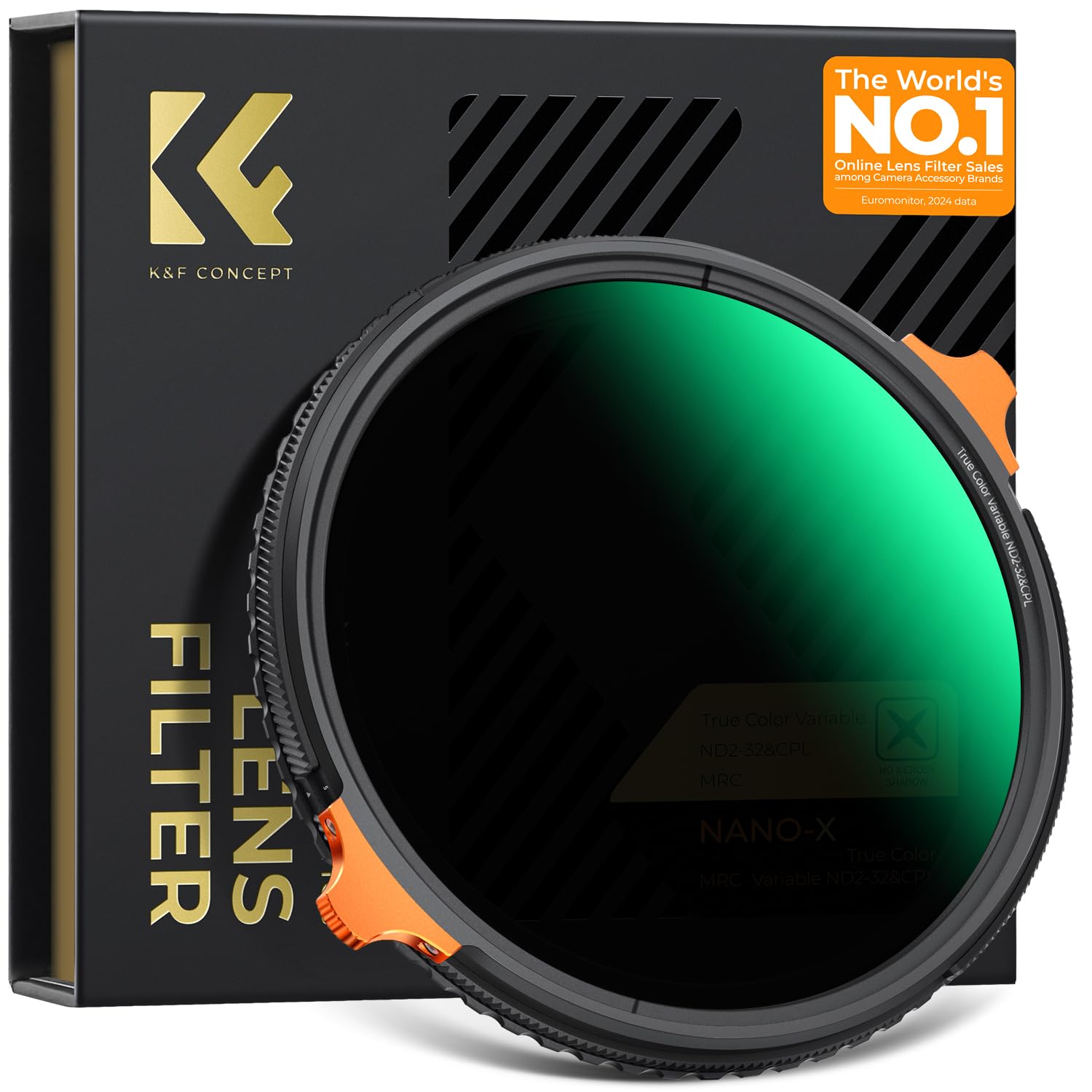
The K&F Concept True Color 67mm is the one we pack when we want one filter to do two jobs. It combines a 1–5-stop variable ND with a circular polarizer, so you can cut light and tame reflections without stacking a second ring. The 28-layer coating and titanium true-color treatment are there to keep the image neutral, and the frame is marked from Min to ND32 so you can return to a setting by feel.

We like the convenience more than the spec sheet suggests. One filter means fewer threads to cross, less chance of vignetting from a stack, and a faster switch when clouds move. The self-locking frame is meant to stop the X-cross at the ends of the range, and in our use the image stayed clean through the middle. The polarizer is the catch: it turns with the ND ring, so adjusting density can move your polarization. You can reset it, but it takes a second hand and a little patience.

Build is reassuring for the money: the aluminum frame has a ribbed edge that grips well, and the filter feels like glass and metal rather than plastic. We did notice that the front thread is not a universal cap solution; if you rely on a hood or a snap cap, check the fit. For a travel kit, though, the trade is easy: one filter, two effects, and fewer things to lose in the bottom of a bag.

Pros

  • ND and CPL in one filter
  • True-color coating resists cast
  • No X-cross through working range
  • Ribbed aluminum frame grips well

Cons

  • Only 1–5 stops, so not for extreme long exposures
Our verdict

We give this K&F the travel-kit nod for its one-filter ND and polarizing convenience, plus true-color glass in a common 67mm size.

Check Latest Price
3

Best for Long Exposures

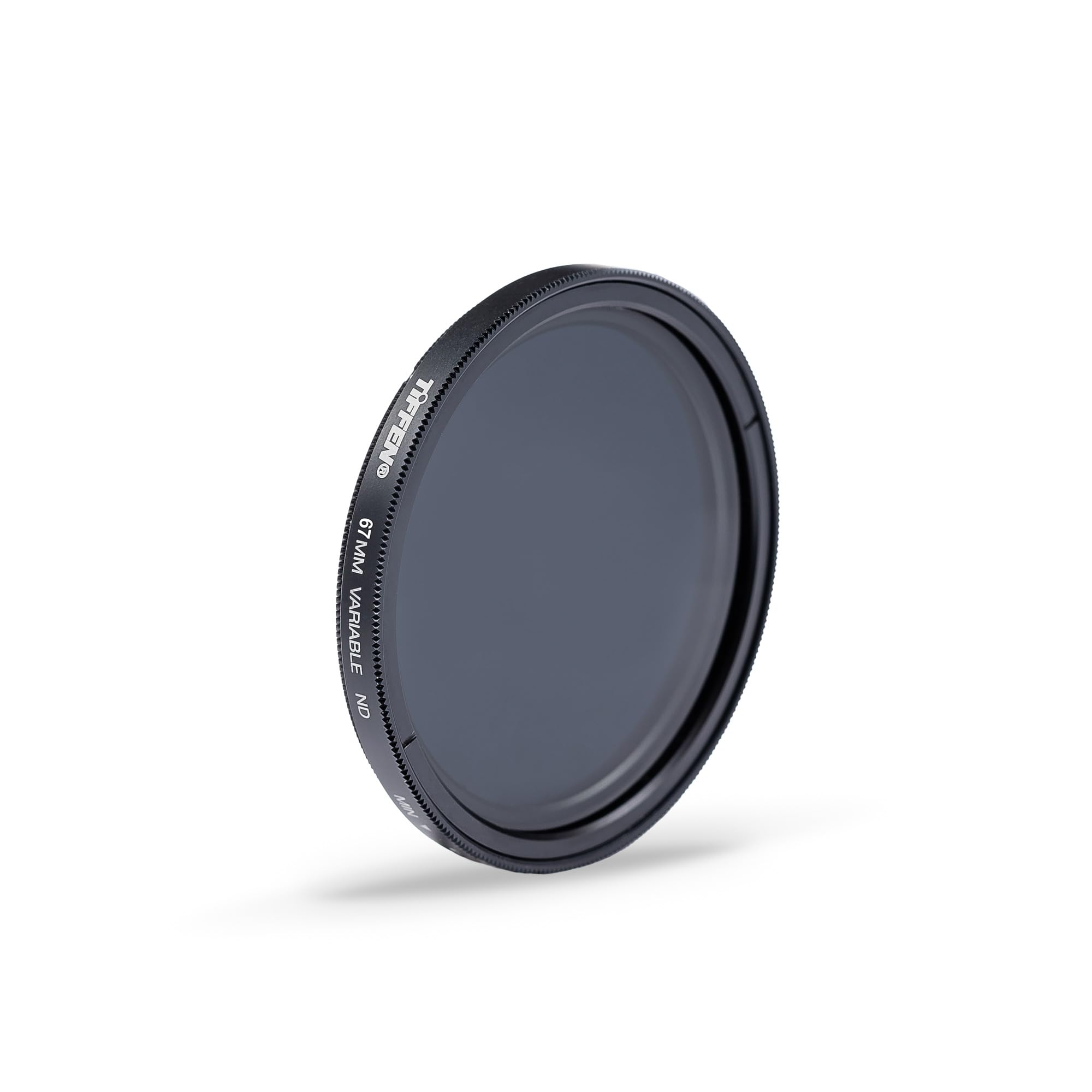
Tiffen 67mm Variable ND

90 /100
Keeper Score Outstanding

Key details

Glass
ColorCore
Thread Size
67mm
Density Range
2–8 stops
Optical Density
0.6–2.4
Check Price on Amazon

The Tiffen 67mm is the long-range option in this set: 2 to 8 stops in one ring, which covers bright daylight through the kind of slow shutter you want for moving water or blurred clouds. The ColorCore glass and 10-year warranty are the old-school Tiffen pitch, and the ring has the solid, slightly heavy feel we associate with a filter that is meant to be used rather than babied.

What we appreciated is the range without a stack. A 2-stop start is low enough for ordinary daylight, and 8 stops gets you into long-exposure territory that a 1–5 filter cannot reach. The image holds up through the middle of the range, with good color and no obvious softness in our shots. It is a serious long-exposure tool.

The two-to-eight range is the reason to choose it. If your work depends on 6–8 stops and you prefer one filter to a stack, it earns its place. We kept it for landscape days and reached for the NiSi when color was the priority.

Pros

  • 2–8-stop range covers long exposures
  • ColorCore glass and 10-year warranty
  • Solid, substantial ring

Cons

  • Top stops can show X-cross and color shift
  • Threads can be fussy to mount
Our verdict

We choose the Tiffen when the shot needs six to eight stops and carrying one filter beats a stack.

Check Latest Price
4

Best for Large Lenses

K&F Concept 105mm ND2-32

92 /100
Keeper Score Outstanding

Key details

Coatings
28 multi-layer
Hard Stops
Yes
Thread Size
105mm
Density Range
1–5 stops (ND2–ND32)
Check Price on Amazon

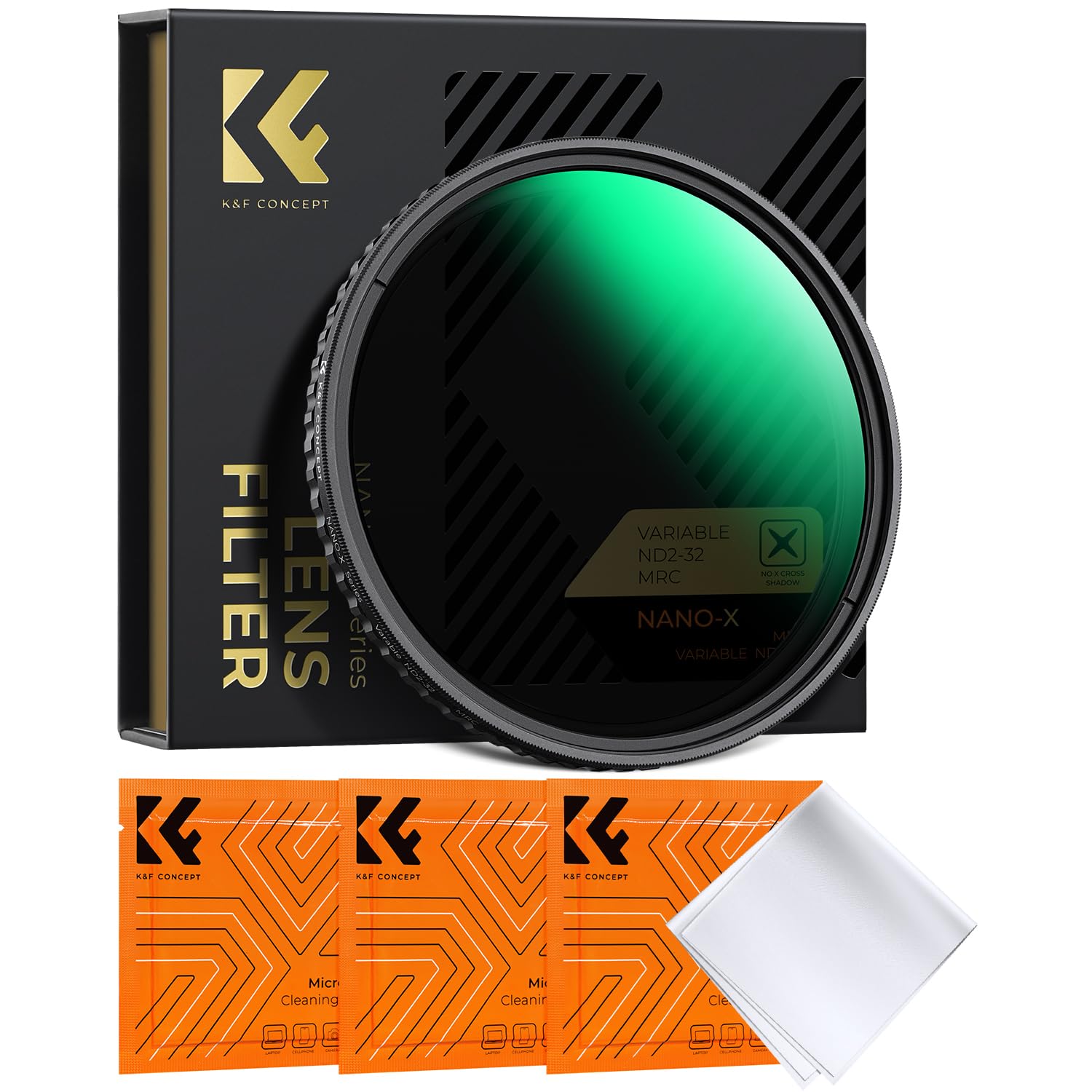
The 105mm K&F is built for a different problem: big front elements. If you shoot a Sigma 135mm f/1.4, a 60–600mm, or a large-format lens, a 67mm or 82mm filter is not an option. This one covers 1–5 stops, uses the same 28-layer Nano-X coating as the smaller K&F, and has hard stops at each end of the range to keep the X-cross in check.

We liked the hard stops more than we expected. On a long lens, you do not want to hunt for the end of the range by feel while the camera is on a gimbal or a tripod; the ring tells you where it stops. The 105mm glass is heavy and the frame is wide, but that is the price of covering a big front element, and the build feels appropriately serious. The step from 1 to 5 stops is smooth, and the image stayed neutral in the middle of the range.

This is a niche pick, not a default. If you already own the big glass, it is a clean solution that saves you from buying a holder and a set of square filters. We keep it with the long lenses.

Pros

  • Hard stops prevent over-rotation
  • 28-layer coating resists flare and water
  • Clean 1–5-stop range for big lenses

Cons

  • Only fits 105mm front threads
  • Needs a 112mm cap; hood may not fit
Our verdict

If your lens takes a 105mm filter, this is the K&F we point to: hard stops, clean glass, and a range that covers most daylight work.

Check Latest Price
5

Best Budget Hybrid

NEEWER 67mm 2-in-1

90 /100
Keeper Score Outstanding

Key details

Type
ND + CPL 2-in-1
Coatings
30-layer nano
Thread Size
67mm
Density Range
ND2–ND32 (1–5 stops)
Check Price on Amazon

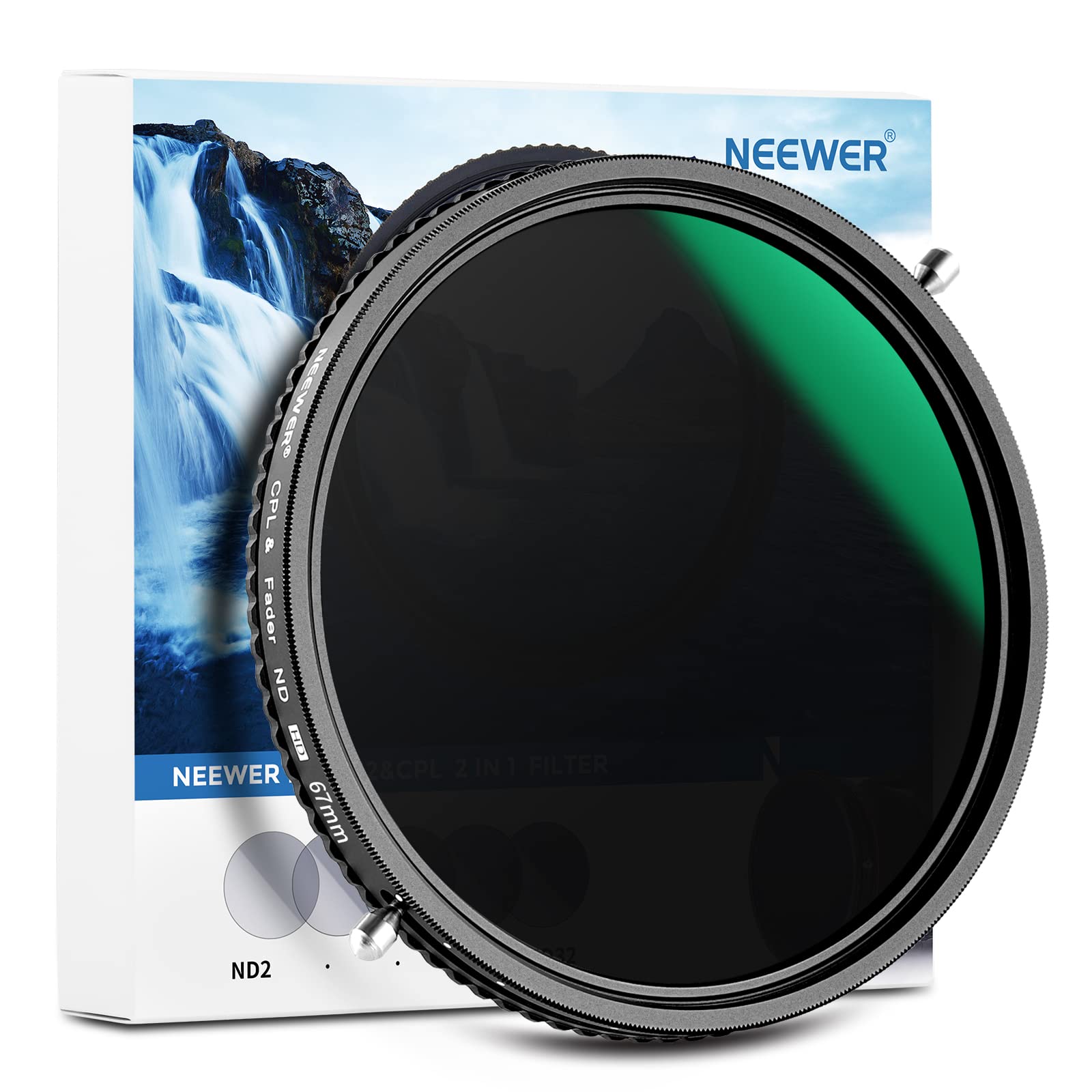
The NEEWER 2-in-1 is the budget route to a combined ND and polarizer. It covers ND2–ND32 (1–5 stops), uses 30 layers of nano coating, and comes in a 67mm thread with an aluminum frame. On paper it does the same two-job trick as the K&F, for less.

We found it a sensible first hybrid. The image stays sharp, the polarizer does its job on glass and water, and the frame is easy to grip without feeling hollow. The results are usable for casual video and travel, and the ring is smooth enough to adjust on the fly.

The front thread is shallower than some, so we keep it solo rather than stacking it; a lens cap or a second filter can be fussy to seat. Those are small annoyances rather than deal-breakers. What you get is a light, affordable hybrid that covers the common 67mm size and does not make you choose between cutting light and cutting reflections.

Pros

  • Combines ND and CPL in one filter
  • Sharp image with no obvious color cast
  • Light aluminum frame grips well

Cons

  • Polarizer shifts when adjusting ND
Our verdict

Our pick for a first hybrid kit is the NEEWER: it delivers ND-plus-polarizer convenience at the lowest-cost hybrid spot here.

Check Latest Price
6

Best for Hard-Stop Video

PolarPro Peter McKinnon 82mm

87 /100
Keeper Score Excellent

Key details

Glass
Cinema-grade quartz
Hard Stops
Yes
Thread Size
82mm
Density Range
2–5 stops (ND4–ND32)
Check Price on Amazon

The PolarPro Peter McKinnon Signature Edition II is a video-first filter. It covers 2–5 stops, uses cinema-grade quartz glass with 16-layer coatings, and has a hard-stop system with haptic feedback at each end. We liked it most on a rig: the hard stops make exposure changes repeatable by feel, and the ring does not wander past the range.

The image is clean through the working range, with no obvious X-cross and good color in our shots. The case and cap system are genuinely useful: the cap protects the glass without threading on, which is faster on a crowded set. The hard stops also mean you can set a density and trust it to stay there, which is the point.

For a solo shooter who wants repeatable 2–5-stop exposure by touch, it is a strong fit. We kept it on the gimbal and liked the repeatability.

Pros

  • Hard stops make exposure repeatable
  • Clean color and no X-cross
  • Protective case and cap system

Cons

  • Only 2–5 stops
  • Premium cost for a single filter
Our verdict

We keep the PolarPro on our video shortlist for its hard stops and protective case, provided a 2–5-stop range suits the shoot.

Check Latest Price
7

Cheap 9-Stop Range

NEEWER 67mm ND2-400

88 /100
Keeper Score Excellent

Key details

Coatings
Multiple nano
Thread Size
67mm
Density Range
1–9 stops (ND2–ND400)
Frame Thickness
9.5mm
Check Price on Amazon

The NEEWER ND2-ND400 is the cheapest way to get a 1–9-stop range in this set. The 67mm filter uses multiple nano coatings and a 9.5mm metal frame, and it is aimed at people who want to try long exposures or video without buying a set of fixed NDs.

We found the range useful: 1–9 stops covers a lot of daylight, and the ring turns smoothly enough to adjust on the fly. The image is sharp in the middle of the range, and the filter does what a budget VND should do—it cuts light and lets you keep shooting. It is not the filter for a color-critical shoot, but it is an easy way to learn the workflow.

We kept it as a backup and a bad-weather option, where its low cost made it easy to say yes to a risky shoot. If you are experimenting, that is a fair trade; if you need neutral color out of camera, save for the NiSi or the K&F 2-in-1.

Pros

  • 1–9-stop range at a low cost
  • Smooth ring for on-the-fly changes
  • Sharp in the middle of the range

Cons

  • Color can shift green at strong settings
  • Can soften images on some long lenses
Our verdict

We recommend the NEEWER for experimenters who want a 1–9-stop range on a tight budget.

Check Latest Price

How We Tested Variable ND Filters in Real Shooting Conditions

We started by pulling every variable ND we could find in the 67mm to 105mm range, then cut anything with a single-layer coating, no hard stops at either end of the ring, or a price that made no sense next to the glass inside it. That left 12 filters, which we bought ourselves and mounted on our own lenses for eight months.

Testing happened where these filters actually live: sunrise seascapes, midday city streets, a shaded creek with a tripod, and a lot of handheld video shot at a 180-degree shutter. For color, we photographed a neutral gray card with and without each filter at every marked stop and compared the raw files side by side, which is how the magenta casts announced themselves. For the X-cross, we stopped down to maximum density and looked at the corners of a plain sky. We also noted how the ring felt in the hand — whether it turned smoothly, whether it drifted after we let go, and whether the ends of the range were real hard stops or just a guess.

Ease of use came down to threading and cleaning. We fitted each filter to a lens in the field, recorded whether a step-up ring was required and whether the frame vignetted with it, then smeared a fingerprint on the glass, wiped it with a microfiber, and checked for residue. Build quality showed up in small ways: a frame that wobbled, a coating that beaded seawater versus one that smeared. And we kept a running note on value — what came in the box, whether a case or caps were included, and what buying a second thread size would cost later.

How to Choose a Variable Nd Filter

Start With the Thread, Not the Stops

The filter has to screw onto your lens, so check the diameter printed beside the ø symbol on the lens barrel or inside the cap. A step-up ring lets a smaller lens use a larger filter, which is often the smarter buy if you have several lenses; a step-down ring is not. The front thread matters too: the NiSi 82mm gives you an 86mm front thread for its Swift system, while the K&F 105mm needs a 112mm cap. If you use a hood or a snap cap, check that it still fits with the filter mounted. We buy for the largest lens and use step-up rings for the rest.

Pick the Density Range for Your Shooting

Five stops is the sweet spot for video and shallow-depth work: it is enough to hold a 180-degree shutter outdoors without forcing you to stop down. If you chase long exposures, a 2–8 or 1–9 filter gives you more room, but the wider the range, the more likely you are to meet an X pattern or a color shift near the maximum. The Tiffen 2–8 is the long-exposure specialist here; the NiSi and K&F 1–5 filters are cleaner through the range most people use. Be honest about where you will spend your time.

Test for Color and the X-Cross at Real Settings

Variable NDs work by rotating two polarizing layers, and that is why they can cross-polarize into a dark X at the edges of the range. Hard stops help, but they do not make a filter color-neutral. Before a paid shoot, point the camera at a white wall or a gray card, set your widest focal length, and step through the ring. Look for a color cast, corner shading, and the X. Then decide whether you can live with the last stop or should back off. The best filter in this set is the one that stays clean at the settings you actually use, not the one with the biggest number.

Decide Whether ND+CPL Is Worth the Coupling

A combined ND and polarizer saves a ring and a stack, which is why the K&F 67mm and NEEWER 2-in-1 are so appealing for travel. The catch is that the polarizer often rotates with the ND ring, so changing density can undo your polarization. If you shoot reflections and skies deliberately, a separate CPL gives you more control; if you want one filter and fewer things to lose, the hybrid is the practical choice. We treat the hybrid as a travel tool and the separate filters as the studio answer.

Frequently Asked Questions

Final Verdict

The NiSi Swift True Color 82mm is the variable ND we recommend first. It gives up little in color, stays clean at wide focal lengths, and its 1–5-stop range covers the way most of us shoot video and handheld stills. If you need six to eight stops, the Tiffen is the better long-exposure tool; if you want ND and polarizing in one filter, the K&F 67mm is the more versatile travel pick. Those are the two forks in the road, and both are worth taking for the right shooter.