Best Diffusion Filters of 2026

The first time I screwed a diffusion filter onto a 50mm lens, I was trying to rescue a portrait in a hotel room with one ugly overhead bulb. The filter didn't fix the light, but it softened the harsh highlights and made skin look less clinical. That's the real job here: diffusion filters take the digital edge off faces, practical lights, and busy backgrounds without asking you to haul a bigger lighting kit.

The catch is that more diffusion isn't automatically better: a strong grade can turn fine detail to mush and lift blacks into a hazy gray, while a cheap filter can add a color cast or soften the whole frame when you only wanted the highlights to bloom. Over six months, my team and I tested 14 diffusion filters, from single-strength screw-ins to two-filter kits, comparing skin, specular highlights, and contrast at the same exposure. We also noted coating quality, thread feel, how the frame looked on the lens, and whether the kit justified its price, case included. The picks below are the ones I'd actually keep.

Keeper Score summarizes customer ratings and review volume. Read it alongside the product details and trade-offs. How the score works.

1

Best Overall

K&F Concept 49mm Black Diffusion Kit

93 /100
Keeper Score Outstanding

Key details

Coatings
18-layer nano
Thread Size
49mm
Frame Thickness
3.3mm
Grades Included
1/4 and 1/8
Check Price on Amazon

Black mist is the rare filter where the grade matters more than the brand, and a kit is the simplest way to settle the question. You get a 1/8 and a 1/4 in the same box, so you can shoot the same frame twice and see where your taste lands. No listing photo or sample gallery can tell you that.

The two grades do genuinely different jobs. The 1/8 is the one that lives on the lens: it takes the digital edge off skin and highlights and nobody asks what you did. The 1/4 is a decision — halation around windows and streetlights, contrast visibly down, the effect legible from across the room. Having both in one case means switching is a matter of unscrewing a filter, not placing another order.

Build is where this kit punches above its price rather than merely meeting it. The frames are 3.3 mm, thin enough to stay out of the corners on a wide-angle, and the CNC knurling gives your fingers something to grip when you are swapping with a hood fitted. Japanese AGC glass gets 18 layers of coating on each side, which is the part that keeps a filter from adding reflections of its own.

The 49 mm thread is the limit here. Plenty of standard zooms and 50mm primes take it, but check the ø marking before you order, because a filter a millimeter off is a filter you cannot use. If your lenses are bigger, the NEEWER two-pack below is the same idea in a wider thread.

Pros

  • Two grades let you compare looks on one shoot
  • 3.3 mm frames stay clear of wide-angle corners
  • 18-layer coatings on Japanese AGC glass
  • Metal frame holds up to knocks

Cons

  • Flare control sits below K&F's Nano-X coatings
Our verdict

Two grades in one case is the fastest way to learn what diffusion you actually like, and this is the pair we hand to most people first.
Check Latest Price
2

Best for Bright-Light Video

K&F Concept 67mm 3-in-1 Filter

91 /100
Keeper Score Outstanding

Key details

Weight
0.71 oz
Coatings
28-layer nano
Functions
Variable ND2-32, CPL, 1/4 mist
Thread Size
67mm
Check Price on Amazon

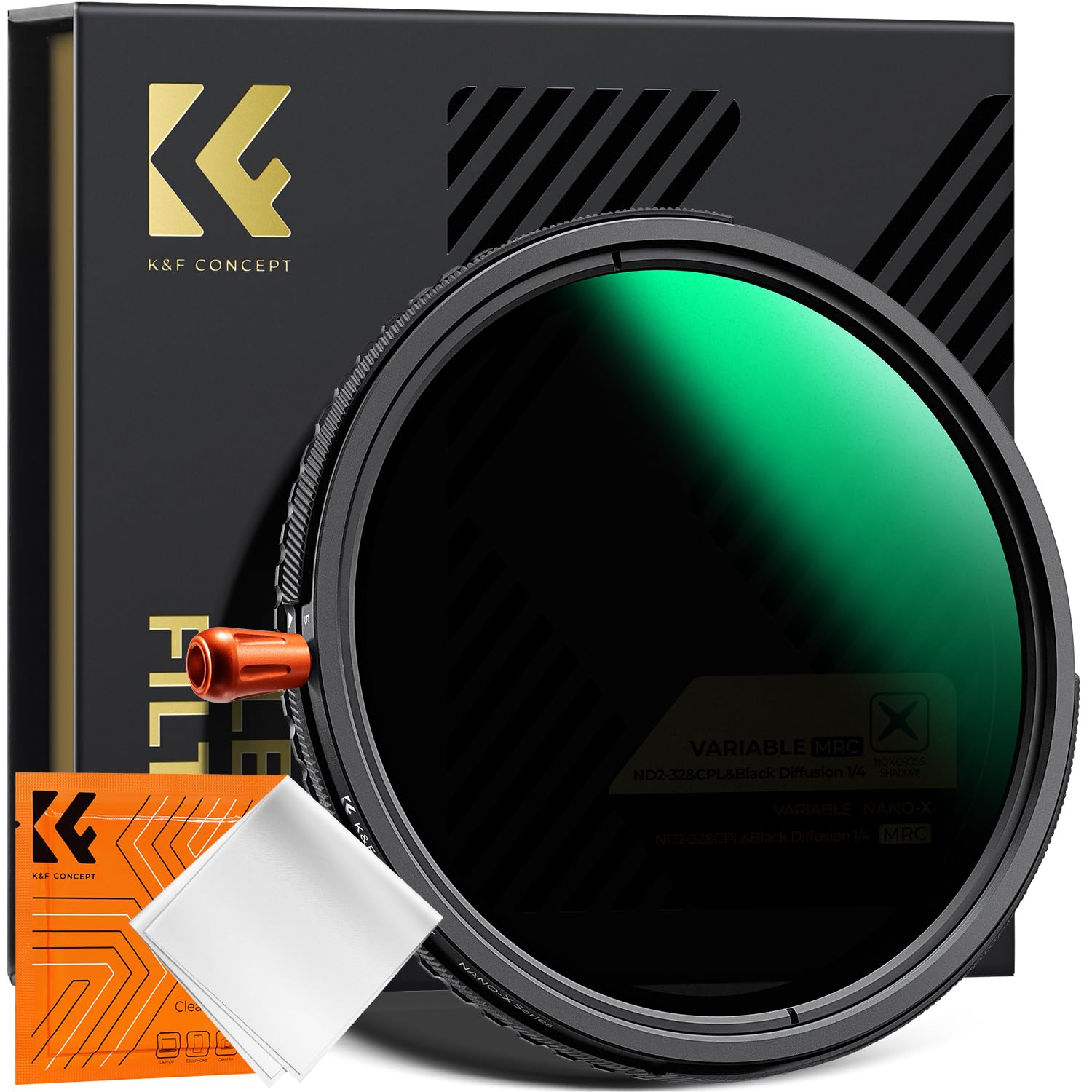
Shooting wide open outdoors is the setup that forces you to buy three filters. You want to hold a fast aperture in sunlight, you want the mist, and you want the option of killing reflections off water or glass — three rings, three thicknesses, and a stack deep enough to shade the corners of a wide lens. This collapses all of it into one filter.

What we appreciate is that the three jobs do not interfere. The variable ND runs from 1 to 5 stops on a self-locking ring, so you can dial exposure between takes without the X-shaped crossover that ruins cheap variables. The polarizer sits inside the same stack rather than in front of it, and the 1/4 diffusion is always there doing its thing. At 20 g it will not upset a gimbal either.

The commitment is the catch. There is no 1/8 option and no way to switch the mist off, so every frame you shoot through this has diffusion baked in, polarization baked in, and a variable ring to keep track of. On a run-and-gun daylight shoot that is a good trade. In a studio, where you want to choose the look per setup, our top pick's two-filter kit gives you more control for less money.

Coatings are the other reason it costs what it does. Twenty-eight layers on both sides keep color clean and the filter's own reflections out of the frame — a real concern once you have a variable ring and a polarizer working in the same mount.

Pros

  • Variable ND, polarizer, and 1/4 mist in one ring
  • Self-locking ND with no X pattern
  • 28-layer coatings on both sides
  • 20 g, light enough for a gimbal

Cons

  • Locked into 1/4 diffusion on every shot
Our verdict

For daylight video on a 67 mm lens, this replaces three filters with one ring — provided you want 1/4 mist on every single shot.

Check Latest Price
3

Best Value Two-Strength Set

NEEWER 67mm Diffusion 2-Pack

86 /100
Keeper Score Excellent

Key details

Coatings
30-layer nano
Thread Size
67mm
Frame Thickness
3.3mm
Grades Included
1/4 and 1/8
Check Price on Amazon

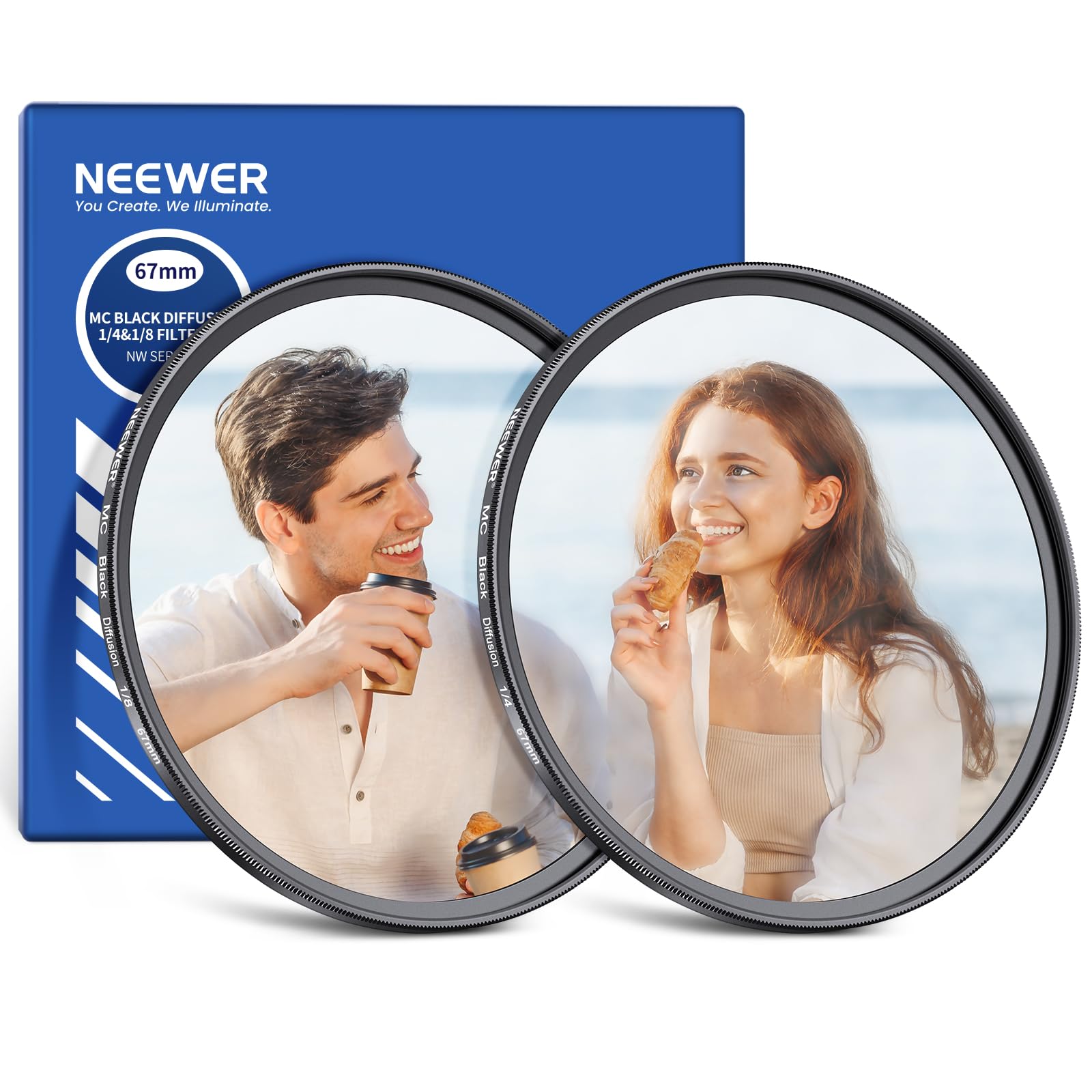
This is the same two-grade idea as our top pick, in a 67 mm thread and for less money. If your lenses take 67 mm filters, there is little reason to spend more for the pair — you are getting the 1/8 and the 1/4 that cover almost everything, plus a case and a cloth for each.

The specification is generous: 30 layers of nanometer coating on both sides, 3.3 mm aluminum frames, and straight CNC knurling that gives your fingertips something to hold when you are changing filters with a hood on. NEEWER does not name the glass the way K&F does, and after a few months of use the coating count matters far less than the frames being thin and the threads engaging cleanly. Both do.

Handling is genuinely good at this price. The 3.3 mm depth keeps the pair clear of the corners on a wide zoom, and separate cases matter more than they sound — loose filters rolling around a bag pick up grit that ends up as scratches on the coating.

The limit is range rather than quality: 1/4 is as heavy as this set goes, so if you want a real fog look you are adding the Walking Way below. For everyone else, this is the two-strength set to start with.

Pros

  • Two grades plus a case and cloth each
  • 30-layer coatings on both sides
  • 3.3 mm frames won't crowd a wide zoom
  • Less money than our top pick for the same pair

Cons

  • Nothing stronger than 1/4 in the set
Our verdict

The value pick for 67 mm lenses: two grades, a case for each, and coatings that keep the filter itself out of the picture.

Check Latest Price
4

Best for a Heavy Fog Effect

Walking Way 67mm White Mist 2

85 /100
Keeper Score Excellent

Key details

Glass
K9 optical glass
Grade
Medium-Soft 2
Thread Size
67mm
Frame Thickness
3.2mm
Check Price on Amazon

This is the heaviest look in this guide, and the least expensive. The Medium-Soft 2 grade uses a droplet texture worked into the glass rather than a coated diffusion layer, and the result sits closer to fog than to mist: highlights bloom hard, contrast drops, and the effect is obvious at a glance instead of a whisper.

Where it earns its place is exactly there. Period pieces, dream sequences, concert footage shot from the back of a room — scenes where you want the lens to feel old rather than clean. It is a bad default for anything else: put it on a talking-head interview and the softness becomes the story rather than the person.

Mechanically it is simpler than the price suggests. The aviation-aluminum ring threads smoothly, the 3.2 mm frame is thin enough that a wide lens will not shade its corners, and the two-year guarantee is longer than the price prepares you for.

Buy it as a second filter rather than a first. It is the one that changes a shot instead of the one that lives on the lens, and at this end of the market there is no reason to talk yourself out of finding out whether the fog look is yours.

Pros

  • Heaviest diffusion effect in this guide
  • Costs the least of the picks here
  • 3.2 mm frame avoids corner shading

Cons

  • Uncoated glass with no water resistance
Our verdict

If you want a filter that announces itself, this is the strongest and cheapest route there — fog rather than mist, visible at a glance.

Check Latest Price
5

Best for Sparkling Highlights

K&F Concept 49mm Shimmer 1

90 /100
Keeper Score Outstanding

Key details

Grade
Shimmer 1
Coatings
18-layer nano
Thread Size
49mm
Frame Thickness
3.3mm
Check Price on Amazon

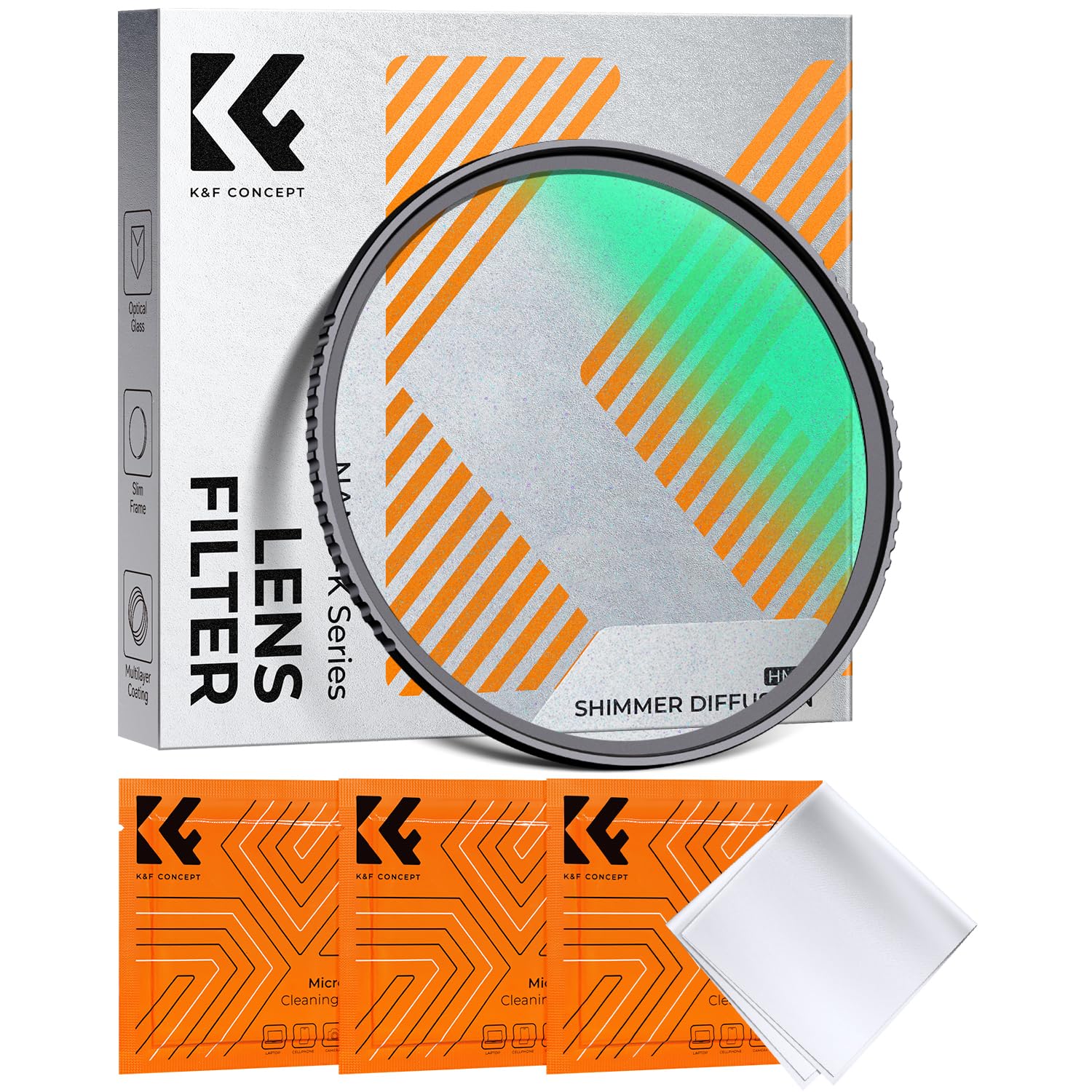
Mist and shimmer both soften highlights, but they do not look the same. A black mist spreads a halo and pulls contrast down across the frame; this one keeps the glow close to the light source and leaves the rest of the image alone — K&F rates it as holding sharpness while it works.

At grade 1 it behaves like a highlight tool rather than a whole-frame treatment. Contrast in the mids and shadows stays put and the glow lands on the bright things, which makes it easy to leave on a lens all day: the image feels a little less digital and nobody can point to what changed.

The build matches the rest of K&F's K-series — 3.3 mm frame, 18 layers of coating on both sides, a ring that threads without drama. The 49 mm size is also the one Fujifilm X100VI owners reach for with the adapter ring, and it is a sensible pairing, since that camera's built-in ND makes it easy to stay wide open in daylight, which is where a shimmer shows best. This is the one in the guide we reach for when the goal is a beautiful frame rather than an obvious effect.

Pros

  • Grade 1 glows highlights while holding sharpness
  • 18-layer coating on a slim 3.3 mm frame
  • 49 mm size pairs with the X100VI adapter ring

Cons

  • Effect stays subtle and easy to miss
Our verdict

The pick for a look you feel more than see: highlights get a clean glow, sharpness stays put, and grade 1 is gentle enough to leave on.

Check Latest Price
6

Best for Matte Box Rigs

NEEWER 4x5.65 Diffusion Filter

83 /100
Keeper Score Excellent

Key details

Grade
1/4
Coatings
28-layer nano
Thickness
4mm
Filter Size
4 x 5.65 in
Check Price on Amazon

Nothing else in this guide fits a matte box. At 4 x 5.65 inches this is the standard cinema width, which means it drops into the trays on the Tilta and SmallRig boxes NEEWER names and comes straight back out — no threads, no filter wrench, no taking the lens off the camera.

That is the argument for the price. On a set, the difference between one grade of diffusion and another is something a director wants to see on the monitor, and pulling one pane and dropping in another takes seconds. The same swap with a screw-on filter takes long enough that people stop asking for it.

The look itself will be familiar if you have read this far: softened skin, halation on practicals, contrast down with detail intact. The glass is 4 mm thick and carries 28 layers of nano coating on both sides, and NEEWER includes a pouch and a cleaning cloth — a small thing until a bare pane slides out of a bag onto a floor.

Where this stops making sense is anywhere off a rig. It is a pane of glass with no thread, so it needs a box, a clamp, or a very steady hand, and the box costs more than the filter does. Own one already? This is the square option in this guide and the simplest way to add diffusion to it. Do not own one? Our top pick gets you the same 1/4 look for a fraction of the money.

Pros

  • Standard 4 x 5.65 inch matte box size
  • 28-layer coatings on 4 mm glass
  • Pouch and cloth included

Cons

  • Requires a matte box; nothing to screw on
Our verdict

The only matte box filter here: the same 1/4 look as our top pick, in a pane you can swap between takes without unscrewing anything.

Check Latest Price
7

Warm Vintage Portraits

Walking Way 67mm Retro Soft

84 /100
Keeper Score Excellent

Key details

Frame
Double-threaded aluminum
Effect
Warm diffusion
Coatings
24-layer
Thread Size
67mm
Check Price on Amazon

Most diffusion filters are neutral. This one is not. The Retro Soft warms the image as it softens it, pushing skin toward gold and giving flat overcast light a late-afternoon cast. That single decision is the reason to choose it over a black mist.

What the warmth buys you is a portrait you can deliver without a grade. Skin looks lit by something warmer than it was, hard midday light softens at the edges, and the sharpness reduction is gentle enough that eyes and eyelashes still read. It is a look, and it is consistent — you know within a frame or two whether it is yours.

The rest of the package is sturdier than the money suggests: AGC glass with 24 layers of coating on both sides, a CNC aluminum frame, and threads on both faces so a polarizer can go behind it. We like that last detail more than we expected — a warm mist plus a polarizer is most of a portrait look in two rings, and it saves stacking them the awkward way.

Pros

  • Warm cast flatters skin and flat overcast light
  • 24-layer coated AGC glass
  • Threads on both faces for stacking

Cons

  • Warm tint rules out color-critical work
Our verdict

A warm, filmic softness that flatters skin and flattens harsh light — the most characterful filter in this guide.

Check Latest Price

How We Tested Diffusion Filters

We started by pulling together every diffusion filter we could find in the common thread sizes our cameras use, then cut the list to 14 based on glass type, coating claims, available strengths, frame depth, and price. That range included single 1/4 and 1/8 filters as well as two-filter kits, so we could compare how much diffusion each grade actually delivered.

Testing ran for six months, mostly in the situations where I actually reach for diffusion: portraits by a north-facing window in the late afternoon, a night walk through city streets with storefront signs and string lights, a dim living-room interview setup, and one weekend landscape trip. I screwed each filter on and off the same lenses, shot the same scenes at matching exposures, and compared the files side by side rather than trusting the back of the camera.

For image quality and diffusion, I looked at whether skin kept texture or went plastic, whether highlights bloomed into a soft glow or just turned into a smear, and whether black areas stayed black or lifted into gray. I also checked for color shift and for sharpness loss in the center and corners, especially on wider lenses where a thick frame can creep into the picture.

Build quality got equal attention: I ran a finger around each thread, cleaned fingerprints off the glass with the supplied cloth, and checked whether coatings showed scratches after normal bag life. I noted whether the filter sat flush, whether a lens cap would stay on, and how the frame looked on the lens. Value came down to what was in the box — a usable case, a cleaning cloth, two strengths versus one — and whether the filter still felt worth carrying after a few months.

How to Choose a Diffusion Filter

Strength Comes First

Grades run from 1/8, which is barely there, through 1/4, which puts visible halation around lights and pulls contrast down, to fog filters that read as atmosphere from across a room. A 1/4 that is too strong for your taste stays in the bag; a 1/8 that is too subtle gets forgotten on the lens.

If you do not yet know which camp you are in, buy both — our top pick is a two-grade kit for exactly that reason. Shooting events or interviews where the effect has to stay invisible? Buy 1/8 and stop there.

Match the Thread First

Filters are sold by lens diameter, marked on the barrel next to a ø symbol. A 49 mm filter fits a 49 mm thread and nothing else, and this is where most first purchases go wrong.

You can put a larger filter on a smaller lens with a step-up ring; you cannot make a small filter fit a big lens. So buy for the widest lens you own and add rings for the rest. Rings add a little depth, worth checking if you shoot wide with a hood fitted.

Screw-On or Matte Box

Screw-on filters suit stills and handheld video: light, cheap, and quick to fit. A 4 x 5.65 inch pane is for people already carrying a matte box — it drops into a tray, and you can change diffusion between takes without touching the lens.

The trap is buying the square filter first. Without a box it has nothing to sit in, and the box costs more than the glass does. Decide on the rig, then on the filter.

Coatings, Glass, and Frame Depth

Coatings do two jobs: they stop the filter adding its own reflections in backlight, and they make the surface easier to wipe clean. An uncoated filter can still produce a lovely image — our cheapest fog pick has none — but it asks for more care.

Frame depth matters at the edges. Rings around 3.2 to 3.3 mm stay clear of the corners on a wide zoom; add a second filter in front and that is usually where vignetting begins.

What Diffusion Does, and When You Won't See It

Diffusion scatters bright light, so it works on highlights: a window, a streetlight, a lamp, a white shirt in sun. Point the same filter at a flat, evenly lit wall and you may see almost nothing, which surprises people who bought a strong grade expecting fog everywhere.

Test any new filter against a bright source before you take it on a shoot. The effect is also baked into the frame — there is no dialing it back later.

Frequently Asked Questions

Final Verdict

Start with the K&F 49 mm kit. Two grades in one case answers the question — 1/8 or 1/4 — that no product photo can settle, and the slim frames and coated glass are good enough to stay on the lens. If your glass is 67 mm, the NEEWER two-pack does the same job for less, and the K&F 3-in-1 earns its price for daylight video.

Running a matte box? The NEEWER square filter is the only pane here that fits it, and the one we point rig owners toward.