Best Telescope Eyepieces of 2026

Magnification isn't a property of your telescope, it's a quotient — divide the scope's focal length by the eyepiece's. Which means the small cylinder in your hand decides whether Jupiter is a bright marble or a banded disc with a shadow crawling across it. A good scope with a mediocre eyepiece is a mediocre scope.

I spent my first two years blaming my telescope for every soft, cramped view before admitting the eyepieces in the box were the problem. Over the past nine months, my team and I have cycled 14 eyepieces and kits through our scopes — twist zooms, ultra-wide designs, starter sets — and the same trade-offs kept surfacing. Zoom range buys convenience, apparent field buys immersion, and eye relief decides whether you see the whole view with glasses on. Weight matters more than you'd guess on a light mount.

One thing nobody tells a first-time buyer: a wider apparent field doesn't brighten the image, it just gives you more sky around it, and the cheap ultra-wides pay for that width with soft edges. Spending more mostly buys clean edges and comfortable eye relief, not brightness. What follows is what we kept reaching for.

Keeper Score summarizes customer ratings and review volume. Read it alongside the product details and trade-offs. How the score works.

1

Best Overall

Celestron 8-24mm Zoom

92 /100
Keeper Score Outstanding

Key details

Weight
12.7 oz
Zoom Range
8mm to 24mm
Barrel Size
1.25 inches
Field Of View
55 degrees
Check Price on Amazon

A zoom eyepiece earns its keep when it keeps you at the telescope instead of in your case. The Celestron 8-24mm goes from a 24mm low-power view down to 8mm with a twist, and it uses the 1.25-inch barrel found on most beginner and mid-size scopes. That range matches the way an evening actually goes: find the Moon or a planet at low power, then dial up without swapping glass and losing the target.

The zoom action is the part that sold us. It turns smoothly enough to make small changes at the eyepiece, and the 55-degree apparent field is usable for lunar and planetary work. The fully multi-coated optics and 2-year warranty make it feel like a long-term accessory rather than a stopgap. It is not a magic eyepiece—a good fixed wide-field eyepiece will beat it on edge sharpness—but as one eyepiece to learn the sky with, the compromise is easy to live with.

The removable rubber eyecup is a small thing we appreciate when sharing the view, and the T-threads open the door to afocal photography if you want to try it. Against the SVBONY SV135, the Celestron covers more low-power range and feels more substantial in the hand; the SVBONY is lighter and more comfortable for glasses. For most visual observers, the wider range is the better trade.

Pros

  • One eyepiece covers 8mm to 24mm
  • Smooth zoom keeps the target centered
  • Fully multi-coated optics and 2-year warranty
  • T-threads and removable eyecup add flexibility

Cons

  • Noticeably heavy on small mounts
  • Field narrows at 24mm
Our verdict

Buy the Celestron 8-24mm zoom if you want one eyepiece that covers lunar, planetary, and deep-sky viewing; it's the most versatile default here for visual observers.

Check Latest Price
2

Best Budget Zoom

SVBONY SV135 Zoom

89 /100
Keeper Score Excellent

Key details

Eye Relief
16.3mm to 18mm
Zoom Range
7mm to 21mm
Barrel Size
1.25 inches
Field Of View
40 to 57 degrees
Check Price on Amazon

This is the zoom for a small scope and a small case. The SV135 runs from 7mm to 21mm, weighs 230 grams, and uses a 1.25-inch barrel, so it slots into the same diagonal as your existing eyepieces. We like it best as a travel or grab-and-go zoom: it's lighter than the Celestron and its 16.3-18mm eye relief is comfortable with glasses.

The 6-element, 4-group optical stack is fully multi-coated, and the 40-57 degree apparent field is usable for lunar and planetary viewing. The full metal body and rubber eyeguard make it feel more expensive than it is, and the zoom ring turns smoothly enough to adjust while you're looking through the eyepiece. The precision barrel fits a standard 1.25-inch diagonal without slop.

Where it earns its place is portability. At 230 grams it doesn't upset a small alt-az mount the way a heavier zoom can, and the long eye relief means you can keep your glasses on for a whole session. If you want one eyepiece for a travel scope or a quick backyard session, this is the one we pack.

Pros

  • Lighter than the Celestron zoom
  • Long eye relief suits glasses
  • Smooth 7-21mm zoom range
  • Full metal body at a budget price

Cons

  • Narrower field than wide-angle eyepieces
  • Some softness at zoom extremes
Our verdict

Choose the SVBONY SV135 zoom if you want zoom convenience in a lighter, lower-cost package; long eye relief makes it the friendlier pick for glasses.

Check Latest Price
3

Best Wide-Field View

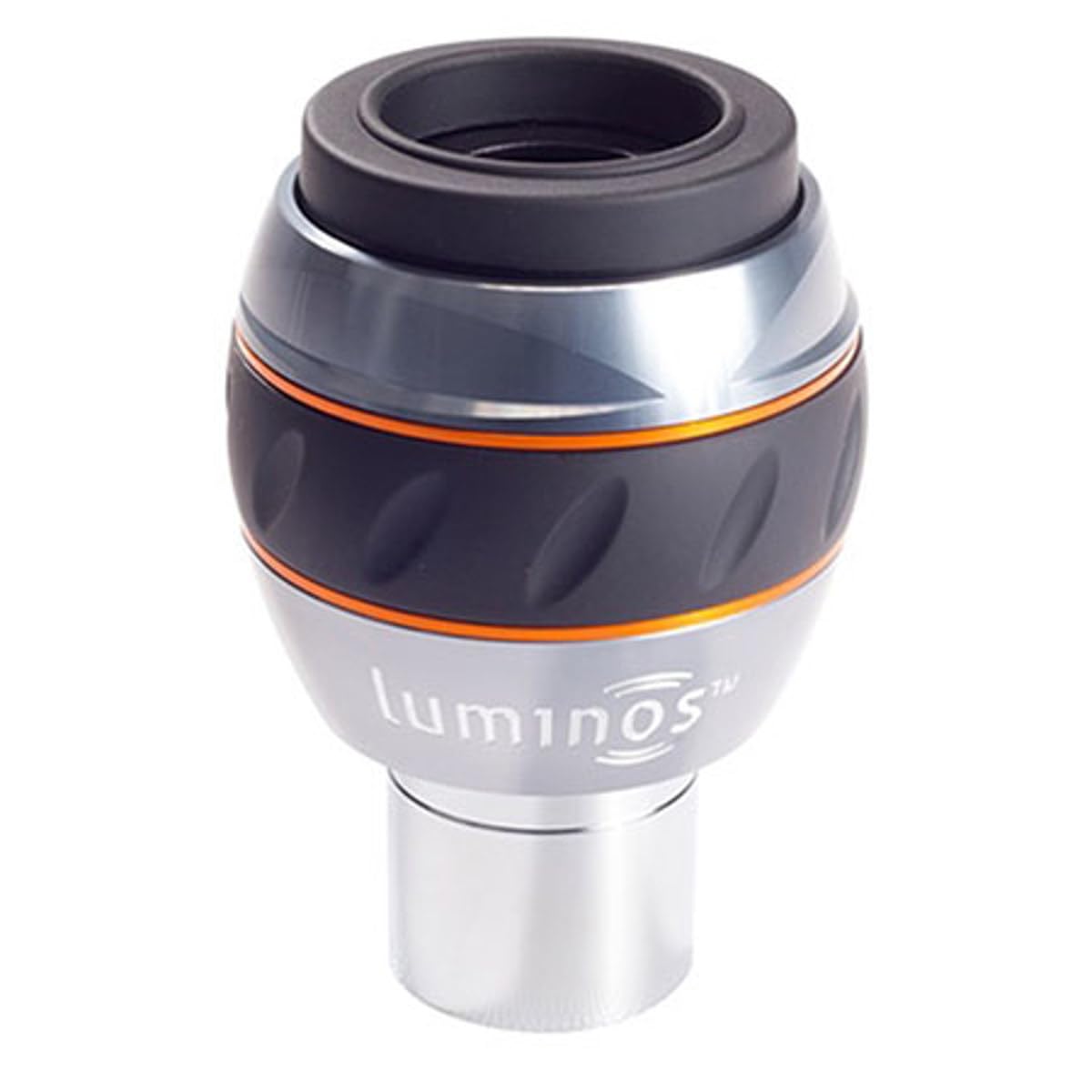
Celestron Luminos 15mm

88 /100
Keeper Score Excellent

Key details

Weight
12 oz
Barrel Size
1.25 inches
Focal Length
15mm
Field Of View
82 degrees
Check Price on Amazon

An 82-degree field changes how you use an undriven mount. Instead of nudging the scope every few seconds, you get a wider window for the target to drift through, and the Luminos 15mm delivers that in a 1.25-inch barrel. We used it as both a finder eyepiece and a deep-sky eyepiece—the 15mm focal length is wide enough for open clusters and bright nebulae, and still gives useful magnification on the Moon.

The retractable rubber eyecup pops up for comfort and drops down for glasses, and the barrel is threaded for filters. The rubber grip is a nice touch when the night turns cold and your fingers don't work as well. Build feels solid without feeling fussy; the anodized aluminum barrel and twist-up eyecup are the kind of details that make an eyepiece pleasant to live with.

This is the eyepiece we choose when the night is about sweeping star fields rather than splitting tight doubles. The 82-degree view feels immersive, and the 15mm focal length is forgiving of imperfect seeing. It is not a planet-killer; for high power, the SVBONY 6mm is the better fit. But for the Orion Nebula, the Pleiades, or panning the Milky Way, it earns its place.

Pros

  • 82-degree field frames deep-sky targets
  • 15mm focal length is versatile
  • Retractable eyecup and filter threads
  • Solid anodized aluminum build

Cons

  • Heavy enough to unbalance small mounts
  • Edge sharpness softens near the field stop
Our verdict

Pick the Luminos 15mm when you want an immersive 82-degree view for deep-sky sweeping and cluster hunting, especially on an undriven mount.

Check Latest Price
4

Best Starter Kit

CELTICBIRD 13-Piece Kit

91 /100
Keeper Score Outstanding

Key details

Case
Metal, foam-lined
Barlow
2x with T2 threads
Filters
Five color, one polarizing, one Moon
Eyepiece Focal Lengths
40mm, 20mm, 12.5mm, 8mm, 6mm
Check Price on Amazon

A kit makes sense when you're starting from one or two stock eyepieces and don't yet know what you'll use most. The CELTICBIRD set gives you five Plossls—40mm, 20mm, 12.5mm, 8mm, and 6mm—plus a 2x Barlow, a Moon filter, a polarizing filter, and five color filters in a foam-lined metal case. That's a full beginner's tray in one box.

The focal-length spread is the smart part. The 40mm is a low-power finder, the 20mm and 12.5mm cover open clusters and the Moon, and the 8mm and 6mm move into planets and double stars. The Barlow doubles any of them, and its T2 threads let you attach a DSLR with the right adapter. We like that the case has cutouts for each piece and a little room left over; it keeps the kit organized instead of turning into a drawer of loose glass.

The Plossl design is simple and the 1.25-inch barrels fit most scopes. The metal case is a genuine upgrade over a cardboard box, and the whole kit is easy to carry to a dark site. For a first kit, the breadth is the point: you can find your favorite focal length before spending more on a single premium eyepiece. We trust the kit as a starting point rather than a final destination.

Pros

  • Five focal lengths from 40mm to 6mm
  • Seven filters and a 2x Barlow included
  • Foam-lined metal case keeps it organized
  • T2 threads allow DSLR attachment

Cons

  • 6mm plus Barlow is a specialist combination
  • Five color filters are a niche extra
Our verdict

Buy the CELTICBIRD kit if you're starting out and want five focal lengths, filters, a Barlow, and a case in one organized purchase.

Check Latest Price
5

Best High-Power Value

SVBONY 6mm 68-Degree

87 /100
Keeper Score Excellent

Key details

Eye Relief
17mm
Barrel Size
1.25 inches
Focal Length
6mm
Field Of View
68 degrees
Check Price on Amazon

A 6mm eyepiece is a high-power tool, and most affordable ones make you press your eye into a tiny lens. The SVBONY 6mm is different: it pairs a 68-degree apparent field with 17mm of eye relief, so glasses wearers can keep their spectacles on and still see the whole view. That combination is why it earns a place here.

The 1.25-inch barrel is fully multi-coated, and the blackened tube helps control internal reflections. On the Moon, the wide field makes it easier to keep a crater or the terminator in view while you focus; on Jupiter, the 6mm focal length gives the magnification you want for cloud belts and the Great Red Spot when the atmosphere cooperates. It is a specialist, not an all-purpose eyepiece—the view is dimmer and the exit pupil smaller than a 15mm or 20mm.

We like the rubber eyeguard and the 5.6-ounce weight; it doesn't lever a small focuser the way a big wide-field eyepiece can. Against the Celestron Luminos, it trades field width for magnification—the Luminos is the deep-sky choice, this is the lunar and planetary choice. If your scope is well collimated and the seeing is decent, it's a lot of high-power eyepiece for the money.

Pros

  • 17mm eye relief at 6mm
  • 68-degree field for high power
  • Fully multi-coated with blackened tube
  • Light 5.6-ounce body

Cons

No notable drawbacks to flag.

Our verdict

Choose the SVBONY 6mm when you need high-power lunar and planetary views with comfortable eye relief, and your scope is well collimated.

Check Latest Price
6

Low-Cost Starter Set

starboosa 3-Piece Set

87 /100
Keeper Score Excellent

Key details

Weight
7.76 oz
Barrel Size
1.25 inches
Field Of View
60 degrees
Focal Lengths
4mm, 10mm, 20mm
Check Price on Amazon

A three-eyepiece set at this end of the price scale is really a question of what it leaves out. The starboosa set gives you 4mm, 10mm, and 20mm eyepieces in 1.25-inch barrels, each with a soft eyecup and multi-coated glass, and it stops there—no Barlow, no filters, no case. That's not a criticism if you already have the accessories and just need more focal lengths.

The 20mm is the everyday eyepiece, the 10mm is the step up for the Moon and planets, and the 4mm is there for the highest power your scope can support. The 60-degree field is wider than a standard Plossl, and the soft eyecups are comfortable for longer sessions. The set weighs 0.22 kg, so it packs easily and won't crowd a small accessory bag.

We like it as a second set for a small refractor or as a low-cost way to try three magnifications before buying a premium eyepiece. It won't replace a wide-field eyepiece or a good zoom, but it doesn't pretend to. The simple build and lack of extras are the point: you get focal lengths, not a box of accessories you may never use.

Pros

  • Three focal lengths at a budget price
  • Soft eyecups and 60-degree field
  • Light 0.22 kg set

Cons

  • 4mm is too high power for many scopes
  • Outer field softens on bright targets
Our verdict

Get the starboosa set if you want three focal lengths on a tight budget and already own the accessories; the 20mm and 10mm earn their place.

Check Latest Price

How We Tested These Eyepieces Under Real Night Skies

We built the shortlist from spec sheets first. Anything that wouldn't seat in a standard 1.25-inch focuser was out, as was anything with uncoated or single-coated glass, and we dropped duplicates so the list covered a real spread of focal lengths instead of five versions of the same power. That left 14 eyepieces and kits, which my team and I used across nine months of observing.

Most of that time was spent in my backyard and on a driveway with a streetlight at the edge of it, with two trips out to genuinely dark sky and several late nights where dew soaked everything by midnight. We swapped eyepieces in the dark, often with gloves on, and noted which ones took two hands and which dropped straight into the diagonal. Zooms got twisted one-handed mid-view to see whether the target slid out of frame or the focus shifted between powers. For apparent field, we parked on a star with the drive off and timed how long it took to cross from edge to edge.

On the Moon and Jupiter we looked for scatter, ghosting, and color fringing, and we checked whether stars stayed sharp in the outer third of the field or smeared into seagulls. Each one got weighed, then mounted on a small refractor to see whether it dragged the tube down and needed rebalancing. We deliberately fogged lenses with breath and wiped them with a cloth to watch for sleeks, and we ran every adjustable eyecup through its positions with glasses on and off. Kits were judged on what we'd genuinely use twice, not on piece count.

How to Choose Telescope Eyepieces

Match the barrel before anything else

Most beginner and mid-size scopes use 1.25-inch eyepieces, and every pick here is that size. A 2-inch focuser can also take 1.25-inch eyepieces with an adapter, but a 1.25-inch focuser cannot take a 2-inch barrel. Check the focuser or diagonal before you buy, and ignore 0.965-inch legacy eyepieces unless your scope is an old department-store model. The barrel is the one compatibility decision that can't be fixed later with technique.

Filter threads are a smaller point: if you already own a Moon filter, confirm the barrel accepts standard astronomical filters.

Work out magnification before you chase power

Magnification is your telescope's focal length divided by the eyepiece focal length. A 1200mm scope with a 24mm eyepiece gives 50x; an 8mm gives 150x. That's why one eyepiece behaves differently on a short refractor and a long Schmidt-Cassegrain. Aim for a low-power exit pupil around 4-7mm and keep high power near 1mm or above unless the night is unusually steady. Check the focal length on the tube or in the manual.

A 2x Barlow doubles magnification, but with a short eyepiece it can push past what the atmosphere supports; we prefer a zoom or a 10mm with a Barlow over a 4mm Plossl.

Choose field of view and eye relief for your eyes

Apparent field of view is how wide the view looks; true field is how much sky you actually see. A 68- or 82-degree eyepiece shows more sky at the same magnification, which helps on an undriven mount—the target drifts for longer before you nudge the scope. Eye relief is the distance your eye sits from the glass. If you wear glasses, look for roughly 15mm or more; the SVBONY 6mm's 17mm and the SV135's 16-18mm are comfortable.

Wide field isn't automatically better: a simple Plossl often has better edge correction, and a very wide eyepiece can be heavy. We prioritize eye relief for glasses wearers and field width for deep-sky sweeping.

Decide between a zoom, a fixed eyepiece, and a kit

Zooms are the most efficient way to cover a range: one barrel, no swapping, and no losing the target between powers. The trade is optical compromise—typically a narrower field and some softness at the ends of the range. Fixed eyepieces give the best view at one focal length, while kits give breadth and a case.

Buy a zoom first if you're still learning what magnifications your scope likes. Buy a fixed wide-field eyepiece if you have a zoom and want a cleaner deep-sky view. Buy a kit if you need filters, a Barlow, and several focal lengths at once. Our picks follow that logic: the Celestron zoom is the all-rounder and the Luminos is the wide-field specialist.

Frequently Asked Questions

Final Verdict

For most people, the Celestron 8-24mm zoom is the one to buy first. It covers the useful magnification range in a single 1.25-inch barrel and makes the find-then-magnify rhythm of an evening simple. If you already have a zoom and want a wider deep-sky view, the Luminos 15mm is the specialist we add next. If you're outfitting a beginner and want a complete box, the CELTICBIRD kit is the better starting point; the SVBONY SV135 is the value zoom when weight and eye relief matter more than range.