Best Telescope Mounts of 2026

Point a telescope at anything worth looking at, and the mount decides whether you actually see it. Touch the tube and a shaky head turns Saturn into a smudge that won't sit still; a solid one lets you step away and come back to the same spot. It's the least romantic purchase in astronomy and the one that determines how often the scope leaves the closet.

We've spent the past eight months with nine mounts — bare alt-azimuth heads, manual German equatorials, and full GoTo setups with counterweights and hand controls — and the split came down to stability against weight every time. One thing first-time buyers get wrong: the payload figure on the box is a visual-use number, and a finder, diagonal, and camera eat into it fast. Overshooting your tube's weight is the cheapest insurance you can buy.

Below are the ones that earned a spot, whether your night is a quick look at the moon or an all-night imaging run.

Keeper Score summarizes customer ratings and review volume. Read it alongside the product details and trade-offs. How the score works.

1

Best Overall

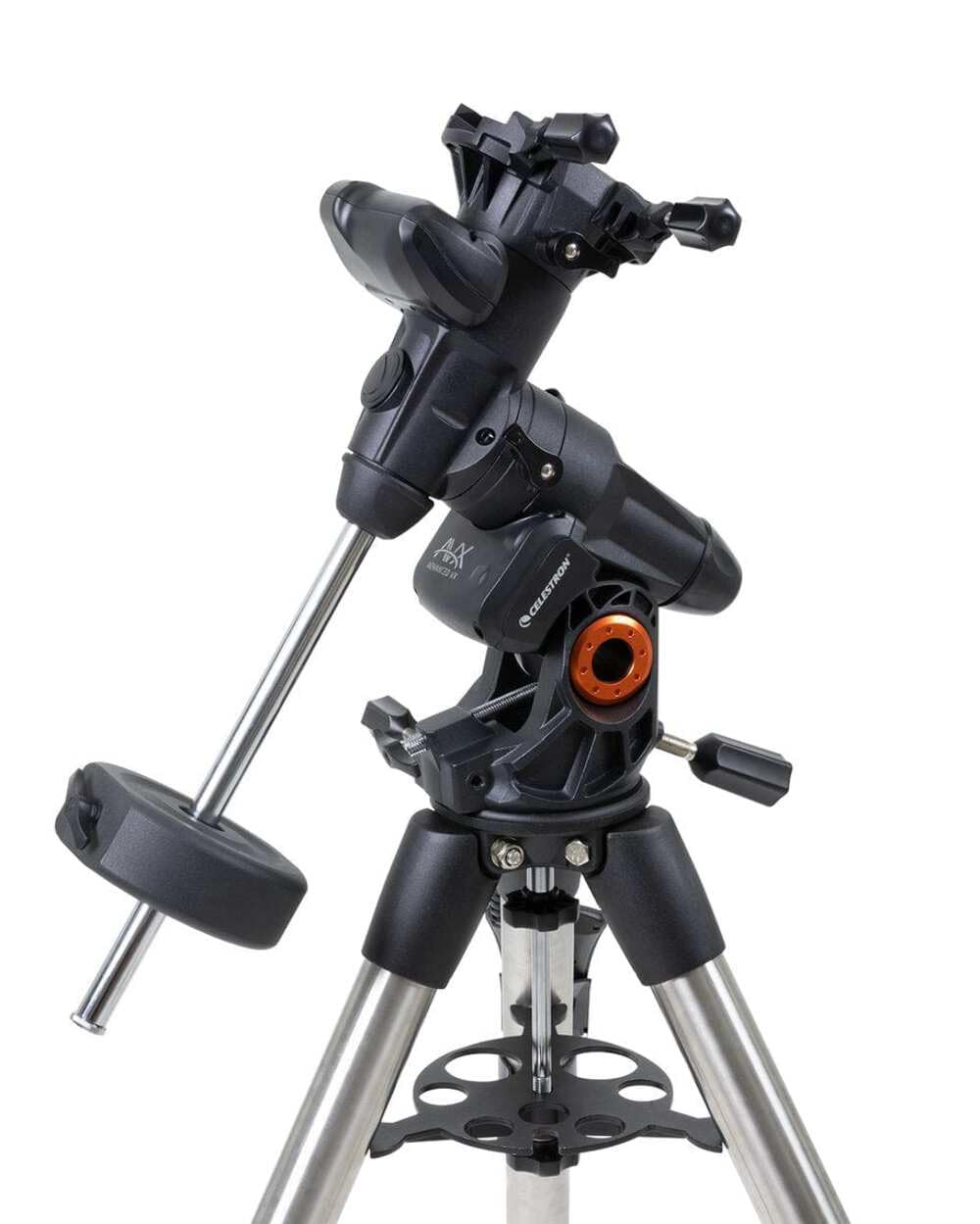
Celestron Advanced VX Mount

83 /100
Keeper Score Excellent

Key details

Saddle
Vixen, CG-5 and CGE dovetails
Mount Type
German equatorial, GoTo
Tripod Legs
2-inch stainless steel
Payload Capacity
30 lb
Check Price on Amazon

Thirty pounds of payload is the figure that settles most of this. It's more than any other mount here is rated for — enough for an 8-inch Schmidt-Cassegrain with a diagonal, a finder and a camera on the back — and we like the headroom it buys: the mount you buy for your first serious tube is still the mount you own when the second one arrives. The 2-inch stainless steel legs and the spreader underneath are what stop all that weight from turning into a wobble you can see in the eyepiece.

Being a German equatorial is the other half of the argument. It tracks the sky on a single axis, so Jupiter stays in the field while you step away from the eyepiece, and a camera can take a run of sub-exposures without the field rotating underneath it. The NexStar+ hand control carries sidereal, solar and lunar rates, and the dual saddle takes Vixen, CG-5 and CGE dovetails, which covers most tubes you're likely to put on it. All-Star Polar Alignment is the feature we appreciated most: you align on stars away from Polaris, so a tree or a roofline sitting exactly north doesn't end the session before it starts.

What it asks in return is level ground, a power supply and a little patience. There's no battery inside, so plan on a 12-volt source, and know that a German equatorial has to be roughly polar aligned before the GoTo will put anything in the field — the first couple of outings take longer than the spec sheet suggests. Latitude adjustment covers 7 to 77 degrees, so it works wherever you live, and the head separates from the tripod for the car.

The CG-4 below is the same decision taken the other way: no motors, no computer, and you do the finding and the tracking yourself for a fraction of the cost. If learning the sky the hard way is the point for you, that's a fair trade. If you want to spend your nights looking, it isn't.

Pros

  • 30 pounds of payload for larger tubes
  • GoTo with lunar, solar and sidereal rates
  • 2-inch steel legs damp vibration
  • Dual saddle fits common dovetails

Cons

  • Motor faults can appear; test both axes early
  • Heavy kit that takes two trips
Our verdict

We recommend the Advanced VX to anyone who wants one GoTo mount to carry a real telescope, visual or camera, and who doesn't mind learning polar alignment in exchange for tracking that holds.

Check Latest Price
2

Best Value Alt-Azimuth

SVBONY SV225 Alt-Azimuth Mount

88 /100
Keeper Score Excellent

Key details

Mount Type
Alt-azimuth, manual
Head Weight
5.16 lb
Slow Motion
Variable speed, both axes
Payload Capacity
22 lb
Check Price on Amazon

Ten kilograms of payload, a CNC-machined hollow body weighing 2.34 kg, and variable-speed slow-motion gears on both axes — for a mount that costs a fraction of a GoTo system, that's an unusual set of numbers. Most of the wobble in an entry-level setup comes from the mount rather than the optics, which is why a head like this can rescue a telescope someone was ready to give up on.

Smoothness is where it earns its keep. Coarse aiming is loose enough to sweep the sky by hand, and then the slow-motion levers take over for the last few degrees onto a planet or a double star. Having them on both axes is the part we noticed most; plenty of budget alt-azimuth heads fine-tune one direction and leave you shoving the other. The dovetail saddle has lock knobs and a metal handle, and the head is small enough to live on a shelf between sessions.

The box holds the head, two fine-tuning levers, lock knobs, screws and wrenches — no tripod. You supply that, and it has to be a substantial one, because a light photo tripod undoes everything the head does well; sort that out before you order and the combined cost is still modest. A 10 kg rating is comfortable under an 80 to 102 mm refractor or a 6-inch reflector. A long, heavy tube on marginal legs is where shake comes from, not the head.

Pros

  • 10 kg payload in a 2.34 kg head
  • Variable-speed slow motion on both axes
  • Dovetail saddle with lock knobs
  • Costs a fraction of a GoTo mount

Cons

  • Control levers can work loose in use
  • No bubble level in the box
Our verdict

This is the mount we point people to when a small refractor needs steadier support than its stock tripod, as long as they already own a substantial tripod to bolt it to.

Check Latest Price
3

Best Portable GoTo Kit

Sky-Watcher Star Adventurer GTi

84 /100
Keeper Score Excellent

Key details

Control
Built-in Wi-Fi
Mount Type
German equatorial, GoTo
Total Weight
26 lb
Maximum Height
44.5 inches
Check Price on Amazon

Picture the trip: a DSLR with a telephoto lens or a small refractor, a car trunk, and a dark site two hours from the nearest town. The Star Adventurer GTi is built for that sentence. It arrives as a complete kit — GoTo equatorial head, tripod, pier extension, counterweight bar and a 5-pound counterweight — so there's no hunting for the one piece that makes it work on the first clear night.

Two details make it more capable than the small head suggests. The pier extension lifts the mount above the tripod legs, which is what stops a camera or a short tube from colliding with them when it swings toward the pole. And the polar scope is built in and illuminated, so you're not clipping a separate finder on in the dark with a headlamp in your teeth.

We came away impressed by how much of a full equatorial experience fits on a 26-pound frame. Once it's aligned, it tracks and the GoTo puts targets in the frame, and the built-in Wi-Fi lets a phone or tablet drive the session. Alignment is the price of admission: expect to spend real time on the pole and a star alignment, expect it to be fiddly the first few nights, and know that the routine leans on a single alignment star, so pointing is good rather than pinpoint.

It's also heavier than the head alone implies, since the tripod and counterweight make up most of those 26 pounds — still a one-person carry, and it takes less trunk space than a full-size equatorial. If your imaging is wide-field Milky Way work with a camera and a 50 mm lens, a plain star tracker does the job for less. The GTi starts to make sense when you want to point at something specific and stay on it.

Pros

  • Full GoTo and tracking in a 26-pound kit
  • Built-in illuminated polar scope
  • Pier extension keeps the camera clear of the legs
  • Wi-Fi control from a phone or tablet

Cons

  • Battery compartment needs a screwdriver
  • Polar scope cover is flimsy
Our verdict

This is the kit we take when the imaging rig has to fit in a trunk: full GoTo, real tracking, and a 26-pound total one person can carry to a dark site.

Check Latest Price
4

Best Manual Equatorial

Celestron CG-4 Equatorial Mount

86 /100
Keeper Score Excellent

Key details

Mount Type
German equatorial, manual
Tripod Legs
1.75-inch stainless steel
Height Range
33 to 47 inches
Payload Capacity
20 lb
Check Price on Amazon

Every automated mount here makes the same trade: money and power for convenience. The CG-4 goes the other way. It's a manual German equatorial rated to 20 pounds, sitting on 1.75-inch stainless steel legs, with slow-motion knobs on both axes — you find the object yourself, then turn a knob to hold it in the eyepiece as the Earth rotates. No hand control, no alignment computer, no battery left at home.

What struck us is how much tripod the money buys. The legs adjust from 33 to 47 inches, so you can stand rather than crouch, and they're rigid enough that a loaded 4-inch refractor settles quickly. The slow-motion controls move a loaded tube without the stiction that makes fine aiming maddening, which is what separates a usable manual mount from an infuriating one.

The clever part is the upgrade path. The mount accepts an add-on motor drive on both axes, so you can start manual at a modest price and motorise later without replacing the whole thing. That makes it a sensible first equatorial: you learn polar alignment and how the sky moves because nothing does it for you, and there's somewhere to go when hand tracking stops being fun.

Polar alignment is a manual job here — no computer is going to find the pole for you, and under a genuinely dark sky with no Polaris in view it takes practice. That's the honest cost of a mount with no electronics, and for a lot of observers it's the reason to buy one.

Pros

  • 20 pounds of payload on 1.75-inch steel legs
  • Smooth slow-motion control on both axes
  • Accepts an add-on motor drive later
  • No power, cables or alignment computer

Cons

  • Tripod is heavy for a small refractor
Our verdict

For a 4- to 6-inch scope and an observer who likes the hunt, the CG-4 tracks by hand on a rock-solid steel tripod and never asks for a battery.

Check Latest Price
5

Standing-Height Viewing

Explore Scientific Twilight I

82 /100
Keeper Score Excellent

Key details

Mount Type
Alt-azimuth, manual
Height Range
36 to 53 inches
Total Weight
16.7 lb
Payload Capacity
18 lb
Check Price on Amazon

Height is the specification nobody checks and everybody notices. The Twilight I runs from 36 to 53 inches, which puts a refractor's eyepiece at standing height rather than somewhere near your knees, and it holds 18 pounds while the whole rig weighs 16.7. That combination is why it keeps its place here: a grab-and-go mount for a 4-inch refractor, not something you tolerate.

The tilting head is the other good idea. It swings up to 45 degrees off vertical, so a long tube can be aimed near the zenith without its back end fouling the tripod legs — the failure that makes inexpensive alt-azimuth mounts maddening with a refractor. Slow-motion cables come with it for both axes, and the spreader tray has eyepiece holders that keep glass off the ground and stiffen the legs at the same time.

There's no motor, no GoTo and no battery, so this is a mount for looking, not for imaging. Assembly is the weak spot: the instructions are thin and hard to follow, so plan on finding a video or working it out from the parts. Once it's together it's the mount that actually gets used on a clear weeknight, because it goes out the door in one trip.

Pros

  • 18 pounds of payload at standing height
  • Head tilts 45 degrees for zenith viewing
  • Spreader tray with eyepiece holders
  • Light enough to carry out in one trip

Cons

  • Caps out at 18 pounds of payload
Our verdict

The alt-azimuth mount we point tall observers to: a 53-inch tripod and a tilting head that keep the eyepiece where you can actually reach it.

Check Latest Price

How We Tested the Mounts

We started with spec sheets, narrowing a long list down to nine heads we could compare fairly: a spread of payload ratings, both alt-azimuth and German equatorial designs, and a range that included heads sold alone alongside full kits with tripods and counterweights. Anything without parts support or with a dovetail saddle that didn't fit common bars got cut early. I also noted what actually came in the box, since a cheap head that needs a separate tripod isn't much of a bargain.

Every mount got set up on a concrete patio, on uneven grass, and on a driveway, and assembled solo in the dark with a headlamp — I timed each one from case to first target. To judge stability I rapped a tripod leg with a knuckle and tapped the tube with a fingertip, counting how long the image took to stop moving, then repeated it with the scope loaded past its rated payload to find where each one gave out. Slow-motion and fine-adjustment controls got the same treatment: small turns, watching for backlash and slop.

I weighed heads and tripods separately and carried each about thirty yards to see how the weight actually felt, then bolted on different tubes and dovetail bars to check the saddle and hardware. GoTo mounts were aligned from scratch each session, and I logged how many targets landed in the eyepiece without hunting. Over eight months, whatever stayed out through dew-heavy nights was checked for rust, stiff bearings, and play in the axes, and I went through every hardware bag looking for missing bolts, crossed threads, and grease where it shouldn't be.

How to Choose a Telescope Mount

Match the Payload to Everything on the Tube

Set the catalog weight of the tube aside for a moment. What the mount carries is the loaded scope — diagonal, eyepiece, finder, rings and, if you're imaging, a camera — and several pounds appear without you noticing. Our rule of thumb: aim for roughly two-thirds of the rated payload for visual use and about half of it for photography, where every wobble shows up in the file.

That puts a 30-pound mount like the Advanced VX comfortably under an 8-inch Schmidt-Cassegrain and explains why a 20-pound CG-4 suits a 4- to 6-inch tube rather than a big Newtonian.

Alt-Azimuth or Equatorial

An alt-azimuth mount moves up-down and left-right the way your head does. It's intuitive, needs no polar alignment, and the eyepiece stays in a workable orientation. An equatorial mount tilts to match the Earth's axis, which lets one motor follow the sky and lets a camera take long exposures without the field turning.

The cost of that is setup: a German equatorial has to be leveled and pointed at the pole before the GoTo does anything useful. Weeknight planets and the Moon argue for alt-azimuth. Deep-sky imaging argues for equatorial.

Stability Comes From the Tripod

A head is only as good as what sits under it, and leg diameter is the honest number. The 2-inch stainless legs under the Advanced VX and the 1.75-inch legs under the CG-4 are doing most of the vibration damping; a spreader or center brace adds the rest.

The trap is pairing a good head with a travel tripod. The SV225 is a fine piece of machining, and it will still shake on legs meant for a compact camera. Check the tripod's own load rating, not just the head's.

Height, and Where Your Eye Ends Up

Minimum and maximum height decide whether you observe standing, sitting or kneeling. A 36-to-53-inch range like the Twilight I's keeps a refractor's eyepiece at standing height; a shorter tripod has you crouching at the start of every session.

Point a refractor near the zenith and the eyepiece drops toward the ground, which is why a tilting head or a tall tripod matters more than the spec sheet lets on. Picture where the eyepiece lands at 60 degrees altitude before you order.

Power, Alignment, and the First Twenty Minutes

GoTo mounts need electricity. The Advanced VX has no internal battery and expects a 12-volt supply, and cold nights eat alkaline cells, so a small power pack is money well spent. Manual mounts need nothing at all, which is their real appeal at a dark site.

Either way, budget setup time. Leveling, polar alignment and a star alignment come before the first object, and a badly aligned GoTo will miss everything you ask it for. Practice the routine once in daylight.

Frequently Asked Questions

Final Verdict

Our pick for a telescope you plan to keep is the Celestron Advanced VX: 30 pounds of payload and 2-inch steel legs handle an 8-inch scope for visual work, and the GoTo tracking is good enough to start imaging, with All-Star Polar Alignment taking most of the sting out of setup.

Take the SVBONY SV225 instead if you have a small refractor, a substantial tripod already, and no interest in motors. Take the CG-4 if you want equatorial tracking without power or a computer.