Best Telescope Cases of 2026

Nobody goes shopping for a telescope case out of enthusiasm. You go because of a night that ended badly — the tube sliding across the back seat on a washboard road, or the corrector plate that took a knock in the closet. A case worth owning solves both halves of that problem: it moves the tube, mount, and tripod in a single trip, and it keeps your optics off the trunk floor where the jumper cables live.

We spent six months loading 12 cases with real scopes, from small refractors up to 9.25-inch optical tubes, and the deciding factor was rarely padding thickness. It was fit — and fit isn't one number. A bag can be genuinely well made and still wrong because the interior runs an inch short of your dew shield, or so roomy that the mount shifts every time you turn a corner.

The other fork in the road is whole-rig versus tube-only. A long case that swallows everything is a two-hands, one-trip affair; a slim tube bag is the one you'll actually carry up a flight of stairs, and you'll come back for the mount. Both earn their place below, so the picks are sorted by the kind of night you're having.

Keeper Score summarizes customer ratings and review volume. Read it alongside the product details and trade-offs. How the score works.

1

Best Overall

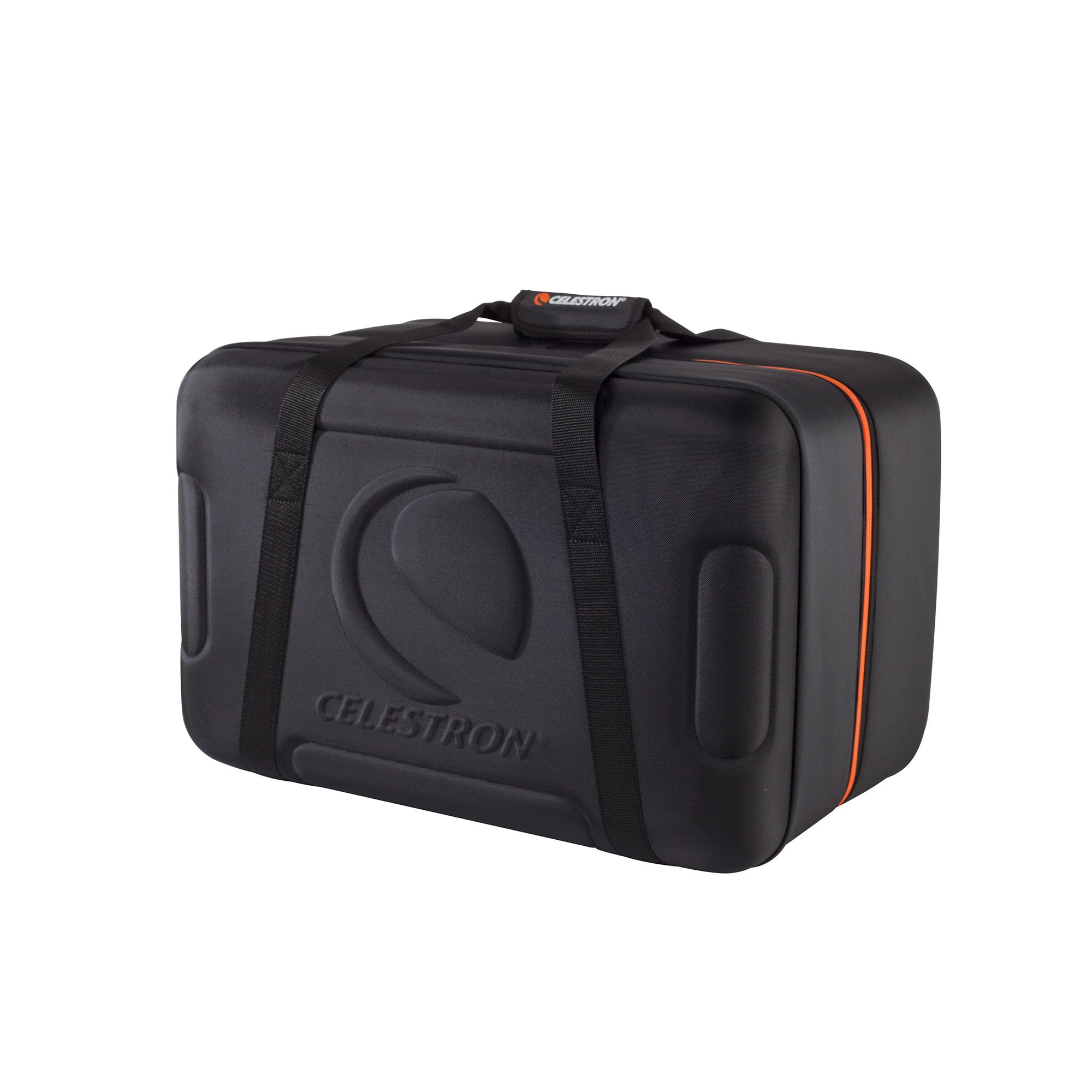
Celestron 40" Protective Carrying Bag

92 /100
Keeper Score Outstanding

Key details

Dimensions
40"L x 15"W x 15"H
Foam Padding
16mm EPE
Carry Options
Shoulder strap, web handles
Water Resistance
Water resistant
Check Price on Amazon

Forty inches long is only half the story; it is the 15-inch width and height that make this the bag most people should buy. Those dimensions let the mount stay on the tube and let the tripod lie alongside, so a session ends with one bag to carry instead of three. We packed a full rig — tube, fork mount, tripod, diagonal — and closed the zipper without rearranging anything, then put the eyepieces in the outside pocket.

That capacity is why it earns the top spot. Two layers of 900-denier polyester sandwich 16mm of EPE foam, thick enough that a knock against a door frame stays a knock, and two access points — one at the top, one at the end — let you slide the optical tube in without hoisting the whole bag onto a table first. The padded accessory bag that ships with it is the piece we use most: eyepieces and filters live there, out of the main compartment and away from anything metal.

The compromise is the carry. There is no frame and no wheel, so 40 inches of loaded bag travels by the two web handles or over one shoulder. From a driveway to a field that is fine; up three flights of stairs it is not, and if your observing site is a long walk from parking, this is the point to think hardest about.

Where it kept earning its keep was the base. Setting the bag down on damp grass at the end of a night is exactly when a soft case soaks through and wicks water toward the tube, and the PVC-reinforced bottom panel is the reason this one does not.

Pros

  • Takes tube, mount and tripod in one bag
  • 16mm EPE foam behind 900-denier polyester
  • Two access points plus a padded accessory bag
  • Two-year Celestron warranty

Cons

  • No wheels, so a loaded bag is a hand carry
Our verdict

Our pick for most people: tube, mount and tripod ride together in 16mm foam over a reinforced base, and the whole thing still carries like a duffel.

Check Latest Price
2

Best Value

GoHimal 40" Telescope Bag

91 /100
Keeper Score Outstanding

Key details

Dimensions
40"L x 11.5"W x 9"H
Compartments
5
Carry Options
Removable shoulder strap, handle
Water Resistance
Waterproof
Check Price on Amazon

Four inches narrower and six inches shorter than our top pick, the GoHimal does most of the same job for considerably less, and for plenty of scopes it is the better buy. The 40-inch main compartment swallows a long refractor or an 8-inch catadioptric, the fabric is waterproof rather than merely water resistant, and the internal straps keep the tube and the tripod in separate lanes on the drive.

We were surprised by how much interior is here for the money. A padded sleeve holds the optical tube, two smaller padded pouches take a mount head or a set of eyepieces, and the plastic buckles cradle the tube instead of clamping it, which is kinder to a painted OTA than a strap pulled tight. Add a full-length zipper, a large external pocket, and a removable shoulder strap that actually has padding on it.

Height is the number to check before ordering. Nine inches of interior is generous for a refractor on a simple alt-az mount and tight for a fork-mounted catadioptric, whose base eats most of it. If the mount is the tallest part of your kit, the Celestron's extra depth is worth the difference; if it is not, this bag saves you real money and is easier to carry besides.

Pros

  • Full 40-inch length at a budget price
  • Waterproof fabric with a full-length zipper
  • Padded sleeve plus two accessory pouches
  • Straps hold tube and tripod apart in transit

Cons

  • Only 9 inches of interior height for a fork mount
Our verdict

If your mount is not the tall part of your setup, this is the full-size bag we hand people first: same 40-inch length, waterproof fabric, and money left over for eyepieces.

Check Latest Price
3

Best Hard Case

Celestron Deluxe EVA Case

90 /100
Keeper Score Outstanding

Key details

Fits
NexStar 4SE, 5SE, 6SE, Evolution 6
Shell
Molded EVA with foam walls
Dimensions
23"L x 15"W x 14"H
Compartments
2
Check Price on Amazon

Owners of a NexStar 4SE, 5SE, 6SE or Evolution 6 are the people this case was shaped around, and it shows: the shell is molded for that family of scopes with the mount still attached, so a session ends by lowering the whole assembly in rather than taking it apart.

It is EVA, molded rather than sewn, with foam along every wall and above the accessory pouch. Two dense foam spacers and a built-in compression strap let you pin the tube and mount where you want them, which matters more than raw thickness — a scope that cannot move cannot hit anything. At 23 by 15 by 14 inches it is compact for what it holds, and the zippered pocket takes a hand control, a few eyepieces and a power cable.

A rigid shell changes what you can do with the case, not just what happens inside it. It does not sag when something is thrown on top, it stacks in a closet, and it does not slowly take the shape of whatever is pressing against it in the trunk. What it does not do is fold away: empty, it wants the shelf space of a small suitcase.

The fit claims are where we slow down. The listing runs all the way from 4-inch to 8-inch optical tubes, which is a wide spread for one shell, while the models named in the detail stop at 6 inches. If you own an 8-inch, put a tape measure on the tube and mount footprint against 23 by 15 by 14 before you order rather than trusting the headline.

For a 6-inch NexStar with its mount, this is the case we buy. It protects like a hard case, carries by two nylon straps, and needs no foam top-up to do its job — the straps are simply the part to keep an eye on after a few seasons of loading and unloading.

Pros

  • Molded EVA shell with foam on every wall
  • Compression strap and spacers pin the scope
  • Fits NexStar 4SE through Evolution 6 with mount
  • Compact hard-case footprint at 23 by 15 by 14

Cons

  • Carry straps are the long-term wear point
Our verdict

For a NexStar 4SE, 5SE or 6SE with the mount left on, this molded case protects like a hard case and stacks in a closet; 8-inch owners should measure first.

Check Latest Price
4

Best Tube-Only Bag

samdew 28" Telescope Tube Bag

86 /100
Keeper Score Excellent

Key details

Fits
4" to 9.25" optical tubes
Dimensions
28"L x 12"W x 12"H
Compartments
4
Carry Options
Detachable shoulder strap, padded handles, trolley strap
Check Price on Amazon

Twenty-eight by 12 by 12 inches, and flat as a folded jacket when there is nothing in it. That is the whole argument for the samdew tube bag: it hangs on a hook in the garage between sessions instead of holding a shelf hostage, and it is ready the moment the scope comes off the mount. That is how we store ours, and it has yet to take up a square foot of floor.

It carries the optical tube and nothing else, which is the point. If your mount lives on a dolly or in its own case, a bag that also tried to swallow a tripod would just be a bigger thing to haul. The padded wrap fastens around the OTA, the divider moves to suit anything from a 4-inch to a 9.25-inch tube, and the pockets are genuinely useful: a clear one in the lid for a finder or a filter case, a large front zipper pocket, and two on the sides.

The back panel has a trolley strap that slides over a rolling suitcase handle, and there is a detachable shoulder strap and padded handles for everything else. Padding is honest rather than deep, so a focuser knob that juts out gets a wrap of foam before it goes in. For shelf storage and car trips with the mount carried separately, this is the tidy answer.

Pros

  • Folds flat between sessions
  • Padded wrap and movable divider hold the OTA
  • Four compartments including a clear lid pocket
  • Trolley strap for airport moves

Cons

  • No compartment for a tripod or mount
Our verdict

The right bag if your mount lives on a dolly or in its own box: it wraps the tube, folds flat between sessions, and slides onto a suitcase handle.

Check Latest Price
5

Best for Small Refractors

USA Gear Refractor Case

83 /100
Keeper Score Excellent

Key details

Fits
21" to 35" telescopes
Width
7" wide end, 4" narrow end
Extended Length
36"
Water Resistance
Water resistant
Check Price on Amazon

The budget end of this list buys the only case that changes size: a zippered extension takes the USA Gear from 21 to 35 inches, so it fits the small refractor you own today and the slightly longer one you trade up to next year. For a starter scope in the 70 to 90mm class, it is the one we recommend without much deliberation.

The tapered shape is the cleverness and the catch at once. It is 7 inches across at the wide end and 4 at the narrow, so it hugs a refractor instead of letting it slide around — and it will not take a fat-tube catadioptric or a Newtonian with wide tube rings. Measure the widest point of the scope with the finder mounted, not the bare tube.

Protection is a layer of foam under water-resistant fabric: enough for a back seat, a tent and a hike, not enough for a baggage hold. A slim tripod goes alongside a small tube if you work at it, and two of these, one per component, is still an easier carry than a single full-size bag. The three-year warranty is unusual at this end of the market.

Pros

  • Adjustable 21 to 35 inch length
  • Water-resistant padded fabric at the lowest cost here
  • Three-year manufacturer warranty

Cons

  • Tapered 7-inch end won't take a wide tube
Our verdict

For a starter refractor in the 70 to 90mm class, this expandable case covers the scope you have now and the slightly longer one you trade up to.

Check Latest Price
6

Mid-Size Kits

bagmate 30" Telescope Bag

90 /100
Keeper Score Outstanding

Key details

Padding
Shock-absorbing foam
Dimensions
29.96"L x 11.5"W
Compartments
3
Carry Options
Removable shoulder strap
Check Price on Amazon

Thirty inches is the size we kept reaching for. Once the scope is under 30 inches long, a 40-inch bag is mostly air, and this one carries a mid-size refractor, its tripod and a box of accessories in something you can sling on one shoulder and walk a quarter mile with.

Three padded internal pouches and hook-and-loop dividers do the organizing, and they are the reason nothing rattles: the tube in the main compartment, the mount head and eyepieces in the pouches, and a divider keeping the tripod out of the optics. The fabric is water repellent rather than waterproof, the shoulder strap comes off, and a hook-and-loop hand strap handles short carries.

We choose it over the full-size bags for anything up to 30 inches and accept the ceiling that comes with it — at just under 30 inches of interior length, a longer tube simply does not go in. It sits in the middle of this group on price and near the top of it for how much of a kit disappears inside.

Pros

  • Three padded internal pouches plus dividers
  • Removable shoulder strap and hand strap
  • Water-repellent polyester fabric

Cons

  • Soft sides flex when stacked under luggage
Our verdict

The mid-size bag we reach for when the scope is under 30 inches: three padded pouches, dividers that keep the tripod off the optics, and an easy one-shoulder carry.

Check Latest Price
7

Long-Tube Rigs

samdew 40.8" Telescope Case

88 /100
Keeper Score Excellent

Key details

Weight
5 lb
Includes
Counterweight pouch, 2 dividers
Dimensions
40.8"L x 12.7"W x 10"H
Compartments
3
Check Price on Amazon

The counterweight is the awkward item in any Newtonian kit: a dense lump of metal that swings into the tube the moment it is loose in the same bag. This samdew case attaches a separate zippered pouch for it, and although the weight itself is not included, that single decision is why it goes to the top of our list for long-tube equatorial rigs.

The interior is built for mixed loads: a soft velvet lining, shock-absorbing sponge and thick pearl cotton behind water-resistant polyester, plus one long rigid divider and a shorter sponge one to split the compartment. Pockets run along the inside of the top cover and across the front, so a finder, a couple of eyepieces and a filter wallet have somewhere to live that is not the main compartment.

At 40.8 by 12.7 by 10 inches it is long and shallow, which suits a refractor or a Newtonian lying on its side. There are two carry handles, a non-slip shoulder strap and no wheels, so it is a bag for a car trunk and a closet floor rather than an airport concourse.

The securing straps are fixed rather than repositionable, so an odd-shaped load leans on the dividers to do the work. Set against that, this is the only bag here that solves the counterweight problem out of the box, and on a cold, dark night that is worth more than another inch of foam.

Pros

  • Attached pouch keeps the counterweight separate
  • Velvet lining over sponge and pearl cotton
  • Long rigid divider plus a short sponge divider
  • Top-cover and front pockets for accessories

Cons

  • Ten-inch height won't stand a fork-mounted SCT upright
Our verdict

The only soft bag here with a home for the counterweight, which makes it the sensible choice for a long Newtonian on an equatorial mount.

Check Latest Price
8

Compact Setups

TORIBIO 28" Telescope Bag

84 /100
Keeper Score Excellent

Key details

Lining
Flocked cloth
Dimensions
28"L x 12"W x 10"H
Compartments
2
Carry Options
Shoulder strap, top handle
Check Price on Amazon

This is the compact option: 28 inches of bag for an astronomer who does not want a 40-inch one. It is sized for a small refractor or a 4- to 6-inch catadioptric with a modest tripod alongside, and light enough to carry by the top handle one-handed.

Inside there are two compartments, a moving divider and straps that keep the tripod off the tube, plus a run of pockets for eyepieces and filters. The lining is flocked cloth, softer against a corrector plate than plain nylon, and the exterior is polyester over a double zipper that runs smoothly around the corners.

Where it gives ground is structure rather than size. The sides are soft and lightly padded, so we treat it as a car-to-field bag rather than something to stack in a trailer with the camping gear. For a small scope that lives in a closet and comes out a few times a year, that is the right trade — the money sits in the pockets, straps and lining instead of in deep foam.

Pros

  • Compact 28-inch body with a flocked lining
  • Divider and straps separate tripod from tube
  • Multi-pockets and a smooth double zipper

Cons

  • 28-inch length caps what will fit
Our verdict

A compact, inexpensive bag for a small scope and a modest tripod — the one to buy if a 40-inch case would be mostly empty space.

Check Latest Price
9

Airline and Truck

Case Club Waterproof Case

83 /100
Keeper Score Excellent

Key details

Fits
Celestron NexStar 8SE kit
Foam
Pre-cut closed-cell polyethylene
Exterior
44.5"L x 16.5"W x 14"H
Water Resistance
Waterproof (IP67)
Check Price on Amazon

One telescope, one shape. The foam in this Case Club case is cut at the factory for a NexStar 8SE — tube, arm mount, hand control, factory tripod, 25mm eyepiece, diagonal and red dot finder — and nothing else settles into those hollows.

What that buys is a case you can treat badly: IP67 waterproof, crushproof, dustproof, airtight, padlockable and approved by the TSA for checked or carry-on baggage. The foam is closed-cell polyethylene, the sort that does not crumble after a few seasons, and the 44.5 by 16.5 by 14-inch shell takes the whole rig with the tripod broken down.

Loaded, it is a heavy thing to move and there are no wheels — top and side handles only — so we plan the trip from the car as a two-handed walk rather than a roll. The reward is a case that goes in a truck bed, on a flight or into a shipping box without a second thought, and no soft bag on this list can honestly claim that.

If your 8SE flies, ships or rides in a trailer, this is the case that ends the worry, and buying it once beats replacing a soft bag twice. If the scope lives in a closet and drives to a field, a padded bag does the same job for far less.

Pros

  • IP67 waterproof, crushproof and dustproof
  • Pre-cut foam for the NexStar 8SE kit
  • TSA approved for checked or carry-on

Cons

  • Foam is cut for one scope only
  • Bulky and heavy once fully loaded
Our verdict

The case for a NexStar 8SE that flies, ships or rides in a truck bed: waterproof, crushproof and cut to fit, provided you accept one scope and no wheels.

Check Latest Price

How We Picked and Tested the Telescope Cases

We started with published optical tube lengths and diameters for the scopes most people own, then compared those against the interior dimensions each case listed — not the exterior. Anything that couldn't take a mounted 8-inch tube, or that ran so long the tube slid end to end, came off the list. From there we ordered 12: soft bags, hard shells, tube-only sleeves, and full-rig cases, spread across price bands.

Over six months, every case got packed and unpacked in a living room, loaded into a trunk, and hauled up a flight of stairs. We noted where the padding actually sat — whether it cradled the corrector end or only the middle of the tube — and whether dividers held their position after a week of use. For storage capacity, we packed the same load into every bag: two eyepieces, a finder, a tangle of cables, and a counterweight where it applied, then zipped it shut to see what had to come back out. Packing time got timed twice, once in daylight and once on a driveway at night with a headlamp.

Strap length got tested the way it fails: at full extension over a winter coat for a half-mile walk, then at its shortest setting to see whether the bag rode against the hip or swung out. We set each loaded bag on the trunk lid and on a sloped driveway to check it stayed upright, lifted it by a single handle to see whether the base sagged, and carried it up two flights by the shoulder strap alone.

Weather and sturdiness came last. We ran a hose over the seams for two minutes and checked the paper towels tucked inside, left bags in a hot car and then a cold garage, and wiped down a dew-soaked one to see how the fabric handled damp. Value was scored at the end by what actually came in the box — dividers, an extra pouch, buckles for the tripod — against what the case cost.

How to Choose a Telescope Case

Measure the tube, then decide whether the mount comes too

Two numbers decide more than any feature list: the length from the front of the dew shield to the back of the focuser, and the height of the scope as it will sit packed — with the diagonal, the finder and any focus motor still on. Add an inch or two of clearance and compare that against the interior, not the exterior, size. If the mount travels in the same bag, height is the number that settles it: 15 inches of interior takes a fork mount that 9 inches will not, which is the real difference between our top pick and our value pick.

The usual mistake is reading the bag's length as though it were the scope's. A 40-inch bag with thick foam walls gives you noticeably less than 40 inches of usable space, and a tripod that fits diagonally is not the same as a tripod that fits.

Soft bag, molded shell, or hard case

Three constructions do three different jobs. A padded soft bag absorbs knocks, folds away when empty and costs least, but it will not stop a cool box being set down on your corrector plate. A molded case like the Celestron EVA holds its shape, stacks in a closet and takes whatever lands on top of it. A waterproof hard case is the only honest answer if the telescope flies, ships or rides in a truck bed.

Match the shell to the worst thing that will happen in transit rather than the average one. Most of us overbuy for the driveway and underbuy for the one trip a year that involves a loaded trailer.

Carry it loaded, not empty

Every bag here is light when it is empty, and none of them stays that way. A 40-inch bag with a mount, a tripod and a counterweight inside is a two-handed lift; a shoulder strap only helps if it is padded and the load sits balanced under it. If the walk from the car is long, or there are stairs, wheels and a rigid frame earn their keep. If the trip is tailgate to field, handles are plenty.

Try the lift before you commit. A case you cannot carry comfortably is a case that stays in the garage while the telescope goes out in the back seat.

Look at how the inside holds the scope still

Padding protects against impact; straps and dividers protect against the scope hitting its own tripod. The better designs wrap a strap or a padded sleeve around the optical tube, put a divider between the tube and the tripod, and give the counterweight its own pouch — it is the heaviest, hardest object in the kit and the one most likely to damage something else.

Foam figures are worth reading. 16mm of EPE foam or 1.5 inches of molded padding is a different class of protection from a single layer of quilted lining. Pockets matter less than they look: you can add a small accessory bag at any point, but you cannot add structure.

Plan where it lives between sessions

A 40-inch case occupies 40 inches of shelf or closet floor whether or not the telescope is in it. If storage is tight, a soft bag that folds flat or a tube-only bag you can hang on a hook is worth real consideration even though it carries less, while a molded case needs permanent space. Decide this before you buy, because the best case is the one you do not have to move out of the way to reach the scope.

Frequently Asked Questions

Final Verdict

The Celestron 40-inch bag is the one we point most people to, because it solves the problem that actually bites: getting the tube, the mount and the tripod to the field in one lift, with enough foam that a pothole is not an event. The reinforced base is the detail that keeps earning its place on wet ground.

Change one requirement and the answer changes. A tighter budget buys the GoHimal; a rig that gets stacked under luggage needs the molded Celestron case; a tube stored on a shelf with the mount carried separately wants the samdew tube bag; and a NexStar 8SE that flies or rides in a truck bed is Case Club territory. Buy for the trip you take most often.