Best Power Banks of 2026

The last time my phone died, I was three hours into a layover and every outlet in the terminal had a bodyguard. Twenty minutes at a kiosk bought me 9 percent — enough to call a ride, not enough to stop worrying. A power bank fixes that, but the numbers on the box rarely mean what you'd think.

I've carried one in my bag for years, and over the past six months we've run 14 of them through commutes, flights, a rainy camping weekend, and a lot of boring Tuesdays. What separates a good one isn't headline capacity — it's how much of that capacity actually reaches your phone, how fast, and whether the thing is light enough that you don't leave it at home.

A few have built-in cables so you never dig for one; some charge several devices at once; a handful add solar panels or a wireless pad for when you're nowhere near an outlet. Mostly, though, I care about reliability — a bank that still has a charge after a month of sitting unused beats one with bigger numbers on the box. Here's what held up.

Keeper Score summarizes customer ratings and review volume. Read it alongside the product details and trade-offs. How the score works.

1

Best Overall

Anker 20,000mAh 87W Power Bank

91 /100
Keeper Score Outstanding

Key details

Weight
15.2 oz
Capacity
20,000mAh
Max Output
87W total, 65W single port
Built-in Cable
USB-C, rated to 10,000 bends
Check Price on Amazon

Sixty-five watts into a single port is the number that separates this Anker from everything else here. That is enough to half-fill a MacBook Air in about half an hour, and a phone goes from flat to useful in minutes rather than hours. It is why this is the pack we take on a working day: one brick replaces the laptop charger, the phone cable and the tablet lead, and the bag ends up lighter rather than heavier.

The cable is the other half of the story — a short USB-C lead molded into the body and rated for 10,000 bends, with one more USB-C port and a USB-A beside it. That is three devices at once, provided you count the built-in lead as one of them. Anker has at least published a bend rating, which most makers do not, and if the lead ever goes you still have two working ports rather than a paperweight.

Nothing about it is small. At 15.2 ounces and just over an inch thick it is a pack you notice in a jacket pocket, and holding a phone while it charges is a two-handed job. The fast refill is conditional too: about an hour and a half assumes a high-wattage USB-C charger, so bring the one that came with your laptop and not the little brick from an old phone.

Trade that against what it can do and the weight looks like a fair deal. Ours lives in the laptop sleeve and gets checked when the battery icon turns red, which on a shooting day is exactly when you want to find it.

Pros

  • 87W total, 65W to a single device
  • Built-in USB-C cable rated to 10,000 bends
  • Phone, tablet and laptop at the same time
  • Refills in about 1.5 hours on a fast charger

Cons

  • Heavy at 15.2 oz and over an inch thick
Our verdict

The pack we reach for first: 87W across three ports covers a phone, a tablet and a laptop, and the cable is built in so it cannot be left at home.
Check Latest Price
2

Best Ultralight

Anker 10,000mAh Slim Power Bank

91 /100
Keeper Score Outstanding

Key details

Output
5V/3A
Weight
8.6 oz
Capacity
10,000mAh
Recharge Time
5 hours
Check Price on Amazon

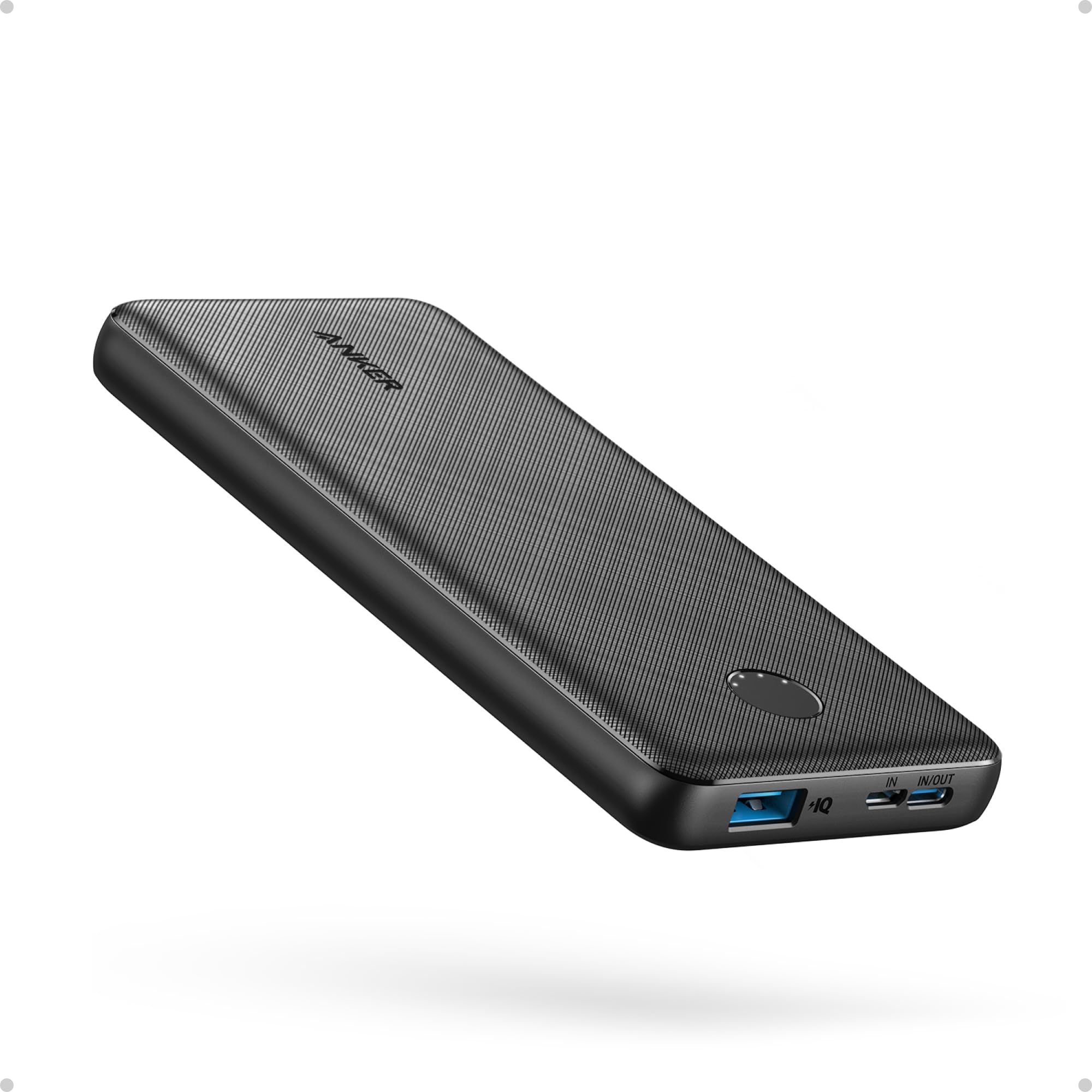
Weight is the whole argument. Anker lists this at 8.6 ounces and 0.61 inches thick, and that is the difference between a pack that lives in a jacket pocket and one that lives in a bag. Set it beside the 20,000mAh packs here and it is a little over half the mass for half the capacity — nothing clever, just a smaller battery in a slimmer shell. A two-way USB-C port and a USB-A cover the phone and the earbuds.

We keep coming back to it for the days when we are out for twelve hours and do not want to think about charging at all. Anker's own figure is two charges for an iPhone 15, and that matches the job: a shoot day, a long train, a festival afternoon. It is the pack that gets left in the bag and forgotten, which is exactly what you want from it.

Fifteen watts is the ceiling, though, so a current phone charges in the slow lane rather than the fast one, and there is a practical routine to it — plug the pack in when you go to bed and the five-hour refill is done by morning. If you need a meaningful top-up in a boarding queue, this is the wrong tool and one of the 30W or 65W packs here is the right one.

Pros

  • 8.6 oz and only 0.61 in thick
  • Two full phone charges from 10,000mAh

Cons

  • Around five hours to refill from empty
Our verdict

The one we take when the bag is already full: barely half a pound, thin as a phone, good for two charges, and honest about its slow output.

Check Latest Price
3

Best for Multi-Day Trips

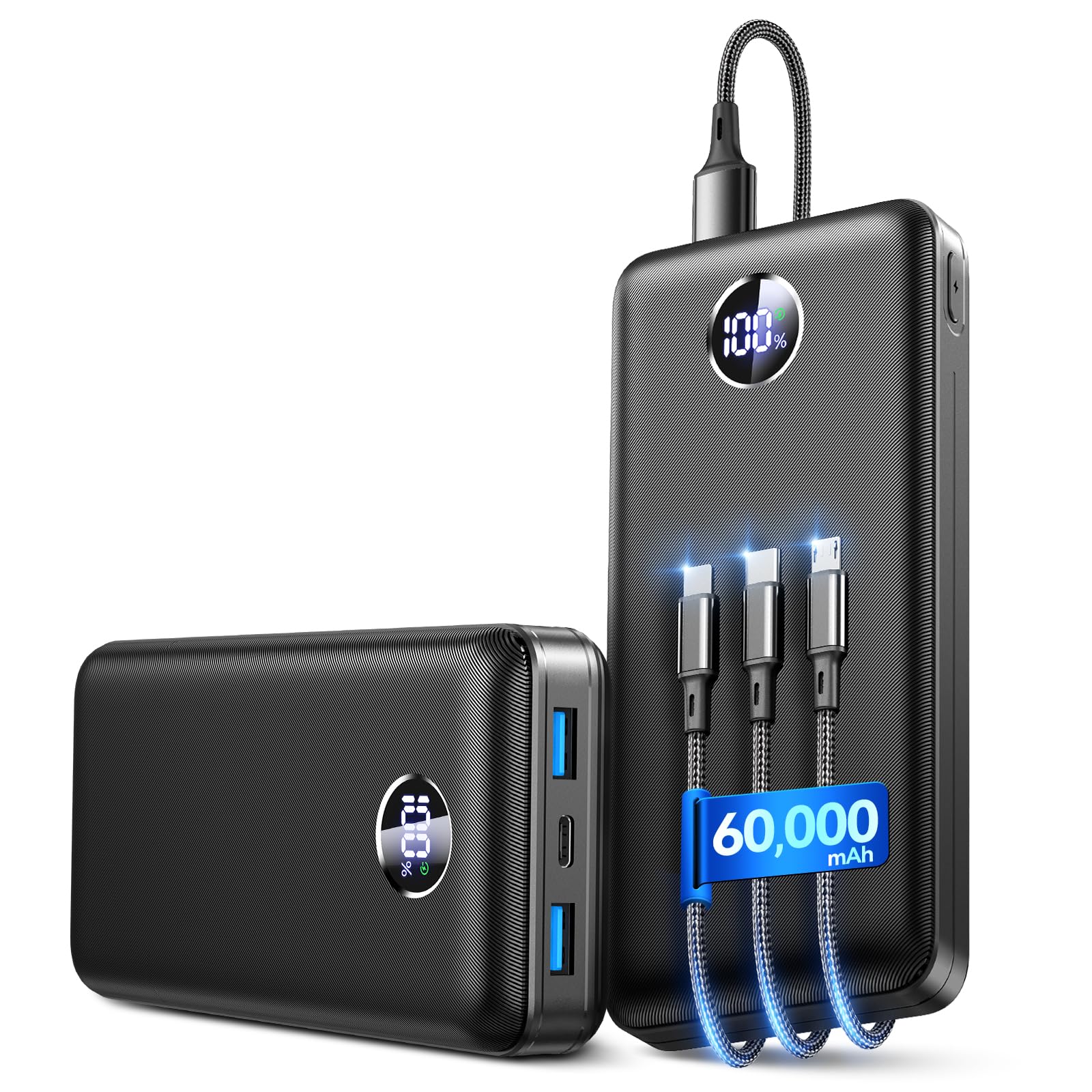
IAPOS 60,000mAh Power Bank

93 /100
Keeper Score Outstanding

Key details

Ports
2 USB-A, 1 USB-C, 3-in-1 cable
Weight
15.5 oz
Capacity
60,000mAh
Max Output
22.5W
Check Price on Amazon

A percentage on the front instead of four unlabeled dots sounds trivial until you are deciding whether there is enough left to get two phones through an evening. We found ourselves glancing at it constantly, and it changed how we rationed the last of the charge. That readout, plus a tank that runs to days rather than hours, is the whole case for this one.

The rest is built for volume. Two USB-A ports, a USB-C port and a three-in-one cable that covers USB-C, Lightning and micro-USB, all able to run together — IAPOS says five devices. On a car trip with three people and a tablet, that is the difference between a queue and no queue at all.

Twenty-two and a half watts is the ceiling, though, and it is shared between whatever is plugged in. Phones charge briskly, a tablet takes its time, and a laptop barely moves, so treat this as a phone-and-tablet pack with an enormous tank rather than a laptop charger. That is the setting it does not serve, and it is worth being clear about before you buy.

Where it earns its place is a cabin, a festival or a car with a tired socket — anywhere the question is how many days rather than how many grams.

Pros

  • Percentage display shows what is left
  • Five devices charging at once
  • Three-year warranty cover

Cons

  • Bulky at 1.1 in thick
  • Capacity runs past the 100Wh airline limit
Our verdict

Built for a long trip away from outlets: a percentage readout that ends the guessing, five devices charging at once, and capacity for days rather than hours.

Check Latest Price
4

Best for Camping

SOARAISE 48,000mAh Solar Power Bank

86 /100
Keeper Score Excellent

Key details

Size
6.38 × 3.43 × 1.57 in
Solar
4 panels
Output
5V/3A
Capacity
48,000mAh
Check Price on Amazon

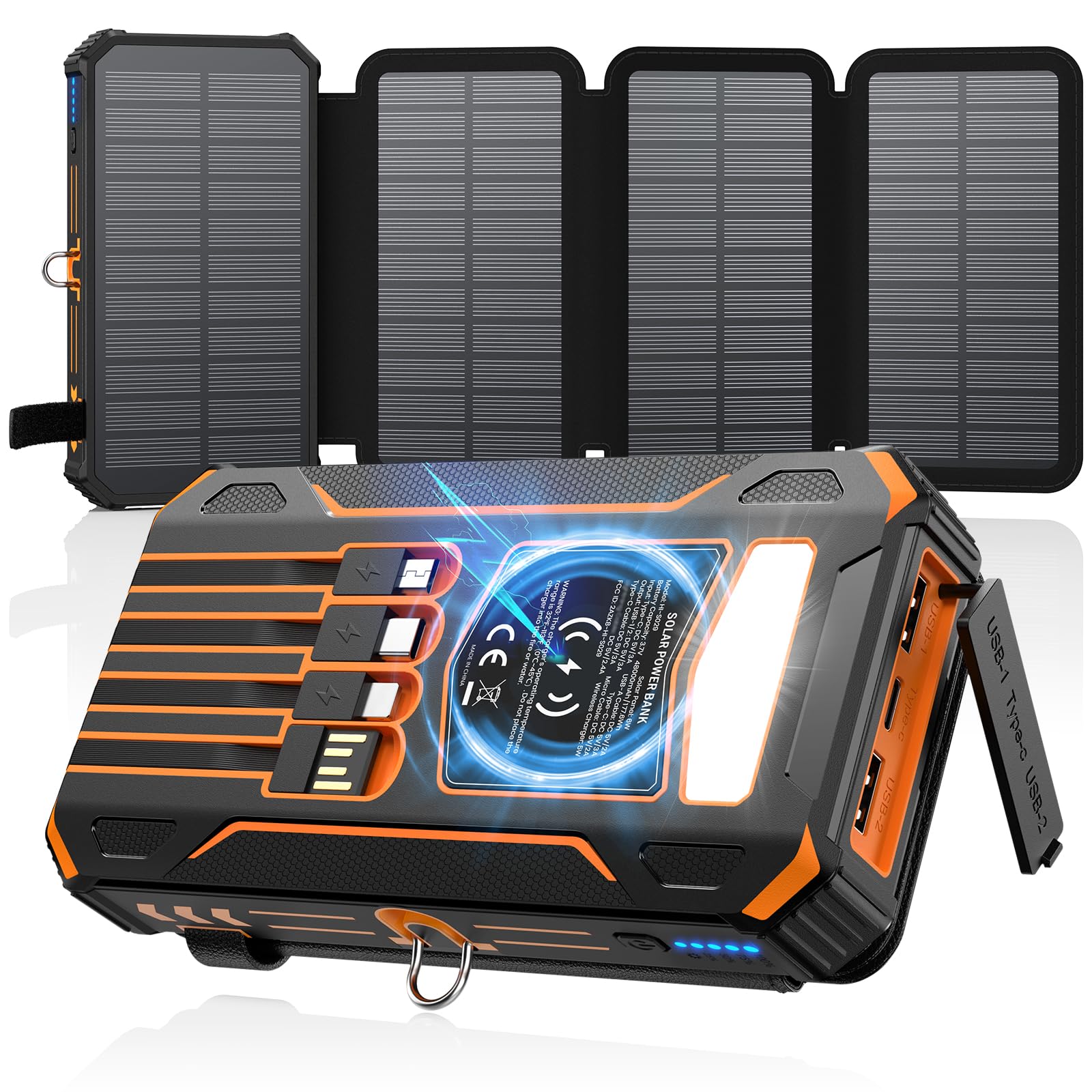
The first thing you notice is the size of it — 6.38 by 3.43 by 1.57 inches in a hard orange shell with rubberized edges that is clearly meant to be dropped. SOARAISE builds four solar panels into the back, four charging cables into the sides and a wireless pad into the top, and for a weekend where the car is base camp that is a sensible set of things to combine in one object.

Those four cables do real work. They cover USB-C, Lightning and micro-USB, so a group with mismatched phones can all plug in without anyone unpacking a pouch of cords, and there are still two USB-A ports and a USB-C port free on top. The pad is the nicer trick at night: you put a phone down on it inside a tent and it starts charging without a cable across the floor.

The panels are the part to be clear-eyed about. An array that fits on a power bank is a top-up, not a charger; ours gained little over a bright day, and nothing about that will refill a battery this size in reasonable time. The 5V/3A output is not fast charging either. We treat the panel as insurance and charge the pack from the wall before leaving, and that is the routine we suggest.

For a festival, a hunting camp or a storm season it earns its keep. For a commute or a cabin bag it is simply the wrong shape, and at this capacity it is a road-trip object.

Pros

  • Four built-in cables cover most phones
  • Wireless pad charges without a cable
  • Sealed against water, dust and knocks

Cons

  • Thick at 1.57 in and best left in a bag
  • Solar panel only trickles power in
Our verdict

The camping pack: four built-in cables, a wireless pad and a shell that shrugs off rain and gravel, with a solar panel that is insurance rather than a charger.

Check Latest Price
5

Day Hikes

BLAVOR 10,000mAh Solar Power Bank

86 /100
Keeper Score Excellent

Key details

Output
20W USB-C
Weight
9.3 oz
Capacity
10,000mAh
Water Resistance
IPX5
Check Price on Amazon

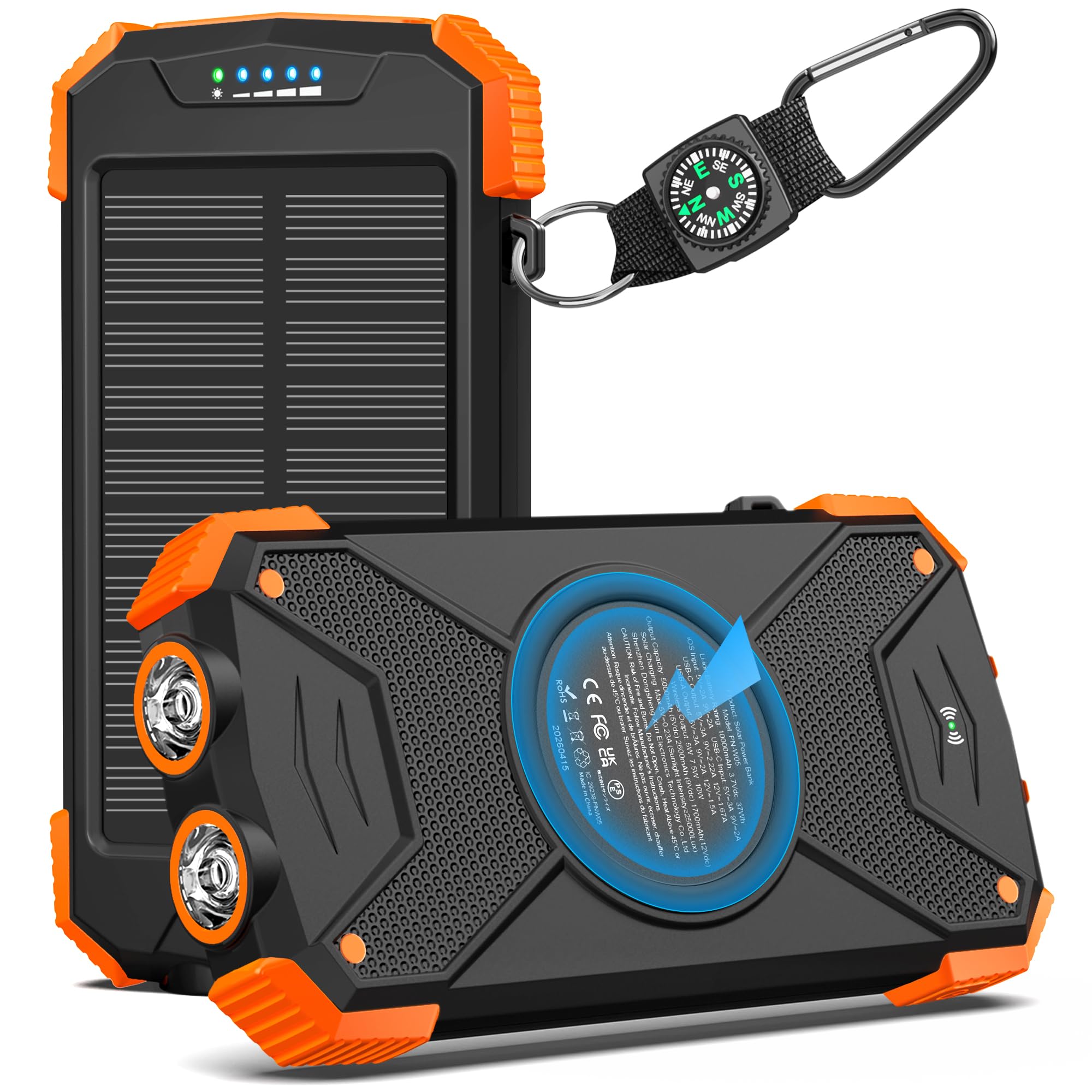
Nine and a third ounces in a rubberized shell rated IPX5 — this is the smallest outdoor pack here, the one that clips to a daypack rather than getting loaded into a car. BLAVOR puts a Qi wireless pad on one face and a pair of flashlights on the other, and charges through a 20W USB-C port, with built-in cables for the rest.

We like it for what it is rather than what the name promises. The pad is genuinely handy in a tent when you do not want to hunt for a cable in the dark, the twin lights are bright enough for a campsite or a walk back from the water, and the sealed shell means a shower of rain is not a crisis. That combination at this weight is the reason it is on the list.

Charging is the ordinary part. Twenty watts over USB-C is respectable for a pack this size, four hours from empty is quick enough to do overnight, and there is a USB-A and built-in leads for everything else. Two charges for a phone is the realistic ceiling, so plan it as a day-out pack and not a weekend one.

Pros

  • Qi wireless pad built in
  • IPX5 shell plus two useful flashlights

Cons

  • Solar panel is a top-up, not a charger
Our verdict

Nine ounces is the whole idea here: a solar pack small enough to clip to a daypack, with a wireless pad and a bright light that earn their place on a hike.

Check Latest Price
6

Emergency Kits

FEELLE 50,000mAh Solar Power Bank

86 /100
Keeper Score Excellent

Key details

Ports
4 built-in cables, 3 ports
Weight
1.1 lb
Capacity
50,000mAh
Off-grid Backup
Hand crank, 4 solar panels
Check Price on Amazon

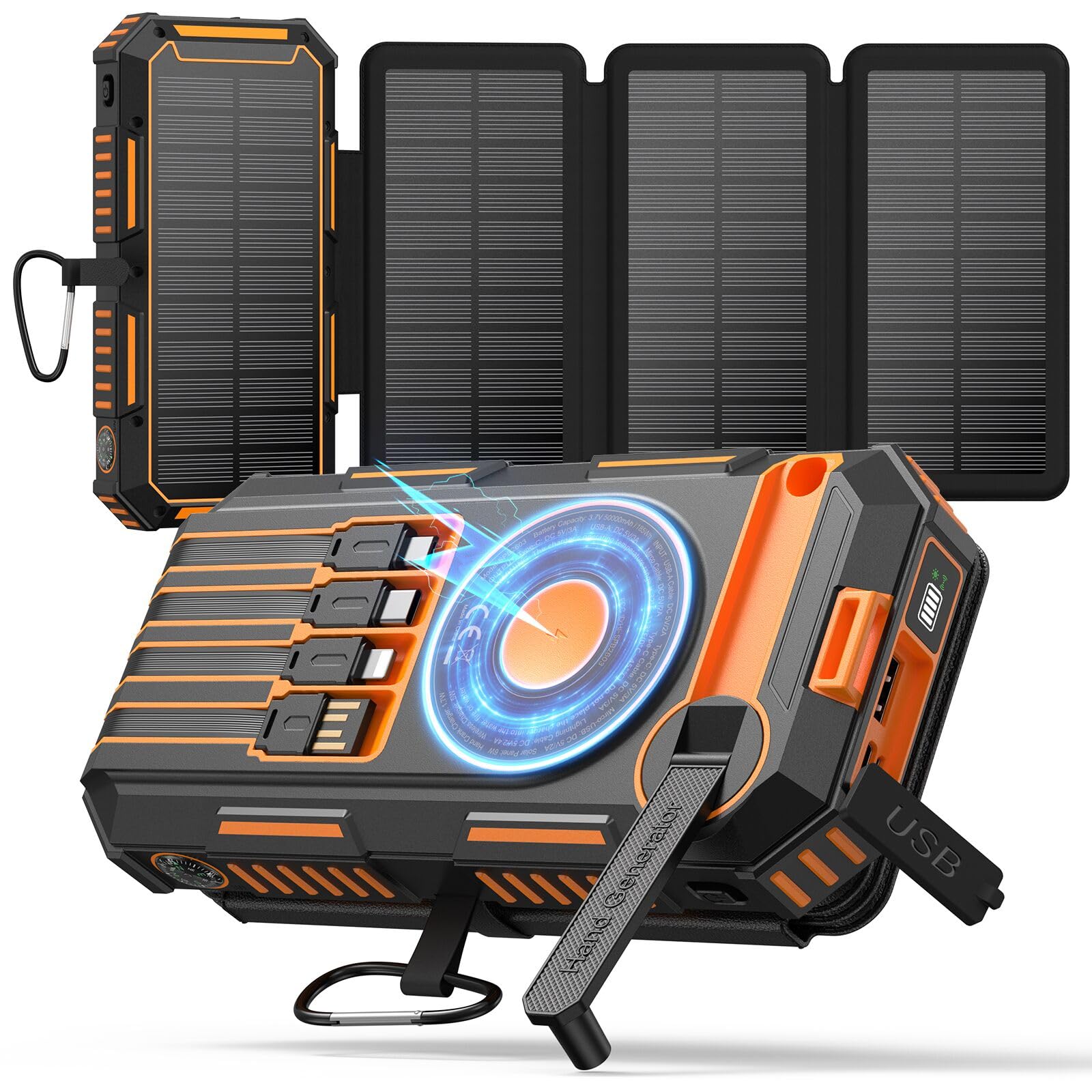
The hand crank is the reason this one exists. Fold it out, wind it for a while and you put a little charge into a battery that is otherwise an inert slab — the sort of thing you are glad to own in a storm and will never touch on an ordinary trip. Nobody else on this list has one.

Everything else is scaled to match. Fifty thousand milliamp hours, four solar panels across the back, four built-in cables and three ports, and enough outputs for six devices at once. There is a 15W magnetic wireless pad on top that snaps a phone into position, plus a compass in the body, because the buyer for this is somewhere without a signal.

It is heavy and it is thick — half a kilogram and 1.97 inches — and the 5V/3A output is slow for this much battery, so phones charge steadily rather than quickly. The crank is emergency equipment too, not a routine: it is tiring and it delivers a trickle. We treat the wall charger as the plan and the crank as insurance, and given that this is the priciest pack here, the wall charger needs to be a fast one.

For a cabin, a boat, a storm season or a vehicle kit it makes sense. For anything you carry every day, the size wins the argument.

Pros

  • Hand crank for a genuine last resort
  • Six devices charging at once
  • Magnetic wireless pad on top

Cons

  • Half a kilogram and nearly two inches thick
  • 5V/3A output is slow for the capacity
Our verdict

The emergency-kit pack: a hand crank nobody else here offers, four panels and six-device charging, in an object you will only carry when the plan is survival.

Check Latest Price

How We Tested: Airport Gates, Tent Flaps, and a Lot of Tuesdays

We started with about 60 listings and cut hard: anything without a stated USB-C PD spec or a coherent capacity claim was out, along with near-duplicates in the same size class. What we wanted was a spread — slim 10,000mAh packs that vanish into a jacket pocket, 20,000mAh workhorses, and the oversized camping bricks. Fourteen made it through, and we've lived with them for six months.

Capacity was the first thing we checked and the least trustworthy. We drained a phone to zero and counted full charges until the bank quit — a 10,000mAh pack that delivers two honest charges is a better buy than one claiming three that gives you 1.5. We timed how fast each got a dead phone to 50 percent, then repeated it with two and three devices plugged in to see whether the speed collapsed. Wireless pads were tested through a normal case, and again with the phone nudged half an inch off-center, which is where it ends up in a bag.

Then we carried them. Every bank spent a week rotating through a tote, a jacket pocket, and a backpack side pocket; weight and thickness get very real by day three. We bent the built-in cables back and forth the way you do when you're stuffing things away, left each one unplugged in a drawer for a month to see what charge it lost sitting idle, and put the solar models in honest midday sun for an hour to find out what the panels actually added. The high-capacity ones came camping, including a cold morning that separated the ones that shrugged it off from the ones that didn't.

Last, value. We worked out roughly what each bank cost per usable charge, because a cheap high-capacity pack that delivers half its rating isn't cheap at all. The ones still riding in my bag are the ones that held a charge, never ran hot, and were small enough that grabbing one never felt like a decision.

How to Choose a Power Bank

Capacity Costs Weight

Capacity is never free. The two Ankers here show the exchange rate: 10,000mAh in under nine ounces, 20,000mAh at fifteen. The listings agree on what that buys, too — roughly two phone charges at 10,000mAh, about four at 20,000mAh. Work backward from your longest day. If one phone charge gets you home, buy small and light; if you are keeping two phones and a tablet alive, buy 20,000mAh and accept the heft.

Be skeptical of the enormous figures on the outdoor packs. A genuine 48,000mAh battery is a pounds-heavy object, so weigh the ounce figure against the milliamp figure before you plan a week around it. Weight is still the most honest measure of what is inside the case.

Watts Decide What It Can Charge

Output wattage, not capacity, tells you what a pack can actually do. Fifteen watts is a slow overnight charge for a phone. Twenty to 30W fast-charges most phones and makes progress on a tablet. Forty-five watts and up reaches small laptops, and 65W or more charges a laptop at close to its own speed. If a laptop is on your list, look for 65W into a single port — the Anker at the top of this list is the one here that clears that bar comfortably.

If you only ever charge phones, 30W is plenty, and the money is better spent on capacity or saved.

Built-In Cables, and What Breaks First

A cable molded into the pack saves the search through your bag, and on a 10,000mAh pack it can be the whole kit. The catch is that the cable is also the part most likely to fail, and on a pack with no spare port that ends the device for good. The ones worth buying pair the built-in lead with an open port — the Anker's second USB-C, the SOARAISE's three spare ports — so a dead cable costs you convenience rather than the trip. Look for a bend rating where one is published.

Flying? Stay Under 100Wh

Airlines cap lithium batteries at 100Wh in carry-on without special approval, which works out to roughly 27,000mAh at 3.7V, and packs do not go in checked luggage at all. That makes 20,000mAh — about 74Wh — the practical ceiling if you fly often. A 25,000mAh pack sits close to the line; a 48,000, 50,000 or 60,000mAh one is well past it, whatever the listing says about travel. If the pack is going in a cabin bag, check the figure before you fall for the capacity.

What Solar Panels and Hand Cranks Are For

The panel on an outdoor pack is a top-up, not a charger. An array that folds onto a power bank cannot collect enough sun to refill a large battery in a day; what it does is keep a charged pack from sitting dead and give you a trickle in an emergency. Charge from the wall before you leave and treat the panel as insurance.

Heat is the other thing to respect. A pack left on a dashboard or in days of direct sun is a pack to stop using, and no power bank belongs in a hot car.

Frequently Asked Questions

Final Verdict

The Anker 20,000mAh 87W is the one we recommend without a condition attached to the use case: it charges a laptop, it fast-charges a phone, the cable is attached to it, and it sits inside the airline limit. The trade is 15.2 ounces, and if that is the trade you do not want, the slim Anker at roughly half the mass delivers two phone charges and disappears into a jacket.

Choose the IAPOS instead if you will be days from an outlet and nobody is carrying a laptop, and the SOARAISE if the trip involves a tent and a car rather than a plane.