Best Portable Power Stations of 2026

The first time a storm knocked out our power for two days, I learned that a drawer full of flashlights is not a plan. A portable power station is the fix: a big battery you can carry to a campsite, set on the kitchen counter, or park beside the router when the grid drops. It keeps phones charged, the fridge humming, and a work laptop alive without hauling out a gas generator.

Over the past eight months, we’ve tested 10 portable power stations, from pocket-sized models to hefty units meant to back up a fridge. The differences that matter aren’t just watt-hours on the box. We compared recharge speed, real-world portability, outlet layout, and whether each one could run everyday devices without tripping. I also checked whether the battery chemistry was built to last, whether capacity could be expanded or serviced later, and whether it worked with the solar panels and cables people already own. The best ones earn their keep; the rest become closet ballast.

Keeper Score summarizes customer ratings and review volume. Read it alongside the product details and trade-offs. How the score works.

1

Best Overall

Jackery Explorer 1000 v2

94 /100
Keeper Score Outstanding

Key details

Weight
23.8 lb
Capacity
1,070Wh
AC Output
1,500W (3,000W surge)
Wall Recharge
About 1 hour
Check Price on Amazon

An hour is what sold us on this one. The Explorer 1000 v2 goes from empty to full in about that long on wall power, with emergency charging switched on in the Jackery app, so the station that sat in the garage since spring is ready before you have finished finding the cooler. That speed changes how you own it: it stops being something you plan around and becomes something you top up on the way out the door.

At 1,070Wh and 1,500W continuous, it lands where most households actually need to be — enough to run a fridge, a router, a CPAP, and a round of phone charges through an evening and into the next morning, with 3,000W of surge for the startup kick on a compressor. Three AC outlets, two USB-C ports (one at 100W), USB-A, a 120W car port, and an LED light cover everything else. We reach for it first for both car camping and storm season, which is not something we can say about the compact units here.

The LiFePO4 cells are rated for 4,000 cycles to 70 percent, and a quiet overnight mode in the app stretches a top-up across the night if noise matters. What it will not do is start a well pump or carry a panel of household circuits: 1,500W is generous for a portable and still a hard ceiling. At 23.8 pounds it is a two-hand lift up stairs and an easy one into a trunk. If your heaviest load is an 1,800W appliance, the EcoFlow Delta 3 Classic covers it for similar money.

Pros

  • One-hour wall recharge from empty to full
  • 1,070Wh and 1,500W cover a fridge and essentials
  • 23.8 pounds with a folding handle
  • LiFePO4 rated to 4,000 cycles

Cons

  • 1,500W rules out big motor loads
Our verdict

Our default pick: 1,070Wh, 1,500W, and a one-hour recharge in a 23.8-pound body that suits car camping and storm season equally well.
Check Latest Price
2

Best for UPS-Style Backup

EcoFlow Delta 3 Classic

93 /100
Keeper Score Outstanding

Key details

Weight
26.7 lb
Capacity
1,024Wh
AC Output
1,800W (3,600W surge)
UPS Switchover
Under 10ms
Check Price on Amazon

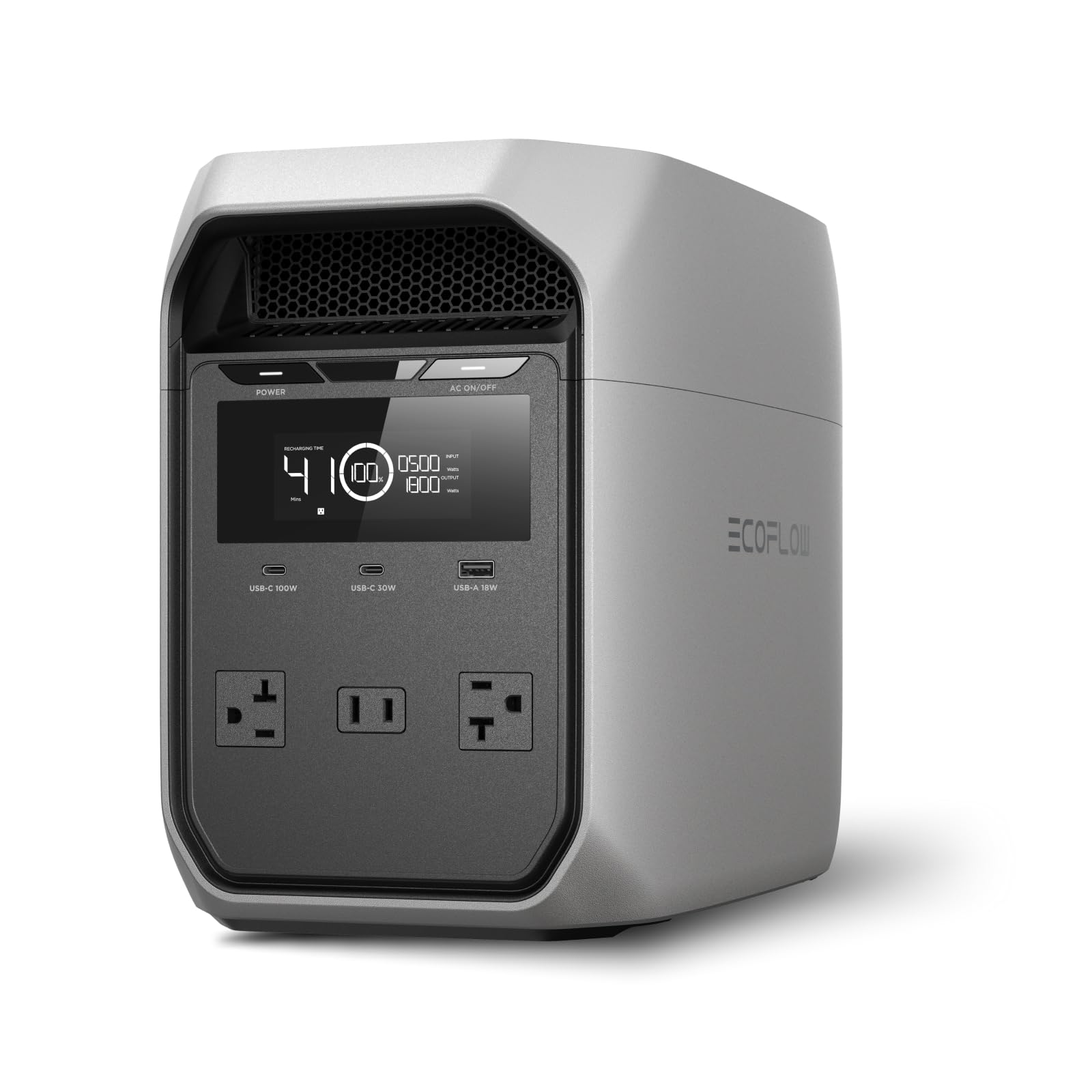
The moment that matters with this one is the flicker when the grid drops. EcoFlow rates the switch-over at under 10 milliseconds, and in practice that means a desktop, a router, or a CPAP keeps running without a reboot — the difference between a power station you store in a closet and one you leave plugged in beside your desk. We think that is the most useful thing a 1,024Wh unit can do.

It is not only a UPS. With 1,800W continuous, 3,600W of surge, and X-Boost behind it, it will run a microwave, a coffee maker, or a circular saw, and a 45-minute charge to 80 percent keeps it practical between outings. Six outlets, a 100W USB-C port, LiFePO4 cells rated for a decade of daily use, and a five-year warranty round out a package that feels built rather than assembled.

Two things to weigh. At 26.7 pounds it is a car-to-house unit rather than a backpack one, and 1,024Wh is an evening of essentials, not a weekend of normal living. If you want the same idea with far more room behind it, the Delta 3 Ultra is the step up in this set.

Pros

  • Under-10ms UPS switchover for desk gear
  • 1,800W continuous with 3,600W surge
  • 0-80% in about 45 minutes
  • Five-year warranty on LiFePO4 cells

Cons

  • 26.7 pounds is a two-hand carry
  • 1,024Wh covers hours, not days
Our verdict

We recommend it to anyone who wants a router, desktop, and lamp to ride out an outage untouched, with enough output for real appliances too.

Check Latest Price
3

Best for Whole-Home Outages

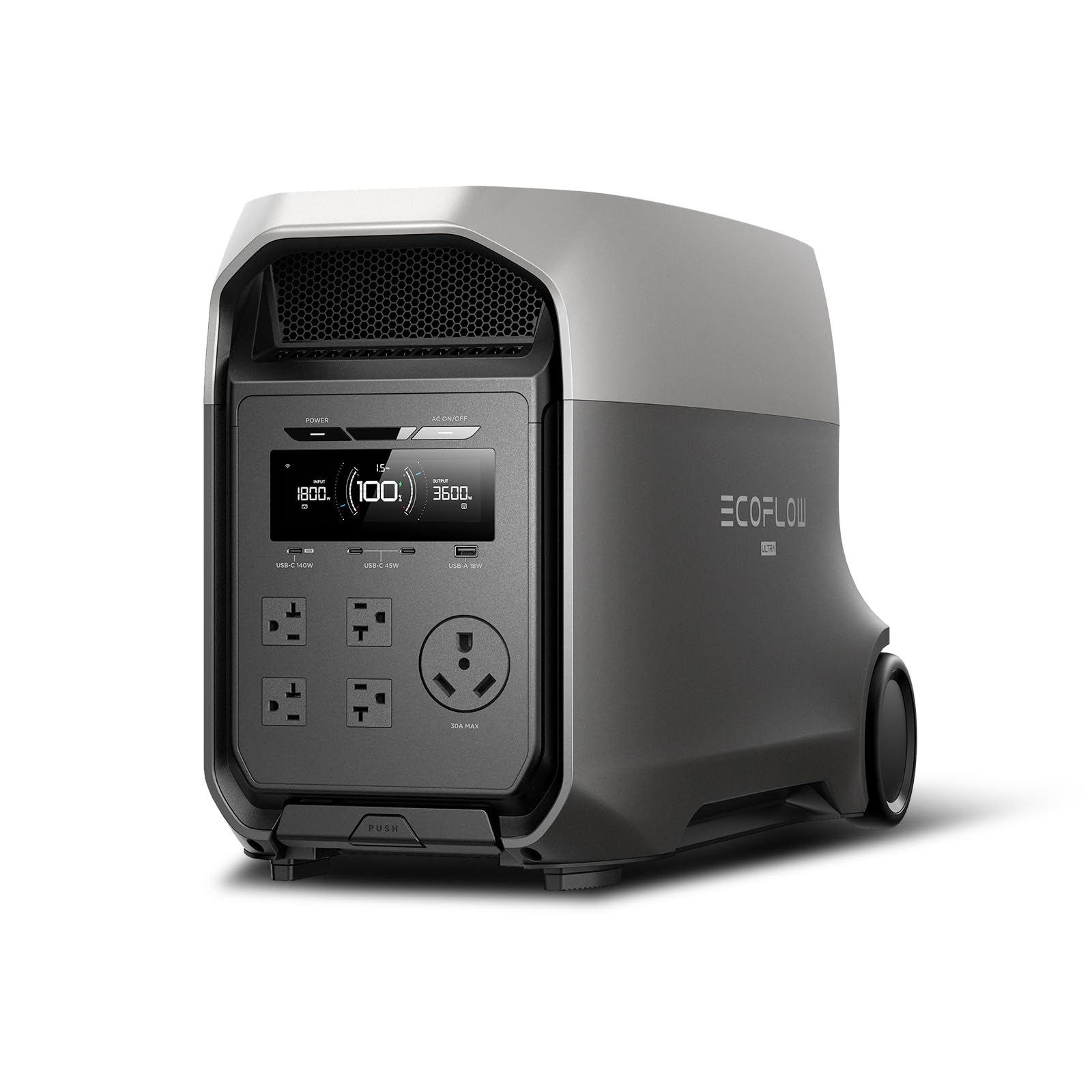
EcoFlow Delta 3 Ultra

88 /100
Keeper Score Excellent

Key details

Weight
72.1 lb
Capacity
3,072Wh
AC Output
3,600W (7,200W surge)
Noise Under Load
25dB
Check Price on Amazon

Twenty-five decibels under load is the claim that made us look twice. That is quieter than a refrigerator, and it is the reason this one can sit in a hallway or a spare bedroom through an outage without becoming the thing everyone in the house complains about.

The numbers behind that calm are serious: 3,072Wh, 3,600W continuous, 7,200W of surge, and a 10ms UPS transfer. Four charging paths — wall, solar, car, or EcoFlow's smart generator — mean it is never stranded, and the outlet set includes three AC plus USB-C and USB-A for the small stuff.

Where it earns its keep is hour eight of a long outage, when the fridge, the freezer, the furnace blower, and the lights are all still on and nothing has tripped. We also appreciate the pass-through design, which sends utility power straight to your devices instead of burning battery to do the same job when the grid is up. What it is not is portable in the hiking sense: 72.1 pounds means it lives where you put it, and you want a second person for stairs.

For a house that goes dark a few times a year, that trade is the right one — you are buying capacity and quiet and accepting that it stays in one place. For a cabin or a van, the 1,024Wh Delta 3 Classic does a similar job at less than half the weight.

Pros

  • 3,072Wh and 3,600W run the big appliances
  • 25dB under load
  • Under-10ms UPS transfer
  • Four charging paths, including solar

Cons

  • 72.1 pounds, so it stays where you put it
  • Not a substitute for a whole circuit panel
Our verdict

The pick for a house that loses power: 3,072Wh and 3,600W of near-silent backup that stays put and keeps the fridge, furnace, and lights going.

Check Latest Price
4

Best Capacity for the Money

EBL Acc2400

86 /100
Keeper Score Excellent

Key details

Weight
54 lb
Capacity
1,843.2Wh
AC Output
2,400W (4,800W surge)
Total Outlets
12 (4 AC)
Check Price on Amazon

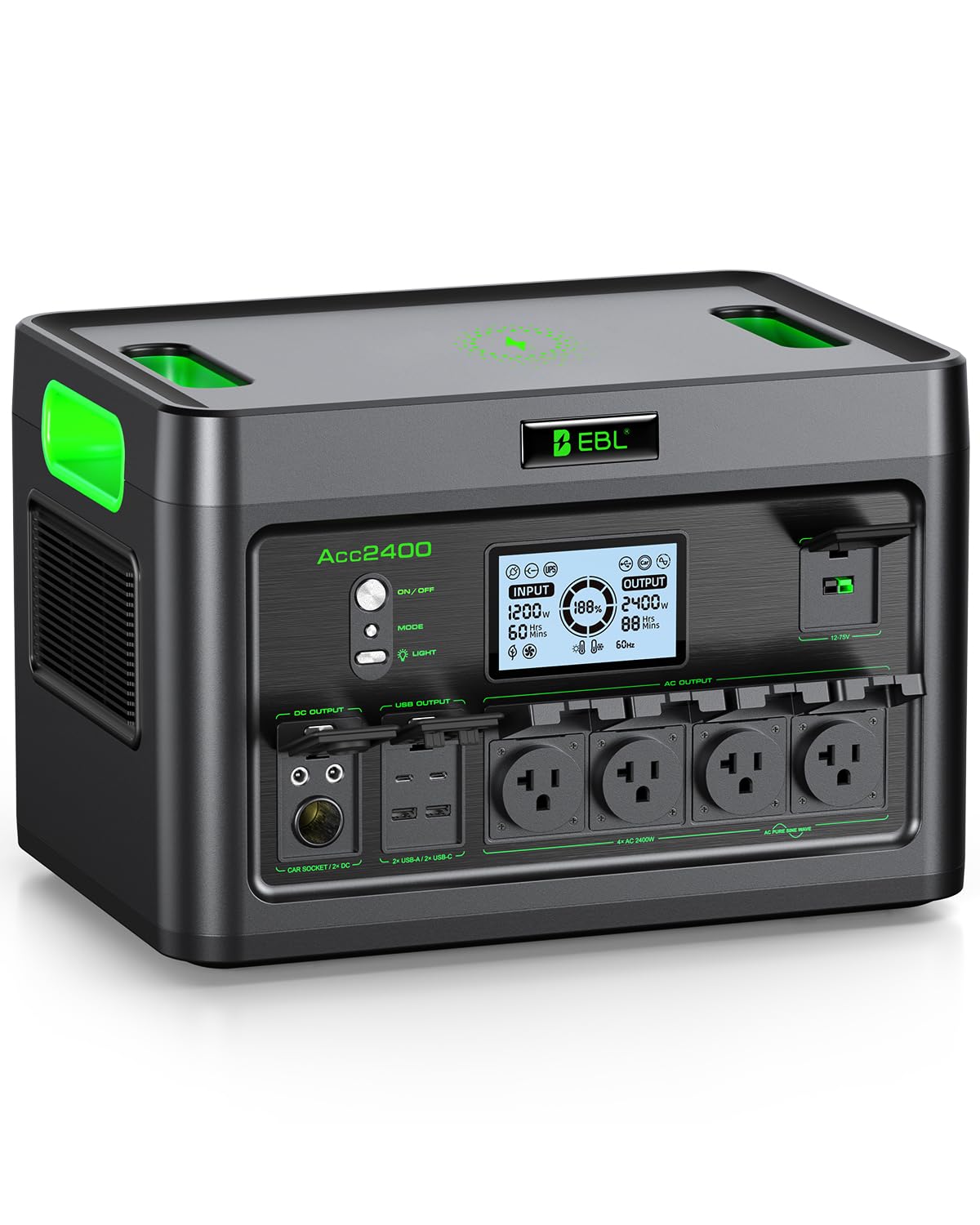
Per watt-hour, nothing else in this set comes close. The Acc2400 puts 1,843.2Wh and 2,400W of output on the table for about what the 1,000Wh units here cost, which is the kind of arithmetic that gets a station onto a jobsite or into a basecamp trailer instead of onto a wish list.

We like what that buys: four AC outlets among twelve ports in total, a 0.1-second emergency switch, LiFePO4 cells rated for more than 3,500 cycles, and dual-side handles that make a 54-pound box manageable between two people. A two-hour recharge is quick enough that a lunch break refills it, and the front display reads clearly from standing height.

The caveats are real. Fifty-four pounds is a two-person lift and permanent floor space, and this model's record is less even than the big-brand units here — some arrive with a fault or stop holding a charge. Unbox it, run it under a real load, and test every outlet while the return window is still open; that habit costs an afternoon and protects the money. Do it and you are getting big-capacity backup for compact-unit money.

Pros

  • 1,843.2Wh and 2,400W at a midrange price
  • Twelve ports, including four AC outlets
  • Two-hour recharge
  • LiFePO4 rated to 3,500 cycles

Cons

  • 54 pounds needs two people and floor space
Our verdict

The capacity-per-dollar pick here: 1,843.2Wh and 2,400W for basecamp or workshop duty, as long as you test it hard in the first weeks.

Check Latest Price
5

Best for a Desk or Shelf

Anker SOLIX C300

91 /100
Keeper Score Outstanding

Key details

Weight
9.1 lb
Capacity
288Wh
AC Output
300W (600W surge)
USB-C Output
140W two-way
Check Price on Amazon

The tower shape is what we noticed first. It is roughly the footprint of a hardback book standing up, so it sits on a shelf, tucks under a desk, or stands in a footwell without sliding around. For a station meant to live near the things it charges, that matters more than another hundred watt-hours.

The 140W two-way USB-C port is the standout: it charges a laptop at full speed and recharges the station itself from a 140W brick, so one cable does both jobs on a trip. Around it you get three AC outlets, a 120W car socket, and eight ports in total, plus 80 percent charge in about 50 minutes from the wall and a five-year warranty that is among the longest here.

The trade is cost. Per watt-hour this is the most expensive compact unit in the group, and the strap that makes it easy to carry is sold separately, which feels like a small nick at this level. We still keep it near the desk, because it is the one that is always close enough to plug into — and if 600W of continuous output matters more to you than the shape, the BLUETTI Elite 30 V2 is the one to look at.

Pros

  • Tower shape fits shelves and desk corners
  • 140W two-way USB-C for charging and recharging
  • 80% in about 50 minutes
  • Five-year warranty

Cons

  • 300W continuous rules out kettles and heaters
  • Carry strap sold separately
Our verdict

The compact we keep within arm's reach: a tower footprint, 140W two-way USB-C, and a five-year warranty, for people whose big load is a laptop.

Check Latest Price
6

Best Compact for High-Wattage Gear

BLUETTI Elite 30 V2

89 /100
Keeper Score Excellent

Key details

Weight
9.5 lb
Capacity
288Wh
AC Output
600W (1,500W lifting)
UPS Switchover
10ms
Check Price on Amazon

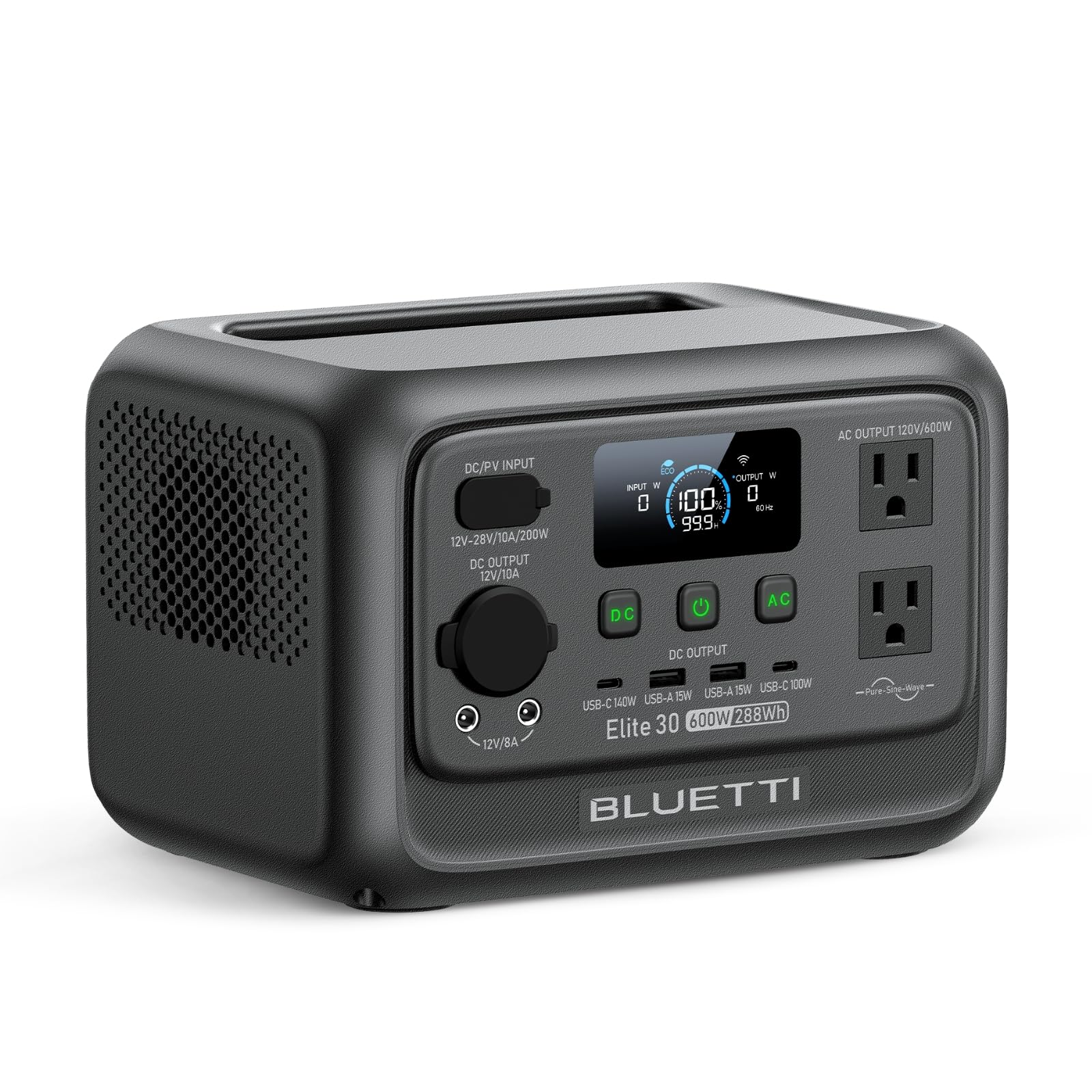
Six hundred watts of continuous output from a 288Wh box is not a typo, and it is roughly double what the other compact units here deliver. That is the whole case for the Elite 30 V2: it can start and run a small appliance that would trip the others, and its Power Lifting mode pushes to 1,500W for short bursts.

Around that headline there is a lot of well-judged detail. A 10ms UPS transfer keeps a router or desktop alive, nine outlets cover the small stuff, and a 380W wall charge takes it to 80 percent in about 45 minutes. At 9.5 pounds with a handle it goes into a backpack or under a desk without complaint, and the five-year warranty matches the longest in this group.

The honesty check is the battery. 288Wh at 600W is under half an hour of running, so the high output buys a short burst of real appliance power rather than an evening of it — a router and a CPAP overnight, yes; a space heater, no. We also treat the lifting figure as a bonus rather than a rating, because the continuous number is what decides whether an appliance stays on.

Where it lands for us is the gap between a phone charger and a 1kWh station: something you can keep in a closet that still runs a fan, a projector, or a small fridge for a while, and recharges before the next evening. If your real load is laptops and camera batteries, the cheaper Jackery Explorer 300 is the more sensible buy.

Pros

  • 600W continuous from a 288Wh unit
  • 0-80% in about 45 minutes
  • 10ms UPS for desk gear
  • Five-year warranty

Cons

  • Full output drains 288Wh in under 30 minutes
Our verdict

The compact for people who need to run an actual appliance: 600W continuous in a 9.5-pound body, as long as you accept short runtimes at that draw.

Check Latest Price
7

Best Ultralight Everyday Pick

Jackery Explorer 300

93 /100
Keeper Score Outstanding

Key details

Weight
7.1 lb
Capacity
292Wh
AC Output
300W (600W peak)
Battery Cycles
4,000 to 70%
Check Price on Amazon

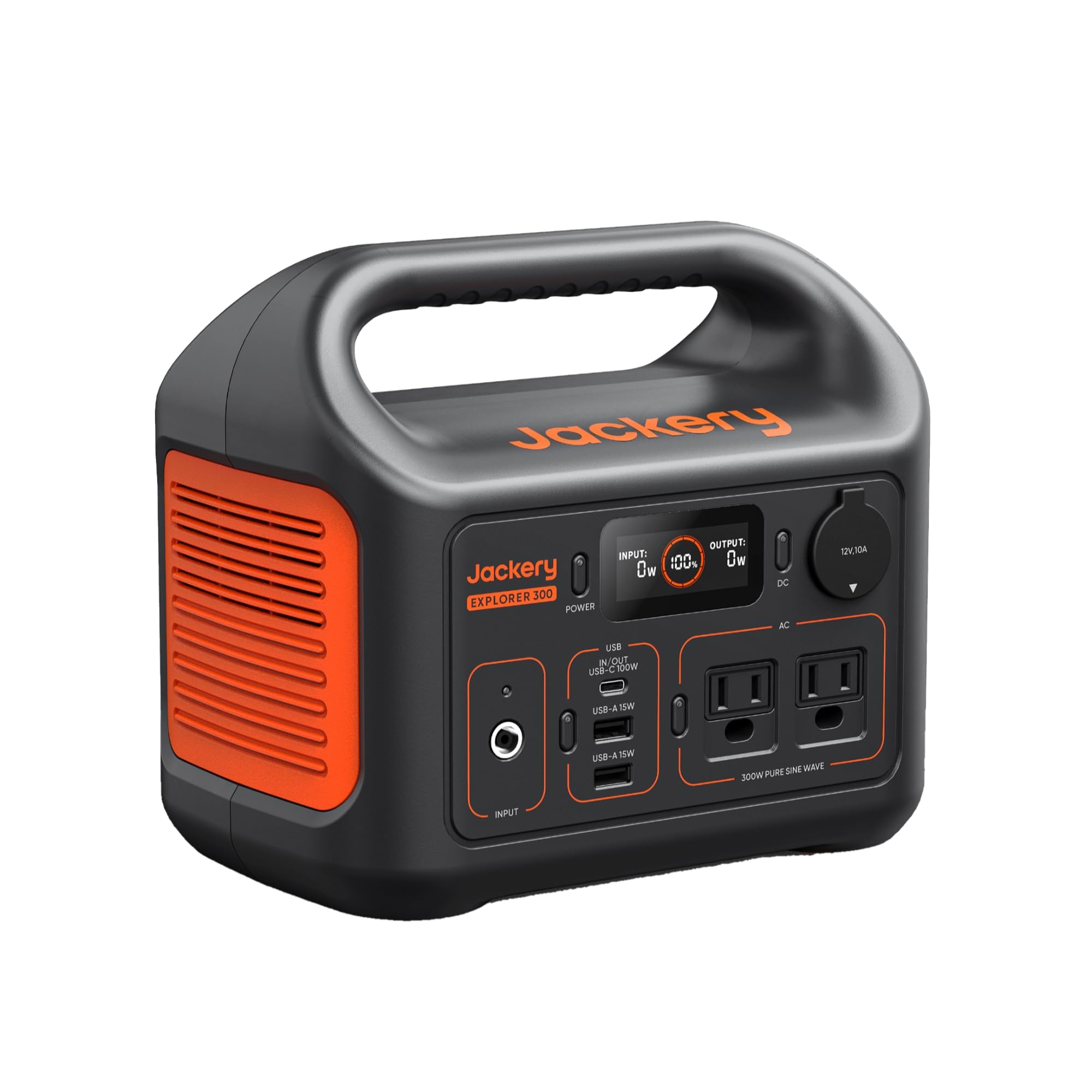
Seven pounds is light enough that you stop thinking of it as equipment. The Explorer 300 swings onto a shelf with one hand, fits between a cooler and a duffel in the trunk, and still puts 292Wh and 300W behind two AC outlets, a 100W USB-C port, two USB-A ports, and a 120W car socket.

Inside, the LiFePO4 cells are rated for 4,000 cycles to 70 percent, which is a long life for a unit this size, and a 100W solar panel takes it to 80 percent in about 2.8 hours. Around the house it covers phones, a laptop, a fan, a lamp, and a router for an evening; at a campsite it does the same work with less fuss than the bigger stations because you will actually carry it out of the car.

The wall charger is the weak spot: about four hours to full, which is slow next to the one-hour units in this group. We do not mind it, because this is a station that lives charged and gets topped up overnight, but if your plan is a fast turnaround from a wall outlet, the BLUETTI Elite 30 V2 or the Delta 3 Classic is the better fit. For the money, it is the one we hand to people who want a small station they will genuinely take with them.

Pros

  • 7.1 pounds with an integrated handle
  • 292Wh and 300W for the essentials
  • 4,000-cycle LiFePO4 cells
  • 80% from a 100W panel in about 2.8 hours

Cons

  • About four hours to recharge from the wall
Our verdict

The everyday small station: 7.1 pounds, 292Wh, and a long-lived LiFePO4 battery for camping and around-the-house top-ups.

Check Latest Price
8

First Solar Kit

ZeroKor 300W Solar Generator

85 /100
Keeper Score Excellent

Key details

Weight
5.1 lb
Capacity
280Wh
AC Output
300W max
Solar Panel
60W included
Check Price on Amazon

This is the only station in the set that arrives with a solar panel in the box — a 60W folding monocrystalline unit that plugs straight in. For a first off-grid kit, having the panel matched to the station removes a step and a compatibility guess that trips up plenty of first-time buyers.

The station itself is 280Wh with 300W of AC output, seven outlets including a quick-charge USB port and a 12V car socket, a 5.1-pound body, and a four-level LED light with an SOS mode. It recharges from a wall, a car, or the panel, and the built-in battery management covers over-voltage, over-current, and short-circuit protection.

Set expectations on that panel. Sixty watts is a trickle at this scale: once you allow for angle, shade, and cloud, refilling 280Wh takes most of a good sunny day, and longer in winter. It is the right panel for keeping phones and a small cooler topped up over a weekend, not for a fast turnaround between trips.

We think of it as a starter kit, and the 12-month warranty is the shortest in this group — worth knowing before you lean on it for a season of trips. If you already own a panel, buy the station that suits you and skip the bundle; if you do not, this is the only way here to get both in one order.

Pros

  • 60W solar panel included in the box
  • 5.1 pounds with seven outlets
  • Wall, car, and solar charging
  • Built-in LED light with SOS mode

Cons

  • 12-month warranty, the shortest in this set
Our verdict

The one to buy if you want a panel and a station in a single order, with the understanding that 60W is a slow trickle of a recharge.

Check Latest Price

How We Tested Portable Power Stations

We built the shortlist by sorting through capacity, outlet count, battery chemistry, weight, solar input, and price, then cut anything that looked hard to carry solo or vague about what it could actually run. Ten units made the cut, and I lived with them for eight months—not in a lab, but in the places these things get used: a weekend campsite, a tailgate, a home outage drill, and the back of a car on a road trip.

Each station was drained and recharged from a wall outlet and from solar, with a watt meter tracking how close it came to the claimed recharge time and how hot it ran. I carried every unit by its handle up and down stairs and packed it into a trunk to judge portability with a real load, not just the spec sheet. During outage simulations, I ran a mini fridge, a fan, a router, a TV, and laptop chargers at the same time, then noted which outlets were easy to reach and whether a high-watt appliance tripped the whole bank.

For compatibility, I plugged in USB-C laptops, AC appliances, and third-party solar panels to see whether the station negotiated power properly or needed a specific adapter. I checked whether capacity could be added later or the battery serviced, since sealed units are common and expansion is not universal. Reliability came down to repeated charge-discharge cycles, fan noise, heat, and whether the display matched what actually came out of the battery. Value was the last filter: I compared what came in the box, the UPS switchover, and the outlet mix against what the station delivered under load.

How to Choose a Portable Power Station

Start With Watt-Hours, Not Watts

Watt-hours decide how long a station runs; watts decide what you can plug in. Once you know your loads, multiply each draw by the hours you need: a 40W CPAP for eight hours is 320Wh, and a 1,070Wh station covers that with room left for phones and a lamp. Expect to lose some of the label figure in the AC conversion, so build in a margin.

Put simply, 300Wh is an evening of small devices, 1,000Wh is a fridge overnight plus the essentials, and 3,000Wh is a household for a day. If your honest use is phones, a laptop, and a fan, the small end is not a compromise — it is the right size, and it will actually get carried.

Match Continuous Watts, Then Check the Surge

Continuous output governs what runs; surge is the brief extra a compressor or motor needs to start. A fridge may pull 200W running and close to three times that for a second on startup, which is why a 300W station with 600W of surge can cycle one and a station without that headroom trips instead.

Watch the marketing terms. Power Lifting, X-Boost, and similar modes deliver a short burst above the continuous rating, and none of them turn a 600W unit into an 1,800W unit for a ten-minute job. Buy on the continuous number and treat the bigger figure as a bonus.

Weight Decides Where It Lives

Under 10 pounds, a station goes in a backpack, on a shelf, or under a desk, and you will move it without thinking. Around 25 pounds it becomes a car-to-house unit: fine in a trunk, awkward on a trail. Past 50 pounds it has a permanent home on the floor and gets moved once.

Portable in a listing often only means there is a handle, so read the weight rather than the photos. Our compact picks weigh about what a gallon of paint does; the 3kWh unit weighs more than a loaded suitcase and needs a second person on stairs.

Chemistry, Cycle Life, and Warranty

LiFePO4 is the chemistry to look for. It is rated for roughly 3,500 to 4,000 full cycles before dropping to about 70 percent of original capacity, against a few hundred for older lithium-ion packs — the difference between replacing a station in a few years and passing it on a decade later.

Warranty is where a maker shows its confidence, and the picks here run from 12 months to five years. Pair that with a recharge time you will tolerate: a four-hour wall charge is fine for a station that lives charged, and a nuisance if you cycle it daily.

Frequently Asked Questions

Final Verdict

Start with the Jackery Explorer 1000 v2. It covers the widest range of ordinary needs — a fridge overnight, phones and a router through an outage, a campsite for a weekend — and the one-hour recharge means it is ready when you need it rather than the morning after.

If your real priority is a desk that never loses power, the EcoFlow Delta 3 Classic's 10ms switch and 1,800W of output make it the better buy. If you are covering a house for days rather than hours, the Delta 3 Ultra is where the capacity lives.