Best Portable Solar Panels of 2026

A solar panel's wattage is the most optimistic number on the box. Those 200- and 400-watt figures come from a lab at perfect tilt with the sun straight overhead — not from a hazy Tuesday at a campsite with a pine tree leaning into your light. What actually matters is how much of that rating survives real weather, real shadows, and being unfolded for the hundredth time.

Over eight months I've hauled 12 foldable panels — 100-watt briefcases up to 450-watt suitcases — through backyard afternoons, a weeklong RV trip, and one three-day blackout. The good ones share a habit: they turn a sunny hour into stored power without asking to be babysat. Portability counts for more than shoppers expect; a panel that weighs like a case of beer stays in the truck, whatever it's rated for.

The other thing I'd tell a first-time buyer is to check the connectors and the cable length before you fall for a wattage — a short run of cable with the wrong adapter can strand you ten feet from your power station. The picks below are the ones that held up, charged close to their claims, and felt worth the money.

Keeper Score summarizes customer ratings and review volume. Read it alongside the product details and trade-offs. How the score works.

1

Best Overall

HQST 200W Portable Solar Panel

87 /100
Keeper Score Excellent

Key details

Weight
11 lb
Max Power
200W
Efficiency
Up to 25%
Waterproof Rating
IP67
Check Price on Amazon

A 200-watt panel that weighs about 11 pounds is the balance most car campers are looking for, and the HQST gets it right. It folds to 1.97 inches thick, so it slides behind a seat or into a closet, and the rigid frame stays flat when you stand it up. We think this is the first panel to buy if you are charging a mid-size power station on weekend trips.

The 25% N-type cells and IP67 rating are the specs that matter after the first season. Two kickstands adjust from 40 to 60 degrees, and the included 3-in-1 cable covers XT60, DC7909, and DC5521, which are the connectors most mid-size stations use. We appreciate that HQST includes the cable instead of making it a separate purchase.

Output is realistic for the class: the 200W rating is a full-sun number, and the panel will not hit it every hour of the day. The bigger question is long-term durability. The panel has held up well for some and shown wear for others, so store it dry and do not leave it baking in the sun when it is not in use. At this price and weight, it is still the easiest 200W panel to recommend.

Pros

  • Light 11-pound package for a 200W panel
  • Includes XT60, DC7909, and DC5521 cable
  • Good value for a 200W panel

Cons

  • No built-in USB charging
Our verdict

We recommend the HQST as the default 200W panel for car campers who want a light, simple setup and do not need built-in USB ports.

Check Latest Price
2

Best for Charging Devices

Renogy 200W Portable Solar Panel

89 /100
Keeper Score Excellent

Key details

Ports
USB-C PD 45W, 2x USB-A, MC4
Weight
13.9 lb
Max Power
200W
Efficiency
25%
Check Price on Amazon

The reason to pick the Renogy over the HQST is the row of ports on the back. A USB-C PD 45W outlet and two USB-A ports let you charge a phone, tablet, or camera battery directly from the panel, without pulling out a power station. That makes it the better choice for a picnic, a day hike, or any trip where the panel is the only power source.

At 13.9 pounds, it is about three pounds heavier than our top pick, and it folds to roughly 24 by 23 inches. The four kickstands let you set it at 40, 50, or 60 degrees, which is more adjustment than most 200W panels offer. We found the magnetic closure handy for keeping the panels together in transit, and the 25% N-type cells put it in the same efficiency class as the HQST. The two-year warranty is average for the category.

Output can also fall short of the 200W rating, which is not unusual for a folding panel but worth knowing if you are sizing a station around it. If you mostly charge a power station and want the simplest setup, the HQST is still the safer buy. If direct device charging is the point, this is the one.

Pros

  • USB-C PD 45W and dual USB-A ports
  • Four kickstands adjust to three angles
  • Magnetic closure keeps panels together

Cons

  • Kickstands feel less stable on uneven ground
Our verdict

We like this one for trips where phones and camera batteries need charging directly, and its four-angle stand helps in low sun.

Check Latest Price
3

Best for Large Power Stations

ZOUPW 450W Portable Solar Panel

89 /100
Keeper Score Excellent

Key details

Weight
29.5 lb
Max Power
450W
Waterproof Rating
IP68
Open-Circuit Voltage
45.9V
Check Price on Amazon

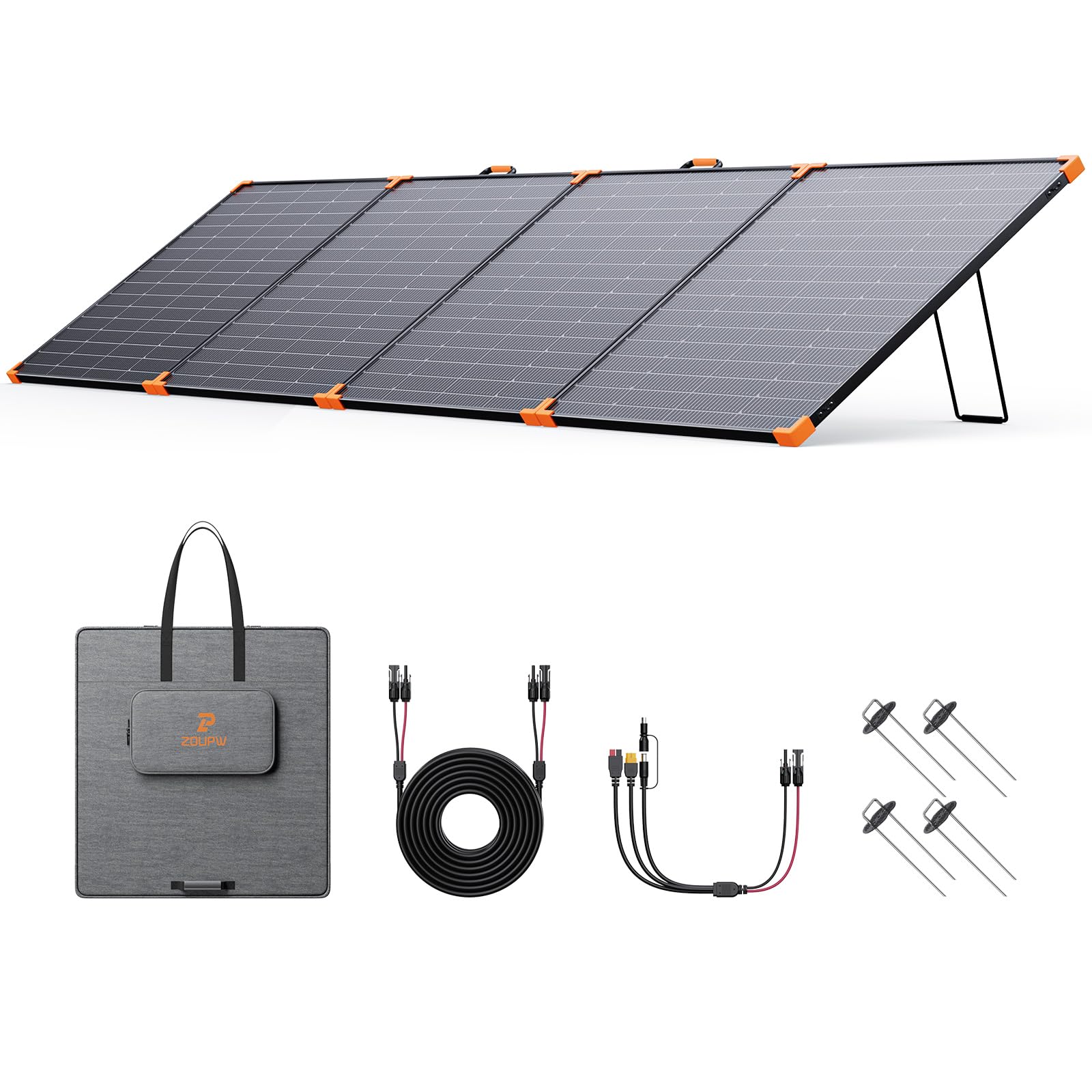
The 45.9V open-circuit voltage is the first thing to check on the ZOUPW 450W. It is built for large power stations with a 40-60V solar input, and it will not play nicely with a small station that caps input at 28V. If your station is in that big-input class, the 450W rating and 12.4A current give it the headroom to charge quickly.

At 29.5 pounds, this is not a panel you carry far. It folds into a 30.43 by 34.56-inch package, and the included bag has a pocket for the 4-in-1 cable. The IP68 rating and ETFE coating are the right choice for a panel that may sit out in rain or marine air. We like the four ground stakes because a panel this large catches wind.

Output is where it earns its keep. The 450W rating is backed by strong real-world output in good sun, and the panel holds up better in light cloud than most of the panels here. The catch is weight: it is heavy enough that you will think twice about moving it alone. For a base camp or RV setup where the panel stays put, that trade is easy to make.

Pros

  • High 450W output for large stations
  • IP68 and ETFE for rain and marine air

Cons

  • Requires a 40-60V power station input
Our verdict

We recommend the ZOUPW 450W for large 40-60V power stations that need serious output and can leave the panel at base camp.

Check Latest Price
4

Best for Small Power Stations

ZOUPW 100W Portable Solar Panel

90 /100
Keeper Score Outstanding

Key details

Weight
9.5 lb
Max Power
100W
Efficiency
23.5%
Waterproof Rating
IP67
Check Price on Amazon

A 100W panel with a 5-in-1 cable and three direct charging ports for about the price of a decent power bank is the reason the ZOUPW 100W earns a spot. It weighs 9.5 pounds and folds to roughly 24 by 21 inches, so it fits in a trunk or a closet without much thought. For a small station or a weekend car-camping kit, that is a useful amount of power without the bulk of a 200W panel.

The 5-in-1 cable is the detail we appreciate most. It covers DC8020, XT60, Anderson, DC5521, and DC7909, which is more connectors than most 100W panels include. The USB-C PD port is rated at 15V/3A, and the two USB-A ports handle phones and small accessories. The ETFE coating and IP67 rating mean it can handle a surprise shower, though it is not a panel to leave out for days.

The 100W rating is a full-sun number, and the panel is happiest when you can aim it directly at the sun. It is not a fast charger for a large power station, and the 12-month warranty is shorter than Renogy's. For the money, it is still a good small-panel value, as long as you are not expecting a 100W panel to behave like a 200W one.

Pros

  • 5-in-1 cable covers common power station plugs
  • USB-C PD and dual USB-A for direct charging
  • Light 9.5-pound package

Cons

  • Output drops sharply in shade or off-angle
Our verdict

We think the ZOUPW 100W is the right small panel for weekend campers who want a complete connector kit without spending much.

Check Latest Price
5

Best Ultralight

FlexSolar 100W Portable Solar Panel

86 /100
Keeper Score Excellent

Key details

Weight
4.1 lb
Max Power
100W
Thickness
0.59 in
Waterproof Rating
IP67
Check Price on Amazon

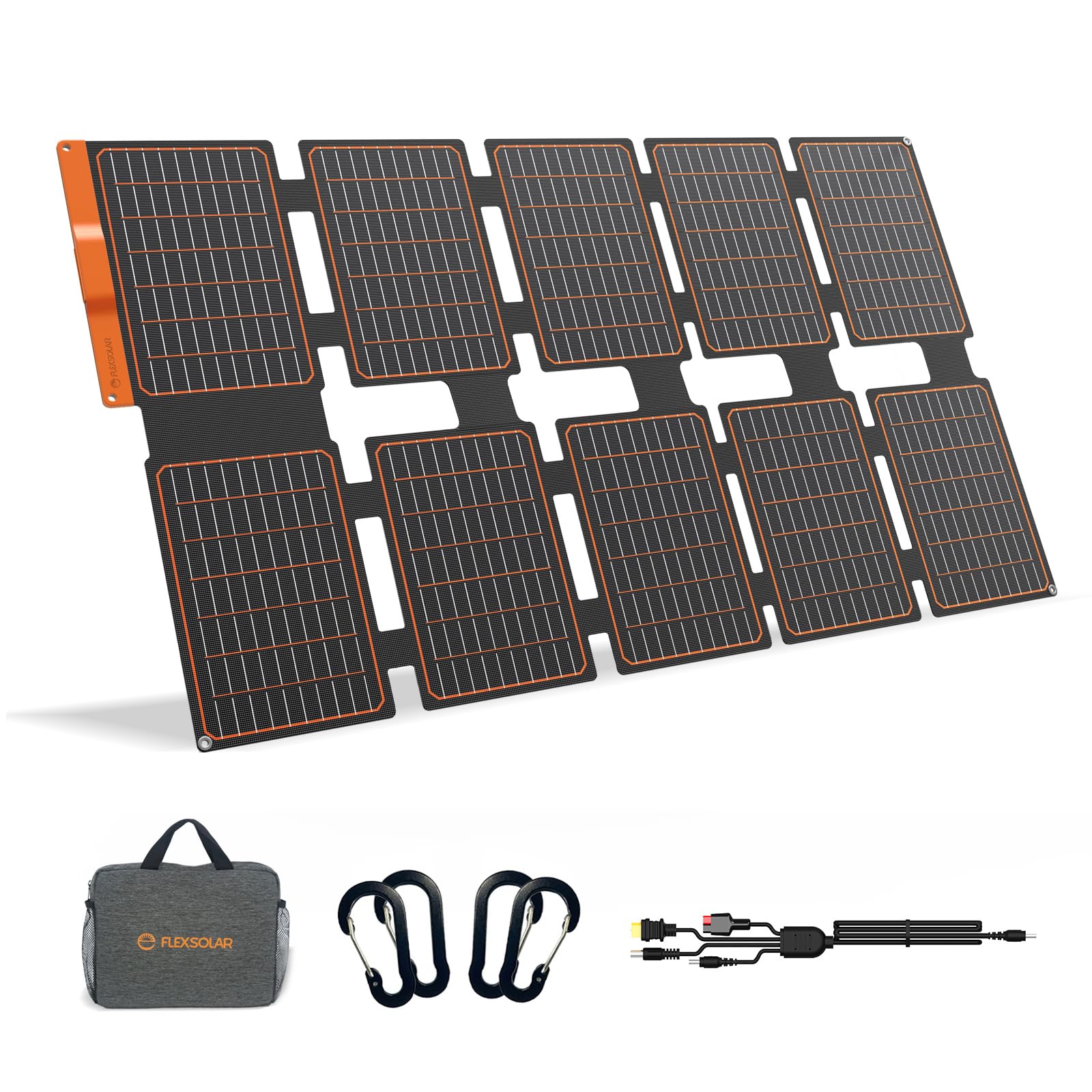
At 4.1 pounds and just 0.59 inches thick, the FlexSolar 100W is the panel that actually disappears into a daypack. It folds to notebook size, and the included carry case makes it easy to lash to a pack or stash in a pannier. If you are hiking or biking and want a trickle of power for a phone, GPS, or camera battery, this is the one we reach for first.

The output setup is more useful than the price suggests: a 45W USB-C PD port, an 18W USB-A port, and a 100W DC output, plus adapters for common power stations. We like that you can charge a phone directly without a station, and the IP67 rating means a little rain is not an emergency. The panel is not a fast charger for a large power station, but it is not meant to be.

Output is the trade-off. The panel tends to land below the 100W rating, which is normal for a panel this small but worth planning around. We still take it for backpacking because the weight savings are real, but we do not rely on it for a week-long off-grid trip.

Pros

  • 4.1-pound package folds to notebook size
  • 45W USB-C PD plus USB-A and DC outputs
  • IP67 rating for rain and splashes

Cons

  • Long-term reliability is mixed
Our verdict

We keep the FlexSolar for backpacking and bike trips where every pound counts and a 100W panel is a bonus, not the main power source.

Check Latest Price
6

Tight Storage

SOKIOVOLA 220W Portable Solar Panel

85 /100
Keeper Score Excellent

Key details

Max Power
220W
Connectors
5-in-1
Folded Size
23 x 22.24 in
Waterproof Rating
IP68
Check Price on Amazon

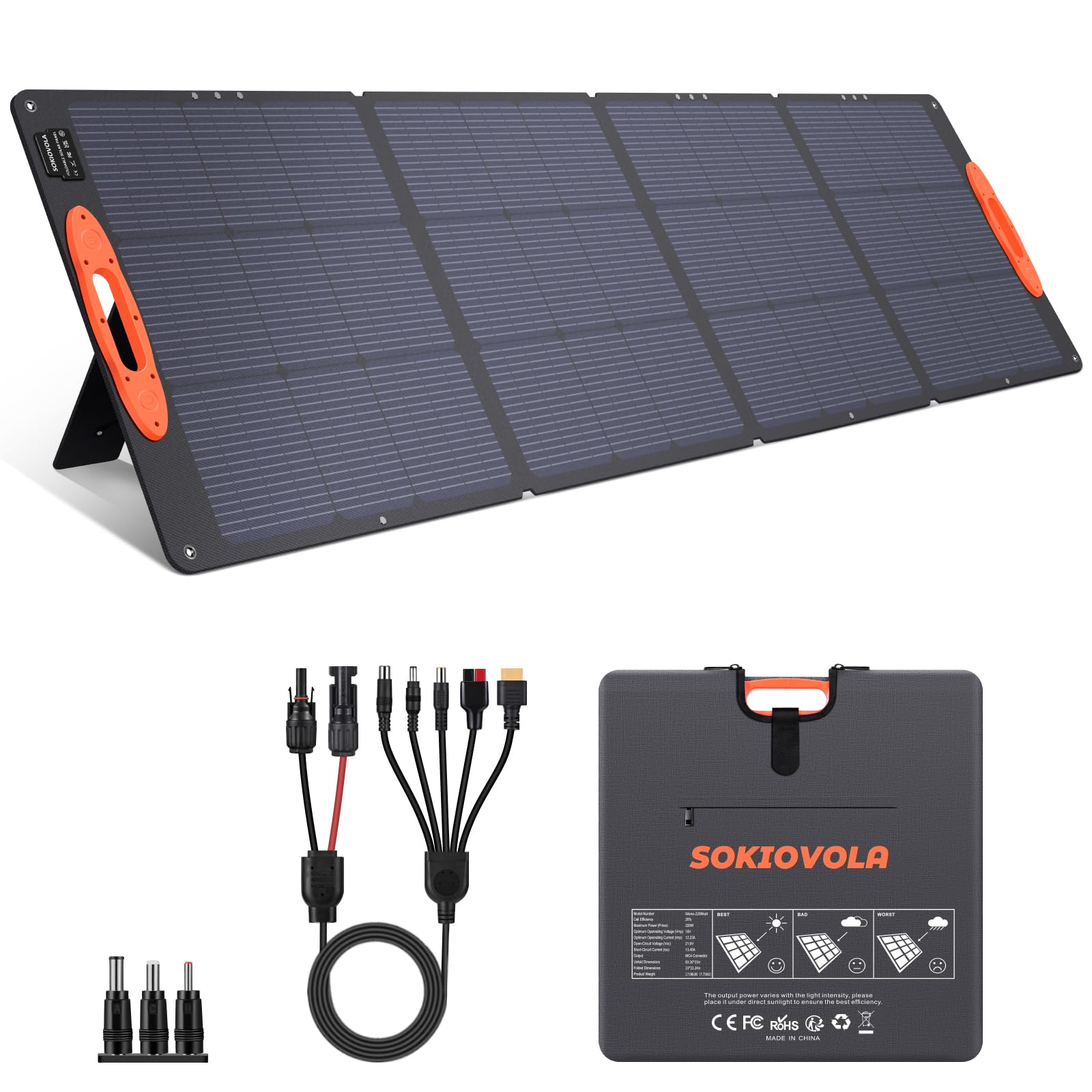
The folded footprint is the reason to look at the SOKIOVOLA 220W. It packs down to about 23 by 22 inches, which is small enough to stand upright behind a seat or in a closet, and the magnetic handle makes it easy to carry. For a small car or a tight RV storage bay, that matters more than a few extra watts.

The panel is rated for 220W, uses ETFE-coated monocrystalline cells, and carries an IP68 rating. The 5-in-1 cable is 10.49 feet long, which gives you more room to place the panel away from the station. We like the three mounting holes and the included adapters; it is a complete kit rather than a panel plus a shopping list.

The trade-offs are consistency and cable length. Output can swing widely depending on angle and sun, and the cable that helps in one setup can feel short when you want the panel farther away. It is a reasonable compact 220W option for tight storage.

Pros

  • Compact 23 by 22-inch folded footprint
  • IP68 and ETFE construction

Cons

  • Durability is inconsistent
Our verdict

We see the SOKIOVOLA as a compact 220W option for tight storage, provided you can live with uneven long-term durability.

Check Latest Price
7

Long Warranty

Renogy 400W Portable Solar Panel

84 /100
Keeper Score Excellent

Key details

Weight
30.2 lb
Warranty
3 years
Max Power
400W
Efficiency
23%
Check Price on Amazon

The 3-year warranty is the reason the Renogy 400W is on this list. Most portable panels here carry a 12-month or 2-year warranty, and a 400W folding panel is a big enough purchase that the extra coverage matters. That longer coverage is the concrete advantage; the rest of the package has to justify the price.

The panel itself is a folding suitcase with 23% efficient cells, fiberglass reinforcement, an ETFE coating, and an IP67 rating. The parallel wiring is designed to reduce the impact of partial shade, and the included case has room for the cable. Setup is straightforward, with sturdy kickstands and a plug-and-play connector set.

Output is good but not the strongest in this group. The 400W rating is optimistic, as it is on every panel here, so plan for a meaningful drop in real sun. The ZOUPW 450W is lighter, cheaper, and more powerful on paper, so the Renogy's case rests on warranty and build rather than raw watts.

Durability is the question mark. The panel has held up well for some, but others have seen corners separate or hot spots develop. At this price, we want a panel that feels bulletproof, and the Renogy does not quite clear that bar. It is still the pick for a buyer who values a long warranty and a known brand over the last few watts.

Pros

  • Three-year warranty is the longest here
  • IP67, ETFE, and fiberglass construction
  • Parallel wiring helps with partial shade

Cons

  • Heavy at 30.2 pounds
Our verdict

We recommend the Renogy 400W for buyers who value a three-year warranty and brand support more than low weight or the lowest cost per watt.

Check Latest Price

How We Tested Portable Solar Panels

We started with every foldable panel that had a real following among RVers and power-station owners, then narrowed by cell type, weather rating, connector compatibility, and price. Anything that needed a proprietary adapter to talk to a common power station got cut, as did panels that couldn't hold their own kickstand on uneven ground. That left 12 panels, which we ran for eight months.

Testing happened where these things actually live: backyards on clear and hazy afternoons, a driveway where a power station charged while we worked, a weeklong RV trip, and one three-day blackout. We logged the wattage going into a power station every half hour and compared it against the claimed rating at the same tilt and time of day, then repeated the run in partial shade to see how fast output fell off.

We measured each cable end to end against the length of a typical vehicle-to-campsite run, weighed every panel folded, and timed setup and pack-down solo, in wind, with cold hands. Durability got the hose: five minutes of spray across the face and junction box, then a check for moisture behind the cells. Each panel was folded and unfolded dozens of times while we watched hinges, corner stitching, and handles for fraying or flex. Value came last — what you paid per real, measured watt in decent light.

How to Choose a Portable Solar Panel

Match Wattage to Your Power Station

A 100W panel is a good match for phones, tablets, and small power stations, while a 200W panel is the practical middle for a 500-1,500Wh station on a weekend trip. Step up to 400W or more only when you have a large station that can accept the input and you are willing to carry the weight. The rated wattage is a full-sun number; plan on less in heat, haze, or an imperfect angle. The HQST 200W is the balance we recommend first for most car campers.

Check Voltage and Connectors First

Wattage is useless if the panel's voltage falls outside your station's solar input range. A large panel like the ZOUPW 450W has a 45.9V open-circuit voltage and is meant for 40-60V inputs; a small station that caps at 28V cannot use it safely or efficiently. Look up the station's maximum input voltage and current, then confirm the included cable has the right plug. A 5-in-1 cable is worth more than a slightly higher watt rating if it saves you an adapter hunt.

Decide How Far You Will Carry It

A panel that stays beside the car can weigh 25 to 30 pounds; a panel that goes into a backpack should stay under 10 pounds. Folded size matters as much as weight, especially in a small car or a tight RV bay. Kickstands and angle adjustment are also part of the portability story: a panel that will not stand steadily on uneven ground is harder to aim. The FlexSolar 100W is the backpacking end of the scale, while the HQST 200W is the car-camping compromise.

Treat Waterproofing and Durability as a Package

IP65, IP67, and IP68 cover different levels of water and dust resistance, but none of them make a folding panel a permanent roof installation. The fabric, laminate, and kickstands still wear under UV and weather, and the warranty is your real backstop. A three-year warranty, like the Renogy 400W carries, is worth paying something for on a large panel. Store the panel dry, secure it against wind, and do not leave it out for weeks at a time.

Decide Whether You Need Built-In USB Ports

A panel with USB-C and USB-A ports can charge a phone or camera battery without a power station, which is useful on day trips and emergency kits. A power-station-first panel can skip those ports and put the money into watts and build. The Renogy 200W and ZOUPW 100W are the direct-charging picks here; the HQST 200W is the simpler power-station panel. If the panel is your only power source, pay for the ports.

Frequently Asked Questions

Final Verdict

The HQST 200W is the panel we recommend first because it hits the useful middle: enough power for a mid-size station, light enough to move alone, and simple enough to set up without a manual. If you need built-in USB charging, the Renogy 200W is the better fit; if you are charging a large 40-60V station, step up to the ZOUPW 450W. For backpacking, the FlexSolar 100W earns its place by disappearing into your pack.