Best Solar Battery Chargers for Cars, RVs, and Boats of 2026

A car battery rarely dies dramatically. It dies over a winter in a driveway, and you find out in spring with a click instead of a crank. Same story for the boat on its trailer, the RV between trips, the mower in the shed. A solar maintainer handles it: a small panel on the dash or the deck, feeding a slow trickle back into the battery so it never reaches empty.

We've spent the past nine months running 14 of these kits through real storage seasons — parked cars, a boat sitting on its trailer, an RV between trips — and the differences came down to more than wattage. A 7.5-watt panel and a 100-watt panel are doing genuinely different jobs, and the charge controller inside matters as much as the number printed on the box.

Here's what nobody tells a first-time buyer: the connectors decide whether you'll actually use the thing. Alligator clips, a cigarette lighter plug, ring terminals, an OBDII hookup — the right one turns install into a two-minute job, and the wrong one turns the panel into trunk clutter. That's roughly how we sorted these picks.

Keeper Score summarizes customer ratings and review volume. Read it alongside the product details and trade-offs. How the score works.

1

Best Overall

Voltset 20W Solar Charger

90 /100
Keeper Score Outstanding

Key details

Panel
20W monocrystalline
Mounting
360° adjustable bracket
Controller
10A MPPT
Weather Rating
IP67
Check Price on Amazon

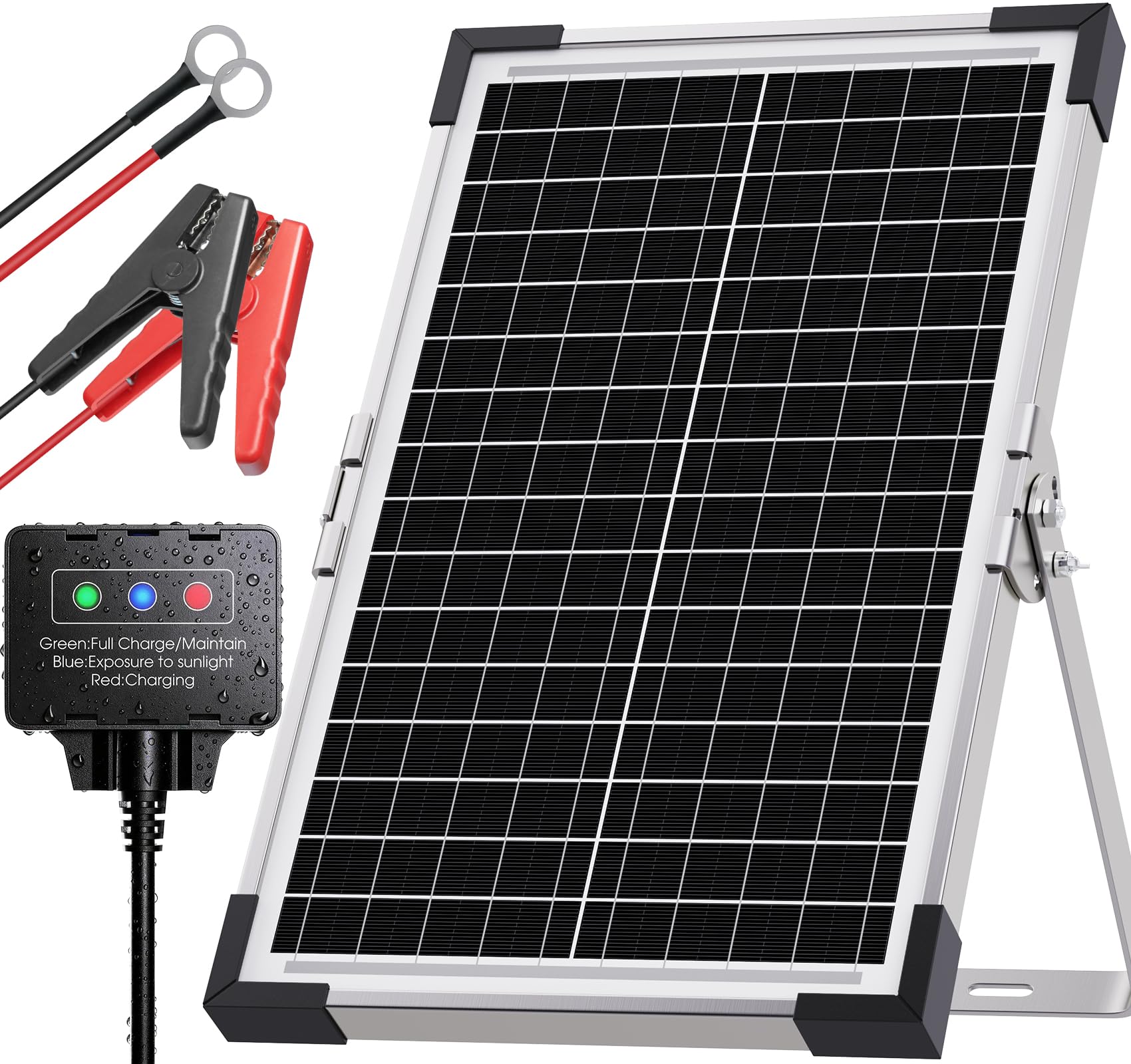
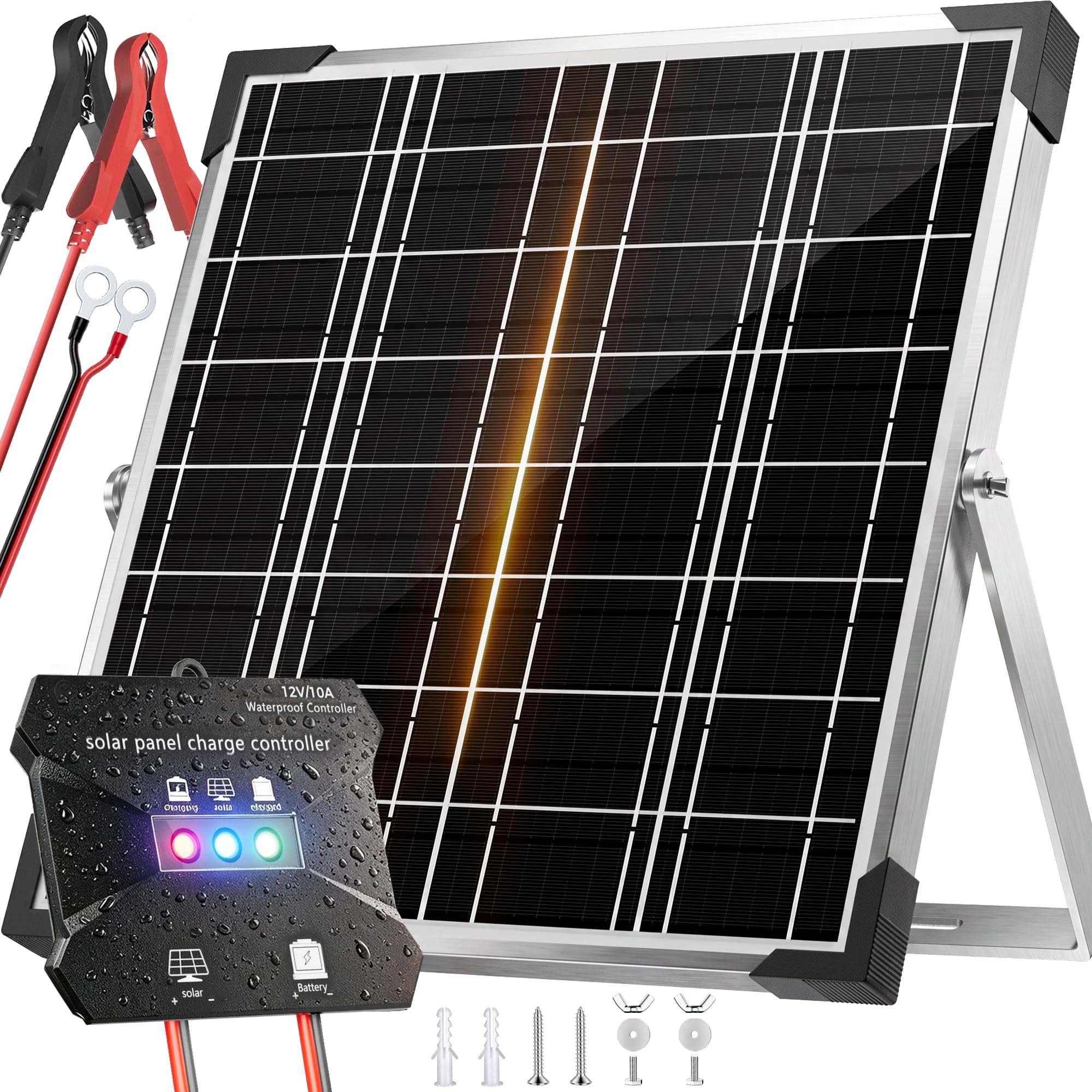
The Voltset kit is the one we reach for first because it does the middle job better than the rest of this set: 20 watts of monocrystalline panel paired with a 10-amp MPPT controller. That is enough panel to maintain a full-size car or a modest RV battery, and enough controller headroom to keep the charging routine from feeling like an afterthought. The IP67 rating and 360-degree bracket make it easy to live with, too.

We like that the kit speaks the language of modern batteries: the listing covers LiFePO4, AGM, gel, flooded, and lithium-ion, not just a generic 12-volt lead-acid. The pre-drilled holes and plug-and-play wiring shorten installation, and the controller stops charging at full and resumes when voltage drops. For a boat, trailer, or stored car, that automatic cycle is the whole point.

The panel is roughly 12.7 by 15 inches and 1.65 inches thick, so it needs a real flat spot rather than a corner of the dash. A few units have quit early; mount it securely and keep the connections dry. Those are the compromises, not deal-breakers, for a kit that covers the widest range of 12-volt jobs here.

Pros

  • 20W panel with 10A MPPT controller
  • IP67 weather protection and adjustable bracket
  • Works with lead-acid and LiFePO4 batteries
  • Stops and resumes charging automatically

Cons

  • Cable runs are short for long vehicles
Our verdict

For most cars, RVs, boats, and trailers, this is the solar maintainer we recommend first.

Check Latest Price
2

Best Charge Control

SUNER POWER 12W Pro

88 /100
Keeper Score Excellent

Key details

Panel
12W
Charging
3-stage
Controller
Ultra-Smart MPPT
Compatibility
Lead-acid, AGM, gel, LiFePO4
Check Price on Amazon

The SUNER Pro is the kit we point to when the battery is expensive enough that the charging routine matters as much as the wattage. Its MPPT controller runs a three-stage bulk, absorption, and float cycle, and it carries eight protections, including reverse polarity, overcharge, over-discharge, and over-temperature. That is more charging intelligence than most maintainers here bother with.

We think that makes it a better fit for a mixed fleet or a battery bank with LiFePO4, gel, AGM, flooded, and sealed lead-acid cells. The 12-watt panel is smaller than the 20-watt Voltset, so it is a maintainer first; the upside is a more deliberate charge cycle and a heavier, 3.3-pound build that feels less like a dashboard accessory. We prefer it for a boat or RV where the battery is left for weeks, not for a quick recovery job.

The panel is heavier than most at 3.3 pounds, so it wants a secure mount rather than a suction cup. If you want the most sophisticated charge control in this set, the SUNER earns the premium; if you want more watts for less, the Voltset is the easier call.

Pros

  • Three-stage charging with eight protections
  • Broad lead-acid and LiFePO4 compatibility
  • Heavy, secure-feeling construction

Cons

  • Indicator lights can be confusing
Our verdict

We think the SUNER Pro is the right choice when you want the most protective charge routine here and own batteries that justify it.

Check Latest Price
3

Best Flexible Panel

FlexSolar 20W Flexible

86 /100
Keeper Score Excellent

Key details

Panel
20W monocrystalline
Weight
1.7 lb
Thickness
0.11 in
Connections
Cigarette, clips, OBDII, ring terminals
Check Price on Amazon

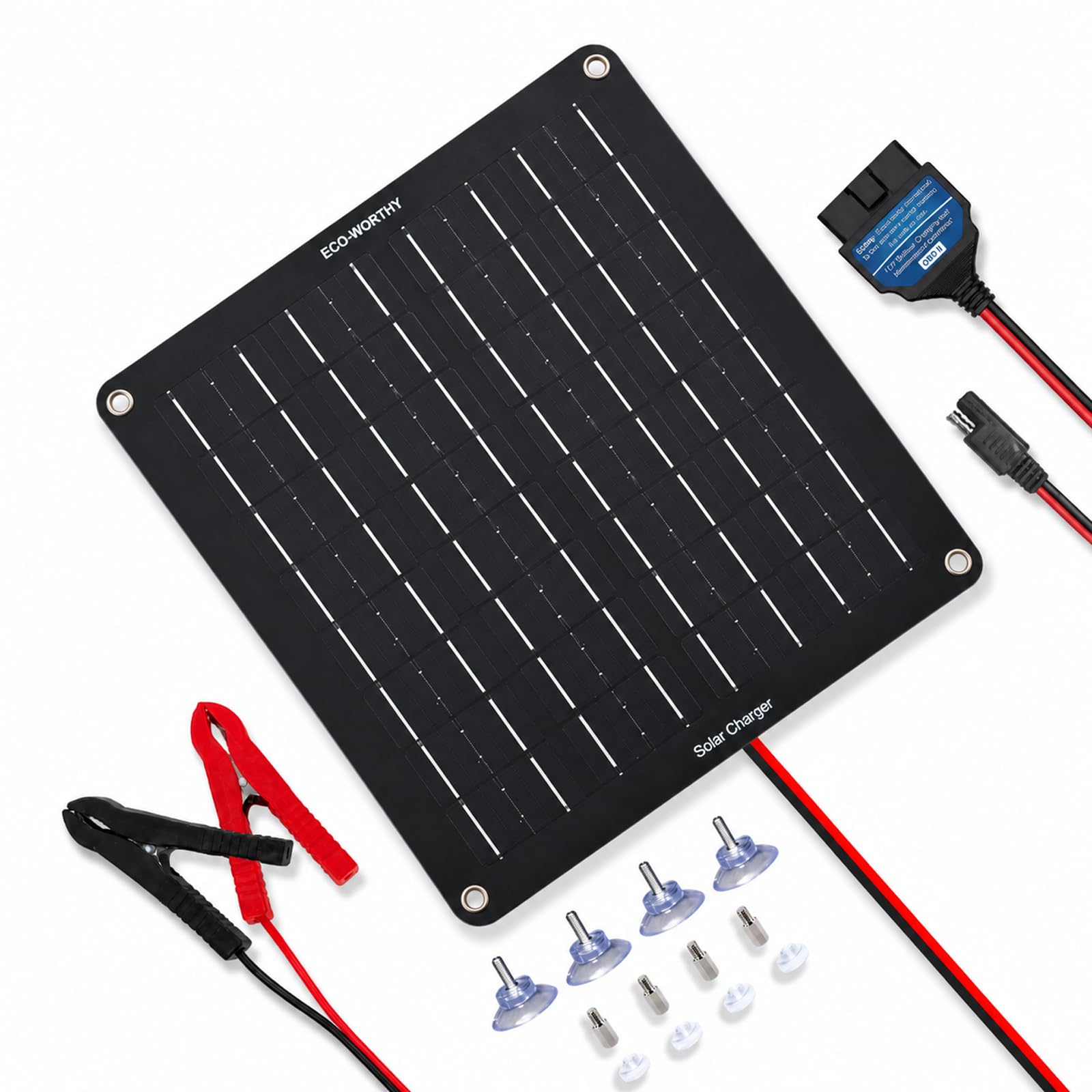
A rigid solar panel needs a flat place to sit, and that is the first thing that goes wrong on a curved windshield, a boat hatch, or the rounded roof of a camper. The FlexSolar kit solves that with a 0.11-inch flexible panel that conforms to the surface instead of fighting it. At 20 watts and 1.7 pounds, it is light enough to mount with the included carabiners or suction cups, and it comes with four connection options: cigarette lighter, alligator clips, OBDII, and ring terminals.

The OBDII adapter is the detail we appreciate most, because it lets you leave the panel connected without running a cable across the dash or clipping directly to the battery every time. The built-in controller stops charging at full and resumes when voltage drops, and the panel's 20-watt rating puts it in the same useful middle ground as our top pick. For a vehicle with a curved surface and a battery that sits for weeks, that combination is genuinely convenient.

We are less confident about the long-term durability: a few units have stopped working within months, so treat the panel as something to mount permanently, not something to move from car to car. Measure the cable run before you commit, because the leads are not generous. The FlexSolar is the flexible pick we recommend, with the caveat that flexibility is not the same as durability.

Pros

  • 0.11-inch flexible panel conforms to curves
  • Four connection options, including OBDII
  • 20W output with built-in controller

Cons

  • Suction cups lose grip in heat
Our verdict

Our pick for curved windshields, roofs, and hatches is the FlexSolar 20W, provided you mount it permanently.

Check Latest Price
4

Best for Large Battery Banks

SOLPERK 100W Kit

88 /100
Keeper Score Excellent

Key details

Panel
100W monocrystalline
Mounting
Z brackets included
Controller
10A MPPT
Maximum Voltage
20V
Check Price on Amazon

The SOLPERK 100W kit is not a trickle charger in the usual sense. It is a 100-watt monocrystalline panel with a 10-amp MPPT controller, built to put meaningful charge back into a boat, RV, or off-grid battery bank rather than just hold a car battery at float. The panel uses 54 cells, has a 20-volt maximum, and comes with Z mounting brackets and alligator clips.

We see it as the pick for someone who is tired of babying a large bank with a 10-watt panel. The 10-amp controller gives the array room to work, and the kit's high rating in this set reflects how well it covers that bigger job. It is also the least compromised choice here for a battery that actually gets drained between trips, not merely parked.

The kit costs more than every other pick here. If your goal is maintenance, stay with the Voltset or SUNER; if you need to replace real amp-hours, the SOLPERK is the one that belongs on the short list.

Pros

  • 100W panel with 10A MPPT controller
  • Includes Z brackets and alligator clips
  • More charging capacity for larger banks

Cons

  • Overkill for small 12V batteries
  • Needs a substantial mounting area
Our verdict

When a boat or RV bank needs real charging, we point to the SOLPERK 100W.

Check Latest Price
5

Best Budget

Callsun 7.5W Charger

86 /100
Keeper Score Excellent

Key details

Frame
Aluminum
Panel
7.5W monocrystalline
Mounting
360° adjustable bracket
Weather Rating
IP68
Check Price on Amazon

The Callsun is the budget kit we recommend because it does not feel like a disposable accessory. The 7.5-watt monocrystalline panel is framed in aluminum, covered with 3.2mm tempered glass, and rated IP68, so it can stay outside in rain or snow without a cover. The 360-degree bracket is more flexible than the flat mounting tabs on most cheap panels, and the three-color LED tells you when the panel sees sun, when it is charging, and when the battery is full.

We like it for a lawn tractor, ATV, or a second car that sits for weeks. The included alligator clips and SAE connector make the wiring simple, and the controller handles the rest. The three-color LED is genuinely useful: blue for sunlight, red for charging, green for full, with a clear read before you walk away.

For the money, the weather sealing and adjustable bracket are the reasons to choose it over a bare plastic panel. Just check the battery voltage after a sunny week; if it is not holding, move the panel to a better spot or step up to a 20-watt kit. The Callsun earns its place as the low-cost option that still feels built for outdoor use.

Pros

  • IP68 aluminum-framed panel
  • 360-degree adjustable bracket
  • Three-color charging indicator

Cons

  • Low 7.5W output limits it to maintenance
Our verdict

The Callsun 7.5W is the budget kit we trust for keeping a small 12V battery topped up outdoors.

Check Latest Price
6

Simple Plug-In Use

ECO-WORTHY 10W Charger

88 /100
Keeper Score Excellent

Key details

Panel
10W monocrystalline
Weight
10.6 oz
Current
0.58 A
Connections
SAE, cigarette lighter, alligator clips
Check Price on Amazon

The ECO-WORTHY 10W is the kit that has been around long enough to feel familiar: a 10-watt monocrystalline panel, a built-in blocking diode, and SAE wiring that ends in either a cigarette-lighter plug or alligator clips. Setup is about as simple as it gets, and the panel is light enough to move between a truck, a tractor, and a boat without much fuss.

We appreciate the straightforward connection options and the fact that the controller is built into the panel assembly rather than hanging off a separate box. The 0.58-amp current rating tells you what this is: a maintainer for a battery that is already healthy, not a charger for a dead one. On a cloudy day, or through a windshield, expect it to be even slower.

The panel's small size means placement matters more than the spec sheet suggests, and we keep it out of our top tier because the long-term record is not as clean as the price suggests. It remains a sensible, low-cost choice for a simple plug-in setup, as long as you are topping off a battery rather than trying to rescue one.

Pros

  • Simple SAE, cigarette, and clip connections
  • Built-in blocking diode
  • Light enough to move between vehicles

Cons

  • Real-world output can fall short of 10W
Our verdict

We like the ECO-WORTHY 10W for a simple, low-cost top-up on a healthy battery, not for recovery.

Check Latest Price
7

Rigid Panel Mounts

POWOXI 7.5W Charger

89 /100
Keeper Score Excellent

Key details

Frame
ABS + PC
Glass
Tempered glass
Panel
7.5W
Weight
2.2 lb
Check Price on Amazon

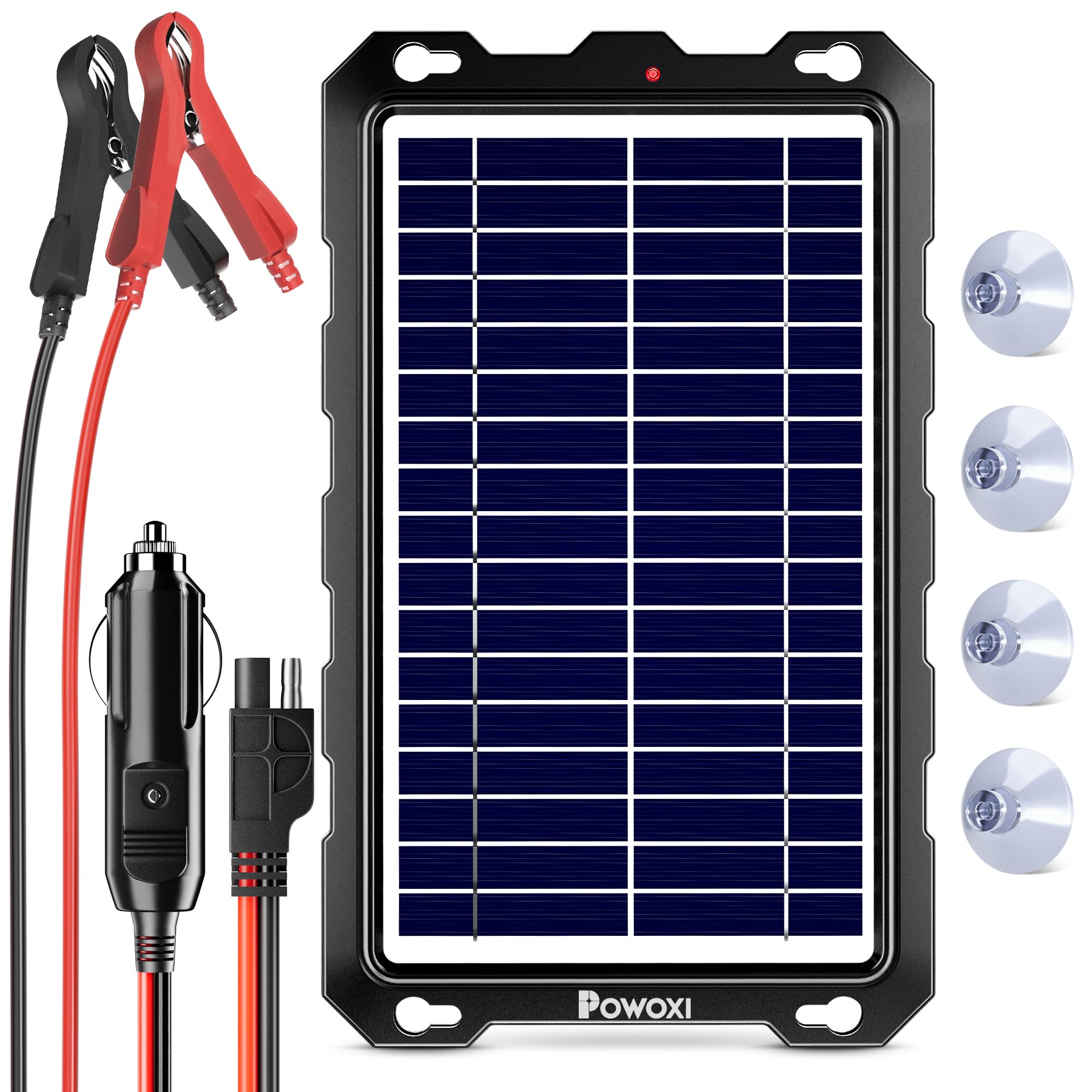
The POWOXI is the traditionalist's kit: a 7.5-watt panel in a rigid ABS and polycarbonate frame, faced with tempered glass. There is no flex here, and that is the point. The frame protects the panel from bending, the glass is impact-resistant, and the whole thing weighs 2.2 pounds, so it can sit on a shelf or mount to a wall without feeling fragile.

We like the dual connection setup: a cigarette-lighter plug for a quick dash connection and alligator clips for a direct battery hookup. The built-in controller is meant to prevent overcharging and reverse drain, and the charging indicator gives you a simple yes-or-no read on sunlight. For a car that sits in a driveway for weeks, that is enough.

The 7.5-watt output is a maintenance trickle, not a charger. It will not bring back a battery that is already weak, and the panel needs direct sun rather than a shaded garage. That is why it sits below the Callsun and the 20-watt kits here.

If you want a rigid glass panel for a semi-permanent mount and you already have a healthy battery, the POWOXI is a reasonable choice. If you need more output or a panel that can wrap a curved surface, the Voltset and FlexSolar are the better answers. We keep the POWOXI on the list for its simple, sturdy feel, not as the default.

Pros

  • Rigid ABS and tempered-glass construction
  • Cigarette-lighter and alligator-clip connections
  • Built-in overcharge protection

Cons

  • Long-term durability is uneven
Our verdict

We keep the POWOXI 7.5W on our list for a rigid, semi-permanent mount and a healthy battery that only needs a top-up.

Check Latest Price

How We Chose and Tested the Best Solar Battery Chargers

We started by pulling every solar maintainer we could find in the 7- to 100-watt range, then cut anything with vague controller specs, no waterproofing claim, or a connector setup that only worked for one type of vehicle. That left 14 kits, which we ran over nine months on a driveway, in a storage yard, and at a marina lot.

Each panel went onto something that genuinely sits: a sedan parked facing south for three weeks at a stretch, a boat on its trailer, an RV between trips, a motorcycle under a cover. We read battery voltage with a multimeter before install and again after seven and fourteen days, then checked whether the controller tapered down to float instead of cooking the battery. Install time was clocked solo, from opening the box to the panel sitting still, and we noted whether the cable actually reached from dash to battery without an extension. Price was weighed against measured output, not the wattage on the label.

Durability got the hose: ten minutes of water on every panel that claimed waterproofing, a month outdoors in the rain, then a close look at whether the clamps and ring terminals had corroded or the panel housing had clouded. We also killed the ignition on each vehicle to see which cigarette-lighter plugs went dead with it — a few did, which quietly turns the panel into a decoration. Once a week we checked that each battery was still holding its charge. What carried the most weight was whether the thing was still working after a month outside, because that's the only test that matters when the vehicle sits all season.

How to Choose a Solar Battery Charger

Match Panel Output to the Job

The 7.5-watt Callsun and POWOXI are maintainers: they offset a small parasitic drain on a healthy battery, but they will not revive a flat one. A 20-watt kit such as the Voltset is the better middle ground for a car, trailer, or modest RV battery, while the 100-watt SOLPERK is for a larger bank that needs real charging. Before you buy, decide whether you are maintaining or recharging. If the battery is already deeply discharged, use a plug-in charger first and let the solar panel take over after that.

Look at the Controller, Not Just the Watts

A panel's wattage tells you its best-case harvest; the controller decides how safely that power reaches the battery. MPPT controllers, like those on the Voltset, SUNER, and SOLPERK kits, chase the panel's best operating point and generally do better in less-than-ideal light. A three-stage bulk, absorption, and float routine is worth paying for on a battery you care about. Check for overcharge, reverse-polarity, and over-temperature protection. The SUNER's eight protections are the most elaborate set here; the cheaper kits cover the basics but ask you to be more careful about polarity.

Plan the Mount and the Cable Run

Measure from the panel's likely sun spot to the battery before you order. A windshield or dashboard is convenient, but glass, tint, and a steep angle cut output, and a hot dash can warp a housing. A flexible panel such as the FlexSolar is the right answer for a curved hatch or roof; a rigid panel is easier to aim and mount on a flat surface. Suction cups are the first thing to fail in heat, so use the bracket or a permanent fastener when the panel lives outside. Short leads are a common surprise on vehicle installs.

Check Weather Sealing and Battery Compatibility

An IP rating is not decoration on a panel that lives outdoors. The Voltset is IP67 and the Callsun is IP68; both are better bets for rain and spray than an unsealed budget panel. Battery compatibility matters just as much: confirm the controller supports your battery type, whether that is flooded lead-acid, AGM, gel, or LiFePO4. The Voltset and SUNER list the broadest compatibility in this set. If your battery is lithium, do not assume a generic maintainer will charge it correctly; check the listing and the controller's battery-type setting before you connect.

Frequently Asked Questions

Final Verdict

Our default is the Voltset 20W because it covers the widest range of 12V jobs with enough panel and a smart controller, without the bulk or cost of the 100W kit. It is the one we recommend first for a stored car, a trailer, or a modest RV battery.

If your battery bank needs real charging rather than maintenance, choose the SOLPERK 100W. If you want the most protective charge routine and your battery justifies it, the SUNER is the upgrade. The Callsun is the budget choice for a small battery that only needs a top-up.