Best Point and Shoot Film Cameras of 2026

A point-and-shoot film camera makes one simple promise: you point it, it makes the decisions, and a week later the lab shows you how those decisions turned out. The delay is part of the charm, but it's also why a cheap one is a gamble — you pay for every wrong exposure twice, on the film and again on the scans. What you want is a camera small enough to carry everywhere and consistent enough to trust.

My team and I spent four months carrying 14 of them: coat pockets on dog walks, totes on weekend trips, and the hands of friends who had never loaded a roll. The keepers weren't the fanciest — they were the ones that read the light correctly most of the time, didn't rattle apart in a bag, and made loading film feel routine. Budget for film and AAA batteries, by the way; they're almost never in the box, and the running cost of film and processing is what actually determines whether you keep shooting. The picks below are the ones I'd hand to a friend without a caveat.

Keeper Score summarizes customer ratings and review volume. Read it alongside the product details and trade-offs. How the score works.

1

Best Overall

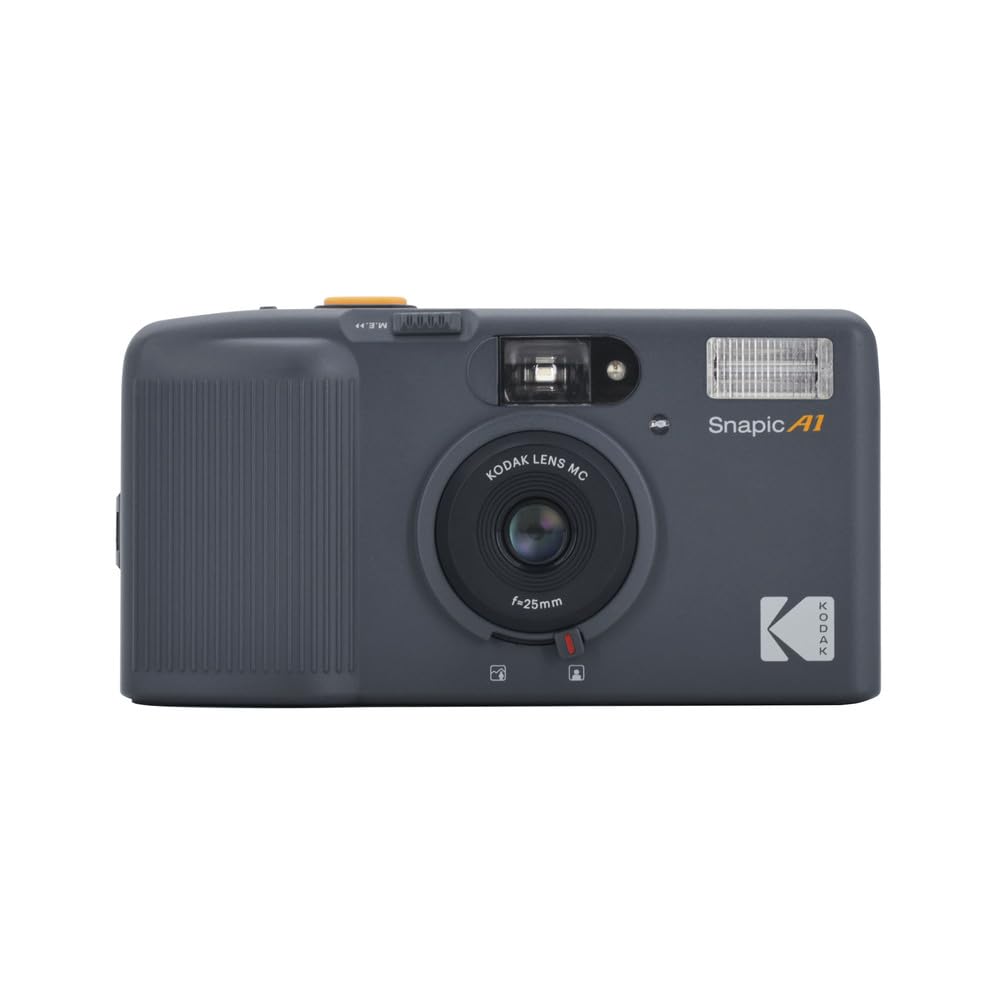
Kodak Snapic A1

88 /100
Keeper Score Excellent

Key details

Lens
3-element glass
Focus
2-zone
Weight
4.13 oz
Film Format
35mm full-frame
Check Price on Amazon

Most inexpensive film point-and-shoots are a plastic lens in a plastic shell, and the pictures come back looking like it. The Snapic A1 is the one we consider the safest first film camera here: a three-element glass lens, a two-zone focus switch, and an automatic flash with red-eye reduction, in a body 4.65 inches wide that weighs 117 grams.

The focus switch is the detail that earns its place. It gives you two positions — close, and everything from a few feet out to the horizon — so a portrait across a dinner table and a street scene two blocks long are both genuinely in focus instead of both hoping. The flash works the same way: it reads the light and fires with red-eye reduction when it's needed, so there's no switch to remember at a party. A multiple exposure mode layers two scenes onto a single frame, a more playful extra than we expected on a camera this simple.

Daylight is where it shines. The automatic exposure handles a bright street or a flat overcast afternoon without any input, so load a 400-speed film and shoot; that hands-off behavior is the whole reason to choose this over a used body of unknown history. The trade is control — no exposure dial, no way to override the meter when the light gets strange — and for snapshots we don't miss it. At 117 grams it disappears into a coat pocket, though the plastic shell doesn't feel like it wants to be dropped on pavement.

Pros

  • Three-element glass lens for sharper frames
  • Two focus zones instead of fixed focus
  • Automatic flash with red-eye reduction
  • Pocketable at 117 grams

Cons

  • Film and AAA battery sold separately
Our verdict

For anyone who wants sharp snapshots without learning exposure, the Snapic A1's glass lens, two focus zones, and auto flash do the work, and the one-year warranty beats gambling on a used camera.

Check Latest Price
2

Best for Film Savings

Kodak EKTAR H35

87 /100
Keeper Score Excellent

Key details

Focus
Focus-free
Weight
3.53 oz
Film Format
35mm half-frame
Frames Per Roll
About 72 from a 36-exposure roll
Check Price on Amazon

Half-frame is the entire idea: the H35 exposes two pictures in the space a standard 35mm camera uses for one, so a 36-exposure roll comes back with roughly 72 shots. For a beginner paying for film and processing roll after roll, that is the single most useful thing a first camera can do, and nothing else here does it.

At 100 grams it's the lighter of the two, small enough to live in a bag pocket, and the built-in flash turns on by rotating the silver ring around the lens — a mechanical touch we prefer to a menu. Focus is fixed, so you raise the camera and press the shutter: everything from a few feet out to the horizon comes back acceptably sharp, and there is nothing to set. It comes in black, brown, sage, and sand, all of them plain enough to carry without thinking about it.

Half-frame has a catch worth knowing before you commit. Each image uses half the film area, so enlargements show more grain and less fine detail than the same shot on full-frame 35mm, and the frames sit vertically on the film — your pictures come back in portrait orientation unless you turn the camera on its side while shooting. For phone scans and 4-by-6 prints neither matters, and the doubled frame count is why we keep coming back to this one for a trip where we expect to shoot a lot. For a landscape you intend to blow up, it does matter, and the Snapic A1 is the better tool that day.

Pros

  • Roughly doubles frames per roll
  • Lighter of the two picks at 100 g
  • Built-in flash for indoor and evening shots
  • Simple enough to hand to anyone

Cons

  • Fixed focus can't isolate a subject
  • Film and AAA battery sold separately
Our verdict

The H35 halves what you spend per picture by shooting two frames for every one a full-frame camera takes, and it does it in a body you'll actually carry.

Check Latest Price

What Four Months of Shooting Film Taught Us

We started by gathering every reusable 35mm compact we could reasonably recommend — pocketable plastic bodies, step-up models with a little more control, and the small handful of nicer cameras people genuinely carry — then filtered by what a buyer needs on day one: standard film, easy-to-find AAA batteries, a body that disappears into a coat pocket, and at least some say over exposure beyond point-and-hope. From that list we bought 14 cameras and shot them for four months, because a film camera can't really be judged until the frames come back.

Each one was loaded on a kitchen counter, then taken out into ordinary life: a wet Saturday walk with the dog, a friend's birthday indoors, a backlit train window, a weekend hike, a dinner table lit by a single lamp. We handed them to people who had never loaded a roll, sent every roll to the same lab so the scans were comparable, and laid the prints out side by side.

Most of what we judged came down to the frames. How often daylight shots came back properly exposed, and whether we could pull a bright window or a shadowed porch into range without redoing the shot. Whether roll two behaved like roll one, with evenly spaced frames and no light leaks. Whether the back door survived a slide off a car seat onto pavement and the battery door survived months in a bag. How many tries loading took, and whether the shutter and flash buttons fell under a thumb without looking. And the honest arithmetic of ownership: camera, batteries, film, and processing, added up over a few months of real shooting.

How to Choose a Point and Shoot Film Camera

Full-Frame or Half-Frame

A half-frame body like the EKTAR H35 fits two vertical images into the space one standard 35mm frame would use, so a 36-exposure roll comes back with roughly 72 pictures. You pay for that in negative area: each image is half the size, so scans show more grain and softer fine detail, and your shots arrive in portrait orientation unless you turn the camera sideways.

If your pictures live on a phone or in a 4-by-6 album, that trade is a good one and the savings are real. If you plan to print large or crop hard, buy full-frame and accept half as many shots per roll.

Focus-Free or Two-Zone

Focus-free sounds like a gift and is really a fixed lens set to render a broad band of distance acceptably sharp. It's excellent for daylight street and travel pictures and gives you nothing when you want one face crisp and the background soft. A two-zone camera such as the Snapic A1 adds a single decision — near or far — which is enough to keep a portrait sharp across a table.

For most beginners that one switch is worth having. If you only photograph streets and scenery, focus-free is simpler and costs less.

How the Flash Decides Your Indoor Photos

Point-and-shoots lean on flash far more than phones do, so check how it turns on. An automatic flash with red-eye reduction, as on the Snapic A1, reads the light and fires when it's needed — exactly what you want at a party. A manual ring or switch, as on the H35, hands you the decision, which is fine once you know the drill and less forgiving on a first roll indoors.

Either way, small on-camera flash falls off fast, so stay within a few paces of your subject.

What Ships in the Box and What You Keep Buying

Nearly every reusable 35mm camera arrives without film or batteries, and where a bundle includes a roll it's usually a 24-exposure one rather than a full 36. Budget for a pack of AAA batteries and a couple of rolls before your first outing.

Then treat developing and scanning as the recurring cost, because it usually outruns the film itself. Buying film in multipacks and dropping several rolls off together is how the per-picture price comes down.

Frequently Asked Questions

Final Verdict

The Snapic A1 is the camera we recommend to most people buying a first film point-and-shoot. The glass lens and two focus zones make ordinary daylight snapshots noticeably sharper than a fixed-focus plastic body manages, the automatic flash takes the guesswork out of indoor shots, and a new camera with a warranty beats gambling on a used one.

Choose the EKTAR H35 instead if the cost of film and processing is what would stop you shooting. Twice the frames from every roll is a genuine advantage, and grain you can live with beats pictures you never took.