Best Reusable Film Cameras of 2026

A reusable film camera is the cheapest way into analog photography, and the fastest way to waste money on it: no screen, no delete button, and every frame costs you again at the lab. What you get in exchange is a camera that runs on a couple of AAA batteries, slips into a jacket pocket, and forces you to actually look at something before you press the shutter. My team and I spent four months carrying 14 of them to farmers markets, birthday dinners, and one very windy beach, and the gap between a camera you'll keep and one that jams mid-roll shows up within a week.

Two things are worth knowing before you pick one. The body matters less than the film and the lab — most of these shoot at a single fixed exposure, so a cheap camera in good light will beat an expensive one indoors every time. Then do the cost-per-frame math: a roll plus developing, divided by the shots you actually get, tells you more about value than the sticker price does. The cameras below are the ones that held up on both counts.

Keeper Score summarizes customer ratings and review volume. Read it alongside the product details and trade-offs. How the score works.

1

Best Overall

Kodak Ektar H35

87 /100
Keeper Score Excellent

Key details

Flash
Built-in
Weight
3.53 oz
Film Format
35mm
Frames Per Roll
About 72 half-frame photos per 36-exposure roll
Check Price on Amazon

Doubling the useful life of a roll is the Kodak Ektar H35's best argument. It shoots half-frame 35mm, so a 36-exposure roll yields around 72 pictures. That changes ownership: you can experiment through a weekend without watching the counter drop as fast, and a disappointing batch costs you half as many frames. The negatives are smaller than standard 35mm, so you trade cropping room for that economy.

The rest of the camera keeps that loop simple. It is focus-free, with a built-in flash controlled by the ring around the lens, and automatic exposure—no meter to interpret, no settings to lose before a shot. At 100 g and about four inches wide, it disappears into a jacket pocket or a small bag. We like that combination for a first reloadable camera because it removes the two things that make film feel fussy: focusing and exposure settings.

The half-frame negative is the compromise. There is less room to crop a loose frame, and you will not get the same fine detail as a full 35mm negative; that is the cost of fitting twice as many pictures on a roll. The camera is at its most useful in daylight; indoors, the built-in flash is doing the work, and the plastic body is not the one to toss loose into a bag with keys.

The detail that changes ownership is the counter. With twice as many frames on the roll, you stop rationing shots, and that is how a beginner gets better. The five colorways are a nice change from the usual black, but the doubled frame count is the reason it stays in a bag.

Pros

  • Doubles frames per roll with half-frame format
  • Focus-free, beginner-friendly operation
  • Built-in flash for indoor and evening shots
  • Light 100 g body is easy to carry

Cons

  • Film and AAA battery are not included
  • No water resistance for wet-weather shooting
Our verdict

We make the Kodak Ektar H35 our top pick because it turns one roll into twice the frames and still fits in a jacket pocket.
Check Latest Price
2

Best Step-Up

Kodak Snapic A1

88 /100
Keeper Score Excellent

Key details

Lens
3-element glass
Flash
Built-in auto with red-eye reduction
Focus
2-zone
Weight
4.13 oz
Check Price on Amazon

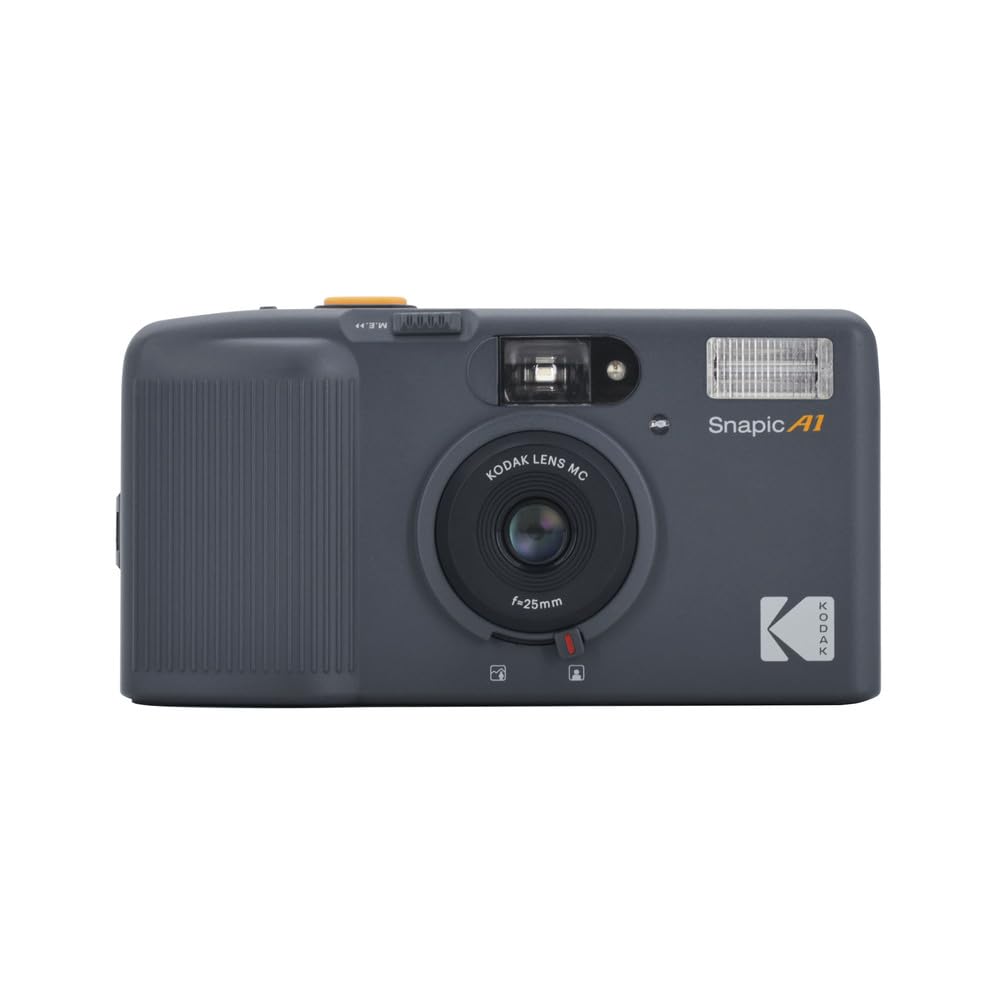
The Snapic A1 is what we point to when the H35's focus-free simplicity starts to feel limiting. Its three-element glass lens and two-zone focus give you a way to choose between a nearer subject and a wider scene instead of relying on depth of field to cover everything. That is the difference that matters for portraits, street shots, and any frame where you want the subject to carry the picture.

At 117 g and 4.65 x 2.44 x 1.38 inches, it is small enough for a coat pocket. The auto flash with red-eye reduction keeps it useful at a party, and the multiple-exposure mode is a genuine creative extra that lets you layer two scenes on one frame. We were also taken with how little the A1 asks of you between those decisions—load it, switch focus when you need to, and shoot.

The body is the compromise. It is light and pocketable, but the plastic shell feels like a compact rather than a camera to knock around, so a small case makes sense. That is the price of keeping the A1 pocketable; it does not undo the lens and focus advantages.

The two-zone switch is the detail that stays with us. It is a small mechanical decision that makes a film camera feel less disposable, and it is the reason the A1 is worth considering over a focus-free body rather than simply a prettier one.

Pros

  • Three-element glass lens
  • Two-zone focus adds near and far control
  • Auto flash with red-eye reduction
  • Multiple-exposure mode for layered frames

Cons

  • No manual exposure override
  • Film and AAA battery are sold separately
Our verdict

If you want more control than a focus-free camera gives, the Snapic A1 is the step-up we recommend, with a glass lens and two-zone focus.

Check Latest Price

How We Tested Reusable Film Cameras

We began with a shortlist of roughly 30 cameras sold as reusable — meaning they take standard 35mm film and can be reloaded, not single-use disposables — and filtered by what a first-time shooter genuinely needs: loading that doesn't fight back, a flash that fires, standard batteries, and a body small enough to carry every day. That left 14 cameras, which we shot over four months on the same film stock and sent to the same lab, so differences in the scans came from the camera and not the processing.

Each one rode in a jacket pocket or tote for at least a week of ordinary life — a farmers market, a birthday dinner indoors, a windy beach, a long drive — sitting next to keys and a water bottle so we could see how the plastic wore. We timed how long it took someone who had never loaded film before to get the leader onto the spool and fire a first frame, then kept a running count of skipped frames, stuck advance wheels, and light leaks along the door seams. Partway through each roll we checked whether the battery was still driving the flash or had started to lag.

For image quality, we shot into a bright sky, in open shade, and indoors near a window with every camera, then compared scans side by side to see where highlights blew out and whether faces came back muddy. We weighed each one empty and loaded and checked whether it disappeared into a jeans back pocket. Finally, we worked out a cost per frame for each — film plus developing divided by the number of shots — because a cheap camera that surrenders half a roll to a light leak isn't cheap at all.

How to Choose a Reusable Film Camera

Put film transport first

The most common way a reusable camera disappoints is not with soft corners; it is with a roll that will not advance, a counter that sticks, or a rewind that leaves film exposed. We rank a clear loading path, a positive wind lever, and a rewind you can feel above a fancy finish. Before trusting a new camera with a trip, run an inexpensive roll through it and watch the counter and the rewind knob. If either hesitates, return the camera before you load another roll.

Choose half-frame or full-frame

Half-frame is the big fork in this category. A half-frame camera puts two pictures in the space of one standard 35mm frame, so a 36-exposure roll gives you around 72 shots. That cuts the film cost per picture and makes experimentation feel cheaper. The trade-off is a smaller negative with less cropping room and less fine detail. Full-frame uses the whole 35mm gate and is the better choice if you plan to enlarge prints or crop tightly. For casual snapshots and learning, the Ektar H35's half-frame economy is hard to argue with; for portraits you intend to print, stay full-frame.

Match focus to your subjects

A fixed-focus lens is not a flaw. It uses deep depth of field to keep most daylight scenes acceptably sharp and removes a decision, which is why it suits a camera that gets handed around. Two-zone focus adds a near and far setting, so you can choose what matters in the frame instead of hoping depth of field covers it. Glass elements are worth paying for when you want more control over contrast and detail; plastic is fine for sunny snapshots. We prefer fixed focus for a bag camera and two-zone focus when portraits are part of the plan.

Be honest about flash and light

A fixed shutter and a small aperture make daylight the native habitat of these cameras. A built-in flash extends the useful day into evening and indoors, but it also decides the look: direct light, bright falloff, and a subject that has to be within range. Manual flash controls are simple and predictable; automatic flash with red-eye reduction is easier to hand to a friend. If you mostly shoot in sun, you can save weight and complexity. If you shoot at night, do not buy a camera without flash.

Budget for the whole roll

The camera is only the entry fee. Film, AAA batteries, processing, and scans are the recurring costs, and they add up faster than most first-time buyers expect. Half-frame helps on film because you get more frames per roll, but ask your lab how it prices half-frame scans before you commit. A bundle with a first roll can be a sensible way to start, provided the camera itself is one you want to keep. Buy a spare battery before a trip; a dead flash is easy to avoid.

Frequently Asked Questions

Final Verdict

For most first-time film shooters, the Kodak Ektar H35 is the one to buy. It makes a roll go twice as far, keeps the controls out of the way, and stays small enough to carry. The half-frame negative is the trade-off; for snapshots and social scans, it is a fair one.

The Snapic A1 is the better choice when you want a glass lens and two-zone focus, provided you accept a plastic body and automatic exposure. Control is the reason to spend more; otherwise, the H35 is the more sensible start.