Best Night Vision Goggles of 2026

Almost every night-vision goggle sold to civilians works the same way: a digital sensor, a lens, and a ring of infrared LEDs that light the dark like a flashlight nobody else can see. Infrared falls off fast, so a pair that looks sharp across a backyard goes gray at the edge of a field. What you're actually choosing between is an emitter, a screen, and a battery.

We've spent six months with a dozen of them — camping trips, the back deck at midnight, a lot of sidewalk walks — and the good ones share a bright emitter, a zoom that doesn't dissolve the moment you use it, and a battery that outlasts the walk. Weight matters more than the specs admit on hands-free models, and so does finding the buttons by feel in the dark.

Value is where the numbers get slippery: the price jumps tend to buy a bigger screen or a card in the box, not more usable range. None of these will match a military light-amplification tube, and for wildlife, camping, and identifying whatever is knocking over the trash cans, they don't have to. The ones below are what I'd hand a friend without a caveat.

Keeper Score summarizes customer ratings and review volume. Read it alongside the product details and trade-offs. How the score works.

1

Best Overall

GTHUNDER NV3180

85 /100
Keeper Score Excellent

Key details

Screen
4 in IPS HD
Battery
4,000mAh rechargeable
IR Range
984 ft
Remote Viewing
Up to 32 ft via app
Check Price on Amazon

The feature we ended up using most isn't the one printed largest on the box. Mount the NV3180 on a tripod, open the phone app, and you can watch from up to 32 feet away — which turns a handheld viewer into something you can leave pointed at a feeder, a den, or a bait pile while you sit somewhere warmer. That's why it's the one we recommend first: it's the rare budget-priced unit that gives you a second way to look through it.

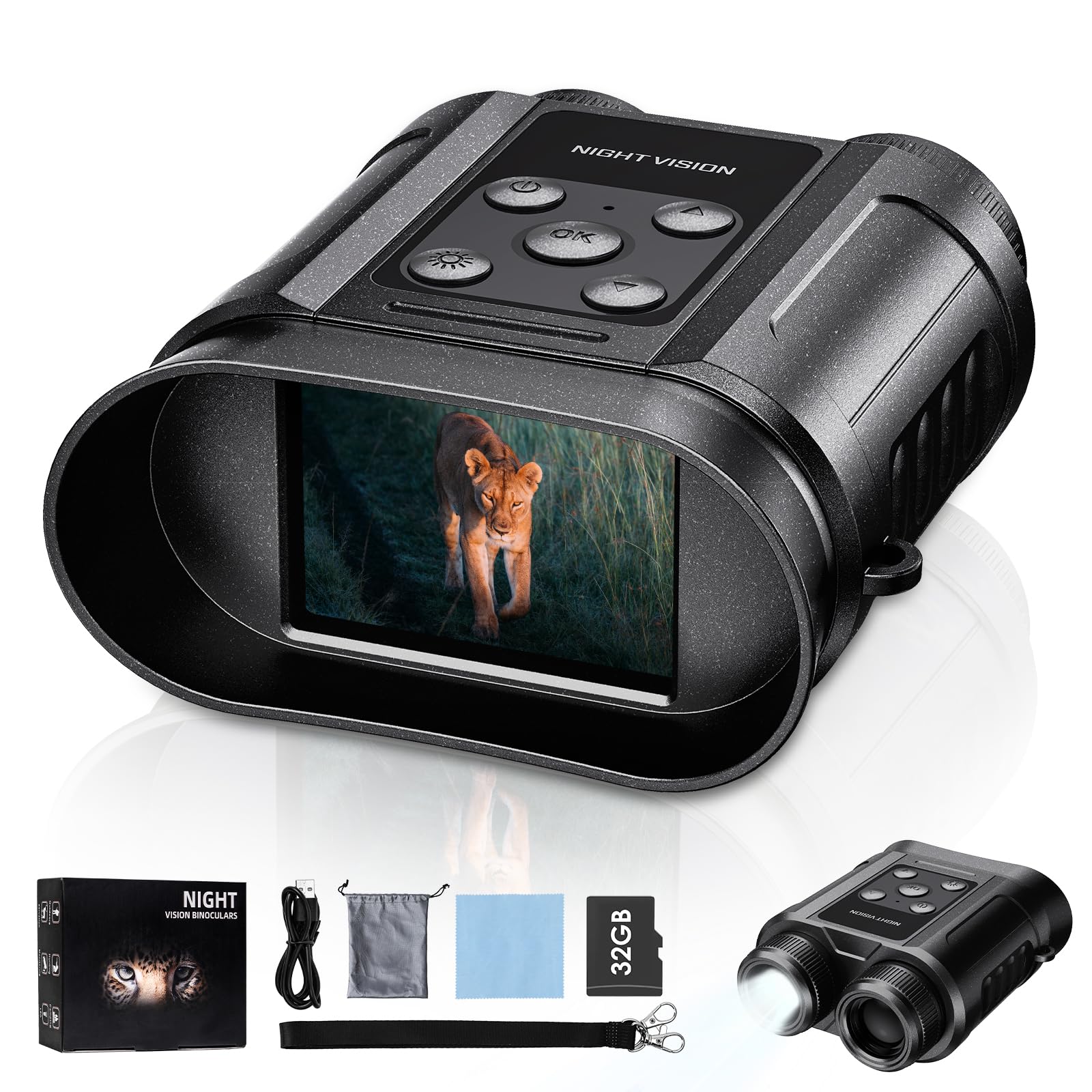
The screen is a 4-inch IPS panel, big enough that a second person can lean in without fighting you for the eyepiece. The 850nm illuminator adjusts across seven levels with a claimed 984-foot reach — read that as how far the beam carries, not how far you'll identify a raccoon in a hedge. The 4,000mAh cell charges over USB-C, and the 32GB card, neck strap, and card reader come in the box, so the only thing left to add is a tripod.

Focus is a wheel, and 12.7mm of eye relief leaves room for glasses, which matches how quickly we got a usable image the first time out. The zoom is the weak spot: it's digital, so pushing it enlarges the grain along with the target, and we treat it as a framing aid rather than a way to pull a deer out of a treeline. Ease of use is where this one quietly wins — there's almost nothing to configure before you can see.

Pros

  • App viewing up to 32 ft away
  • 4-inch IPS screen big enough to share
  • Seven IR levels, 984 ft claimed reach
  • Eye relief works with glasses

Cons

  • Screen glares even at its lowest brightness
Our verdict

The best all-rounder here for most people: a 4-inch screen two can watch, app viewing from 32 feet away, and the widest spread of useful features at budget money.

Check Latest Price
2

Best Image Quality

VABSCE NS400C

87 /100
Keeper Score Excellent

Key details

Video
Beyond 4K video
Battery
6,000mAh rechargeable
Included Card
64GB
IR Illuminator
Focusable 850nm
Check Price on Amazon

The NS400C is the most expensive handheld here, and it's the one case in this group where we think the extra money shows up in the image rather than in a longer feature list. The illuminator is focusable, which is the detail worth understanding: instead of a fixed cone of infrared, you tighten the beam to push light further down a field or open it up for close work in the yard.

That focus is the difference we care about. Most units here give you a brightness dial and nothing more, and being able to shape the beam is closer to having a zoom for the dark than to having a dimmer. The low-light imaging is the cleanest in this set, and the full-colour mode means you aren't always staring at a green screen. On a tripod at the edge of a field, this is the unit we keep pointed outward longest.

Two things to plan around. It isn't weather-sealed, so a dewy night wants a dry bag. And battery life is the variable: run the infrared at full power through a long session and the 6,000mAh cell can fall behind, so a power bank in the pack settles it. The 64GB card and the carrying case are both in the box, which takes a little of the sting out of the price.

Pros

  • Focusable IR beam reaches farther
  • Cleanest low-light image here
  • 64GB card and case included

Cons

  • No weather sealing for dew or rain
Our verdict

Spend more here if the picture is the point: the focusable illuminator and the cleanest low-light image in this group, on a unit built to sit on a tripod.

Check Latest Price
3

Best Battery Life

VISIOGEAR Night Thunder X3

80 /100
Keeper Score Excellent

Key details

Battery
5,000mAh, up to 18 hrs IR off / 10 hrs IR on
Warranty
3 years
Low-light Mode
AI Color Boost
Video And Photos
4K video, 40MP photos
Check Price on Amazon

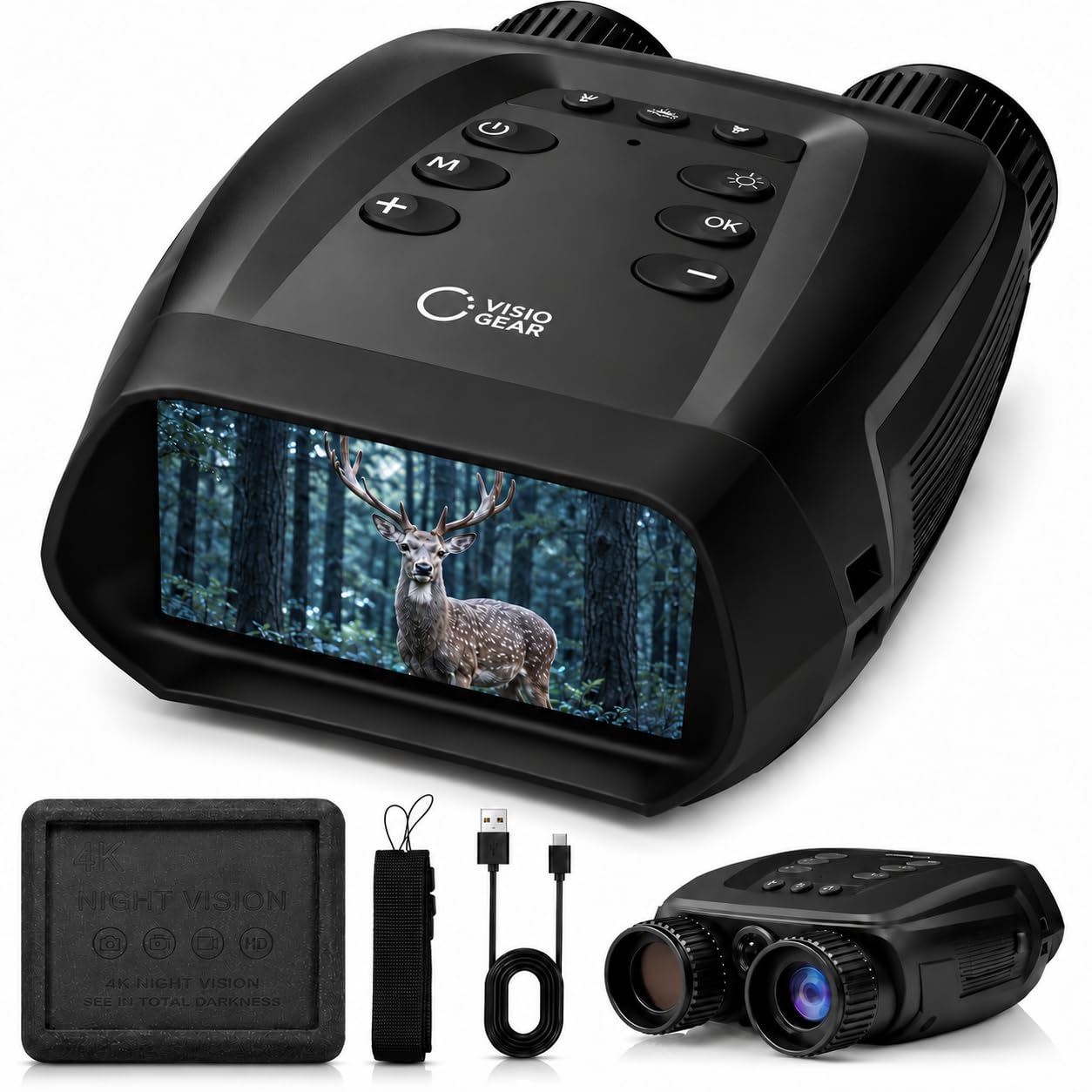
Eighteen hours with the infrared off, ten with it on. Those are stated figures rather than a rounded range, and they're the reason this one earns a place: it's the difference between a device that dies at midnight and one still running when the sky starts to grey. With the illuminator off, the 5,000mAh cell is doing very little work — which is exactly the point.

AI Color Boost is what makes that possible. It amplifies moonlight and starlight instead of throwing infrared, so you can watch a dark field without lighting it up, and the battery lasts because of it. Backlit buttons read as a small thing until you're setting up at dusk; we noticed them most on the walk out, when finding the controls without a headlamp in your teeth is worth more than it sounds. The built-in flashlight gets used more than the goggles on that same walk.

Where it gives ground is adjustment. Three IR levels against the seven most rivals offer is a coarse dial, and the 8x zoom is the same digital crop as everyone else's — it magnifies pixels, not detail. If you spend more time watching a fixed area than sweeping one, neither costs you much, and the 3-year warranty is the longest in this group.

Pros

  • Up to 18 hrs with the IR off
  • AI Color Boost works without IR
  • Backlit controls for dark setup

Cons

  • Only three IR brightness levels
  • No memory card in the box
Our verdict

The one for an all-night sit: up to 18 hours with the infrared off and 10 with it on, plus a colour mode that keeps the beam dark when there's moonlight.

Check Latest Price
4

Best Big Screen

XOOIOOY N338

88 /100
Keeper Score Excellent

Key details

Zoom
10x digital
Screen
4.5 in
Battery
5,000mAh
Included Card
16GB
Check Price on Amazon

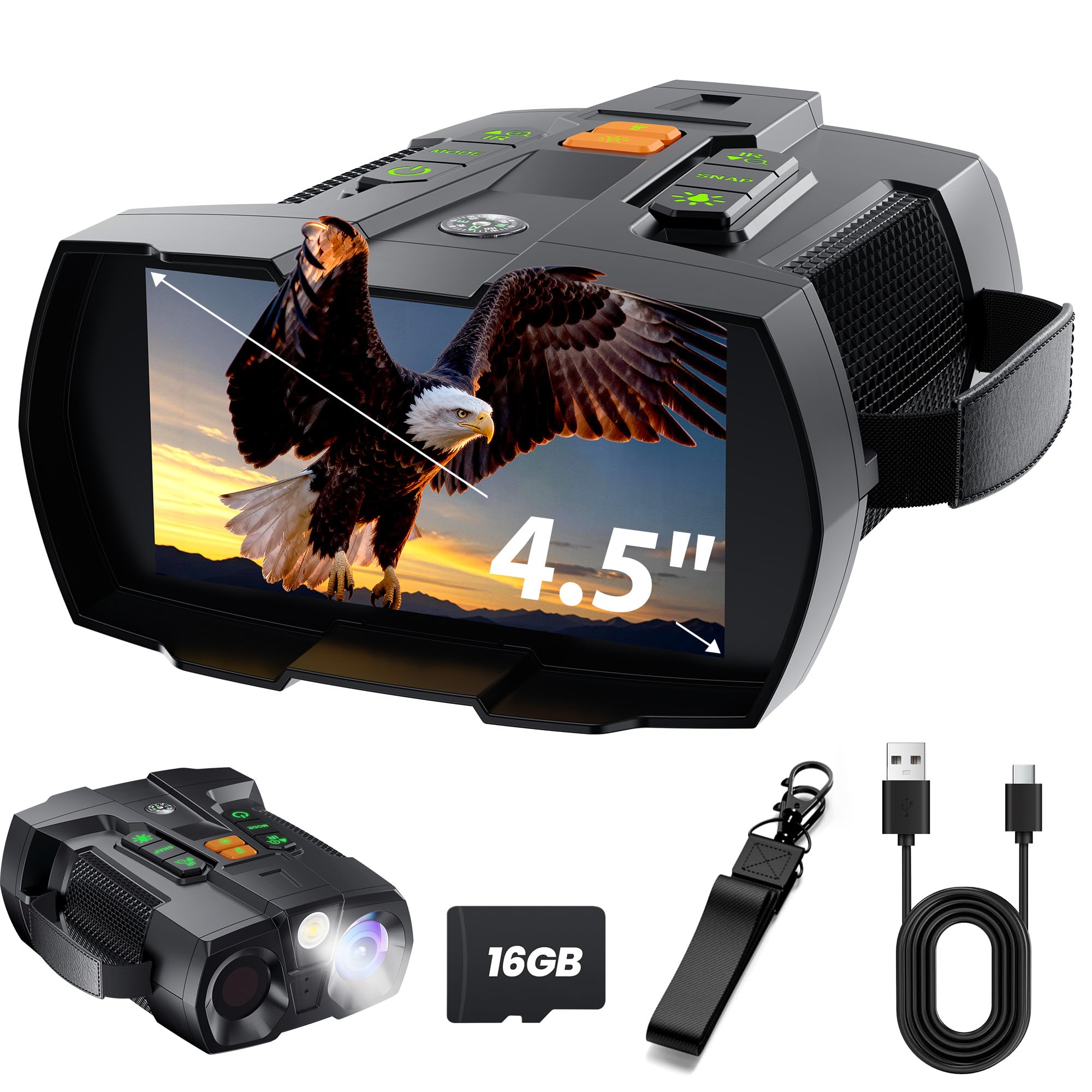
4.5 inches is the largest display in this group, and it changes who can use the thing. A screen that size means a kid, a grandparent, or a second person in a camping chair can all see the same owl without passing the unit back and forth every thirty seconds. If you're buying night vision for a household rather than for yourself, this is the one we point people to.

What earns its place beyond the screen is that the extras are night-specific rather than filler. The buttons glow in the dark, so you aren't hunting for the power switch with your phone light on — on a device whose whole job happens after dark, that's the kind of detail that suggests someone took a prototype outside. Add a compass, a three-mode LED light, and a 24-month warranty, and the package is more thought-through than most at this level.

The 10x zoom is digital, so the usual caveat applies: it crops rather than resolves, and the picture softens as you climb. For backyard watching — a feeder, a nest box, the far fence line — that isn't the limitation it would be in open country, because the point is watching something you've already found rather than finding it.

Pros

  • 4.5-inch screen, largest in this set
  • Glow-in-the-dark buttons
  • Compass and three-mode LED light

Cons

  • 16GB card is small for 4K video
Our verdict

Buy this if two people will be watching: the 4.5-inch display is the largest here, and the glow-in-the-dark controls mean nobody has to hold a phone torch.

Check Latest Price
5

Best Hands-Free

ArzzuNiu Head-Mounted

81 /100
Keeper Score Excellent

Key details

Mount
Headband and helmet bracket
Screen
2.7 in LCD
Battery
3,000mAh rechargeable
IR Range
1,312 ft
Check Price on Amazon

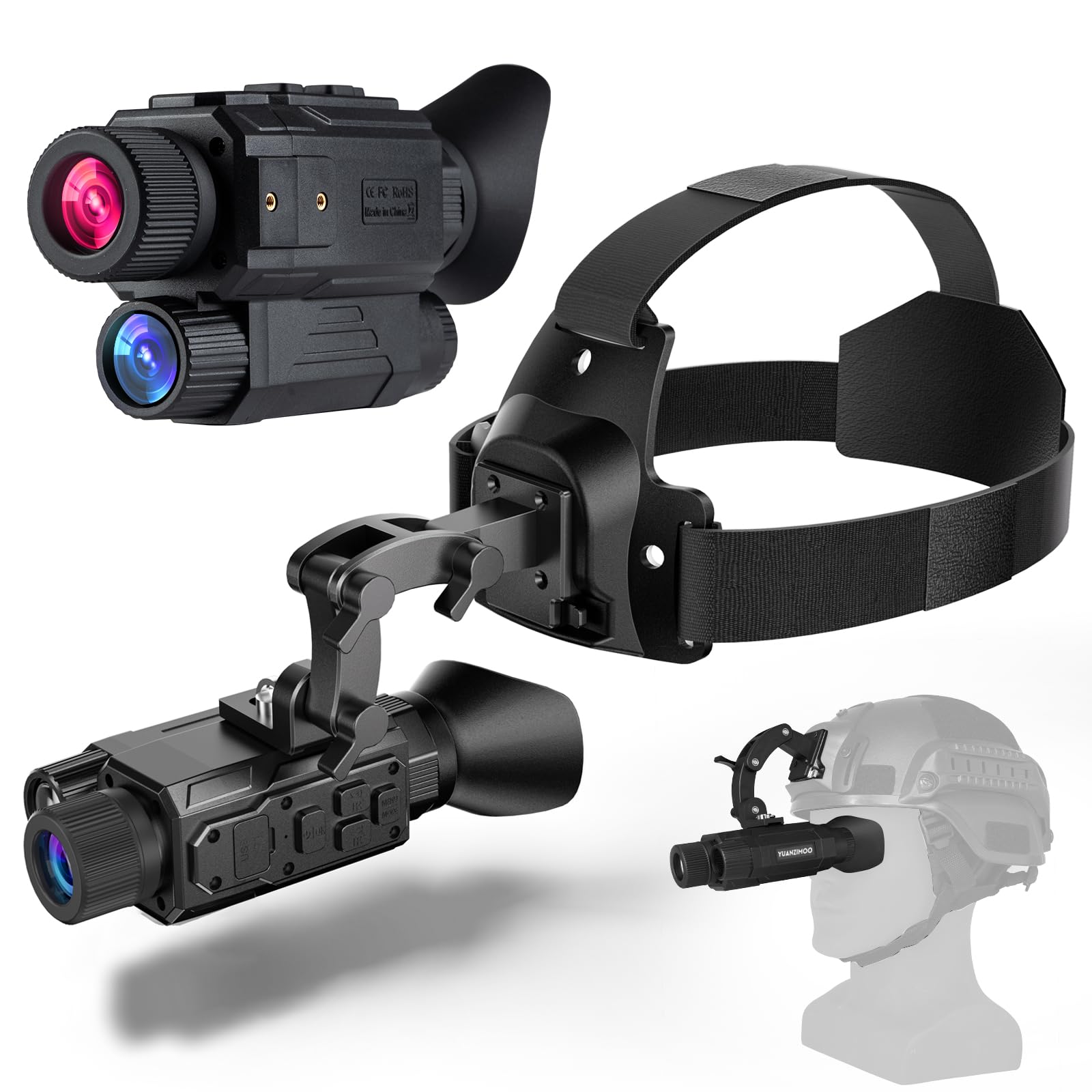
The case for wearing your night vision rather than holding it is simple: a thermal, a rifle, a dog lead, a gate latch, a flashlight. Mount this one on the included headband, or on a FAST or MICH helmet with the bracket in the box, and both hands stay free while you keep watching. That's the job none of the handhelds here can do, and it's the whole reason this one is on the list.

It's a digital unit, so your eye is on a 2.7-inch screen a couple of inches from your face rather than through true binocular optics — the compromise of every head-mounted design at this level. The stated 1,312-foot infrared reach is the longest in this group, and the picture holds up in complete dark well enough to record 4K video and 12MP stills to the 32GB card in the box. The 3,000mAh cell lasts an evening of intermittent use.

The catch is the field of view. On a head mount you're looking at a narrow window, which is fine while you're standing at a fence line and genuinely awkward if you walk — you lose the periphery that keeps you out of a ditch. We use it planted, at a window or a gate, and the narrow view stops mattering. Anywhere you need to move, the handhelds serve you better.

Pros

  • Headband and helmet bracket included
  • 1,312 ft stated IR reach
  • Records 4K video and 12MP stills

Cons

  • Headband pressure builds over long sessions
Our verdict

Buy this if your hands are busy: the headband and helmet bracket let you scan with both hands free, and the 3,000mAh cell covers an evening.

Check Latest Price
6

Best Compact

Tizycod N09

81 /100
Keeper Score Excellent

Key details

Screen
2.4 in
Weight
8.47 oz
Battery
2,500mAh rechargeable
IR Range
984 ft
Check Price on Amazon

Two hundred and forty grams, and roughly the size of a deck of cards. That's the argument for the N09: a night vision device you don't think twice about putting in a jacket pocket is one you'll actually have with you when something moves at the edge of the yard. The bigger units here tend to live in the truck.

The specification sheet is honest about the trade. A 2.4-inch screen, a 2,500mAh cell, and a 984-foot infrared figure put it in the middle of this group rather than at the front of it. What you get in exchange is 32GB of storage in the box, a seven-level IR illuminator with a separate flashlight, and controls simple enough that a child can run them without the manual.

For a teenager's first unit, a spare to keep in the glovebox, or a gift that won't get left at home, that balance is right. It's the least impressive one here on paper and quite possibly the one that gets used most, which is a trade we make happily. It's also the one to hand a kid without wincing.

Pros

  • 240 g and pocket-sized
  • 32GB card included
  • Seven IR levels plus flashlight

Cons

  • 2.4-inch screen is the smallest here
  • 2,500mAh battery limits long sessions
Our verdict

The one that actually travels: 240 grams and small enough to vanish in a jacket, with a card in the box and controls a kid can work out.

Check Latest Price
7

Long-Range Zoom

WISHBETY JA53

86 /100
Keeper Score Excellent

Key details

Zoom
16x digital
IR Range
1,000 ft
IR Levels
9 levels
Water Resistance
Water resistant
Check Price on Amazon

Sixteen times is the biggest zoom number in this group, and it's the reason to look twice at this one. It's also the reason to think before buying. The zoom is digital: it crops the sensor, so the field of view narrows to 6.5 degrees at the long end and the image softens as it climbs.

What we appreciate is that the adjustment around it is real rather than decorative. Nine IR levels is more control than most rivals give you, the 1,000-foot range sits at the top of the handheld group, and the body is rated water resistant — worth having when the grass is wet and the session runs long. A 5,000mAh cell, a 32GB card, and a two-year warranty round it out, in a body about 5.7 by 4.3 inches.

The 3.5-inch screen is a sensible size for the package, and the diopter adjustment runs to plus or minus five, which is enough to use it without glasses if you prefer. Weight is the tax: this is the heaviest handheld here, and you'll feel it on a long walk in.

So: 16x for a fixed vantage point, not for sweeping a hillside. Set it on a tripod aimed at a field edge or a known trail crossing and the narrow view stops being a problem and becomes the point. If you plan to walk and scan, buy for field of view instead and accept the smaller number on the box.

Pros

  • 16x digital zoom
  • Nine IR levels
  • Water-resistant body

Cons

  • Heaviest handheld here at 0.89 kg
Our verdict

Sixteen times zoom and a water-resistant body for mid-range money, but the magnification narrows the view, so it suits a fixed vantage point rather than a sweep.

Check Latest Price
8

One-Handed Looks

YUANZIMOO Monocular

81 /100
Keeper Score Excellent

Key details

Battery
2,200mAh rechargeable
Included Card
32GB
Magnification
2x optical, 8x digital
IR Illuminator
850nm, 7 levels
Check Price on Amazon

A monocular does one thing the binoculars here can't: it leaves a hand and an eye free. Raise it, take the look, put it down — you're not committing both eyes to a screen, and on a walk where the point is the walk as much as the wildlife, that's the difference between carrying it and leaving it in the car.

The hardware is sensible for the size. An 850nm illuminator with seven levels, a 24mm multi-coated lens, and a stated 984-foot reach put it in the same territory as the full-size units, while 2x optical magnification alongside 8x digital is a more honest arrangement than digital alone. The 2,200mAh cell is rechargeable, so no hunting for AA batteries at the trailhead, and a 32GB card is in the box.

Zoom is where it comes apart. At its longest setting the view closes to a keyhole and the picture goes soft, which is why we leave it near the bottom of its range and let the optical magnification do the work. Read the 8x as a crop you can fall back on, not as a lens.

Where that leaves it: this is the unit for a jacket pocket, a kayak hatch, or a quick check on whatever is knocking the bins over. For a planned evening watching a field, two eyes through the binoculars are less tiring than one over an hour.

Pros

  • One-handed, single-eye use
  • 2x optical plus 8x digital
  • 32GB card included

Cons

  • 2,200mAh is the smallest battery here
Our verdict

A one-eyed, one-handed alternative to the binoculars here: light, quick to raise, and happiest living in a jacket pocket.

Check Latest Price

How We Tested Night Vision Goggles in Real Darkness

We built the shortlist by pulling every consumer night-vision unit we could find that published an actual spec sheet — sensor resolution, IR illuminator type, battery capacity, display size, whether a card came in the box — and dropped anything that wouldn't say what kind of emitter it used. That left a dozen models, from hand-held binoculars to head-mounted hands-free goggles, and we've spent the last six months using them.

Most of that time was spent outdoors after dark: a backyard with the porch light off, a camping trip where the nearest streetlight was miles away, a suburban sidewalk under sodium lamps, and a garage with the door down. At each spot we set a marked post at 50, 100, and 200 feet and noted the distance where the image stopped being readable and started being grain.

We cycled every IR brightness level to see whether the middle settings did anything useful, ran the zoom to its limit to watch how quickly the picture fell apart, and recorded clips to a card so we could play them back on a laptop the next morning — the on-board screen always flatters itself. We timed each battery from full charge to shutdown with recording running, and we wore every head-mounted pair for 20-minute stretches to judge strap fatigue rather than just reading the weight off a scale.

Ease of use got its own test: we handed the goggles to a teenager and to a friend who'd never touched night vision and asked them to change the IR level without turning on a light. Then we compared notes across price tiers to see what the extra money actually bought — usually a larger display or a bundled card, occasionally a genuinely better sensor.

How to Choose Night Vision Goggles

Start With the Infrared Illuminator

Everything you see in true darkness is your own light coming back. That light is an 850nm infrared illuminator, and the number of levels it offers determines how much you can tune it: too much at close range washes a face out, too little at distance shows you eyeshine and nothing else. A focusable illuminator, like the one on the VABSCE NS400C, is the more useful feature of the two, because it concentrates the beam instead of just dimming it.

The quoted range — 984 feet, 1,000, 1,312 — describes how far that light carries, not how far you can identify something. Judge a unit on how adjustable the beam is and buy the reach you'll actually use.

Screen, Field of View, and the Zoom Trap

These are digital devices, so you're looking at a small screen rather than through glass, and screen size becomes a real buying decision. A 4- to 4.5-inch display lets a second person watch; a 2.4-inch one is a solo view. Field of view matters just as much and is the number sellers bury: a wide view makes scanning a treeline quick, while the narrowest units here close to 6.5 degrees.

Zoom is digital on nearly everything at this price. Sixteen times crops the sensor rather than resolving more detail, so a bigger number buys size, not information — the trap is choosing the unit with the largest multiplier and discovering you can't find anything to point it at.

Battery, Weight, and How You'll Hold It

Rechargeable cells run from 2,200mAh to 6,000mAh, but capacity isn't runtime: the illuminator is the drain, and the honest comparison is the manufacturer's hours with IR on versus off. VISIOGEAR quotes both, which is a good sign. Weight decides whether the thing travels — 240 grams goes in a jacket pocket, 890 grams needs a strap and a reason.

Holding matters more than most buyers expect. A handheld is for standing and watching; a head-mounted unit frees both hands but hands you a narrow window you shouldn't walk behind, so choose it for a fixed position rather than a hike.

Weather, and What You'll Actually Bring Home

Dew is the quiet killer of a night out. Water resistance is worth having if you'll be in a field past midnight, and it isn't universal in this group. Be realistic about recording, too: the headline video resolution usually runs a step behind what you see live, and a still pulled from a dark field is grainier than the screen suggests.

Judge a unit by its live view and treat photos and video as a way to show someone what you saw, not as evidence.

Frequently Asked Questions

Final Verdict

Start with the GTHUNDER NV3180. It gives a first-time buyer the most ways to use one device — a screen you can share, an app that lets you watch from across the yard, and enough infrared reach for a field edge — without a premium price. That combination is why it's the pick we point most people to.

If the picture itself is the point, the VABSCE NS400C has the cleaner low-light image and the focusable beam that reaches further. And if your hands are already full, the ArzzuNiu solves a problem none of the handhelds can.