Best Night Vision Monoculars of 2026

Night vision splits into two families, and the split matters more than any number on the box. Digital monoculars amplify whatever faint ambient light is left and lean on an infrared illuminator when there's almost none; thermal units ignore light entirely and read body heat instead. That single difference decides whether you spot a coyote at the treeline or stare at a very dark field.

I've carried one or another on evening walks for years, and over the past six months my team and I used 12 monoculars, thermal and digital, on everything from backyard prowls to a week of camping. What separated them wasn't resolution — it was what the image looked like in near-total dark, how much ground you could sweep without panning twice, and whether the unit vanished into a jacket pocket or dragged at your neck.

Zoom is the most oversold feature here; digital zoom mostly magnifies grain, so I'd take a clean sensor and a wide field of view over a big magnification number. The price ladder isn't linear either — a jump in cost sometimes buys a very small jump in image quality. What follows is what held up.

Keeper Score summarizes customer ratings and review volume. Read it alongside the product details and trade-offs. How the score works.

1

Best Overall

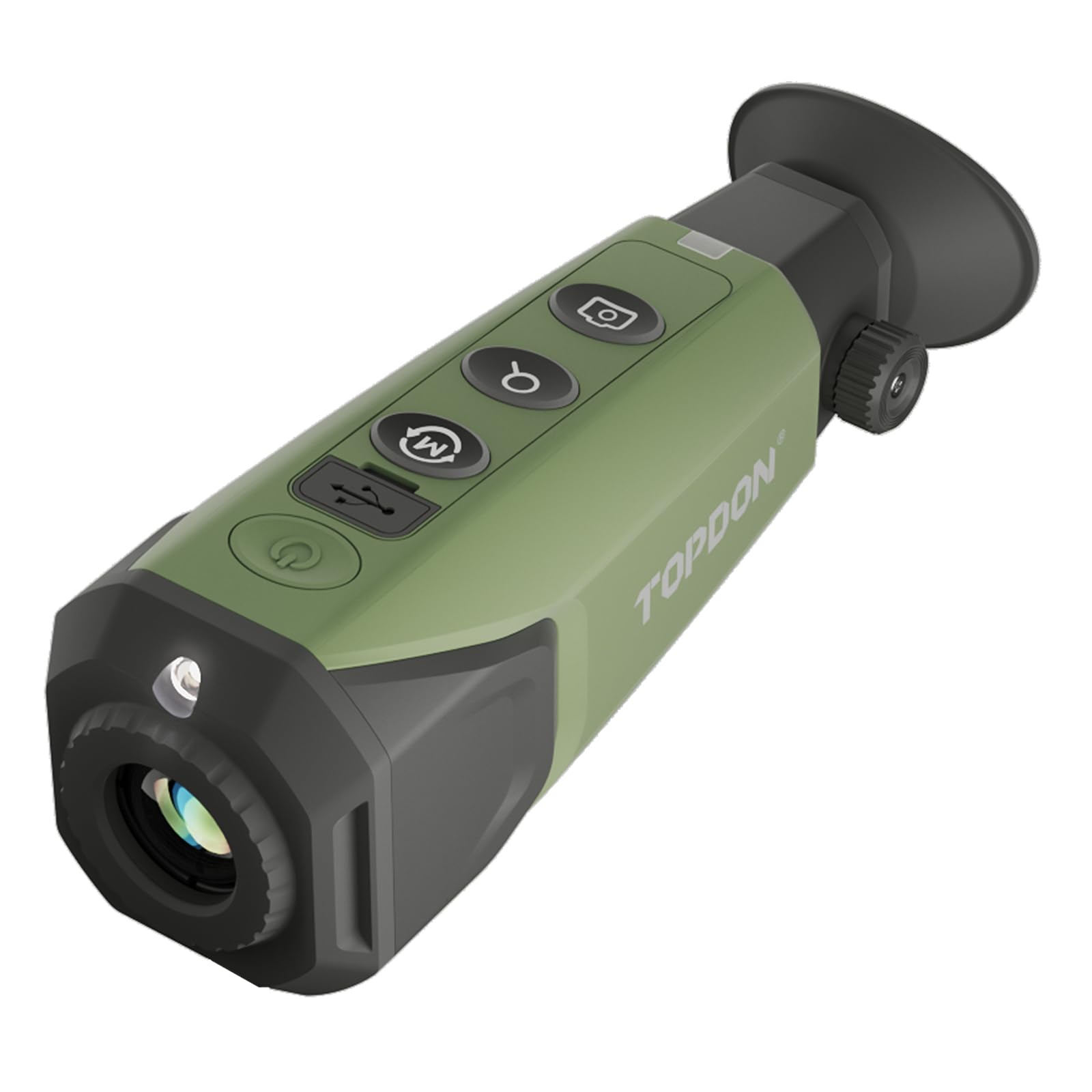
TOPDON TS004 Thermal Monocular

88 /100
Keeper Score Excellent

Key details

Battery
Up to 11 hours
Imaging Type
Thermal
Field Of View
13.5 degrees
Thermal Resolution
256 x 192
Check Price on Amazon

The TS004 pairs a 256x192 thermal sensor with a 13mm lens and a 50Hz refresh rate. Its 5,000mAh battery is rated for up to 11 hours, and the body carries an IP67 rating for dust and water. The phone app mirrors the live view, and the five viewing modes cycle from a single button.

We made it the top pick because it balances the things a first thermal buyer needs: enough resolution to pick out a heat signature, a smooth 50Hz view, and a battery that lasts a full night. The 13.5-degree field of view is narrow enough to reach across a field but wide enough to sweep without constant re-aiming. The app is genuinely useful when you want a second person to see what you're looking at.

Fine detail is the trade-off. A 256x192 sensor gives you a clear hot spot, not a close-up, and the 8x digital zoom adds convenience rather than real information. We treat the TS004 as a detection and tracking tool, and we reach for the RIX K3 when we need to identify something at distance. For finding game, livestock, or a lost dog in total darkness, it is the most sensible all-around thermal here.

Pros

  • Up to 11 hours of battery
  • IP67 dust and water sealing
  • Smooth 50Hz thermal refresh
  • Phone app mirrors the view

Cons

No notable drawbacks to flag.

Our verdict

We recommend the TS004 first for total-darkness scanning: its 50Hz thermal view, all-night battery, and IP67 body make it the most sensible all-around thermal here.

Check Latest Price
2

Best for Thermal Detail

RIX Pocket K3 Thermal Monocular

84 /100
Keeper Score Excellent

Key details

Lens
15mm
Weight
0.47 lb
Field Of View
17.5 degrees
Thermal Resolution
384 x 288
Check Price on Amazon

The Pocket K3's 384x288 sensor is the highest thermal resolution in this group, and it is the one we pick when detail matters more than price. The 15mm lens and 2x base magnification put more pixels on a distant heat source than the 256x192 thermals here, and the 50Hz refresh keeps the image smooth while panning. At 0.47 pounds, it is light enough to hang from a lanyard or slip into a chest pocket.

The 800x600 OLED display and electronic image stabilization are the details that make it pleasant to use. EIS won't turn a shaky hand into a tripod, but it takes the edge off one-handed scanning. The RET processing adds contrast without making the image look artificial. We also like the 5-year warranty, which is longer than most here.

What you give up is a little versatility. The 17.5-degree field of view is fine for glassing open ground, not for walking a trail with the unit to your eye. The 2x base magnification is modest for very long shots, and digital zoom still softens the view. If you need a wide, hands-free digital view, the GNG2K is the better tool; if you need the clearest thermal image in this set, this is it.

Pros

  • 384x288 thermal sensor
  • Light 0.47-pound body
  • Electronic image stabilization
  • 5-year manufacturer warranty

Cons

  • Premium price for the resolution gain
Our verdict

The Pocket K3 is the thermal to buy when you need the clearest image in this group and can accept a premium price and a narrow field of view.

Check Latest Price
3

Best for Digital Low-Light

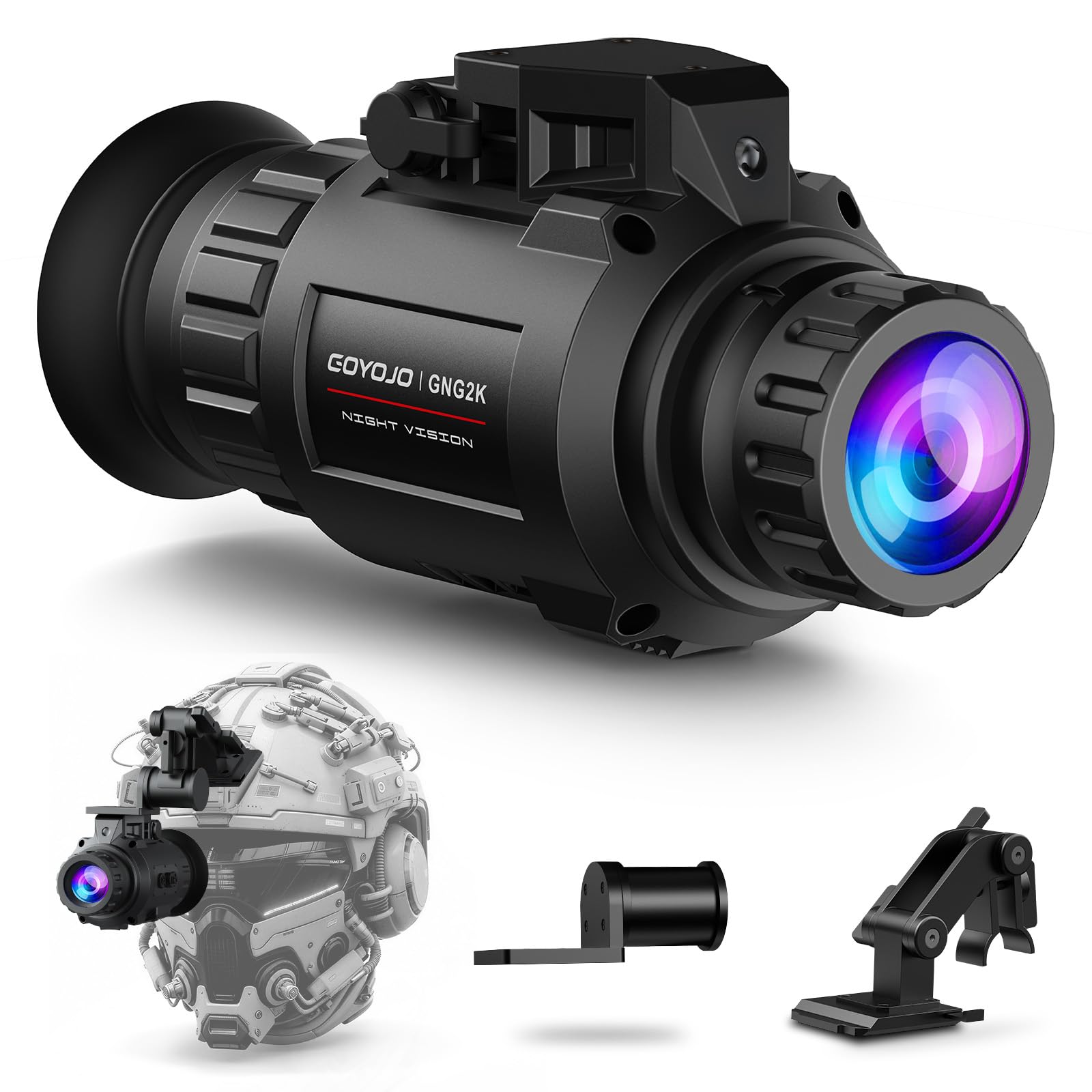
GOYOJO GNG2K Night Vision Monocular

81 /100
Keeper Score Excellent

Key details

Resolution
2K / 60Hz
Imaging Type
Digital infrared
Field Of View
45 degrees
IR Wavelength
940nm
Check Price on Amazon

A 45-degree field of view is the widest in this group, and it changes how the GNG2K feels: you can walk a trail or scan a treeline without constantly panning. The 2K sensor and 60Hz refresh give it a natural, almost daylight-like picture, especially with the IR illuminator off. The 940nm IR is the stealth detail we appreciate most for hunting, since it is less likely to spook game than a visible red beam.

We think this is the digital monocular to choose if your nights usually have some ambient light and you want a wide view. It works surprisingly well without IR, and the 1-4x digital zoom is enough for close-to-mid-range identification. The helmet mount and 13.6-ounce body make it a practical hands-free option, though it is heavier than the pocket thermals.

The catch is that it is still digital. In true pitch black you need the IR illuminator, and the 300-meter IR range is a detection figure, not a promise of clear identification. We reach for a thermal when the field is completely dark; we reach for the GNG2K when we want to see the whole scene. That makes it the most versatile digital pick here, as long as you don't expect thermal-style heat detection.

Pros

  • Widest 45-degree field of view here
  • Stealth 940nm IR illuminator
  • 2K sensor with 60Hz refresh
  • Helmet mount included

Cons

  • Digital zoom softens the image
Our verdict

Choose the GNG2K if you want a wide, natural digital view for walking and scanning; it is the most versatile digital optic here.

Check Latest Price
4

Best for Pocket Carry

RIX Pocket K2 Thermal Monocular

85 /100
Keeper Score Excellent

Key details

Lens
9mm
Weight
7.05 oz
Field Of View
19.4 degrees
Thermal Resolution
256 x 192
Check Price on Amazon

The Pocket K2 is the one that disappears into a jacket pocket, and that portability is why we keep it in the rotation. At 200 grams and roughly the footprint of a rangefinder, it is easy to carry on a hike or stash in a glovebox. The 256x192 sensor and 50Hz refresh give it the same smooth thermal view as the larger TS004, just through a smaller 9mm lens.

The integrated lens cover is a small thing we ended up using constantly: one finger slides it open, so there is no cap to lose in the dark. The 19.4-degree field of view is wider than the TS004's, which makes close-to-mid scanning easier. We also like the 5-year warranty and the 800x600 OLED display, both of which make it feel more finished than a budget thermal.

The K2 is happiest on close cover, backyards, and treelines you can walk to. It is not the unit for glassing a field from a truck, and the 7x digital zoom loses resolution quickly. If you need to pick a heat signature out of a distant treeline, the 15mm G215 or the 384x288 K3 is the better tool. For everything you can carry in a small pocket, the K2 is the easiest thermal here to live with.

Pros

  • Pocketable 200-gram body
  • Integrated slide lens cover
  • 50Hz thermal refresh
  • 5-year manufacturer warranty

Cons

  • Short 9mm lens limits long-range detail
Our verdict

The Pocket K2 is the easiest thermal to carry every day; pick it for close-to-mid scanning, not for long-range identification.

Check Latest Price
5

Best for Long-Range Value

GOYOJO G215 Thermal Monocular

84 /100
Keeper Score Excellent

Key details

Lens
15mm
Battery
6+ hours
Detection Range
1,417 m
Thermal Resolution
256 x 192
Check Price on Amazon

The G215's 15mm lens and 1,417-meter human detection claim point at the job it does best: scanning open ground for heat. The 256x192 sensor and 50Hz refresh are familiar thermal specs, but the longer lens puts more pixels on a distant target than the 10mm or 13mm units here. The 6 color palettes and 4x zoom are easy to cycle with one hand.

We appreciate the replaceable battery more than the app: on a cold night, swapping a cell is faster than waiting on a charger. The 16GB of internal storage and Wi-Fi are useful if you want to share a clip, and the focus knob turns smoothly enough to dial in a treeline without hunting. The 6-hour-plus runtime is enough for a long sit, though not for a whole weekend without spares.

We think this is the thermal value pick for open-ground scanning. It has the reach of the premium 15mm units without the RIX K3's price, and it runs on cells you can carry. The 256x192 sensor shows a hot shape at distance, not a detailed animal. If you need the clearest image, spend for the K3; if you need reach on a budget, this is the one.

Pros

  • 15mm lens for open-ground reach
  • 50Hz thermal refresh
  • Replaceable batteries
  • Wi-Fi and 16GB storage

Cons

  • IP65 sealing only
Our verdict

The G215 is the thermal value pick for open-ground scanning: a 15mm lens, replaceable cells, and enough reach for long fields.

Check Latest Price
6

Best for Ultra-Compact Carry

Carson MiniAura Night Vision Monocular

83 /100
Keeper Score Excellent

Key details

Weight
3.4 oz
Battery Type
3 AAA
Imaging Type
Digital infrared
Field Of View
19 degrees
Check Price on Amazon

At 3.4 ounces, the MiniAura is the one you forget is in a pocket until you need it. It is a completely digital monocular with a black-and-white image, a 19-degree field of view, and 2x magnification. The built-in 850nm illuminator has adjustable intensity, and the whole thing runs on three AAA batteries.

We like it for close-range checks around camp, a dark attic, or a night hike where you want a pocketable spotter and nothing more. The single-button IR adjustment is simple enough to work by feel, and the soft pouch keeps it from rattling around. It feels like a tool rather than a toy, which is not something we can say for every budget digital unit here.

The 19-degree field of view is narrow, and the image gets bright and washed out when the IR is turned up close. Scanning a wide area takes patience because you see a small slice at a time. We think of it as a budget pocket spotter, not a hunting optic. If you need a wide, hands-free view or a thermal image, move up to the GNG2K or one of the thermals; if you want a tiny backup that runs on easy-to-find batteries, this is it.

Pros

  • Ultra-compact 3.4-ounce body
  • Adjustable 850nm IR illuminator
  • Simple one-button operation
  • Soft storage pouch included

Cons

  • Uses three AAA batteries, not included
Our verdict

The MiniAura is the pocket backup to buy when you want simple night vision that runs on AAA batteries and disappears in a bag.

Check Latest Price
7

Best for Long Nights

MiLESEEY TNV10 Pro Thermal Monocular

81 /100
Keeper Score Excellent

Key details

Battery
12 hours
Refresh Rate
50Hz
Built-in Memory
32GB
Thermal Resolution
320 x 240
Check Price on Amazon

The TNV10 Pro's 12-hour rated battery is the longest in this group, and that is the reason it earns a place. The 4,500mAh pack is paired with a 30/60-minute auto-off, so it can sit between scans without draining. For a night in a blind or a truck, that runtime is the difference between a full session and a short one.

The 320x240 thermal sensor and 13mm lens sit between the 256x192 thermals and the RIX K3's 384x288 on detail. The 50Hz refresh keeps panning smooth, and the five palettes cover the usual white-hot, black-hot, and color views. The 32GB of built-in memory records MP4 video at 400x300, which is fine for documenting a scan but not for a polished clip.

Hot-spot tracking is the feature we didn't expect to use as much as we did: it puts a marker on the warmest point in the frame, which makes it easier to keep a target in view while moving. The 400x300 video resolution is modest, and the 1.41-pound body is heavier than the pocket units. Neither matters much if the unit mostly lives on a tripod or a truck seat.

We think this is the thermal for long, stationary nights. It has the battery to outlast the other picks and enough resolution to spot heat at a reasonable distance, but it is not the sharpest image here. If your priority is runtime, this is the one; if you need the clearest detail, the RIX K3 is the better spend.

Pros

  • 12-hour rated runtime
  • 320x240 thermal sensor
  • 32GB built-in video storage
  • Hot-spot tracking

Cons

  • IP65 sealing limits wet-weather use
Our verdict

Pick the TNV10 Pro if runtime is your priority: it runs for up to 12 hours and records to built-in storage, with a 320x240 thermal sensor.

Check Latest Price
8

Hands-Free Budget

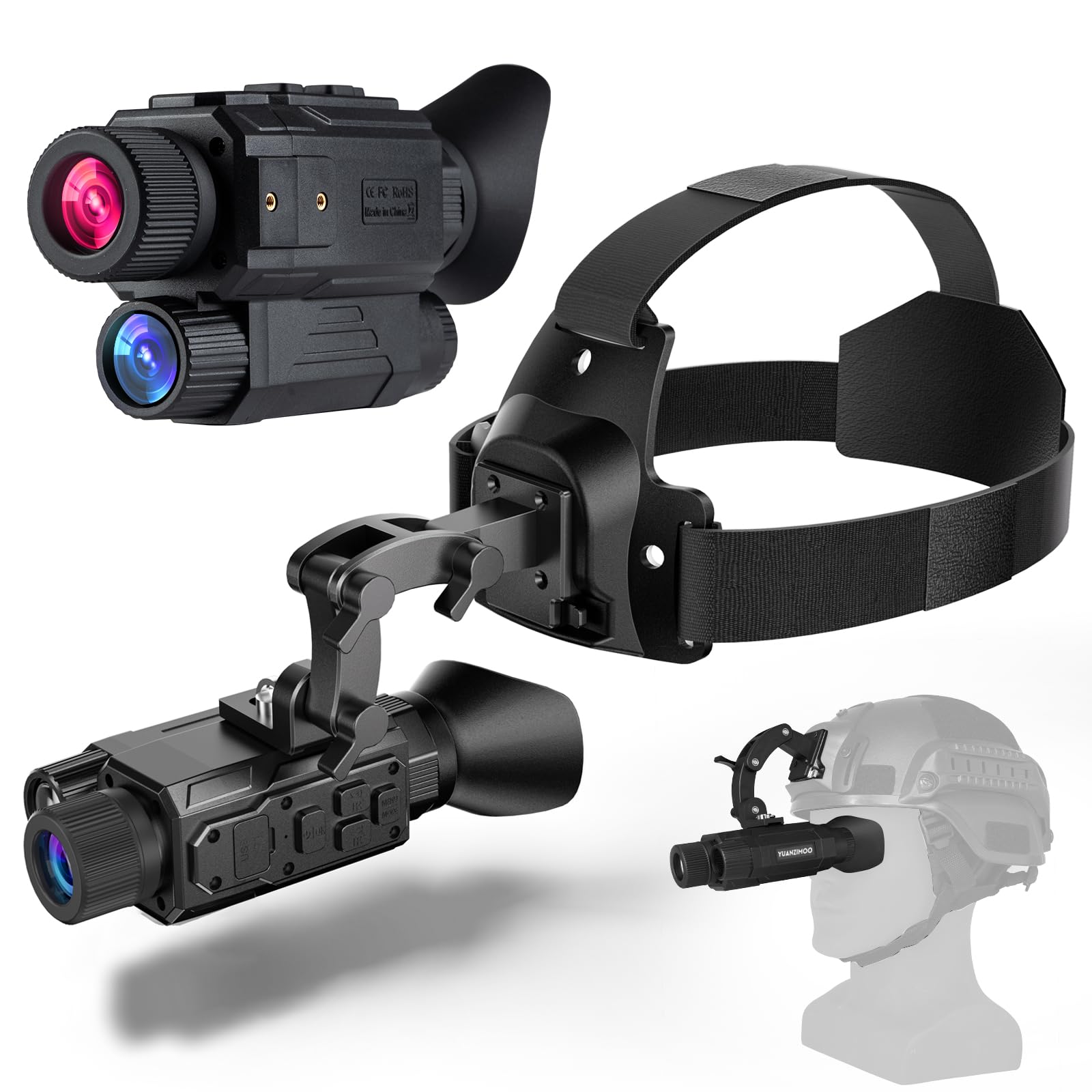
YUANZIMOO Head-Mounted Night Vision Monocular

81 /100
Keeper Score Excellent

Key details

Battery
2,200mAh rechargeable
Magnification
8x digital / 2x optical
Viewing Range
984 ft
IR Illuminator
850nm, 7 levels
Check Price on Amazon

The LG66 comes with an elastic head strap, and that is the feature that makes it useful: you can keep both hands free while walking a fence line or setting up camp. It can also be used handheld, but the head-mounted mode is the reason to pick it over the other budget digitals here. The 2,200mAh rechargeable battery and 32GB card are included, so it works out of the box.

The 850nm IR illuminator has seven brightness levels, and the 984-foot viewing range is enough for close-to-mid-range observation. The image is clearest at the lower zoom settings; the 8x digital zoom is a convenience, not a detail tool. The 2x optical magnification gives you a reasonable starting view, and the photo and video modes are simple to operate with the top buttons.

Recording is the bonus: the included 32GB card holds photos and video, and the playback mode is straightforward. The head strap is the main compromise: it is not as stable as a helmet mount. For a budget hands-free device, that is a fair trade.

We think this is the one to get if you want hands-free night vision for camp or a property walk without moving up to a thermal. It is a close-range tool, and the digital zoom won't replace a longer lens. But for a budget digital, it gives you a head strap, a battery, and a memory card in one box.

Pros

  • Hands-free elastic head strap
  • 32GB memory card included
  • Seven-level IR adjustment
  • 2,200mAh rechargeable battery

Cons

  • 850nm IR is visible to game
Our verdict

The YUANZIMOO is the budget hands-free pick for camp and property walks, with a head strap, a 32GB card, and simple recording built in.

Check Latest Price

How We Tested Night Vision Monoculars

We started by pulling spec sheets for every monocular we could get our hands on and sorting them by sensor resolution, lens size, refresh rate, and format — thermal or digital infrared. That got filtered down to 12 units spanning the price range, including a couple of helmet-mountable models, since plenty of people want these hands-free.

Testing ran six months, mostly after dark: evening walks along a treeline, a 2 a.m. backyard scan to see what kept tipping the trash can, a camping trip with no moon, and a barn with the doors shut — the closest thing to a true zero-light scene we could arrange. We glassed the same targets each session and wrote down the distance at which each one stopped being identifiable, which gave us a fair read on image quality and real visibility rather than a spec-sheet guess. We also swept each unit across the same stretch of field to see how wide the view actually felt, then pushed the zoom to check whether it resolved detail or just magnified noise.

Every unit rode in a jacket pocket and on a neck strap, and we timed the trip from stowed to eye — the gap between a pocket-sized monocular and a brick is obvious by the third night. We panned each one across the treeline at a walking pace to see whether the claimed refresh rate held up or the image smeared, and paired every Wi-Fi-capable unit to a phone to judge whether the app earned its place. Cold mornings were the battery test: each unit spent a night outside near freezing and we checked what was left at dawn. Throughout, we kept a running note of what each one did well against what it cost, because strong thermal performance and a narrow field of view can both be true of the same monocular.

How to Choose a Night Vision Monocular

Thermal or Digital Infrared?

The first fork is thermal versus digital infrared. A thermal sensor sees heat and works in complete darkness, but it renders a heat map, not a visible-light scene. A digital monocular amplifies ambient light and adds IR when the night is truly black, giving a more natural image and often a wider view. Choose thermal to find a warm body in a dark field; choose digital to recognize shapes, read a trail, or walk with a wide view. The trap is treating a thermal's detection range as an identification range—at distance it is a hot dot, not a detailed animal.

Resolution and Display Matter More Than Zoom

Resolution and display matter more than the zoom number. A 256x192 sensor is the entry point; 320x240 and 384x288 put more pixels on the target, and a 50Hz refresh pans more smoothly than 25Hz. Digital zoom only crops the image, so an 8x setting on a 256x192 sensor gets soft quickly. Look for a clean base image, a lens that matches your range, and a display you can read without squinting. We prioritize native resolution over advertised magnification every time.

Match Field of View to How You Move

Match the field of view to how you move. Wide fields around 40 to 45 degrees suit walking, helmet use, and scanning close cover; narrow fields around 13 to 20 degrees put more pixels on distant targets but make you pan constantly. If you stand and glass a field, narrow is fine. If you walk a trail, a wide digital view like the GNG2K's 45 degrees is less fatiguing. The trap is buying a fixed high magnification for moving use—it magnifies hand shake and narrows the view.

Plan Power, Sealing, and Mounting

Plan power, sealing, and mounting before you buy. Runtime runs from a few hours to 12; replaceable 18650 cells are easier to swap on a long night than a built-in battery, while USB-C charging is convenient for short trips. IP65 handles rain and dust; IP67 adds brief submersion. Check the mount: a 1/4-inch-20 thread takes a tripod, a helmet shroud needs the right bracket, and a head strap is not the same as a helmet mount. We treat the battery and mount as part of the purchase, not accessories.

Budget for the Whole Kit

Budget for the whole kit, not just the optic. AAA batteries, spare 18650 cells, a lens cloth, and a mount add up. Check what comes in the box: some units include a head strap or helmet bracket, and some leave you to supply one. Our advice is to spend on the sensor and the mount first, then add the small stuff. A spare battery is worth more than a fancy case on a long night.

Frequently Asked Questions

Final Verdict

The TOPDON TS004 is the one we recommend first: it combines a 50Hz thermal view, up to 11 hours of battery, and IP67 sealing in a package that works all night. If you need to identify rather than detect, the RIX Pocket K3's 384x288 sensor is the upgrade worth making. And if your nights have some ambient light, the GOYOJO GNG2K's 45-degree digital view is the easier all-around optic.