Best Microphone Isolation Shields of 2026

A microphone doesn't know you're in a spare bedroom. It hears the bare wall behind you, the ceiling fan, the laptop hum, and turns all of it into a recording that sounds like, well, a spare bedroom. A good isolation shield won't soundproof a room, but it can soak up the reflections that make a close-mic'd voice sound thin, boxy, or echoey. I've recorded in closets, blanket forts, and one especially lively home office, and the difference a well-placed shield makes is not subtle.

Over the past six months, our team tested 12 microphone isolation shields, from folding panel-style reflectors to foam balls that fit over the mic. We listened for real sound-quality gains and noise reduction, checked whether built-in pop filters actually softened P and B blasts, and paid close attention to the unglamorous stuff: whether the clamp held, whether the hinges stayed where I put them, whether the shield still felt solid after weeks of folding and unfolding, and how much desk space it claimed. Value came down to the whole package, quieting the room without adding a wobble, a slip, or a folded-up shape that fought back. The picks below are the ones that made my recordings sound closer to a treated studio, without pretending to be one.

Keeper Score summarizes customer ratings and review volume. Read it alongside the product details and trade-offs. How the score works.

1

Best Overall

Aokeo AO-505 Isolation Shield

91 /100
Keeper Score Outstanding

Key details

Mount
3/8 and 5/8 in
Weight
2.87 lb
Coverage
23.2 x 11 x 2 in
Construction
Metal and foam
Check Price on Amazon

At 23.2 inches wide, the AO-505 puts more foam between a vocalist and the room than most shields here, and that is why it is our top pick. We mounted it on a boom and appreciated that the extra width reaches past the mic and shock mount instead of leaving the rear corners exposed. The 11-inch height is enough for seated vocals; a standing singer should check the top edge against their mouth position before committing.

The metal-backed foam has a solid, purposeful feel, and the standard 3/8-inch thread with a 5/8-inch adapter means it works with the stands and clips most home studios already own. We also like that it folds down without needing tools, which matters if the same desk has to become a guest room between sessions.

The mounting frame is the part we treat gently. With all the weight on one side, the metal can flex near the joint if you crank it down or carry it by the panel; we lift it by the mount and support the shield while tightening. That is a handling habit rather than a dealbreaker, but it is why we keep it in a case rather than tossing it loose into a gear bag.

No stand is included, so this pick assumes you already have one. If you do, the combination of coverage, standard threading, and fold-flat storage is hard to beat for a home vocal setup. If you do not, the Dmsky kit is the cleaner first purchase.

Pros

  • Wide 23.2-inch coverage
  • Standard 3/8 and 5/8 mounting
  • Folds flat for storage
  • Metal-backed foam feels substantial

Cons

  • No pop filter included
Our verdict

This is the shield we recommend first for a stand you already own: broad coverage, standard threads, and a simple fold-down design.

Check Latest Price
2

Best All-In-One Kit

Dmsky Isolation Shield Kit

90 /100
Keeper Score Outstanding

Key details

Panels
5
Included
Pop filter and tripod
Stand Height
78.7 in
Panel Adjustment
180°
Check Price on Amazon

The Dmsky kit is what we point to when someone is starting from nothing: five foam-lined panels, a pop filter, and a tripod that reaches 78.7 inches, all in one box. The panels adjust through 180 degrees, so you can open them into a wider arc for a vocalist or close the wings in around a tighter mic position.

Five panels buy more wrap than a three-panel shield, and we found the extra coverage useful when recording close to a wall. The pop filter is the other practical addition: it saves a separate order and puts the filter at the right distance in front of the capsule. The tripod is the piece that decides whether the kit feels convenient or fussy.

At full height with the shield mounted, the stand can feel top-heavy. We kept the legs spread wide and the mast lower for seated work, which settled it; if you need the shield at eye level while standing, this is a kit to set up carefully rather than move around often.

For a first podcasting or vocal setup, the completeness is the appeal. If you already own a solid stand, put the money into the Aokeo and add a pop filter later; if not, this kit removes the guesswork.

Pros

  • Five panels wrap around the mic
  • Pop filter and tripod included
  • Tall 78.7-inch stand
  • Panels adjust through 180 degrees

Cons

  • Bulkier to store than a shield alone
Our verdict

Buy this if you want a complete recording corner in one order: five panels, a pop filter, and a tall stand that work together.

Check Latest Price
3

Best Preassembled Shield

LyxPro VRI-30 Shield

89 /100
Keeper Score Excellent

Key details

Weight
3.75 lb
Assembly
Fully assembled
Coverage
19.3 x 12 x 3.5 in
Material
Aluminum and foam
Check Price on Amazon

The LyxPro VRI-30 arrived fully assembled, which made it the easiest shield here to get onto a stand. We unclipped it, threaded it on, and were recording in the time it usually takes to unfold and align a panel. That convenience is the reason it earns a place, even though the Aokeo covers more width.

The 19.3 x 12-inch panel is still generous for a single vocalist, and the aluminum frame feels stiffer than the price suggests. At 3.75 pounds it is light enough to hang from a boom without dragging the arm down, but substantial enough that it does not shimmy when you adjust the mic.

Coverage is the trade-off. The 19.3-inch width is comfortable for a cardioid condenser, but a wide shock mount or a two-handed performance setup can poke past the edges. That is the compromise for the preassembled frame, and it is a fair one for a podcaster who values a fast setup over the widest possible panel.

Pros

  • Ships fully assembled
  • 19.3 x 12-inch panel
  • Light 3.75-pound frame
  • Aluminum and foam construction

Cons

  • No pop filter included
Our verdict

This is the shield for someone who wants to skip assembly and get a solid, prebuilt panel onto a stand quickly.

Check Latest Price
4

Best Desktop Booth

TroyStudio Portable Vocal Booth

86 /100
Keeper Score Excellent

Key details

Use
Desk or stand
Exterior
12 x 12 x 16 in
Interior
8 x 10 x 12 in
Foam Thickness
2 in
Check Price on Amazon

The TroyStudio is less a shield than a small foam room for the microphone. Its inside measures 8 x 10 x 12 inches, and every inside surface is covered in 2-inch egg-crate foam, so the mic sees absorption above, below, and to the sides rather than just behind.

That enclosure is why it works so well for spoken word. We used it for voiceover-style recording and found the room fall-away more complete than with a flat panel, especially in a corner where reflections come from two directions. It also folds down for storage, which a metal shield of similar coverage does not.

We set ours up on a desk and left it there; the fold-down design is more about storage between projects than daily packing. The opening at the bottom is sized for a stand, but a thick boom or oversized shock mount can make the fit awkward, so check that clearance before you commit.

For a dedicated voiceover corner, the enclosure is worth the desk footprint. If you sing or play an instrument and move while recording, a flat panel will feel less confining and cover a wider arc.

Pros

  • Foam on every inside surface
  • Surrounds the mic on five sides
  • Folds for storage
  • Works on a desk or stand

Cons

  • Foam frame can shift when handled
  • Takes more desk space than a panel
Our verdict

This is the one for voiceover at a desk: it surrounds the mic with foam and folds into a smaller box when you are done.

Check Latest Price
5

Best Isolation Ball

penypeal Isolation Ball

88 /100
Keeper Score Excellent

Key details

Fits
50-75 mm mics
Weight
4.23 oz
Coverage
5-sided seal
Front Filter
Double layer
Check Price on Amazon

A slip-on foam ball is the lowest-effort way to treat a microphone, and the penypeal gets the shape right. Its five-sided seal wraps the capsule on all but the front, where a double-layer filter handles plosives, so you get isolation and pop control without adding a second accessory.

We like the 50-75 mm fit range because it covers the larger end of common condensers, and the 120-gram weight is still light enough to leave on the mic between takes. The foam is dense without feeling brick-like, and it stays put on a mic that sits in the middle of that range.

We think this is the right ball for a mic that travels. It needs no clamp, it stays on the mic when you move the arm, and it adds very little bulk to a bag. Fit is the thing to check: on a body near the small end of the range, it can shift when you adjust the stand, and a mic with a non-removable cage may not seal at all. Measure the body before you order.

Pros

  • Five-sided seal around the capsule
  • Double-layer front filter
  • Fits 50-75 mm mics
  • Light 120-gram body

Cons

  • Less coverage than a panel shield
Our verdict

This is the isolation ball we reach for with a 50-75 mm condenser: five-sided foam, a double-layer front, and no extra clamp to fight.

Check Latest Price
6

Small-Mic Portability

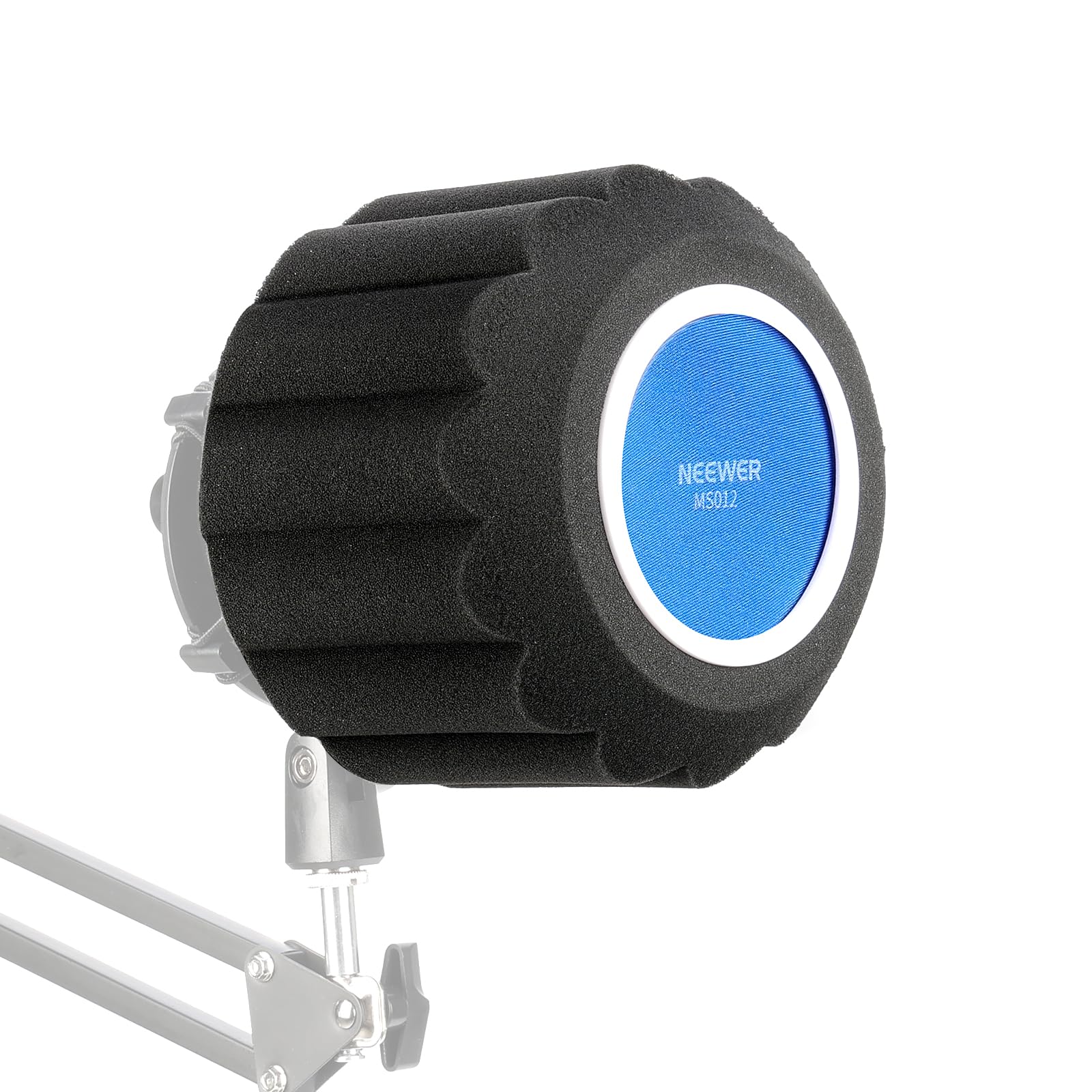
NEEWER MS012 Isolation Ball

89 /100
Keeper Score Excellent

Key details

Fits
43-68 mm mics
Foam
Five layers
Filter
Double layer
Weight
2 oz (58 g)
Check Price on Amazon

At 2 ounces, the NEEWER MS012 is the isolation ball that disappears into a bag. It is a slip-on foam cover rather than a panel, so there is no clamp, gooseneck, or stand hardware to add to your setup.

Five layers of acoustic foam and a double-layer front filter handle the work, and the 43-68 mm fit range suits compact condensers and many handheld mics. The foam is dense enough to keep its shape, but the ball is still flexible enough to slide over a mic without feeling like you are forcing it.

We think this is the right ball for a small mic and a light travel kit. It takes up almost no space, and because it sits on the mic itself, it moves with the mic when you adjust the arm. Check the diameter before ordering; the wrong size will not seal.

Pros

  • Weighs just 2 ounces
  • Five-layer acoustic foam
  • Double-layer front filter
  • Fits 43-68 mm mics

Cons

  • Less coverage than a panel
  • Fits only 43-68 mm mics
Our verdict

The ultralight pick for a compact 43-68 mm mic: it adds five-layer foam and a double filter without a clamp or a stand.

Check Latest Price
7

Budget Home Studio

Moukey MPFBK3 Shield

88 /100
Keeper Score Excellent

Key details

Mount
3/8 and 5/8 in
Panels
3
Weight
2.12 lb
Material
Metal and ABS
Check Price on Amazon

The Moukey MPFBK3 is a three-panel shield that folds into a compact shape and weighs 0.96 kilograms, so it is easy to move between a desk and a stand. The metal front frame and ABS back panel keep it from feeling disposable, even though it is one of the lighter full-size shields here.

It uses the same 3/8- and 5/8-inch mounting standard as the other panels, and the folding wings let you close it around a mic or open it into a wider arc. We found the hinge action simple enough to adjust one-handed while the mic was live.

The coverage is modest. It is a better fit for a single vocalist with a compact mic than for a wide acoustic guitar or a singer who moves around, and the ABS back panel does not feel as stiff as the steel on the Aokeo. That is the trade for the lower weight and the folding design.

For a second setup, a travel rig, or a first shield on a tight budget, we think the folding design earns its place. Just do not expect it to cover a large mic and shock mount the way a wider panel does.

Pros

  • Folds into three panels
  • Weighs 0.96 kg
  • Standard 3/8 and 5/8 mounts
  • Metal and ABS construction

Cons

  • No stand or pop filter included
Our verdict

A light, foldable three-panel shield for a single vocalist who needs to stash it between sessions.

Check Latest Price
8

Tight Desk Spaces

TONOR Isolation Shield

89 /100
Keeper Score Excellent

Key details

Panels
3
Weight
1.48 lb
Coverage
13 x 8.3 x 1.77 in
Foam Thickness
1.7 in
Check Price on Amazon

The TONOR shield is compact by design: 13 inches wide, 8.3 inches tall, and 1.7 inches of foam on the front. That makes it one of the easier shields to leave on a small desk without it dominating the space.

The three-panel design folds at the ends, and the steel frame has a simple, utilitarian feel. It can sit on a tabletop or mount to a stand, which gives it more flexibility than a fixed panel for a podcaster who records in different spots.

The size cuts both ways. A small condenser or dynamic mic fits comfortably behind it, but a large-diaphragm mic in a shock mount can extend past the edges, and the mount is fiddlier to adjust than the better panels here. We also found the foam is best at close range; it is not the shield for a room with heavy slap.

We think it is a sensible pick for a tight desk and a small mic, especially if you want to move between tabletop and stand use. Just measure your mic and shock mount first; if the combo is wide, go up to the Aokeo or LyxPro.

Pros

  • 1.7-inch high-density foam
  • Light 670-gram frame
  • Folds at the ends
  • Desk or stand use

Cons

  • No pop filter included
Our verdict

A compact, light shield for a small mic and a tight desk, with the flexibility to sit on a table or a stand.

Check Latest Price

How We Tested the Best Microphone Isolation Shields

We began with the isolation shields that come up most often in recording forums and retailer best-seller lists, then narrowed the field by mounting style, panel material, folded footprint, and whether the clamp could fit both a desk and a mic stand. The final group was 12 shields, and we used each for six months in a home office, a bare-walled spare bedroom, and a closet turned into a makeshift vocal booth. Each went on the same condenser mic at the same gain so comparisons stayed fair.

For sound quality and noise reduction, I recorded the same spoken paragraph, a sung scale, and a few sharp P and B plosives with and without each shield. I listened for room ring, boxiness, and breath noise; with models that included a pop filter or foam cover, I compared those passages against the bare mic. I also noted whether the shield cleaned up the tone or just muffled the top end.

Stability, sturdiness, and clamp functionality got the less glamorous tests. I nudged desks, bumped boom arms, and moved panels through their full range to see whether hinges held their angle or sagged. I clamped each mount to thin and thick desk edges and to a mic stand, checking for slipping, wobble, and marks. Durability came from repeated folding and unfolding, tugging at foam edges, and watching for loose threads or cracked plastic. I also judged size by whether the shield crowded the mic or blocked my screen, and whether it packed down small enough to stash. Value was the whole package: quieting delivered, hardware included, and whether it still felt solid after months of use.

How to Choose a Microphone Isolation Shield

Coverage and Placement

The shields here run from 13 inches wide to 23.2 inches wide, and that spread matters more than panel count. A compact 13-inch panel like the TONOR can tame reflections for a small condenser on a desk; a 23.2-inch Aokeo gives a vocalist and shock mount more room before sound wraps around the edges. If you record acoustic guitar or move around while singing, choose the wider panel or a booth.

Do not buy by photo alone. Several compact shields look larger in a listing than they do around a microphone, so measure the mic and shock mount at their widest point and compare that to the panel's width and height. The shield should sit behind the capsule with a little margin on each side; if the mic hangs past the edges, the room is still in the recording.

Stands, Mounts, and Stability

Most panels use a 3/8-inch thread with a 5/8-inch adapter, which covers common stands and clips. The bigger question is whether you already own a stand. We prefer a shield-only pick like the Aokeo when you have a solid stand; an all-in-one kit like the Dmsky makes sense when you do not, though a tall tripod with five panels on top can feel top-heavy. Keep the legs wide and the mast lower when you can.

Check the mount before you buy, not after. Some shields sit on a desk, some clamp to a boom, and some need a threaded stand. If your mic is on a heavy boom arm, a light panel is easier to keep aimed; if you use a desktop stand, a small shield or a slip-on ball may be less fuss.

Foam, Layers, and Realistic Expectations

Thickness helps, but it is not the whole story. The TONOR uses 1.7-inch foam, the TroyStudio uses 2-inch foam on every inside surface, and the panels combine foam with a reflective or vented backing. A shield absorbs the reflections that bounce back from the wall behind the mic; it does not soundproof the room or stop a neighbor's bass. If the room is noisy, treat the shield as one layer and move the mic closer to the source.

For a home vocal or podcast setup, put the shield behind the mic and keep the mic away from bare walls and monitors. A shield that covers the rear and sides will do more than a thicker piece of foam that only covers one small spot. If you need isolation from other people in the room, a booth or a treated closet will do more than any panel here.

Balls, Booths, and Travel

Slip-on balls are the travel option. The NEEWER weighs 2 ounces and fits 43-68 mm mics; the penypeal weighs 120 grams and fits 50-75 mm bodies with a five-sided seal. Both are best for a single mic and a light kit, and neither covers the room the way a panel does. Measure the mic body; a ball that is too loose will shift, and one that is too tight is a fight to install.

A desktop booth like the TroyStudio is the opposite trade: it takes up desk space but surrounds the mic on five sides, which is useful for voiceover and audiobook work. If you sing or play an instrument and move while recording, a panel is more flexible. Pick the form factor around how you record, not around how it looks on a shelf.

Frequently Asked Questions

Final Verdict

Start with the Aokeo AO-505 if you already have a stand you trust. Its 23.2-inch coverage gives a vocalist room to move, the standard threads fit most mounts, and the fold-down frame stores easily. If you are starting from nothing, the Dmsky kit is the cleaner buy: five panels, a pop filter, and a tall tripod in one order, with the caveat that the stand is top-heavy at full height.

For travel, the penypeal ball is the simplest way to add foam to a 50-75 mm mic. If your mic is smaller, the NEEWER covers the 43-68 mm range in an even lighter package.