Best Light Pollution Filters for Night Skies of 2026

The first time I aimed a telescope at the Orion Nebula from my driveway, I got a grey smudge under a tangerine sky — the streetlight two houses down was winning. A light pollution filter won't hand you dark skies, but it's the cheapest thing you can screw onto an eyepiece or a lens to pull contrast back. What it can't do is rescue a target that's already washed out.

My team and I spent the past eight months with 12 of them — 1.25- and 2-inch telescope filters plus camera-thread versions — under the same suburban sky and on a few darker trips. The gap between good and mediocre never shows on a spec sheet; it shows up as a cast you can't edit out, glass that smears when you clean it, or a frame that cross-threads at 2 a.m.

Every filter subtracts light, so the good ones give up very little while cutting the sodium and mercury glow that flattens a nebula. These are the ones that stayed in my case.

Keeper Score summarizes customer ratings and review volume. Read it alongside the product details and trade-offs. How the score works.

1

Best Overall

SVBONY 1.25-Inch UHC Filter

90 /100
Keeper Score Outstanding

Key details

Mount
1.25 in
Coatings
Multi-coated
Warranty
1 year
Filter Type
UHC broadband
Check Price on Amazon

For most people who want to see nebulae from a light-polluted backyard, the first filter to try is a 1.25-inch UHC, and this SVBONY is the one we recommend. It threads onto the eyepieces and diagonals that come with most starter telescopes, so you do not need to rebuild your kit to get started. The 1.25-inch barrel is the right size for a modest refractor or reflector, and the low price makes it an easy experiment.

The UHC design suppresses some of the wavelengths produced by streetlights while passing the emission lines that make nebulae glow. That translates into a darker background and stronger contrast on objects like Orion, Lagoon, and the Ring Nebula. Galaxies and star clusters emit across the spectrum, so they mostly get dimmer rather than more detailed. The effect is also modest under severe skyglow; this is a filter, not a dark-sky site.

Build is simple and sensible: optical glass in an aluminum frame, multi-coatings, a standard 31.75mm thread, and a small protective case. At 40 grams it will not upset the balance of a small eyepiece, and the case is the kind of small convenience we appreciate when the filter comes off in the dark. Expect a cool blue cast on bright stars; most UHC filters trade color accuracy for contrast. If you already run 2-inch eyepieces, look at the Optolong instead; for a first 1.25-inch filter, the trade-offs are easy to accept.

Pros

  • Darkens sky background for emission nebulae
  • Fits standard 1.25-inch eyepieces
  • Low-cost first filter
  • Aluminum frame and protective case

Cons

  • 1.25-inch mount only
Our verdict

We recommend this as the first light pollution filter for visual observers: it boosts emission nebulae, fits 1.25-inch eyepieces, and keeps the cost low.

Check Latest Price
2

Best for Astrophotography

Optolong 2-Inch L-Pro Filter

89 /100
Keeper Score Excellent

Key details

Use
Visual and photographic
Frame
Aerospace-grade aluminum
Mount
2 in (M48 x 0.75)
Filter Type
L-Pro broadband
Check Price on Amazon

The L-Pro is a 2-inch filter with an M48 thread, which puts it in a different lane from a 1.25-inch eyepiece filter. It is built for 2-inch focusers and camera-side adapters, and that is where it makes sense.

Our pick for deep-sky imaging, the L-Pro uses a broadband design that suppresses skyglow while keeping more natural star color than an aggressive UHC. We prefer that balance for galaxies, clusters, and mixed fields where a heavy color cast would be distracting. It also works visually in a 2-inch diagonal, though the camera is where it earns its keep.

The aerospace-grade aluminum frame and multi-coatings suit a filter that will live on a camera train, and the 2-inch barrel covers a wide field. It can lean slightly blue, which is a fair trade for the color it preserves. You pay a premium for the wider mount and the gentler color handling, and that is the main reason to hesitate. For a color camera and a 2-inch focuser, it is the more flexible long-term buy than a 1.25-inch UHC.

Pros

  • Retains natural star color
  • Broadband contrast for mixed deep-sky targets
  • 2-inch barrel for wide-field imaging
  • Aerospace-grade aluminum frame

Cons

  • 2-inch/M48 mount only
Our verdict

Our pick for 2-inch deep-sky imaging, the L-Pro preserves more natural star color while cutting skyglow for cameras and visual use.

Check Latest Price
3

Best for 58mm Lenses

K&F Concept 58mm Night Filter

90 /100
Keeper Score Outstanding

Key details

Coatings
28-layer multi-coated
Filter Size
58 mm
Frame Depth
0.15 in
Water Resistance
Waterproof
Check Price on Amazon

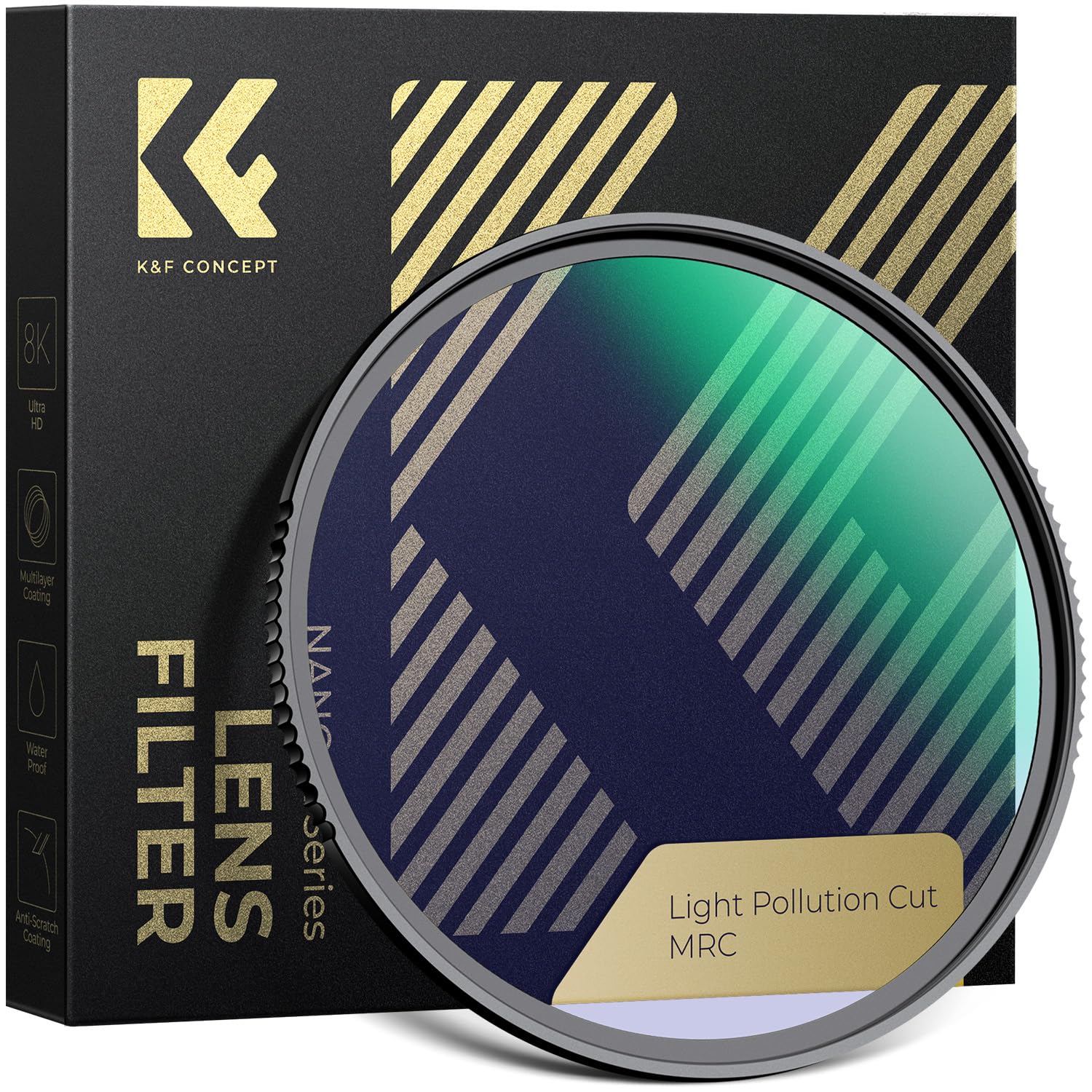
The number that matters on this K&F is 0.15 inch: that is how slim the frame is, and it is the reason the filter suits wide lenses. A thick ring can vignette the corners of a nightscape; this one stays out of the way. The 58mm thread is fixed, so it only helps if that is the size your lens takes.

As a nightscape filter, it works differently from a telescope UHC. It is designed to reduce the yellow cast from streetlights while keeping the scene looking natural, not to turn the sky black. We think that is the right tool for city and suburban photographers who want cleaner skies without a heavy blue or green wash. The 28-layer coating is water-, oil-, and scratch-resistant, and the AGC glass is a sensible choice for a filter that rides in a camera bag.

A fingerprint on a filter this thin shows up in high-contrast night shots, so use a blower and microfiber rather than a sleeve. The slim ring also makes it easy to leave on a lens without adding a visible step. If your lens takes a different thread, start by matching the diameter rather than by choosing a brand.

Pros

  • Slim 0.15-inch frame limits vignetting
  • 28-layer coating resists water and oil
  • Reduces yellow streetlight cast
  • Fits 58mm lens threads

Cons

  • Effect is subtle in heavy skyglow
Our verdict

We like this for 58mm lenses when city glow is washing out nightscapes; the slim frame cuts yellow cast without adding bulk.

Check Latest Price
4

Best for Wide-Angle Nightscapes

Hoya 72mm Starscape Filter

89 /100
Keeper Score Excellent

Key details

Frame
Low-profile
Weight
0.71 oz
Coatings
Multi-coated
Filter Size
72 mm
Check Price on Amazon

A 20-gram filter with a low-profile ring sounds like a small detail until you put it on a wide-angle lens. The Hoya's frame is designed to sit close to the glass, which helps it avoid the corner shading a chunky ring can add to a nightscape.

We reach for this one when the goal is a natural-looking city sky rather than maximum nebula contrast. It reduces the yellowish and greenish cast from streetlights while preserving color and contrast, and the 72mm size suits larger front elements. This is a camera-lens filter, not a telescope eyepiece filter, so it does not deliver the aggressive emission-line cut of a UHC.

The multi-coating and water resistance are useful on a lens that gets taken out in dew and drizzle. It is also one of the pricier camera filters here, which is the trade-off for the low-profile build and Hoya's coating quality. If your widest lens takes 72mm and you want the sky to keep its color, this is the more polished choice than the K&F.

Pros

  • Low-profile frame suits wide lenses
  • Light 20 g build
  • Reduces yellow-green streetlight cast
  • Water-resistant multi-coating

Cons

  • 72mm thread only
Our verdict

We choose the Hoya when a 72mm lens needs a low-profile filter that reduces streetlight cast and stays out of the way.

Check Latest Price
5

Best for Warranty Coverage

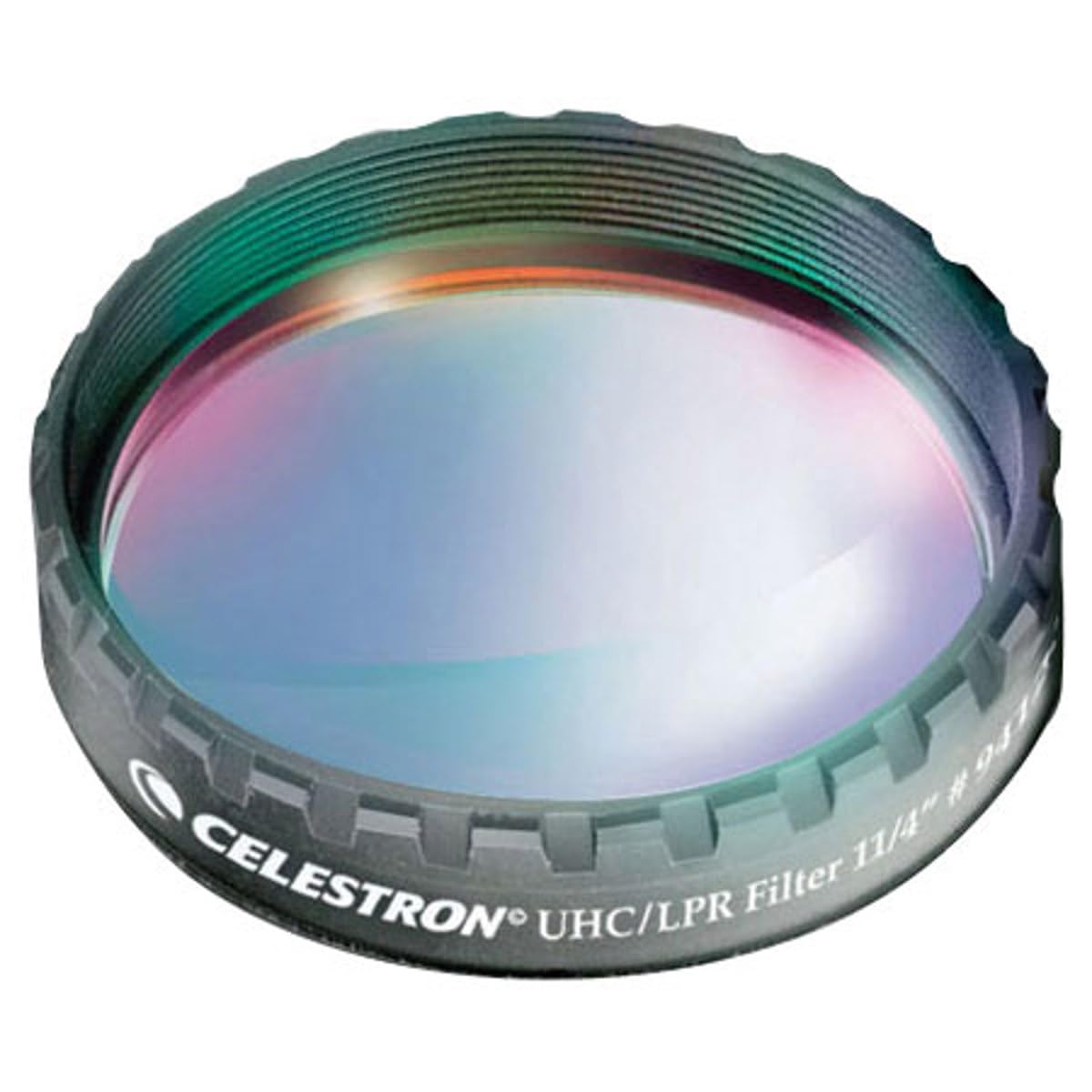
Celestron 1.25-Inch UHC/LPR Filter

84 /100
Keeper Score Excellent

Key details

Mount
1.25 in
Coatings
Multi-coated
Warranty
2 years
Filter Type
UHC/LPR
Check Price on Amazon

The Celestron sits in the same 1.25-inch UHC lane as our top pick, but it asks for more money and backs the purchase with a two-year limited warranty. That comparison is the whole story: the optical job is familiar, the ownership terms are not.

It uses multicoated optical glass in a standard 1.25-inch barrel and is positioned for visual use. Celestron's LPR design is meant to darken the sky background and lift nebula contrast, which is the same job the SVBONY handles for less. The filter is a sensible match for a starter or mid-size reflector or refractor with a threaded eyepiece, and the 31.75mm thread is the common size.

That warranty is the reason we recommend it to buyers who value support more than the lowest price. We treat it as the conservative choice rather than the value leader. If the filter is going on a shared club scope or a telescope that sees hard use, the extra coverage has real appeal.

Pros

  • Two-year limited warranty
  • Standard 1.25-inch fit
  • Multi-coated optical glass
  • Celestron brand support

Cons

  • 1.25-inch mount only
Our verdict

We point warranty-minded telescope owners to this 1.25-inch UHC/LPR: it does the familiar nebula-contrast job with two-year coverage behind it.

Check Latest Price
6

Budget Visual Observing

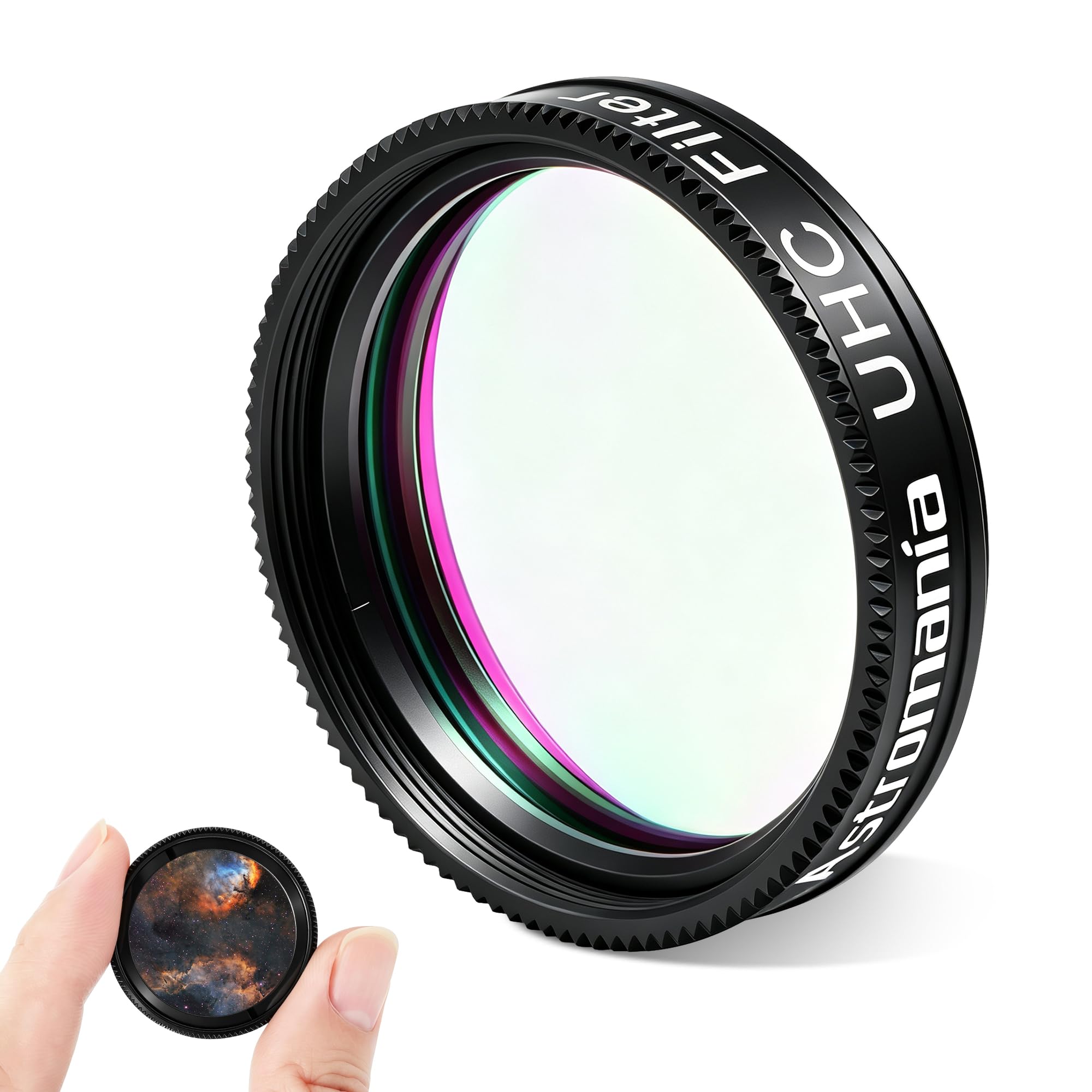
Astromania 1.25-Inch UHC Filter

84 /100
Keeper Score Excellent

Key details

Frame
Aluminum
Mount
1.25 in
Coatings
Anti-reflection coated
Filter Type
UHC broadband
Check Price on Amazon

The Astromania is the lowest-priced ticket into a 1.25-inch UHC, and that is its main reason to exist. It does the same basic job as the SVBONY — darkening the sky background and lifting contrast on bright emission nebulae — with a simpler, no-frills presentation.

The filter uses optical glass in an aluminum frame with anti-reflection coatings, and it threads onto standard 1.25-inch eyepieces. On bright targets like Orion or Lagoon, the gain is easy to see. Expect a purple-blue cast on bright stars; it is the price of the more aggressive filtration.

We see this as the filter to try if the SVBONY is unavailable and you want to keep the outlay as low as possible. It is a reasonable second filter for a small scope, not the one to build an imaging rig around. For a bright nebula and a modest eyepiece collection, it earns its place as the budget alternative.

Pros

  • Lowest-cost 1.25-inch UHC here
  • Lifts contrast on bright emission nebulae
  • Optical glass and aluminum frame
  • Fits standard 1.25-inch eyepieces

Cons

  • Dims the whole field
Our verdict

We see this as the lowest-cost way to try a 1.25-inch UHC, with the understanding that its view is dimmer and its color shift stronger.

Check Latest Price

How We Tested Light Pollution Filters Under Suburban Skies

We built the shortlist from the specs that actually change what you see: whether a filter is broadband or a narrower UHC-style bandpass, the thread size and how deep the frame sits once mounted, the coating stack, and the frame material. Anything with uncoated or dyed glass got cut before testing, since a filter that dims more than it filters is worse than no filter. That left 12 filters, which we used for eight months.

Most of that time was spent in my driveway under a streetlight I can't do anything about, on clear nights from late fall into spring, plus two trips out to darker skies. I swapped each filter on and off the same eyepiece and the same camera lens, target by target — Orion, Andromeda, the Pleiades, then the Milky Way core as it came around — so the comparison was the filter, not the weather. Suburban observers also take these on and off in the dark constantly, so I did exactly that, gloves on, more than once.

For effectiveness, I counted stars in the same patch of sky with and without each filter and noted whether nebulosity actually stepped forward or just got dimmer. For color, I shot a white reference frame and checked for the blue-green or yellow cast some coatings leave, then looked at whether star colors stayed plausible. Build quality got tested by threading each filter on and off a dozen times, and cleanliness by deliberately handling the glass and then wiping it with a lens cloth to see whether the coating smeared or came clean. Value came down to one question: how often would I actually reach for it?

How to Choose a Light Pollution Filter

Match the Mount First

A filter only helps if it fits the light path. Telescope filters come in 1.25-inch and 2-inch barrels; camera-lens filters use the thread diameter printed on the lens, such as 58mm or 72mm. A 1.25-inch filter will not screw onto a 2-inch eyepiece, and a 58mm filter will not fit a 72mm lens. Check the eyepiece barrel or the lens cap before ordering, then choose the filter that matches. The SVBONY and Celestron are 1.25-inch designs; the Optolong is 2-inch; the K&F and Hoya are camera-lens filters.

Choose by Target and Passband

For visual observing, a UHC filter is the usual first step: it suppresses some artificial light while passing the emission lines that make nebulae glow. That makes objects like Orion and Lagoon stand out, but it also dims stars and can shift colors. A broadband imaging filter such as the L-Pro preserves more natural color and is easier to use on galaxies, clusters, and mixed deep-sky fields. If you mostly photograph through a camera lens, a nightscape filter is a gentler tool still.

Keep Expectations Real

A light pollution filter improves contrast; it does not restore a dark sky. The gain is strongest on emission nebulae and weaker under broad, bright skyglow, so a filter that transforms a suburban view may barely register downtown. Before spending more, try to observe from the darkest spot you can reach and let your eyes adapt for twenty minutes. If your sky is severely polluted, a filter is a modest helper, not a substitute for travel or a narrowband imaging setup.

Look at the Ring, Coatings, and Support

On a wide camera lens, a thick filter ring can vignette the corners; the K&F's 0.15-inch frame and the Hoya's low-profile ring address that. Multi-coatings make the glass easier to clean and more resistant to water and oil, which matters when dew forms. Warranty is the other ownership detail: the Celestron's two-year coverage is worth paying for if you want support, while a budget first filter makes sense if you are still learning what your sky will give you.

Frequently Asked Questions

Final Verdict

For most visual observers, the SVBONY 1.25-inch UHC is the filter to buy first. It fits the eyepieces you likely already own, keeps the experiment inexpensive, and does the one job that matters: pulling emission nebulae out of suburban skyglow.

If you photograph through a 2-inch focuser, the Optolong L-Pro is the better buy; its wider mount and gentler color handling suit cameras and mixed deep-sky targets. Camera-lens shooters should match their filter thread first, then choose the K&F for 58mm or the Hoya for 72mm.