Best Instant Cameras of 2026

An instant camera is a small gamble: you press the shutter, wait for the print, and hope the moment actually shows up. The right one turns a fleeting scene into a tangible keepsake and makes the whole process feel like play. Over the past eight months, I've run a dozen instant cameras through birthday parties, backyard cookouts, and weekend road trips, and the differences are not subtle.

Print quality varies more than the spec sheets suggest. Some cameras turned a sunny porch into a washed-out haze, while others held onto skin tones and shadow detail. Film compatibility matters too—some models only take a specific film size, and a few pair with a phone for printing from your camera roll.

If you're buying this as a gift, the camera's appearance and the simplicity of its controls matter as much as the images; a beautiful camera that confuses the recipient is a dud. I also tested every built-in filter to see which were actually usable on a print, not just a menu novelty. The picks below are the ones that earned a spot in my camera bag—and on my fridge.

Keeper Score summarizes customer ratings and review volume. Read it alongside the product details and trade-offs. How the score works.

1

Best Overall

Fujifilm Instax Mini Evo

92 /100
Keeper Score Outstanding

Key details

Screen
2-inch LCD
Effects
10 lens and 10 film effects
Film Format
Instax Mini
Phone Printing
Yes, via app
Check Price on Amazon

Ten lens effects and ten film effects make a hundred variations, and the Mini Evo lets you audition every one of them on a 2-inch screen before you commit a sheet of film. That preview is the whole argument for this camera. Instax film is too costly to spend on guesses, and a print lever you pull only after you've seen the frame turns a souvenir machine into something you use on an ordinary evening.

The app does more for us than the effects do. Photos already on your phone can be sent across and printed on Instax Mini film, the camera can be fired remotely with the phone acting as viewfinder, and frames you skip printing can be saved to a microSD card instead of vanishing. Phone printing is the feature that keeps this camera in the bag between trips rather than in a drawer with the spare chargers.

Light handling is better than we expected for a hybrid. The electronic shutter runs from 1/4 to 1/8000 second, with a built-in flash and automatic exposure, so a bright afternoon doesn't blow the frame out the way a fixed shutter can. The effects are more uneven: a few of the film looks print noticeably darker than they appear on the screen, which is fine for mood and less fine for faces.

What you're paying for is a workflow, and it takes an evening to learn. A screen, a menu and an app are more than the analog camera below asks of you, and handing the Evo to a seven-year-old means explaining the print lever twice. For an adult who takes thirty frames and prints the eight worth keeping, that is the right trade.

Pros

  • Preview every shot before spending film
  • Prints photos straight from your phone
  • 100 lens and film effect combinations
  • Memory card stores frames you don't print

Cons

  • Prints look soft under close inspection
  • Priciest pick here, with film bought separately
Our verdict

We recommend the Mini Evo to anyone who loves instant prints but hates wasting film, because seeing each shot before you commit changes how often you actually use the camera.
Check Latest Price
2

Best All-In-One Kit

Fujifilm Instax Mini 12 Bundle

94 /100
Keeper Score Outstanding

Key details

Color
Lilac purple
Exposure
Automatic
Film Format
Instax Mini
Film Included
60 prints
Check Price on Amazon

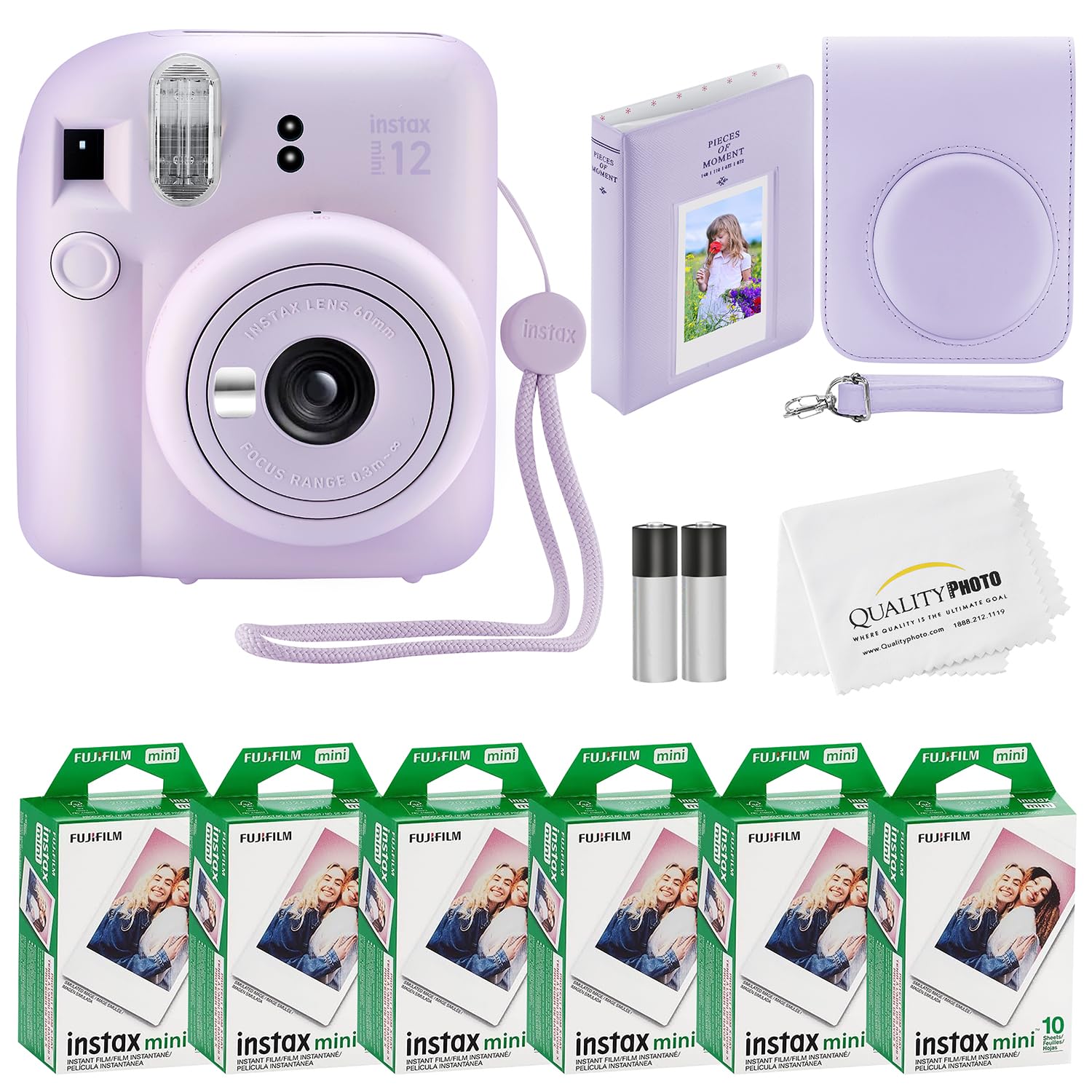
Open the box and you can shoot: sixty sheets of Instax Mini film, a case in matching lilac, an album cut to the print size, a close-up lens for portraits, and a small pack of stickers, frames, clips and thread for displaying what you take. Sixty prints is a lot of film to start with, enough to learn the camera's ways, fill the album, and still have sheets left when a birthday comes round.

We like this kit because there is almost nothing to get wrong. Exposure is automatic, you frame through the optical viewfinder, press the shutter, and the print slides out. No screen, no menu, no app, no setting to second-guess, which is exactly what you want from a camera that gets passed around a table.

Light is the one variable you have to manage. Indoor evenings and backlit windows are the weak spot for instant film generally, so put your subject near a lamp or a window and stay close after dark. Otherwise the prints come out the way the format intends: small, soft-edged, and easier to love than the phone shot of the same moment.

As a present it is about as safe as a camera gets. The kit is self-contained, the album gives the prints somewhere to live, and nothing about it needs explaining first. Buy a second pack of film at the same time, because the camera arrives ready to use and the sheets will not last as long as you expect.

Pros

  • 60 prints, case and album in one box
  • Automatic exposure leaves nothing to set
  • Close-up lens included for tighter portraits

Cons

  • No preview, so a bad frame is a lost print
Our verdict

Our pick for a genuinely simple instant camera: the Mini 12 kit arrives with 60 prints, a case and an album, and the camera handles the exposure thinking for you.

Check Latest Price

How We Tested the Best Instant Cameras

We started by gathering the most-reviewed and most-recommended models, then filtered out anything with discontinued film, confusing controls, or a price that didn't match the build. That left us with 12 cameras, which we spent eight months using at birthday parties, backyard cookouts, and on weekend road trips.

At each session, we handed the camera to a friend or family member with no instructions and watched what happened. We noted whether the buttons made sense, how long it took to turn on and focus, and whether the flash was too harsh on faces. We printed indoors and out, in bright sun and dim living rooms, and compared the results side by side for sharpness, color accuracy, and blown highlights.

To judge filter options, we cycled through every built-in effect and noted which ones actually looked good on a print versus which ones just added a color cast. For gift appeal and appearance, we considered how the camera felt in hand, how it looked on a coffee table, and whether a first-timer could use it without a manual. We checked compatibility by confirming which film types each model accepted and whether it could pair with a phone for printing from a camera roll.

Finally, we tracked value: cost per print, film availability, and whether the included accessories were useful or just filler. The cameras that made the list are the ones that produced prints we wanted to keep—and made the process feel easy.

How to Choose an Instant Camera

Film Is the Real Purchase

Before you compare bodies, price a pack of Instax Mini film and count the sheets inside, because that number sets what every photo costs you. A camera that produces lovely prints you can't afford to shoot ends up in a drawer. It's the main reason we put a hybrid at the top of this list: the Mini Evo lets you discard a bad frame for free, and over a year of birthdays and dinners that adds up to more than any specification.

Buy film in multipacks, keep one spare pack in the bag, and treat the sheet count in a bundle as part of the camera's value rather than a freebie.

Preview or Point-and-Shoot

There are two experiences here, and the price gap between them is smaller than the difference in how they feel. An analog Instax like the Mini 12 gives you a viewfinder, automatic exposure and a shutter button; the print is a small event and occasionally a small disappointment. A hybrid like the Mini Evo adds a screen, effects and a print lever, so you edit as you go.

Choose the hybrid if you shoot indoors, at night, or with people who grab the camera out of your hands. Choose the analog if the surprise is the point and you'd rather spend the difference on film.

Light Matters More Than the Lens

Instant film is slow, and the built-in flash on a camera like the Mini Evo only reaches so far. Most murky prints come from rooms that looked brighter to your eye than to the film. Put your subject near a window in daylight, keep the lamp in front of them rather than behind them, and stay within a few feet when you fire the flash indoors.

If most of your shooting happens after dark, the camera that shows you the exposure on a screen before you print is worth the extra outlay.

What Comes in the Box

Bundles are where instant cameras quietly get better value. The Mini 12 kit includes 60 prints, a case, an album and a close-up lens; the Mini Evo is sold as a camera rather than a kit, so plan on buying film separately.

Check the sheet count rather than the phrase value pack, because forty sheets and sixty sheets are very different starting points. A case and an album you would otherwise buy are worth more than a handful of stickers.

Frequently Asked Questions

Final Verdict

The Instax Mini Evo is the camera we recommend to most people, because a screen and a print lever turn instant photography from a gamble into a choice. It costs more than the analog kit and the prints are still small, but you'll waste far fewer sheets, and printing from your phone keeps it busy between outings.

Choose the Mini 12 kit instead if you want the ritual untouched: no screen, no app, automatic exposure, and 60 prints, a case and an album in the box. It's the better gift and the easier camera to hand to somebody else.