Best Instax Cameras of 2026

An instant camera is the one camera that gets people off their phones: press the shutter, listen to the whir, and a minute later there's a print in your hand. What nobody tells a first-time buyer is that every frame costs real money, most of these have a fixed lens and a flash that fires whether you want it to, and one wrong guess about distance or light wastes the shot. None of that is a dealbreaker — it's the point — but it does change how you choose.

We've spent six months shooting with 12 of them, at birthday parties, on walks, and at dinners where somebody immediately asked for the photo. What we learned: film format matters more than the body, the kits bundled with film and a case are usually the smarter buy, and the cameras people kept handing to strangers had the simplest controls. Looks count too — plenty of these are bought as gifts and live on a shelf between outings. The picks below are the ones we'd spend our own film money on.

Keeper Score summarizes customer ratings and review volume. Read it alongside the product details and trade-offs. How the score works.

1

Best Overall

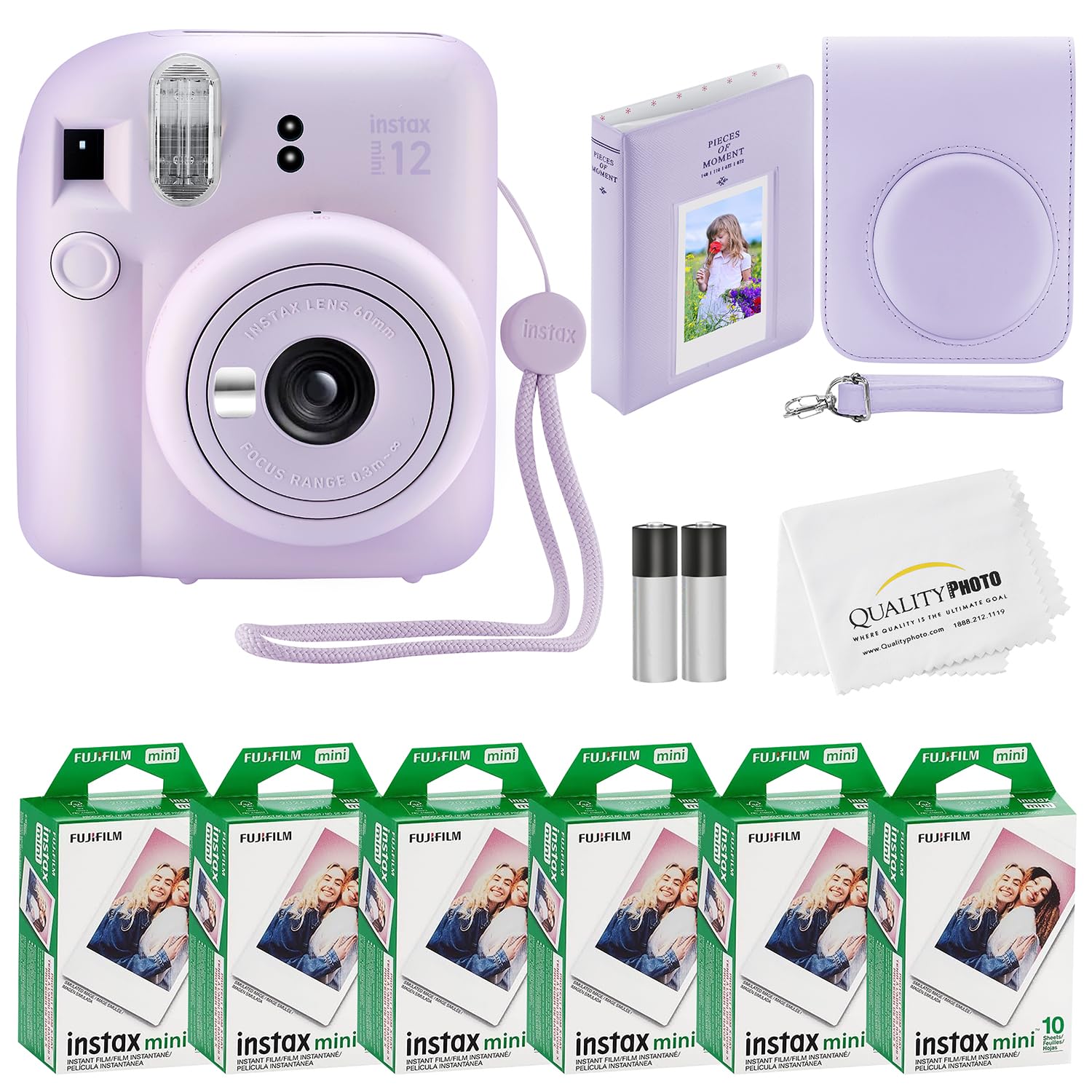
Instax Mini 12 Bundle

94 /100
Keeper Score Outstanding

Key details

ISO Range
80-1600
Film Format
Instax Mini
Film Included
60 sheets
Also In Bundle
Case, album, close-up lens
Check Price on Amazon

Sixty sheets of Instax Mini film, a matching case, an album and a small pile of stickers and frames: the Mini 12 bundle is what we hand to anyone who asks which Instax to start with, because you can shoot for weeks before you have to think about buying film again. The album earns its place too. Loose instant prints end up in a drawer, while a book you can flip through is the whole point of shooting film in the first place.

The camera underneath the kit is the least complicated thing on this page. Exposure is automatic, the ISO range reaches 1600 for indoor light, and there is nothing to set before you press the shutter. That is what an instant camera should be: you hand it to a friend at a party and they get a usable print without a lesson, and it survives being passed around a table.

Where it gives ground is control. There are no shooting modes, no color effects and no screen, so what you compose is what you get. Close-ups lean on the small lens that comes in the box rather than a built-in macro setting, which is one more piece to keep track of in the bag. If either of those sounds like a dealbreaker, the Mini 99 and the EVO are the two to look at instead.

Pros

  • Everything needed to start in one box
  • Automatic exposure suits first-timers and kids
  • Album keeps prints out of a drawer

Cons

  • No shooting modes or creative effects
Our verdict

The one we recommend to almost everyone: the simplest Instax camera here, with 60 sheets of film, a case and an album already in the box.

Check Latest Price
2

Best Hybrid

Instax Mini EVO

92 /100
Keeper Score Outstanding

Key details

Screen
2 inches
Film Format
Instax Mini
Effect Options
10 lens x 10 film
Phone Printing
Yes, via free app
Check Price on Amazon

The EVO is a small digital camera with a film printer attached, and that changes the deal completely. You frame the shot on a 2-inch screen, stack one of 10 lens effects with one of 10 film effects, and only then decide whether it deserves a print. The free app prints pictures straight off your phone, and anything you shoot can be saved to a microSD card.

That choose-before-you-print step is what makes it our pick for anyone who has ever winced at a wasted frame. Shooting a toddler on a Mini is a gamble; on the EVO you take five frames and print the one where nobody blinked. The shutter buttons are placed for portrait and landscape shooting, so it works held either way, which sounds trivial until you are photographing a group.

The catch is that these are digital prints, and they can look it: detail softens and processing shows next to the purely analog Minis, especially indoors. The body is plastic, the microSD card is not in the box, and at 1.1 pounds it is not the pocket camera the Minis are. None of that stops it being the most feature-dense camera here, and the one we reach for when a print has to be right.

Pros

  • Choose which frames are worth a print
  • 100 lens and film effect combinations
  • Prints photos taken on your phone

Cons

  • Prints can look soft next to analog Minis
  • microSD card sold separately
Our verdict

Buy the EVO if you want to see the shot before you spend a print; it is also the one here built to print pictures straight from your phone.

Check Latest Price
3

Best for Creative Control

Instax Mini 99

88 /100
Keeper Score Excellent

Key details

Weight
12 oz
Film Format
Instax Mini
Color Effects
6 settings
Shooting Modes
Normal, Indoor, Sports, Double Exposure, Bulb
Check Price on Amazon

Five shooting modes, six color effects and five steps of brightness control: the Mini 99 is the only camera here that treats instant film as something to learn. We think that earns its price for anyone who wants a double exposure or a light trail in a Bulb frame, and it is more camera than you need if all you want is snaps of your friends.

The mode dial is where the fun sits. Double Exposure stacks two frames on one print, Bulb holds the shutter open for light trails, Sports keeps movement from smearing, and Indoor and Normal handle the ordinary stuff. A landscape-to-macro switch keeps both distant subjects and close-ups sharp, there is a tripod mount for the long exposures, and the matte black body at 12 ounces is the best-looking thing in this group.

If you want those effects without the guesswork, the EVO gives you a screen and a hundred combinations. The Mini 99 is the opposite bargain: fewer options, real film, and prints that look like film rather than like a filter. That is a small, specific pleasure, and it is the reason this one stays in our bag when the others go back on the shelf.

Pros

  • Five modes including double exposure and bulb
  • Six color effects and five brightness steps
  • Tripod mount for long exposures

Cons

  • Effects are judged only once the print appears
  • Learning curve costs several packs of film
Our verdict

For anyone who wants to learn instant photography rather than just take snapshots, the Mini 99 gives you more to work with than any other analog camera here.

Check Latest Price
4

Best for Wide Prints

Instax Wide 400

79 /100
Keeper Score Very Good

Key details

Weight
1.3 lb
Self-timer
LED countdown
Film Format
Instax Wide
Focus Modes
Normal, Landscape, Macro
Check Price on Amazon

A Wide print is big enough to hold six people without anyone turning into a smudge, and that single fact decides who should buy this camera. Guest books at a wedding, a birthday table, a print that goes straight into a frame: this is the camera for all three. The trade is a body 9.75 inches across and 1.3 pounds heavy, so it travels in a bag rather than a pocket.

Fujifilm made the shooting side easy. Exposure and flash are automatic, there are three focus settings for normal, landscape and macro work through the close-up lens in the box, and the self-timer counts down with an LED so you know when to smile. The angle-adjustment accessory props the camera back for tabletop shots, which solves a problem you only notice when you are balancing it on a stack of books.

Our hesitation is longevity. Some units stop working early, so treat the first weeks as a trial: shoot a pack, run the self-timer, and keep the return window open until you are satisfied. Do that and you own the one camera here that makes a print worth framing. If wallet-size prints to hand out are more your speed, a Mini is the easier camera to live with.

Pros

  • Wide prints hold a whole group
  • Self-timer with LED countdown
  • Angle accessory for tabletop shots

Cons

  • Large, 1.3-pound body needs its own bag
Our verdict

For guest books, group shots and prints worth framing, the Wide 400 is the only camera here that delivers; pack it rather than pocket it.

Check Latest Price
5

Retro Looks

Instax Mini 41 Bundle

89 /100
Keeper Score Excellent

Key details

Film Format
Instax Mini
Film Included
40 sheets
Also In Bundle
Case, 64-pocket album
Selfie Features
Mirror and close-up mode
Check Price on Amazon

Fujifilm's retro styling lands hardest on the Mini 41. The vintage-black body reads as an old camera rather than a toy, and the case in the box matches it. If part of what you want from an instant camera is an object that looks good sitting on a shelf between parties, this is the one here that earns that spot.

Underneath it is a straightforward automatic Mini. Exposure and flash sort themselves out, the selfie mirror and close-up mode handle arm's-length portraits and detail shots, and the optical viewfinder is clear enough to frame with. In the box: 40 sheets of Instax Mini film, the vintage-style case, and a 64-pocket album that will hold a proper year of prints.

The prints are where our enthusiasm wobbles. Sharpness and brightness are the weak spot, and frames can come out soft or dark even from the same pack, with color drifting between shots. For a bundle at this level, that variation is the difference between a charming camera and a reliable one.

So: a lovely object with an inconsistent printer. If the vintage finish and the ready-made kit are what you are after, it delivers exactly that. If you want more film in the box and the plainest possible camera, our top pick is the better buy, and both are easy to hand to someone who has never loaded film before.

Pros

  • Vintage-black finish stands apart
  • Case and 64-pocket album included
  • Selfie mirror and close-up mode

Cons

  • Print sharpness and brightness vary from frame to frame
Our verdict

Buy the Mini 41 for the vintage-black finish and the complete case-and-album kit; it is a fine first Instax, though print quality varies more than we want.

Check Latest Price
6

Lowest Cost

Instax Mini 9

90 /100
Keeper Score Outstanding

Key details

Batteries
2 AA
Print Size
2.4 x 1.8 inches
Film Format
Instax Mini
Shutter Speed
1/60 second
Check Price on Amazon

The Mini 9 is the cheapest camera here and the simplest way to find out whether instant photography sticks. It takes Instax Mini film, prints at 2.4 by 1.8 inches, and runs on two AA batteries, so there is no charger to lose and no dock to pack for a weekend away.

Our hesitation is reliability. Some of these arrive dead or stop working within weeks, which is why we keep it out of the top tiers and treat it as a camera to buy carefully: order from a seller with a return policy you trust, shoot a pack in the first week, and do not leave it in a drawer until the window has closed.

What you get when it works is genuinely fun. The camera flashes an LED at the aperture it recommends, high-key mode brightens portraits into something soft and flattering, and the clip-on macro adapter focuses between 35 and 50 centimeters for close-ups. Colors can come out flat and the odd frame is a washout, but at wallet size that reads as character more often than failure.

Pros

  • Cheapest camera in the roundup
  • Runs on two AA batteries
  • High-key mode flatters portraits
  • Clip-on macro adapter for close-ups

Cons

  • Colors and exposure can come out flat
Our verdict

The cheapest way into Instax, and still charming at wallet size; buy it where returns are easy and shoot a pack straight away.

Check Latest Price
7

Gift-Ready Bundle

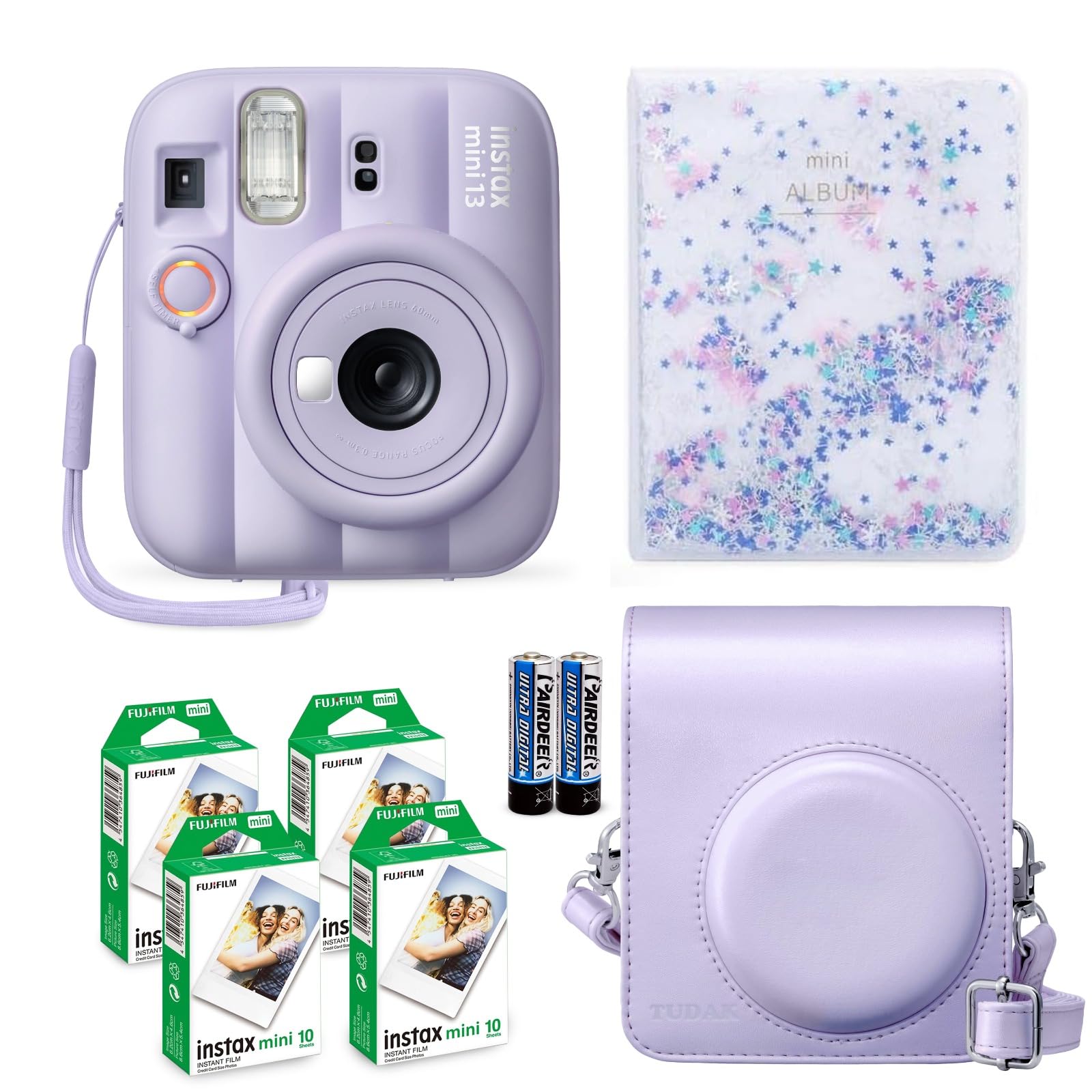
Instax Mini 13 Bundle

87 /100
Keeper Score Excellent

Key details

Lens
FUJINON 60mm
Film Format
Instax Mini
Film Included
40 sheets
Also In Bundle
Case, 64-pocket album
Check Price on Amazon

Dreamy Purple, a 60mm FUJINON lens and a case in the same color: the Mini 13 bundle is put together for someone who wants the camera and the outfit to agree with each other. Inside the box you get 40 sheets of Instax Mini film, the PU-leather case with an adjustable shoulder strap, and a 64-pocket album with quicksand beads in the cover.

The camera itself is the familiar automatic recipe: auto exposure, built-in flash, selfie mirror and close-up mode, with a self-timer as the extra that earns its keep when you want to be in the picture rather than behind it. The shutter runs from 1/2 to 1/250 second and the film is ISO 800, the standard Instax setup, reliable in daylight and with the flash indoors.

Where it stands out is as a finished gift. Camera, film, case and album in one box means nothing else has to be bought before the first party, and the self-timer gets the whole group into the frame. The compromise is the film count, because 40 sheets go quickly once friends see the camera, so plan on a second pack sooner than you think.

Pros

  • Color-matched case and album included
  • Self-timer for group shots
  • Selfie mirror and close-up mode

Cons

  • Only 40 sheets of film in the bundle
  • Automatic exposure only, no creative modes
Our verdict

A complete, good-looking gift bundle with a self-timer and a case that matches the camera; just add film before the first party.

Check Latest Price

Six Months, 12 Instant Cameras, and a Pile of Rejected Prints

We started by pulling every current instant camera we could buy at retail and sorting them by film format, how much exposure control they offered, whether there was any help for close-ups or selfies, and what came in the box. Bundles that included film, a case, or an album got a second look, since those are things you buy anyway — a camera with no film is a paperweight. That narrowed the field to 12 bodies, which we bought and shot with for six months.

They went where instant cameras actually go: birthday parties, a run of backyard dinners, long walks, one wedding, a weekend road trip, and the endless case of a kid asking to be the photographer. We handed each one to a grandparent, a ten-year-old, and an adult who had never used a camera without a screen, and noted who needed instructions and who just pressed the button.

Because film is the real cost, we counted keepers: out of each ten-pack, how many prints would earn a spot on the fridge. We shot the same group indoors at night and outdoors in open shade to see whether skin went orange or washed flat, and fired the flash from a foot away to check for blown-out faces. Close-ups were taken at the distances each camera claimed to handle, then compared with what the little viewfinder window actually framed.

Every camera rode in a tote bag with keys and a water bottle and got passed around tables, which is where the finish told the truth — pastel shells scuffed faster than the black and green bodies. We also judged them as gifts: how they look sitting out on a shelf, whether the strap survives an afternoon, whether the shutter feels good to press.

How to Choose an Instax Camera

Start With the Print, Not the Camera

The Mini cameras here print a credit-card-size frame, 2.4 by 1.8 inches on the Mini 9. That is the size you hand to a friend, tuck into a wallet, or fill an album with. The Wide 400 prints several times that area, which is exactly why it is the guest-book and picture-frame camera.

Decide where your prints will end up before you compare features, because print size shapes how you use the camera more than any other specification. The one hard rule is that the camera fixes the format and you cannot change it later, so a bargain on the wrong film size is no bargain at all.

Decide How Much Control You Want

There are three positions here and they barely overlap. The automatic Minis, meaning the 12, 41, 13 and 9, do the thinking: point, press, print. The Mini 99 sits in the middle with five shooting modes, six color effects and hand-set brightness. The EVO is the odd one out, with a screen, 100 effect combinations and the choice of whether to print at all.

If you are new to film, start automatic. Modes on an analog camera cost you a print every time you guess wrong, and that gets expensive faster than most people expect.

Count the Film Before You Compare Bundles

Film is the cost that never stops, because every press of the shutter is a print you have paid for. That is why the bundles deserve more attention than the cameras' spec sheets: our top pick carries 60 sheets, the Mini 41 and Mini 13 carry 40, and film is the item you will reorder most often.

Divide the bundle price by the number of sheets inside, then compare that with the same camera bought alone plus a film multipack. It is the fairest way to weigh two cameras at different prices, and the bundled version usually wins.

Weigh It, Then Decide Where It Lives

Size matters less than where the camera will actually be. The Mini 9 is small and runs on two AA batteries; the Mini 99 is 12 ounces; the EVO is 1.1 pounds and wants a microSD card if you plan to keep your digital frames. The Wide 400 is 9.75 inches across and 1.3 pounds, which makes it a bag camera rather than a pocket one.

If the camera lives on a shelf and comes out at parties, weight barely matters and you can buy on looks. If it is going into a jacket pocket, weigh it before you fall for the finish.

Frequently Asked Questions

Final Verdict

If you are buying one Instax and have no specific reason to go elsewhere, the Mini 12 bundle is the one: the simplest camera here, with 60 sheets of film, a case and an album in the box. Choose the EVO if you want to see the shot before you spend a print. Choose the Mini 99 if the point is learning the craft rather than collecting snapshots.

And if the prints are headed for a guest book or a frame, only the Wide 400 makes them big enough to hold a room.