Best Fujifilm Flashes of 2026

Every birthday-dinner photo I've taken with a pop-up flash has the same look: a white face, a black background, and a cake lit like it's sitting under a streetlamp. A real speedlight fixes that in about four seconds — tilt the head at the ceiling and the light comes back down soft. What the spec sheet won't tell you is which ones actually do that reliably, because Fujifilm's own units and the third-party options built for the same hot shoe don't behave alike at all.

My team and I have spent the past eight months shooting with 12 of them, from palm-sized pocket units to full-size speedlights, and the gaps show up fast: how much power survives once you switch on high-speed sync, whether a compact body can bounce off a ceiling at all, and how long you stand there waiting between frames. Treat a guide number as a ceiling rather than an average — a bounce can eat two stops before you notice. Some picks here won't win a power contest; they won because they slip into a jacket pocket and still got the shot.

Keeper Score summarizes customer ratings and review volume. Read it alongside the product details and trade-offs. How the score works.

1

Best Overall

Godox iT32 + X5F

92 /100
Keeper Score Outstanding

Key details

Power
Built-in rechargeable battery
Weight
5.96 oz
Wireless
2.4G RF with X5F trigger
Guide Number
18
Check Price on Amazon

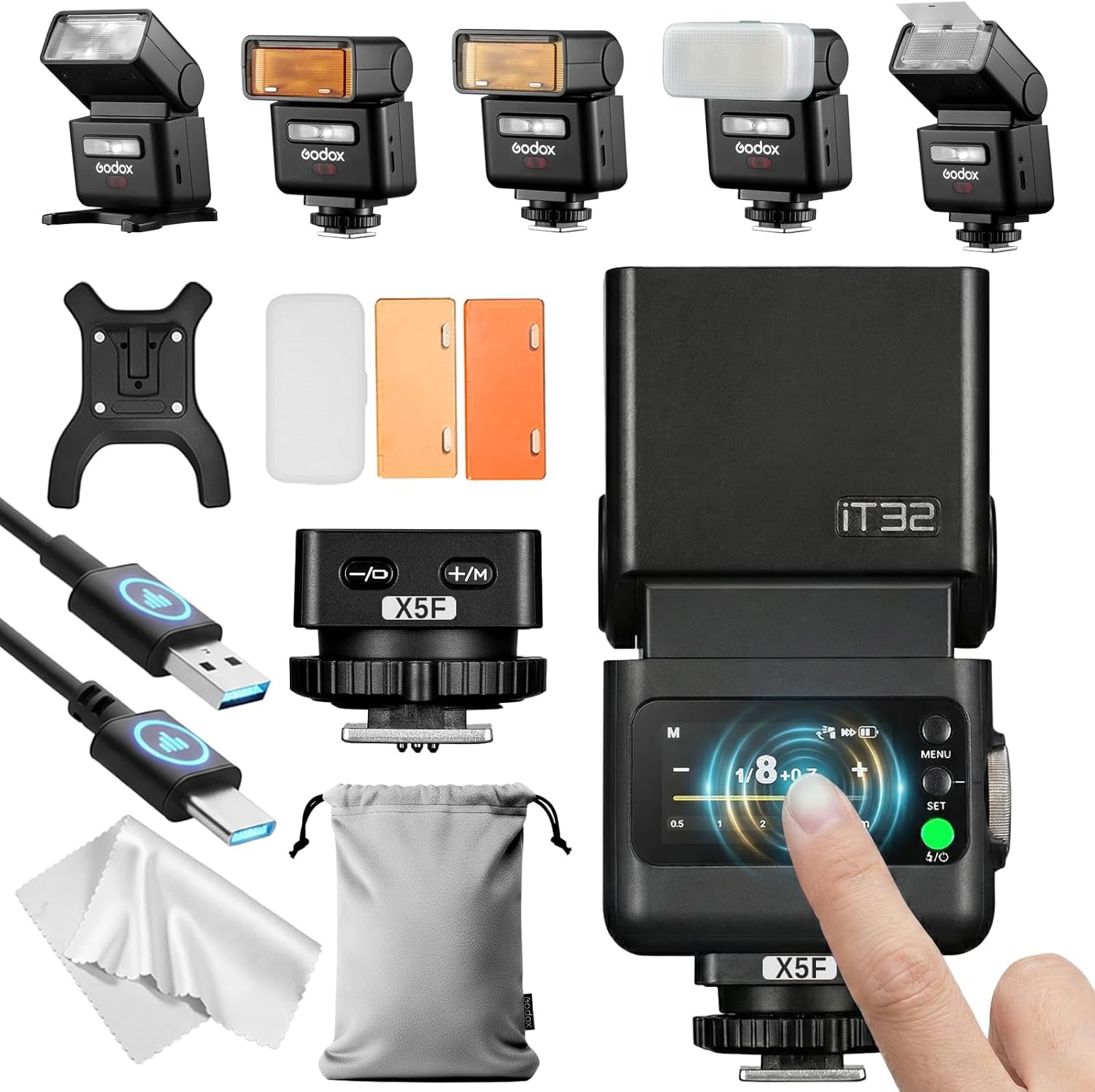
The X5F module clipped to the foot of the iT32 is the reason this is our top pick. Slide it off and it becomes a 2.4G transmitter while the flash body turns into an off-camera slave you can hold in one hand or stand on a shelf. Plenty of flashes can work off-camera; this is the only one in this group that ships with a separate trigger in the box, and the magnetic connection makes the swap a one-second job instead of a menu dive.

It stays small, too. At 169 g the iT32 sits on an X-T5 or an X100F without making the camera nose-heavy, and the whole thing drops into a jacket pocket alongside the mini stand and diffuser. What you give up for that is output: a guide number of 18 is fill light, indoor light and portraits at conversational distance. Bounce it off a high ceiling and you will want to be close to your subject. For a reception hall, the Godox TT350F below has a great deal more in reserve.

Day to day, the controls are the friendliest here. A color touchscreen, a select dial and two physical buttons mean you can change power with a thumb while the camera stays at your eye, and high-speed sync to 1/8000 sec lets you keep the aperture open outdoors instead of hitting the sync ceiling. The kit is unusually complete: diffuser, a half and a full orange filter that cling to the head magnetically, a mini stand and a storage bag.

One detail to check before you order: the compatibility list is split into three groups rather than one flat roster. Group A takes in the X-T5, X-S20, X-T4, X-T3, X-Pro2, X-T30 and the GFX 50 bodies; the X100F and X100T sit in group C, and older bodies such as the X-Pro1 and X-T10 in group B. Find your camera's group in the listing rather than assuming every X-series body is covered the same way.

Pros

  • Detachable X5F doubles as a wireless trigger
  • Color touchscreen and dial make power changes quick
  • 169 g rides easily on a small body
  • Diffuser and two magnetic color filters included

Cons

  • Guide number 18 limits bounce and group shots
  • Rechargeable only, with no AA fallback
Our verdict

We make this our default for Fujifilm shooters who want reliable TTL now and off-camera light later, without buying a trigger as well.

Check Latest Price
2

Best AA-Powered

Godox TT350F

87 /100
Keeper Score Excellent

Key details

Power
2 AA batteries, approx. 210 full-power flashes
Weight
200 g without batteries
Coverage
24-105mm
Guide Number
36 (m ISO 100)
Check Price on Amazon

Two AA cells are the whole argument. No charger to remember, no waiting on a built-in pack: carry a spare pair and you are shooting again in the time it takes to swap them. On a long day of events that matters more than any screen, and it is why this is the flash we pack when we do not know how long we will be out.

It is also the most powerful of the small TTL units here, with a guide number of 36 against the iT32's 18, and a head that zooms from 24mm to 105mm as you turn the lens. Guide numbers are quoted at the head's longest setting, so a wide 24mm frame receives rather less than 36 suggests — but the extra reach is real, and it is the difference between bouncing off a ceiling and merely lighting a face. Recycle runs from 0.1 to 2.2 seconds, and a set of cells is good for roughly 210 full-power pops.

The head tilts and swivels, which changes more photographs than any figure on a spec sheet: aim it at a wall and the light arrives bigger and softer than a direct hit. Settings run through an LCD panel, four function buttons and a jog dial — slower than the touchscreen on the iT32, and perfectly workable once you have your three usual modes saved. Two housekeeping notes: the AA cells are not in the box, and the flip-out wide panel needs to seat fully when you pack the flash away, since a partly open panel can make it misbehave.

Pros

  • Guide number 36, the strongest of the compact picks
  • Swappable AA cells for long shoots
  • Head tilts and swivels for bounce
  • 2.4G radio with 30 m transmission

Cons

  • AA batteries not included
  • Button-and-dial menu is slower than a touchscreen
Our verdict

We choose this one for long days away from an outlet: AA cells you can swap, a guide number of 36, and a head that tilts and swivels.

Check Latest Price
3

Best Fujifilm-Brand Compact

Fujifilm EF-X8

88 /100
Keeper Score Excellent

Key details

Modes
TTL, manual, commander
Wireless
Optical pulse
Sync Speed
1/250
Guide Number
26.2
Check Price on Amazon

There is no screen, no radio and no zoom range here — the EF-X8 is about as plain as a Fujifilm flash gets, and that is the point. It slides into the hot shoe, the camera's own flash settings drive it, and TTL, manual and commander modes are all reachable without learning a second interface. Guide number 26.2 is more light than its slim body suggests, and it is enough to lift a face indoors or open up a shadow on a bright day.

We reach for it when the plan is one small flash on the camera and nothing else: it adds almost no bulk to an X-T4 or X-Pro body, and the commander mode will fire a second unit optically when you want a bit of shape. That last part is the boundary. Optical pulse triggering is line-of-sight, so it works in a living room and struggles around a corner or in bright sun. If off-camera light is on your list, the iT32 or the TT350F is the better spend; if it is not, this is the least fussy way into Fujifilm TTL.

Pros

  • Works with Fujifilm's own flash settings
  • Guide number 26.2 from a very small body
  • Commander mode for triggering a second unit

Cons

  • Optical triggering needs a clear line of sight
Our verdict

For a first-party flash that works straight from the Fujifilm flash settings with no learning curve, we think this small unit is the easy buy.

Check Latest Price
4

Best for Off-Camera Wireless

Fujifilm EF-60

78 /100
Keeper Score Very Good

Key details

Power
4 AA batteries
Weight
10.6 oz
Coverage
24-200mm
Guide Number
60 (ISO100·m at 200mm)
Check Price on Amazon

This is the expensive one, and the reason is radio. Fujifilm built the EF-60 as its first radio-controlled clip-on flash, which means it can be triggered without the line-of-sight dance that optical systems demand. If you have been putting up with a slave that only fires when it can see the camera, that single change is what you are paying for.

Output is the other half of the pitch. The guide number of 60 is quoted at 200mm, with coverage running from 24mm to 200mm and down to roughly 16mm with the built-in diffuser, plus auto zoom that follows the lens as you turn it. That makes it a working flash for groups, halls and daylight fill rather than a fill-light accessory. It runs on four AA cells, so spares are cheap and swapping is quick.

Where it earns its place is with a Fujifilm shooter who wants the off-camera light to come from the camera maker rather than a third party — same brand, same support, one system. The costs are real: on the hot shoe it is a 300 g lump next to the mini units, and on price it sits in a different bracket from everything else we picked. If you only ever fire a flash mounted on the camera, the iT32 or the TT350F will cover it for a fraction of the money.

Pros

  • Guide number 60 with 24-200mm auto zoom
  • Radio wireless, so no line-of-sight requirement
  • 16mm coverage with the built-in diffuser
  • Runs on four AA cells, so spares are easy

Cons

  • The most expensive flash in this guide
  • 300 g makes it bulky on a small body
Our verdict

We recommend this only if you need radio-controlled off-camera light from Fujifilm itself; otherwise the third-party picks here do the same job for much less.

Check Latest Price
5

Best Budget TTL

Viltrox Vintage Z1 Pro F

89 /100
Keeper Score Excellent

Key details

Power
Built-in battery, USB-C charging
Weight
4.8 oz
Guide Number
12
Recycle Time
1 s
Check Price on Amazon

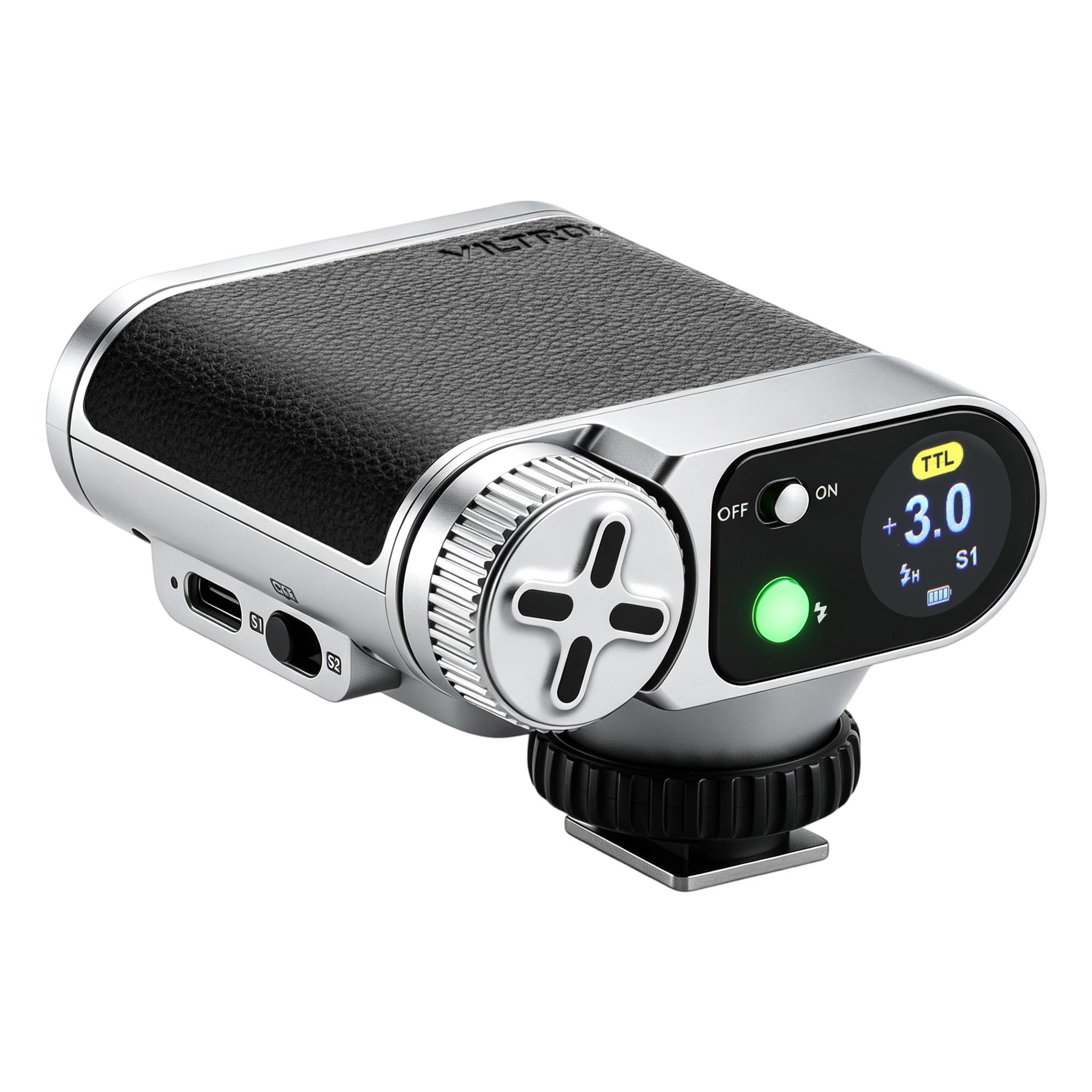
Retro is doing a lot of work here: a silver metal body, a curved glass touchscreen and proportions that look like they were drawn decades ago. On a black Fujifilm body it reads as deliberate rather than bolted on, and at 136 g it does not upset the balance of a small camera. If you care how your kit looks when you are out, this is the one that looks like it belongs there.

The numbers are more interesting than the styling. A one-second recycle is quick for anything this size, and the built-in battery is rated for 350 full-power flashes or up to 10,000 at minimum power — enough that we stopped thinking about charge. It tops up over USB-C in about 70 minutes and will shoot while it charges, which is the sort of detail that saves an evening.

TTL works on Fujifilm bodies, with a seven-stop manual range for when you want to place the light yourself, plus S1 and S2 optical slave modes so a second one can be fired by the first flash with no extra gear. Add the three-year warranty — the longest of anything in this guide — and it is the easiest budget recommendation here. The guide number of 12 is the boundary: close portraits, small rooms and fill. Take it into a big room and you will be shooting wide open.

Pros

  • One-second recycle and 350 full-power flashes
  • USB-C charging, and it shoots while charging
  • Three-year warranty
  • TTL on Fujifilm plus a seven-stop manual range

Cons

  • Guide number 12 suits close work only
Our verdict

The one we hand to anyone who wants TTL, a fast recycle and a body that looks right on a retro Fujifilm without spending much.

Check Latest Price
6

Pocket Carry

Viltrox Vintage Z2-F

81 /100
Keeper Score Excellent

Key details

Power
420 mAh built-in battery
Weight
1.83 oz
Coverage
28mm
Guide Number
6
Check Price on Amazon

Folded, the Z2-F is a 52 g block that slides into a jacket pocket, and that is the entire case for owning one: it lives on the camera or in a bag and you forget about it until the light goes flat. Hinged open, the head rises roughly 60mm above the shoe, which lifts the light off the lens axis and takes some of the flat, shadowed look out of a close portrait.

TTL works on Fujifilm bodies, and there are five manual steps when you want to pull the light down for a moodier frame. Coverage is fixed at 28mm, which suits the small primes these cameras get used with, and the internal 420 mAh battery charges over USB-C in around 70 minutes. The guide number of 6 is the catch: this is fill for people a few steps away, not a light for a group across a hall.

Pros

  • Folds into a 52 g pocket-sized block
  • Pop-up head lifts light clear of the lens axis
  • TTL for Fujifilm plus five manual steps

Cons

  • Guide number 6 is fill-light territory
  • Softbox diffuser sits loose, with no spare parts
Our verdict

We keep this folded in a jacket pocket for indoor snapshots and close fill; it is not the flash for a group in a large room.

Check Latest Price

How We Tested Fujifilm Flashes

We built the shortlist from both directions: the manufacturer's own TTL units and the third-party speedlights that Fujifilm shooters keep recommending to each other in forums and camera shops. Every candidate had to communicate natively with the X-series hot shoe, offer TTL and high-speed sync, and bring something different to the table — radio triggering, a tilting head, a genuinely pocketable body, or a price that undercuts the rest. That filtering left us with 12 units, and we bought or borrowed each one rather than relying on loaners for a single afternoon.

Testing ran for eight months of ordinary shooting. Each flash came to dim restaurant dinners, sat on top of the camera during living-room portrait sessions with standard eight-foot ceilings, and went outdoors at golden hour where we pushed shutter speeds to 1/4000 and 1/8000 to see how the backlit portraits held up. A few traveled in a camera bag on hikes and weekend trips, which is where compact size and portability stopped being abstract and started being a question of whether the thing came with us at all.

At each session we counted frames per battery set, timed how long the ready light took to come back after a full-power pop, and shot bursts until the flash fell behind the camera. We bounced heads off ceilings and walls and noted which images needed a stop of recovery afterward, then mounted and unmounted each unit from the hot shoe dozens of times to see whether the foot loosened or the connection started dropping frames. Reliability was the axis we weighted hardest, because a flash that misfires at the wrong moment is worth nothing regardless of what it cost — and value only counted when the unit delivered under those conditions.

How to Choose a Fujifilm Flash

Start With TTL and High-Speed Sync

TTL is what keeps a flash in your bag after the novelty wears off: the camera meters a pre-flash and sets output, so moving from a dim corner to a bright window does not mean re-dialing power every frame. Every flash we picked supports it on Fujifilm bodies.

High-speed sync is the second question, and it only matters if you shoot wide open outdoors. The Godox iT32 and TT350F carry HSS to 1/8000 sec, which lets you hold an f/1.4 aperture in daylight instead of stopping down to the camera's sync ceiling of around 1/250 sec. If that is your kind of photography, treat HSS as a requirement rather than a bonus.

Read the Guide Number With the Zoom Attached

Guide numbers are quoted at ISO 100 and, on a zoom head, at the longest setting. The Fujifilm EF-60's figure of 60 is measured at 200mm, and the same flash at 24mm is a far dimmer proposition. Compare numbers knowing that the wide end always loses.

As a rule of thumb, a compact unit in the teens or low twenties is fill and indoor light, while something around 36 or above can bounce off a ceiling and still put light on a face. Bouncing burns most of your output, so if you shoot in tall rooms, buy more guide number than the room suggests you need.

Weigh AA Cells Against a Built-In Battery

AA-powered flashes, like the Godox TT350F and the Fujifilm EF-60, never leave you waiting on a charger: swap the cells and keep working. Built-in rechargeable packs, as on the iT32 and both Viltrox units, make for lighter bodies and charge over USB-C, and the Z1 Pro will even shoot while charging.

For a long event, we still prefer AA cells, because a flat pack ends your evening unless you carry a power bank. For a camera bag that already holds a cable, an internal battery is one less thing to buy and one less thing to forget.

Decide Whether You Need Radio at All

Radio triggering does not care about line of sight, so a 2.4G flash can sit behind a modifier or around a doorway and still fire. Optical systems — the EF-X8's commander mode, the Viltrox S1 and S2 slave modes — need the slave to see the master's light, which is fine in a living room and unreliable in sunshine.

If the flash will live on the hot shoe, do not pay for radio. If you want a second light, it is the feature worth stretching for, and it is where most of the price difference between these picks sits.

Check the Head, the Mount and Your Camera's Group

A head that tilts and swivels is what lets you bounce, and bouncing is the difference between a hard direct hit and light that looks like it came from a window. The TT350F articulates both ways; the pocket units trade that for size.

Then read the compatibility list properly. The iT32's is split into three groups of Fujifilm bodies rather than one flat roster, so find your camera before you assume it is covered. Weight counts too: a 300 g unit on a small body makes the whole kit feel front-heavy.

Frequently Asked Questions

Final Verdict

For most Fujifilm owners the Godox iT32 is the flash to buy. It is the only pick here that arrives with a trigger as well as a flash, it is light enough to leave mounted on a small body, and it grows into a two-light setup without a second purchase. What you accept in return is output: at guide number 18 you are buying convenience, not reach.

If you need more light, or carrying AA cells suits you better than carrying a cable, the TT350F is the stronger buy — roughly double the listed guide number and a head that bounces and swivels, for less money. And if your off-camera work already runs on Fujifilm's radio system, the EF-60 is the only unit here built to join it.