Best Macro Ring Flashes of 2026

A ring flash does what a speedlight can't: it wraps light around the front of the lens, so a beetle's shell or a watch dial comes out evenly lit, with no shadow swallowing the detail you were chasing. That evenness is also the problem. Bare tubes leave a flat ring-shaped catchlight in every dewdrop, and not every model lets you dial the two sides independently or clip a diffuser over the light.

The part that decides whether you'll keep using it is the mount. A flash that doesn't speak your camera's TTL metering, or whose adapter rings don't match your filter thread, costs more in missed frames than any spec sheet admits. My team and I spent nine months with a dozen of these — TTL and manual, dual-tube and single — mostly at my kitchen table and in the backyard at dusk.

Something worth knowing before you shop: at macro distances you're stopped down to f/11 or beyond with the flash inches from the subject, so raw power matters far less than how the light is shaped and how quickly the unit recycles between frames. The picks below split along exactly those lines.

Keeper Score summarizes customer ratings and review volume. Read it alongside the product details and trade-offs. How the score works.

1

Best Overall

Godox MF-R76

83 /100
Keeper Score Excellent

Key details

Guide Number
14 (m) / 46 (ft)
Adapter Rings
49, 52, 55, 58, 62, 67, 72, 77mm
Exposure Control
Manual, 1/128 to 1/1
Full-power Flashes
660
Check Price on Amazon

The rechargeable battery is the first thing that changed how we shot with this one. Godox rates it at 660 full-power pops per charge, and that is a different kind of session from the AA-powered rings in this group — we stopped planning around battery changes halfway through a set and started thinking about the light instead. No spare cells in a pocket, no swap mid-stack while a subject is still sitting still.

What earns it the top spot is the combination of that battery, a universal single-pin hot shoe, and eight adapter rings covering 49 to 77mm, which is enough for essentially any macro lens you'd put a ring on. It isn't tied to one camera brand the way the Canon, Nikon and Sony-fit picks below are, and that alone makes it the safest first buy. The dual tubes fire together or separately with a ten-step ratio from 1/128 to full power, so you can keep a little shadow on one side of a beetle rather than flattening it out completely.

Setting output by hand is the trade, and for macro work we found it costs less than it sounds. Working distance is fixed and repeatable, so once you've dialed an output for a set it holds shot after shot, and ten steps are fine enough to land where you want. The LCD and function buttons are readable at arm's length and the focus lights are bright enough to lock on in dim undergrowth. Chasing skittish insects at varying distances is the one case where we miss metering.

Two fits to confirm before ordering. The controller sits in the hot shoe, so check a recessed or non-standard shoe on your body, and confirm the Sony fit on your own camera rather than assuming it. The adapter rings go into the lens's filter thread, which every macro lens has but a reversed or adapted lens may not.

Pros

  • 660 full-power flashes per charge
  • Eight adapter rings cover 49 to 77mm
  • Independent dual tubes with ten-step ratio
  • Universal hot shoe, not tied to one brand

Cons

  • Adapter rings need a matching filter thread
  • 0.9 kg kit is a lot on a small body
Our verdict

We recommend the MF-R76 to anyone who wants one ring flash that works on any body and lasts a whole session without a battery change.

Check Latest Price
2

Best for Canon TTL

Yongnuo YN14EX II

87 /100
Keeper Score Excellent

Key details

Guide Number
18 (ISO 100, m)
Recycle Time
3 sec at full output
Adapter Rings
52, 58, 67, 72mm
Exposure Control
TTL, manual
Check Price on Amazon

Yongnuo built this as a Canon-fit answer to Canon's own ring lite, and at a fraction of the price the resemblance goes past the shape. You get TTL metering through the hot shoe, a guide number of 18 — the highest of anything in this guide — and a full-output recycle around three seconds. For a Canon DSLR and a 100mm macro, that is the value call here, and we make it without much hesitation.

The kit is more modest than the Godox. Four adapter rings (52, 58, 67 and 72mm) cover the common macro thread sizes, and four color-temperature filters let you warm or cool the ring to suit the scene. The two tubes fire together, singly, or at a ratio, so you can keep some direction in the light instead of going fully shadowless. A large LCD and an LED AF assist lamp handle the rest.

What you give up is everything outside Canon. This is a dedicated body, so it isn't the pick for a two-system household or someone eyeing a mirrorless move — the Godox above covers more ground for those buyers. We also minded the weight: 930 grams is a lot to hang off the front of a compact body, and the ring sits well forward of the lens, which changes how the whole rig balances on a ball head. On a gripped DSLR it disappears; on a small body you feel it on every frame.

Pros

  • TTL metering for Canon bodies
  • Guide number 18, the highest here
  • Three-second recycle at full output

Cons

  • Canon-dedicated mount only
  • Only four adapter rings, limiting lens choice
Our verdict

We point Canon shooters here when they want TTL metering and serious output without paying brand-name ring-lite money.

Check Latest Price
3

Best Budget for Sony

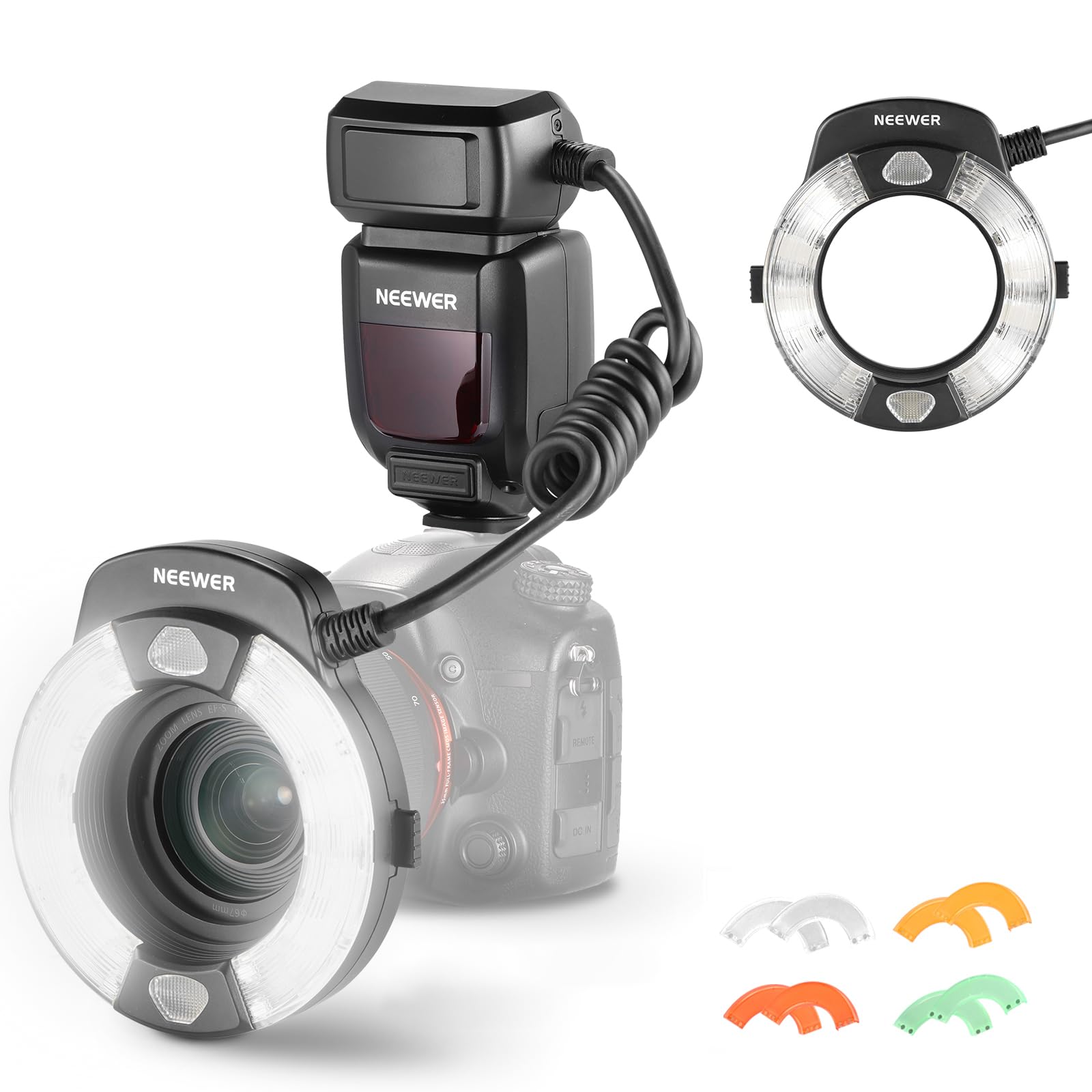
Neewer RF1-S

83 /100
Keeper Score Excellent

Key details

Power
4 AA batteries
Output
76Ws
Guide Number
15 (ISO 100, 1m)
Adapter Rings
8 included
Check Price on Amazon

Near the bottom of this group's price range sits a Sony-fit ring flash with TTL, 76Ws of output and a guide number of 15. That is a lot of specification for the money, and it is why we kept it in the guide rather than treating it as a curiosity.

Three modes do the work: TTL when you want the camera to sort exposure, manual from 1/1 down to 1/128, and a multi mode for repeated pops in a single frame. The two tubes run separately or together, two assist lamps help autofocus find a subject in low light, and a small LCD shows where you are. Eight adapter rings and four color gels round out a kit that reads more expensive than it is.

Our reservation is the power. Four AA batteries are easy to replace but they are a running cost the lithium-powered Godox doesn't have, and they sag in cold weather. We still point a Sony shooter here first when the budget is fixed: TTL exposure and 76Ws of output for about the price of a manual ring is the trade we take.

Pros

  • TTL, manual, and multi flash modes
  • Eight adapter rings and four gels included
  • 76Ws output with a guide number of 15

Cons

  • Sony bodies only
  • AA batteries are a recurring cost
Our verdict

We steer Sony shooters on a tight budget to the RF1-S, where TTL and 76Ws cost less than most manual rings.

Check Latest Price
4

Best for Nikon on a Budget

Meike MK-14EXT-N

82 /100
Keeper Score Excellent

Key details

AF Assist
LED
Flash Modes
Manual, A, B, A+B, continuous
Guide Number
14
Exposure Control
i-TTL, manual
Check Price on Amazon

Meike built this for Nikon DSLR shooters, and the list of supported bodies is long and specific — the D3000 series, the D5000 and D7000 lines, and the D600 through D800. If you're on an F-mount Nikon and want a ring flash that meters through the shoe, this is where the budget conversation starts.

i-TTL and a guide number of 14 are the headline, but what we appreciate is the tube control: manual, tube A alone, tube B alone, both together, or a continuous brightness mode. That last one earns its keep on a tripod, where you're often working one-handed and can't spare a hand for a test shot — you compose with the light on, then fire.

Reliability is the question mark, and the mounting is where it shows up. The adapter plate doesn't always hold the ring firmly against the lens, so check the seating every time you mount it and watch it as you focus. Weigh that against the price and the tube modes and it still earns a place for Nikon shooters who prefer to put the difference toward a lens — as long as you buy it knowing that the seating is the part to watch.

Pros

  • i-TTL metering for Nikon DSLRs
  • Tube A, tube B, both, or continuous
  • Continuous mode helps compose on a tripod

Cons

  • Adapter plate can work loose on the lens
  • Nikon F-mount bodies only
Our verdict

We recommend the MK-14EXT-N to Nikon DSLR owners who want i-TTL and useful tube control without spending much.

Check Latest Price
5

Best Premium

Canon MR-14EX II

82 /100
Keeper Score Excellent

Key details

Power
4 AA batteries
Flash Tubes
Two, together or independent
Guide Number
34.4 ft. / 10.5m
Modeling Light
White LED focusing lamps
Check Price on Amazon

The white LED focusing lamps are what separate this from every third-party ring here. They give you a steady preview of the light, and two forms of modeling flash let you see the shape of the shadow before you commit to the shutter. On a tripod, with a subject that isn't going anywhere, that turns macro lighting from guesswork into something you can actually judge.

The rest is Canon thoroughness. E-TTL through the shoe, twin tubes that fire together or independently, a guide number of 10.5 meters, 1/250 second sync, and a dot-matrix LCD that stays legible in a dark room. It runs on four AA batteries, and it supports optical wireless E-TTL alongside a Speedlite if you're building a two-light setup.

The price is the hard part. It costs far more than the Yongnuo, which gives a Canon body TTL and a higher guide number, and it isn't the brightest unit in this guide either. What you're paying for is the modeling lamps, the build, and the fact that a Canon body and a Canon flash behave predictably together when there's no time to troubleshoot.

So the recommendation is narrow and firm. If you shoot Canon, work from a tripod, and want to see your light before you fire it, nothing else here does that, and the cost stops mattering on the third shoot where it saves a reshoot. If you just need ring light for a hand-held bug shot, take the Yongnuo and put the difference toward a better macro lens.

Pros

  • Modeling lamps preview the light before firing
  • E-TTL with independently firing twin tubes
  • LCD stays readable in dark rooms

Cons

  • Costs far more than the other picks
  • Four AA batteries, no rechargeable pack
Our verdict

We recommend the MR-14EX II to Canon shooters who work from a tripod and want to see the light before they fire it.

Check Latest Price
6

Lightweight Travel Macro

Godox ML-150II

79 /100
Keeper Score Very Good

Key details

Guide Number
12
Recycle Time
0.1–2 sec
Adapter Rings
49, 52, 55, 58, 62, 67, 72, 77mm
Brightness Levels
11
Check Price on Amazon

Point this at a coin on a table, dial in the brightness, and the ML-150II simply works — eleven steps, no menus worth learning, and a ring light enough to leave on the lens between setups. It is an LED ring flash with a guide number of 12, 0.1 to 2 second recycle, and the same eight adapter rings (49 to 77mm) as Godox's bigger unit, which means it fits nearly any macro lens you already own.

The ceiling is lower than the strobe units. A guide number of 12 gives you less punch than the higher-rated picks in this guide, which matters when you're competing with daylight rather than a desk lamp, and the light sits flatter than a two-tube strobe can manage. For tabletop work, flowers, coins, documents, and anything else that sits still in modest light, that's a boundary you won't run into.

Pros

  • Eleven brightness steps with simple controls
  • Eight adapter rings, 49 to 77mm
  • Light enough to leave on the lens

Cons

  • No TTL metering; output set by hand
Our verdict

We like the ML-150II for tabletop and flower work, where its small ring and simple controls beat a heavier strobe rig.

Check Latest Price
7

Continuous Macro Light

Digital Nc 48 LED Ring

77 /100
Keeper Score Very Good

Key details

LED Count
48
Light Output
Continuous
Adapter Rings
8 rings, 49-77mm
Ring Body Weight
4.41 oz
Check Price on Amazon

Start with what this is: a continuous LED ring, not a strobe. Forty-eight LEDs give you steady light you can watch on the rear screen as you move the camera, which is genuinely useful for focusing on something small and for building a focus stack frame by frame. Nothing fires, so you see exactly what you're going to get before the shutter opens.

The kit is generous for the money: eight adapter rings from 49 to 77mm, four diffusers, a coiled cord and a controller with an LCD. The ring body comes in at 125 grams, light enough that it doesn't drag a small lens out of balance, and the output runs warm to cool so you can match room light instead of fighting it.

Mounting is where we want reassurance. The adapter doesn't always lock the ring firmly to the lens, and a ring that shifts while you're focusing is worse than no ring at all. Fit it, check it every time, and treat any movement as a reason to stop and reseat rather than push on. Buy this as a continuous macro light for documents, coins and plants on a windowsill — not as a stand-in for a strobe.

Pros

  • 48 LEDs of steady, visible light
  • Eight adapter rings and four diffusers
  • 125 g ring body stays out of the way

Cons

  • Continuous light only, so it can't freeze motion
Our verdict

We suggest the Digital Nc ring for static subjects and focus stacking, where seeing the light matters more than freezing it.

Check Latest Price

How We Tested Macro Ring Flashes

We started by sorting every ring flash we could find by mount, metering, and what actually ships in the box — adapter rings, gels, diffusers — then cut anything that covered only one filter thread size or locked you into a single camera system. Twelve made the cut, and we shot with each of them for nine months.

Mounting came first, because it's where most of these fall down. I fitted each unit to lenses with 49mm through 77mm threads, timing how long an adapter ring swap took with cold hands and noting whether the ring seated squarely or needed a shim. I also checked hot-shoe fit and whether the foot wobbled after a few weeks riding in a bag, then ran the same white-card-then-glossy-subject sequence on every unit to see whether TTL exposure held steady or drifted when the subject got dark and reflective.

For the light itself, I photographed the same four subjects — a coin, a moth from the porch light, a geranium petal, and a watch movement — at 1:1 with bare tubes, then again with each supplied diffuser and color filter. I was looking for specular hotspots on glossy surfaces, a visible ring burning into reflective subjects, whether the two tubes could be balanced enough to model a curve instead of flattening it, and how fine the manual output steps went, since a coarse jump between power levels blows the exposure at macro range. Recycle time I timed by firing at full power until the unit slowed, counting the seconds between pops.

Reliability showed up in unglamorous places: battery doors that loosened, cables that kinked at the connector, a tube that dimmed after a few hundred frames. And because the extras are often sold separately, I logged what came in each box — a cheaper flash that needs three add-ons before it works isn't cheaper.

How to Choose a Macro Ring Flash

Strobe or Continuous Light

Strobes are what most macro shooters mean by a ring flash: a brief, powerful burst that freezes a moving subject and holds its own against daylight. Continuous LED rings trade that power for visibility — you compose with the light already on, which suits static subjects, focus stacking and any situation where you want to see the falloff before you commit. Ask which you shoot more of. If your subjects move, or you work outdoors at midday, take a strobe; the Digital Nc ring here is the continuous option, and it will not stop a wing.

Match the Mount Before Anything Else

Two kinds of mount sit in this guide. Dedicated units — Yongnuo for Canon, Meike for Nikon, Neewer for Sony, Canon for Canon — talk to the camera and give you TTL metering. Universal single-pin units like both Godox models fire on almost any hot shoe but make you set output yourself. TTL earns its keep when your subject keeps moving closer and further away; manual is often preferred when you work at a fixed distance on a tripod. Decide which photographer you are before you start comparing guide numbers.

Adapter Rings and Lens Fit

Every ring flash here mounts by screwing an adapter into the lens's filter thread, and the sizes in the box decide which lenses you can actually use. The Godox units include eight rings from 49 to 77mm, which covers most macro primes; the Yongnuo ships four, from 52 to 72mm. Check your lens's filter diameter before ordering — it's printed on the barrel or the front cap. A step-up ring handles a mismatch, but it adds depth, and on a very short lens that extra depth can push the ring into the light path.

Power, Recycle and Running Cost

AA-powered units are easy to feed and easy to strand: four cells means a lot of swapping across a long session, and cold weather shortens them. The Godox MF-R76's rechargeable pack is rated for 660 full-power pops, which is why it leads this list — you charge it and stop thinking about it. Recycle time shapes your rhythm too. Three seconds at full output, as on the Yongnuo, is respectable; if you stack frames in quick succession, that pause becomes part of how you work.

Working With a Ring on the Lens

A ring flash is bulk hanging off the front of your lens, and that changes handling more than a spec sheet suggests. The Yongnuo kit runs to 930 grams; the Digital Nc ring body is 125 grams. Weight ahead of the mount makes a ball head creep, so budget for a head that holds if you shoot on a tripod. Think about shadow, too: a single ring gives flat, shadowless light, which is why the dual-tube units here let you fire one side at reduced output when you want shape instead of evenness.

Frequently Asked Questions

Final Verdict

For most people buying a first macro ring flash, the Godox MF-R76 is the one to order. The rechargeable battery, eight adapter rings and independently controlled tubes cover more situations than anything else here, and none of it depends on which camera body you own.

If you shoot Canon and want metering through the shoe, the Yongnuo YN14EX II gives you TTL and a higher guide number for a lot less; Nikon owners get the same logic from the Meike. Buy for the mount you own today, not the one you might switch to.