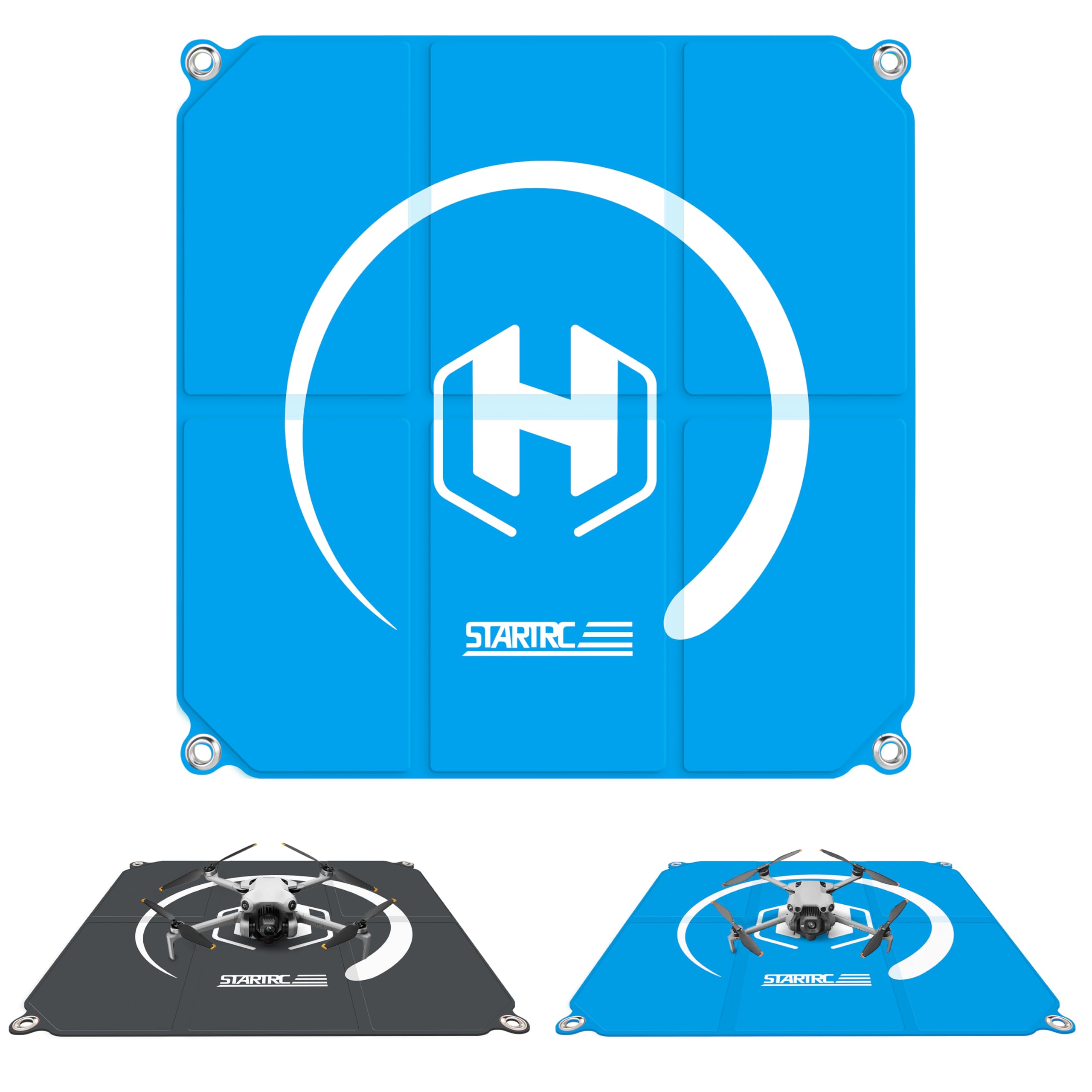
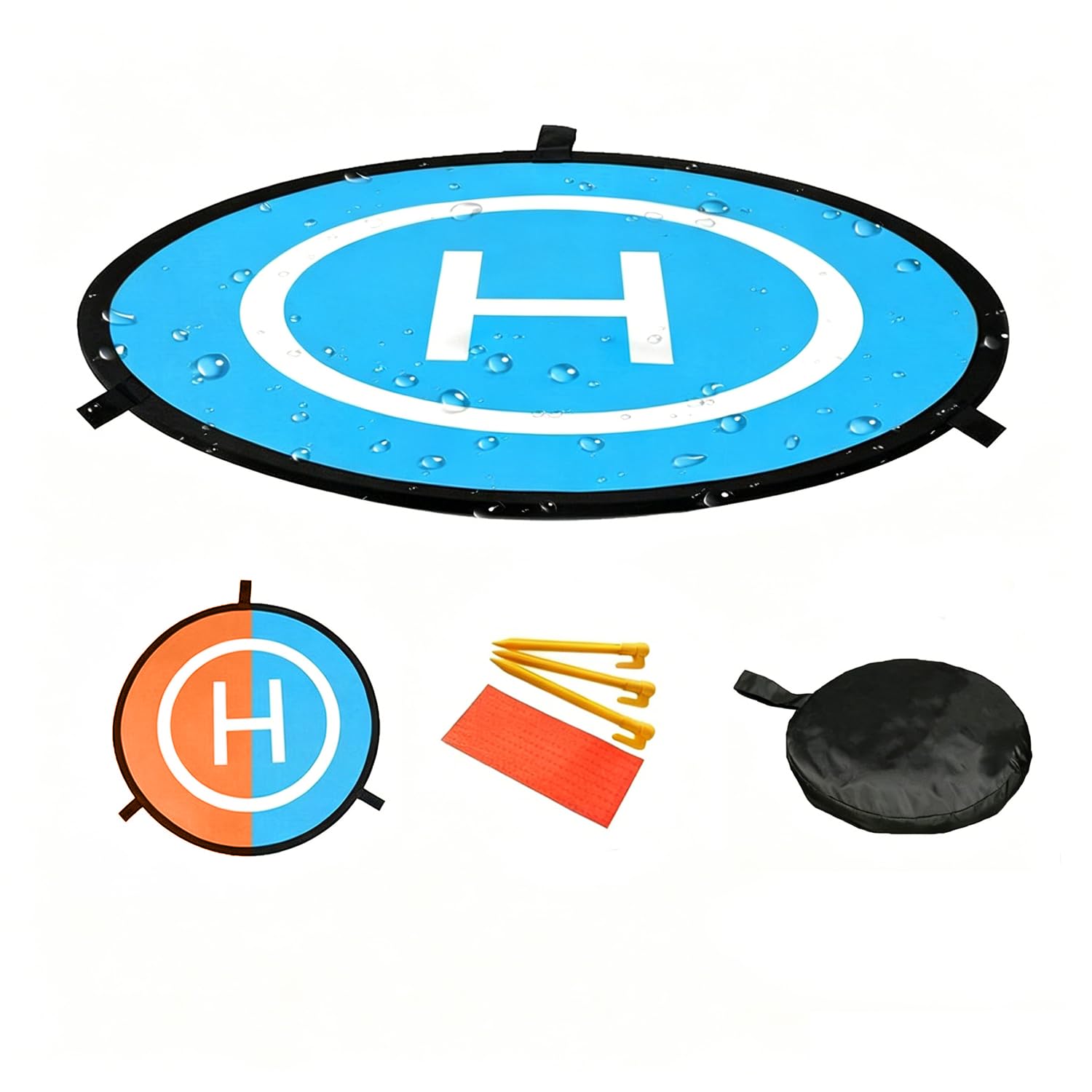
Best Drone Landing Pads of 2026

Landing pads are one of those accessories you buy after your first bad landing. Wet grass, loose gravel, a patch of sand the props fling straight into the motors — a mat gives you a defined, high-contrast target, gives the downward sensors something flat to read, and keeps grit out of the gimbal. It also carries a built-in tradeoff: the pad that's most forgiving to land on is the one that eats the most room in your bag.

Over the past four months my team and I have flown off 14 of them, from a pad smaller than a folded map to one nearly 28 inches across with LEDs stitched into the rim. Size is only half the argument: weighted corners that hold in prop wash, a fold that springs open one-handed, and reflective edging you can spot at dusk decide whether a pad lives in your kit or gets left in the trunk. What comes in the bag for the money counts too, and the picks below run from a bare-bones mat to a lit-up one for evening flights.

Keeper Score summarizes customer ratings and review volume. Read it alongside the product details and trade-offs. How the score works.

1

Best Overall

VCUTECH 25-Inch Landing Pad

94 /100
Keeper Score Outstanding

Key details

Size
25 x 25 in (65 x 65 cm)
Faces
Two-color double-sided
Material
Waterproof PU PVC
Check Price on Amazon

Twenty-five inches corner to corner is more landing area than a Mini or an Air strictly needs, and that's exactly the point: on a pad this size you can be a few inches off in a crosswind and still come down on coated fabric instead of on gravel. The two-color faces give you a bright target in the camera feed, and the graphic on each side pulls your eye to the middle while the drone descends.

What surprised us is how little of that size you pay for once it's packed. The pad folds along its seams without a fight — the thing we've learned to dread on landing pads — and it drops into the top of a drone bag beside the controller. The waterproof PU PVC is the other quiet win: mud and sand rinse off with a bottle of water, and it doesn't hold grit the way a woven nylon mat does. After a wet morning on a riverbank we wiped it down, left it to dry on the dashboard, and it came out of the bag clean the next week.

Weight is where it gives ground to the Hoodman. It sat flat through a breezy afternoon of launches, but this is a coated mat rather than a laminated slab, and in a real gust you'll want a foot on a corner until the rotors are up. Ours came in pink, which reads clearly against grass and asphalt; if your launch spots are pale sand or dry desert, the yellow and orange pads here will pop harder.

Pros

  • 25-inch surface forgives a sloppy approach
  • Folds along its seams without a fight
  • Waterproof PU PVC rinses clean
  • Weighted enough to sit flat in a breeze

Cons

  • Folded bundle is wide for a small drone case
Our verdict

We recommend the 25-inch VCUTECH to almost everyone: it hands you the most landing area in this group short of a specialist pad, folds in seconds, and costs less than most of the alternatives.

Check Latest Price
2

Best for Windy Launches

Hoodman LP21 Landing Pad

94 /100
Keeper Score Outstanding

Key details

Weight
1.9 lb
Ballast
Six vinyl-covered laminates
Diameter
21 in
Material
Vinyl over laminate
Check Price on Amazon

Six vinyl-covered laminates are sewn into this pad, and the difference they make shows up the moment the rotors spin up. On a gravel pull-off we've had thin mats skate and ripple under prop wash; this one sat there as if it had been bolted down. That's the whole case for spending more: if your launch spots are loose-surfaced and breezy — coastal grass, dirt lots, open fields — the Hoodman takes the one variable you can't control out of the takeoff.

At 1.9 pounds it's still a pad you'll carry. It folds into a package you can strap to the outside of a daypack with its own rubber belt, and the 21-inch face is a comfortable target for a Mavic or an Air. The vinyl surface shrugs off sand and wipes clean, and the edges have come through a season of folding and unfolding without curling.

Two things to accept. The fold has a knack to it — get the panels out of sequence and the pad fights you, so learn it in the kitchen before you're doing it on a hillside in gloves. And it's the priciest pad in this group by a wide margin over the pads that do most of the same job. Weekend flyers will get most of the way there with the VCUTECH; the Hoodman earns the extra for people who fly in wind more often than not.

Pros

  • Weighted laminates stay flat under prop wash
  • No stakes needed to hold it down
  • 1.9 pounds still packs for a hike
  • Wipe-clean vinyl over laminate

Cons

  • Highest price in this group
Our verdict

If you fly where the wind actually blows, we think the Hoodman is worth the extra: six weighted laminates keep it flat when lighter mats ripple and skate.

Check Latest Price
3

Best for Night Flying

FPVtosky Reflective Landing Pad

93 /100
Keeper Score Outstanding

Key details

Faces
Blue and red
Weight
1.08 lb
Material
Double-sided PU leather
Folded Size
10.2 x 7.4 x 0.7 in
Check Price on Amazon

Point a headlamp or a landing light at this pad and it lights up like a road sign. The reflective face is the reason to buy it: at the end of a day's flying, when the light is going and you're lining up a descent, a target that bright is worth more than any printed graphic. One side is blue and the other red, so you can flip it to suit the terrain.

The rest of the package is quietly sensible. It's 490 grams of double-sided PU leather — heavy enough to lie down flat on short grass, light enough to forget in a pack — and it folds along creases already set into the material, so it goes back into its bag without a wrestling match and ends up around 10 by 7 inches. Mud rinses off under a tap.

For dusk flights with a Mini or a Mavic, this is the pad we reach for: a reflective face does more for a tired pilot at the end of the day than another two inches of mat would. Of the two sides, the red is the more useful — it holds contrast against wet grass and dark soil, where the blue goes quiet in shade.

Pros

  • Reflective face shines under a landing light
  • Set creases make folding easy
  • Waterproof PU leather rinses clean
  • 490 grams lies flat on short grass

Cons

  • Can lift at an edge in a strong gust
  • Reflectors need a light aimed at them
Our verdict

Our pick for dusk flights: the reflective face lights up under a landing light, and 490 grams of PU leather lies flat and folds without a wrestling match.

Check Latest Price
4

Best for Big Drones

ACROTOR 27.6-Inch LED Landing Pad

89 /100
Keeper Score Excellent

Key details

Weight
12.3 oz
Diameter
27.6 in (70 cm)
Lighting
Removable LED strip
Material
Waterproof nylon
Check Price on Amazon

The LED strip is the feature you're paying for here, and it does less than the product pictures imply. It marks the rim — from the air on a dark field you'll find the pad without trouble — but it doesn't throw light onto the ground you're landing on. Treat it as a locator and fly the landing on the camera and a headlamp, and you'll be pleased; expect a lit helipad and you won't be.

The size is the other half of the story, and it's the half we like more. At 27.6 inches this is the biggest target in this group, which matters if you're bringing down a Mavic 3, an Air 3S, or anything whose legs need clearance. The nylon shell is waterproof and wipes down, and it folds to a fraction of its open size with a pouch to match.

Two practical notes. The strip comes off, so on a daylight trip you can leave it at home and save the bulk. And getting the panels back into the pouch is a knack that took us a few tries on a windy hill. Neither is a dealbreaker, and neither changes the fact that for a big airframe this is the pad with the most room for error.

Pros

  • 27.6-inch surface, the largest here
  • Removable LED strip for night marking
  • Waterproof nylon wipes down
  • Folds to a fraction of its open size

Cons

  • Reflective tape can lift at the edges
Our verdict

We rate it the big-drone pad here, as long as you treat the LED strip as a locator for the pad rather than a light for the landing itself.

Check Latest Price
5

Best for Soft Ground

STARTRC 22-Inch Landing Pad

91 /100
Keeper Score Outstanding

Key details

Size
22 x 22 in (55 x 55 cm)
Weight
16 oz
Material
Waterproof PU
In The Box
Four ground stakes
Check Price on Amazon

Four ground stakes come in the bag, and they change what this pad can do. On wet grass, loose sand or the crumbling edge of a plowed field you pin the corners and stop thinking about wind entirely; on pavement you leave them in the bag and let the pad's own weight do the work. We pegged it out on a wet morning and it was exactly where we left it after a dozen launches.

What we didn't expect to care about is the rigid mid-deck. A soft mat drapes over tufts and clumps and hands you a lumpy landing; this one bridges them, so the drone settles onto something genuinely flat. Six folding sections, 16 ounces of pad, a waterproof PU surface that wipes clean, and a storage bag — the whole thing is built to be used rather than admired.

The 22-inch face is the sweet spot for anything from a Mini to a Mavic 3: enough room to land without hunting, small enough for a pack's side pocket. The blue-gray face is easy to pick out against grass and gravel, though on fresh snow it has less contrast than an orange pad would, which is worth knowing if you fly through winter.

Pros

  • Four stakes included for soft ground
  • Rigid panel bridges grass and gravel
  • 22-inch face suits Mini through Mavic 3
  • Waterproof PU wipes clean

Cons

No notable drawbacks to flag.

Our verdict

The one we hand to people who fly off grass, sand or snow: four stakes, a rigid panel that stays level, and a price that makes it easy to keep in the car.

Check Latest Price
6

Best Compact

CQT 17-Inch Landing Pad

92 /100
Keeper Score Outstanding

Key details

Size
16.9 x 16.9 in (43 x 43 cm)
Faces
Yellow and dark gray
Weight
14.7 oz
Material
Waterproof PU PVC
Check Price on Amazon

Seventeen inches is the size that makes a landing pad disappear into a small kit, and this one does: it folds into its pouch and slides into a jacket pocket or the front compartment of a camera bag.

The yellow face is the one to fly home to. It holds contrast against grass, gravel and tarmac, and you can pick it out in the camera feed from a long way up. The reverse is a dark gray, which suits bright, flat light better than a screaming yellow does. The PU PVC is waterproof and stain-resistant, so mud comes off with a bottle of water and a wipe.

Where it earns its place in this group is portability: this is the pad we tuck into a small bag when the flight is a quick one and the drone is a Mini, a Neo or an Avata. The trade is surface area — a Mavic 3's legs will hang over the edge, so treat it as a small-drone pad — and the pouch is a soft sleeve rather than a zippered case, which is one less thing to break.

Pros

  • Folds small enough for a shoulder bag
  • Yellow face reads clearly from the air
  • Waterproof PU PVC washes clean
  • Under a pound in the bag

Cons

  • Can bow at the seams on rough grass
Our verdict

For Mini and Avata pilots we like this 17-inch pad best: it folds small, wipes clean, and leaves the rest of the bag for batteries.

Check Latest Price
7

Backpacking

YINGJEE 22-Inch Landing Pad

92 /100
Keeper Score Outstanding

Key details

Size
22 in (55 cm)
Material
Waterproof coated nylon
In The Box
Three ground nails and bag
Night Markers
Eight reflective strips
Check Price on Amazon

This is a coated nylon sheet with a printed target on it, not a laminated slab, and that's exactly why it has a place here: it weighs next to nothing and it disappears into a pack.

The 22-inch face gives you the same working area as several heavier pads in this group, and the print — a bright target with a landing circle — is legible from height in good light. Eight reflective strips come in the box for night work, and you place them yourself around the outer ring, which means they end up where your camera actually looks rather than where a factory decided.

Waterproof nylon, three ground nails and a zippered pouch with a hand strap. Rain and wet grass aren't a problem: a shake, a wipe, and it goes back in the bag.

Our use for it is the trip where every ounce counts — a hike, a bike-packing run, a day when the drone is one of five things in the pack. On gravel it keeps debris out of the props without giving you the rigid surface a board does. If you launch from rough ground every weekend, one of the weighted pads will serve you better; if you carry your pad more often than you set it down, this is the one.

Pros

  • Packs smaller and lighter than any pad here
  • Eight reflective strips you position yourself
  • Three ground nails included
  • Waterproof coated nylon

Cons

  • Needs staking once the wind picks up
  • Nylon holds creases along the fold lines
Our verdict

We keep this one for trips where weight matters: it's the lightest way to get a 22-inch launch surface here, provided you use the nails it comes with.

Check Latest Price
8

Flat Packing

Lekufee Folding Landing Pad

89 /100
Keeper Score Excellent

Key details

Weight
1.43 lb (0.65 kg)
Folded Size
10.8 x 7.3 x 0.63 in
Construction
PU leather over PVC board
Unfolded Size
21.6 x 21.6 in (55 x 55 cm)
Check Price on Amazon

There's a reinforced PVC board inside this pad, sandwiched between two faces of PU leather, and you can feel it the moment you pick it up: it's a panel, not a cloth. That's what keeps 21.6 inches of pad dead flat over a rock or a rut, and it's why the folded bundle is a hard, thin slab instead of a soft lump.

Folded, it measures about 10.8 by 7.3 by 0.63 inches, thin enough to slide into a laptop sleeve or the flat pocket of a camera backpack. Both faces are bright — red on one side, yellow on the other — and the smooth surface wipes clean with a damp cloth, the sort of thing you notice after a session on wet sand.

At 1.43 pounds it isn't the pad you carry on a long hike for its own sake; that's the YINGJEE's job. What you get for the mass is a surface that doesn't argue with the ground underneath it.

We like it for travel shoots, where the pad lives in the same bag as a laptop and gets set down on car parks, gravel verges and flat roofs. It's a well-finished pad that simply has livelier competition here: the VCUTECH gives you more landing area for less, and the STARTRC brings stakes for soft ground. Come to this one when flat packing and a rigid, wipe-clean surface are the two things you care about.

Pros

  • Rigid board stays flat over ruts and rock
  • Folds to a 0.63-inch slab
  • Smooth surface wipes clean
  • Red and yellow faces for visibility

Cons

  • Heavier than the fabric pads here
Our verdict

For a pad that stays perfectly flat and slides into a laptop sleeve, we think this is the best version of that here — you just pay for the rigidity.

Check Latest Price

How We Picked and Tested the Best Drone Landing Pads

We started with roughly 35 pads on paper and narrowed them by three practical things: footprint once deployed, packed weight, and whether the corners were weighted, staked, or neither. Fourteen made the cut and spent four months in the field.

Those pads flew with us from a gravel trailhead, a dew-soaked park field at 7 a.m., a dusty equipment lot, and my own backyard during evening sessions. We unfolded each one one-handed, the way you actually do it with a controller in the other hand, and noted whether it sprang open or needed wrestling. We weighed each on a kitchen scale with its case, then checked whether it slid into a backpack side pocket. We set each on a slope and ran takeoffs and landings back to back to see if the corners lifted in prop wash or the whole mat skated, giving staked and weighted designs the same treatment on wet grass.

After each session we hosed the pads down, folded them wet, and left them in a warm car overnight to see which ones smelled, which dried out, and which hinges and seams started fraying after a few dozen folds. At dusk we walked about 150 feet away and judged how reflective edging and LED rings read against grass versus pavement, and whether the light helped or just glared. Value came last: we compared what shipped in the bag — case, stakes, tie-down cord — against what the pad cost, and whether the materials looked like they'd survive a full season of that.

How to Choose a Drone Landing Pad

Start with the ground under the drone

Sand, gravel and dry dirt are the reason landing pads exist: rotor wash lifts that grit straight into motor bearings and across the camera lens, and the damage accumulates quietly rather than all at once. If you launch from clean pavement every time, or you hand-catch, you can skip the whole category.

If your spots are loose-surfaced, buy for the worst one you fly from: a sealed PU or PVC face on a pad with some mass behind it, plus stakes if that ground is soft. A pad that lifts and slides is worse than none, because you stop trusting it and start skipping it.

Weight, stakes, or a rigid core

Three things keep a pad down: ballast sewn into the pad, ground stakes, or the stiffness of a board. Ballast is the one that works on pavement, where stakes have nothing to bite into — the Hoodman's six laminate inserts and the FPVtosky's 490 grams are the same idea at different scales. Stakes win on grass and sand, and a rigid mid-deck bridges tufts so the landing surface stays level.

Be honest with yourself about wind. A light nylon mat is a hiking pad, and it needs pegging the moment the rotors are turning; a laminated pad will sit through gusts that would flip it.

Size: match the diameter to the airframe and the bag

Landing pads run from about 17 inches to nearly 28, and the right one depends on what you fly. A Mini, Neo or Avata is comfortable on 17 inches; an Air or Mavic 3 wants 22 to 25; anything with a wider stance or a gimbal that hangs low is easier on the ACROTOR's 27.6 inches.

The trap is buying the biggest pad and then leaving it at home. A 25-inch pad that folds into your bag beats a 28-inch one that stays in the car, so measure the folded bundle against the bag you actually carry before you fall for the surface area.

Seeing the pad: color by day, reflectors and lights after dark

Contrast matters more than color preference. A bright orange or yellow face reads against grass, gravel and dark soil; against pale sand or snow, a darker or bluer face can be the clearer target. Flip a double-sided pad and you get both options for nothing.

After dark, reflective strips only work if a light is aimed at them — your landing light or a headlamp — while an LED strip marks the pad's position without lighting the ground around it. Neither replaces a careful descent on the camera; both make the pad easier to find when the light is going.

Materials and upkeep

PU and PVC-coated pads wipe clean and stay waterproof through a wet morning. Coated nylon is lighter and packs smaller but holds grit in the weave and takes creases more readily, and a rigid PVC board sits flat but won't drape, so it lives inside a bag rather than strapped to one.

None of these pads need special care beyond a rinse and a wipe. The material choice is really about how much flatness you're willing to carry, and whether you'd rather save weight or save the fuss.

Frequently Asked Questions

Final Verdict

Start with the VCUTECH 25-inch pad. It gives you more landing area than anything here short of the big-drone ACROTOR, it folds without a fight, and it sits at the bottom of this group on price — no other pick beats it on more than one of those at once.

Two situations change the answer. If you fly in genuine wind off loose ground, the Hoodman's laminates are worth the premium, and if dusk is when you fly, the FPVtosky's reflective face earns its place in the bag.