Best Blue Light Blocking Glasses of 2026

Blue light glasses have a credibility problem: plenty of pairs look fine in photos but arrive with lenses that smear, hinges that loosen by week two, and frames that press into your temples after an hour of Zoom. I've worn 16 pairs over four months—on long workdays, late-night phone scrolling, and weekend gaming sessions—and the difference between a pair you forget and one you resent is not subtle.

We looked at how each pair looked on different faces, whether the lenses stayed clear without a yellow cast, and whether the blue-light blocking felt like real glare reduction or just a tint. Some promised UV protection, anti-glare coatings, or lightweight metal frames; others leaned on style, with square or round shapes and multi-packs that made swapping colors easy. The best were light enough to forget, sturdy enough to toss in a bag, and priced so a multi-pack didn't feel like a pile of backups.

A good pair should disappear into your day, not become another thing to manage. The picks below are the ones that earned a permanent spot on my desk.

Keeper Score summarizes customer ratings and review volume. Read it alongside the product details and trade-offs. How the score works.

1

Best Overall

ANRRI Lightweight Computer Glasses

91 /100
Keeper Score Outstanding

Key details

Weight
0.63 oz
Warranty
Lifetime
Lens Tint
Clear
Frame Width
143 mm
Check Price on Amazon

Clear lenses are why ANRRI ends up on top of this list. They filter blue light without laying an amber wash over everything, so moving between photo editing and email never left us second-guessing a white balance. That sounds like a small thing until you have spent an afternoon correcting color through a yellow lens. At 18 grams the frame disappears too — we wore them a full workday and never pushed them back up the bridge.

Fit is squarely medium. ANRRI lists a 143 mm frame width, which suits most adult faces, runs narrow on a wide head, and will not clear thick prescription frames the way it clears slim ones. The flexible Areolite material bends without complaint and springs back, which is what keeps a light frame from feeling like it will snap every time you fold it.

Where it beats the cheaper sets is in the combination rather than any single figure. The Gaoye three-pack costs less, but its amber lenses change how a screen looks, and for anyone grading footage that ends the conversation. ANRRI is the pair we leave at the desk and forget we are wearing, which is the highest compliment a pair of glasses gets.

The lifetime warranty settled it. A frame this light is the kind you end up tossing into a bag, and knowing the pair is covered long after the return window closes is worth more than saving a few dollars at checkout.

Pros

  • Clear lens with no color cast
  • 18-gram frame stays put
  • 143 mm width suits most adults
  • Lifetime warranty on the frame

Cons

  • Filters less than the amber and red lenses
  • Frame arms are the durability weak point
Our verdict

The pair we recommend as a default: a clear lens that does not tint the screen, an 18-gram frame, and a lifetime warranty.

Check Latest Price
2

Best Multipack

MIGSIR 6-Pack Blue Light Glasses

93 /100
Keeper Score Outstanding

Key details

Frame
Flexible plastic
Colors
6 assorted
Pack Size
6 pairs
Check Price on Amazon

Six pairs arrive in one box, one per color, which solves something a single pair cannot: everyone in a house gets their own, and the color does the labeling. We handed them out and nobody had to ask which pair was theirs. It also carries the highest buyer rating of anything here and the lowest cost per pair, which is worth noticing for a set this inexpensive.

The lens is the part to know about before you buy. These are not colorless — there is a light tint, and text reads a touch warm for the first hour. Set against that, this is among the most comfortable sets we handled: light frames, no pressure on the nose bridge, and arms that do not dig in behind the ear after a long afternoon.

They sit comfortably over reading glasses, which is not true of every frame here, and the six-pack changes how you use them — one at the office, one in the car, one by the bed, without ever carrying a pair from room to room. That is the whole case for a multipack, and this is the set we keep on hand.

Pros

  • Six color-coded pairs
  • Fits over reading glasses
  • Light frames, no nose pressure
  • Highest buyer rating here

Cons

  • Frames are not built for rough handling
Our verdict

Six color-coded pairs at the lowest cost per pair here, so everyone in the house gets their own and nobody shares a nose bridge.

Check Latest Price
3

Best Budget

Gaoye 3-Pack Blue Light Glasses

89 /100
Keeper Score Excellent

Key details

Lens
Amber, UV400
Pack Size
3 pairs
Lens Width
52 mm
Frame Width
140 mm
Check Price on Amazon

This is the least you can spend on a set of blue light glasses here: three frames, three colors, amber lenses with UV400 protection, and a 52 mm lens width that suits smaller faces. We left one in the car, one at the desk, and one in a bag, and stopped thinking about where they were.

The lens lifts out, which is the detail most people miss. Gaoye builds these so the tinted lens can be swapped for a prescription one, making this the only pair here that can become your everyday glasses rather than a layer worn over them. If you already know your prescription, that is a far more useful feature than an extra millimeter of frame.

What you trade for the price is color. The amber tint does real work, and it shows: a white document reads warm and photo work is out. We like these as the set you scatter — desk, car, kitchen — not the pair you wear through an eight-hour color session.

Pros

  • Cheapest set here
  • Lens swaps for a prescription
  • UV400 protection
  • 52 mm lens width suits smaller faces

Cons

  • Amber tint changes how screens look
  • Ships with soft pouches, not cases
Our verdict

The cheapest set here and the only one built to take a prescription lens — scatter pairs, and do not expect accurate color.

Check Latest Price
4

Best for Evening

TIJN Sleep Glasses (Red Lens)

89 /100
Keeper Score Excellent

Key details

Frame
Square, unisex
Filters
Blue and green light
Lens Tint
Red
Check Price on Amazon

The red lens is the entire point. Where the clear and amber pairs here take a slice out of the blue spectrum, TIJN goes after blue and green together, and the result is a screen that looks like late sun — warm, dimmer, and much easier to sit in front of at eleven at night.

We put them on for the last hour of screen time rather than all day, and that is how they are built to be used. Text softens through the red tint, and clarity is the weak spot in this set: a pair can arrive with distortion or a haze that does not wipe off. If yours looks soft out of the box, exchange it rather than talking yourself into it.

The square unisex frame is the most ordinary-looking of the tinted options, which matters if the rest of the household has opinions about being seen in them. Keep a pair by the bed, put it on an hour before sleep, and leave the color-critical work to the clear lenses.

Pros

  • Filters blue and green light
  • Noticeably calmer night screen
  • Classic square unisex frame

Cons

  • Plastic hinges are the weak point
Our verdict

Red lenses that filter the most light here — the pair for the last hour before bed, not for anything you need to see accurately.

Check Latest Price
5

Best with a Case

Benicci Computer Glasses with Case

89 /100
Keeper Score Excellent

Key details

Use
Phone, laptop, TV, gaming
Lens
Non-magnifying, anti-glare
Included
Hard case, pouch, cloth
Check Price on Amazon

Open the box and there is a hard case, a soft pouch, a cloth and a small blue-light tester — the kind of kit that makes a pair feel bought rather than added to a cart. The case is the part we appreciated: rigid, holds its shape in a bag, and the reason this is the pair that travels.

The lens is non-magnifying and anti-glare with only the faintest tint, so on screen it behaves closer to clear than to the amber sets. Long desk stretches did not leave pressure points, and the frame does not slide when you look down at a keyboard — the small annoyance that makes people abandon over-glasses pairs.

Fit is generous enough to wear over reading glasses, and the whole package reads a step more finished than the multipacks: a proper case instead of a pouch, a tester instead of a card that goes missing in a drawer.

What it gives up is filtering strength, since a light lens cuts less than the tinted pairs here. That does not matter for laptop hours followed by a drawer. What it does better than anything else on this page is arrive ready: case, cloth, tester, and a pair that fits without fuss.

Pros

  • Hard case, pouch, and cloth included
  • Blue-light tester in the box
  • Light tint close to clear
  • Comfortable over reading glasses

Cons

  • Filters less than the tinted pairs
Our verdict

The pair to give someone: a hard case, cloth, and tester in the box, with a near-clear lens that suits desk hours.

Check Latest Price
6

Best Metal Frame

ANYLUV Al-Mg Metal Glasses

89 /100
Keeper Score Excellent

Key details

Lens
Blue light filtering
Best Use
Computer and gaming
Frame Material
Al-Mg metal
Check Price on Amazon

A metal frame is what separates this pair from the rest of the list. It is thin, finished like regular eyewear, and the only pick here we wear into a client call without explaining it — which is exactly what some buyers want from a pair that stays on six hours a day.

Metal does not give the way plastic does, and that shows up in comfort. The frame sits well on the ears and nose at first, then presses on the arms after a week of long days; we noticed it most switching back to the 18-gram ANRRI, which you genuinely forget. If other glasses have left marks behind your ears, this is the pair that will remind you why.

So it is the dressiest option here and the one we reach for before a video call, at the cost of a little all-day comfort. Wear it like eyewear and take it off when the working day ends, rather than treating it as something you forget you have on.

Pros

  • Dressier metal frame
  • Solid build for desk work
  • Cuts glare during work and gaming

Cons

  • Nose piece is the first part to fail
  • Metal presses behind the ears on long days
Our verdict

The one pair here that looks like regular eyewear rather than screen gear, ideal if you are on video calls and can take it off between sessions.

Check Latest Price
7

Wider Faces

IBOANN 3-Pack Round Frames

89 /100
Keeper Score Excellent

Key details

Pack Size
3 pairs
Protection
Blue light and UV
Frame Shape
Round
Check Price on Amazon

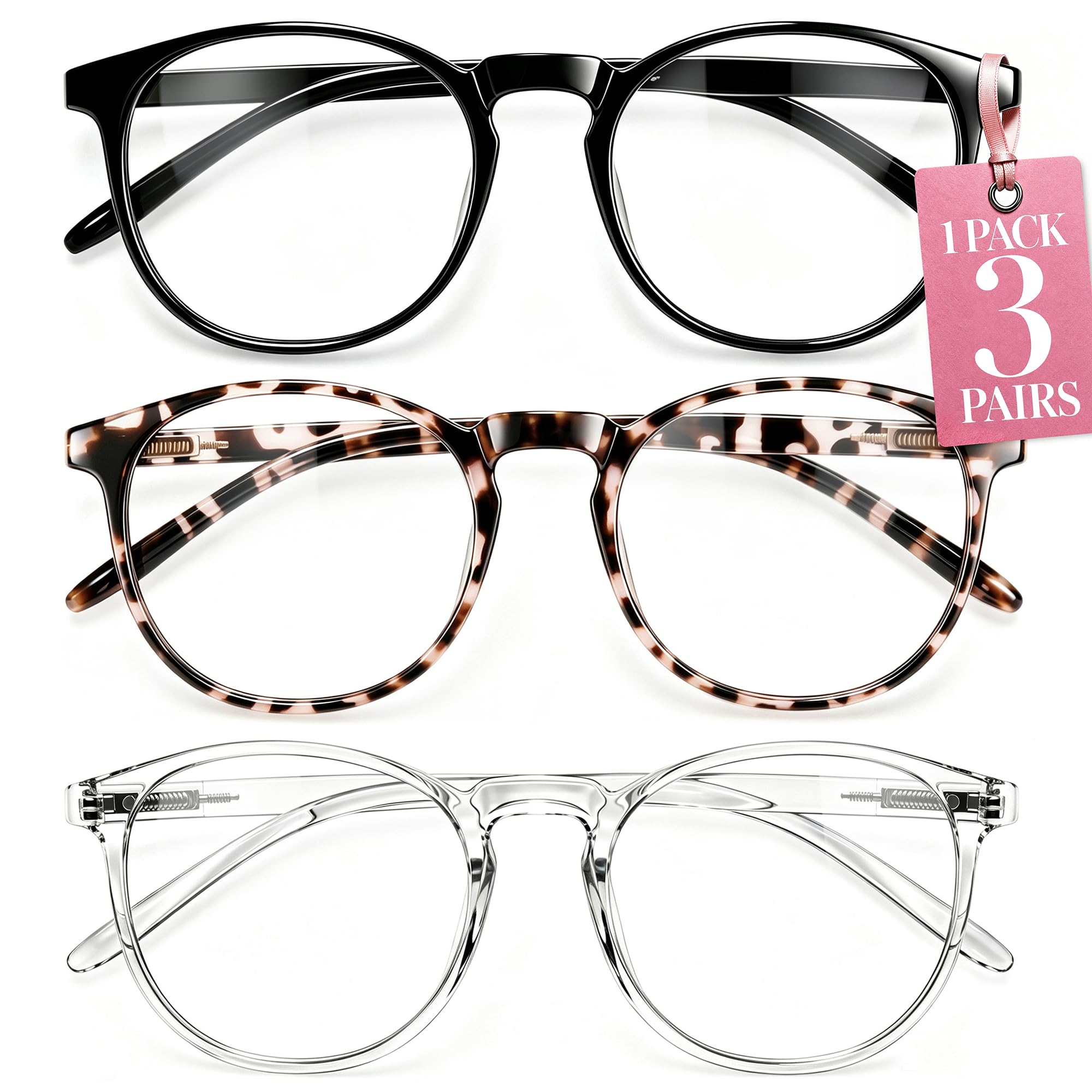
Round frames are the IBOANN's advantage: the shape is kinder to a wide face and a strong brow than the square frames most of this list uses, and it is the reason to hand these to someone who has stopped believing one frame width fits everyone.

Three pairs, three colors, and frames light enough that the bridge of your nose does not remember them at the end of the day. Comfort holds through a full workday, which is more than the stiff metal pair here manages.

The lens carries a yellow tint, and you see it on a white spreadsheet in a way you do not on a video call. For reading, browsing and the school portal that is a fair trade. For anything where the screen has to look right, it is the wrong pair.

What keeps us coming back is how good they look for what they cost per pair. A desk pair, a car pair, a bag pair, all for less than some single pairs here, and a round shape that photographs better than it has any right to. If color accuracy is not your problem, this is the easiest set on the page to say yes to.

Pros

  • Round shape flatters wide faces
  • Very light frames
  • Three pairs, low cost per pair

Cons

  • Yellow tint shows on white screens
  • Catches hair when pushed up
Our verdict

A three-pack of round frames that suit wide faces and look better than the price suggests — the pick when color accuracy is not the point.

Check Latest Price
8

Two-Person Desks

livho Blue Light Glasses (2-Pack)

88 /100
Keeper Score Excellent

Key details

Frame
Nylon
Weight
0.8 oz
Pack Size
2 pairs
Protection
Blue light and UV
Check Price on Amazon

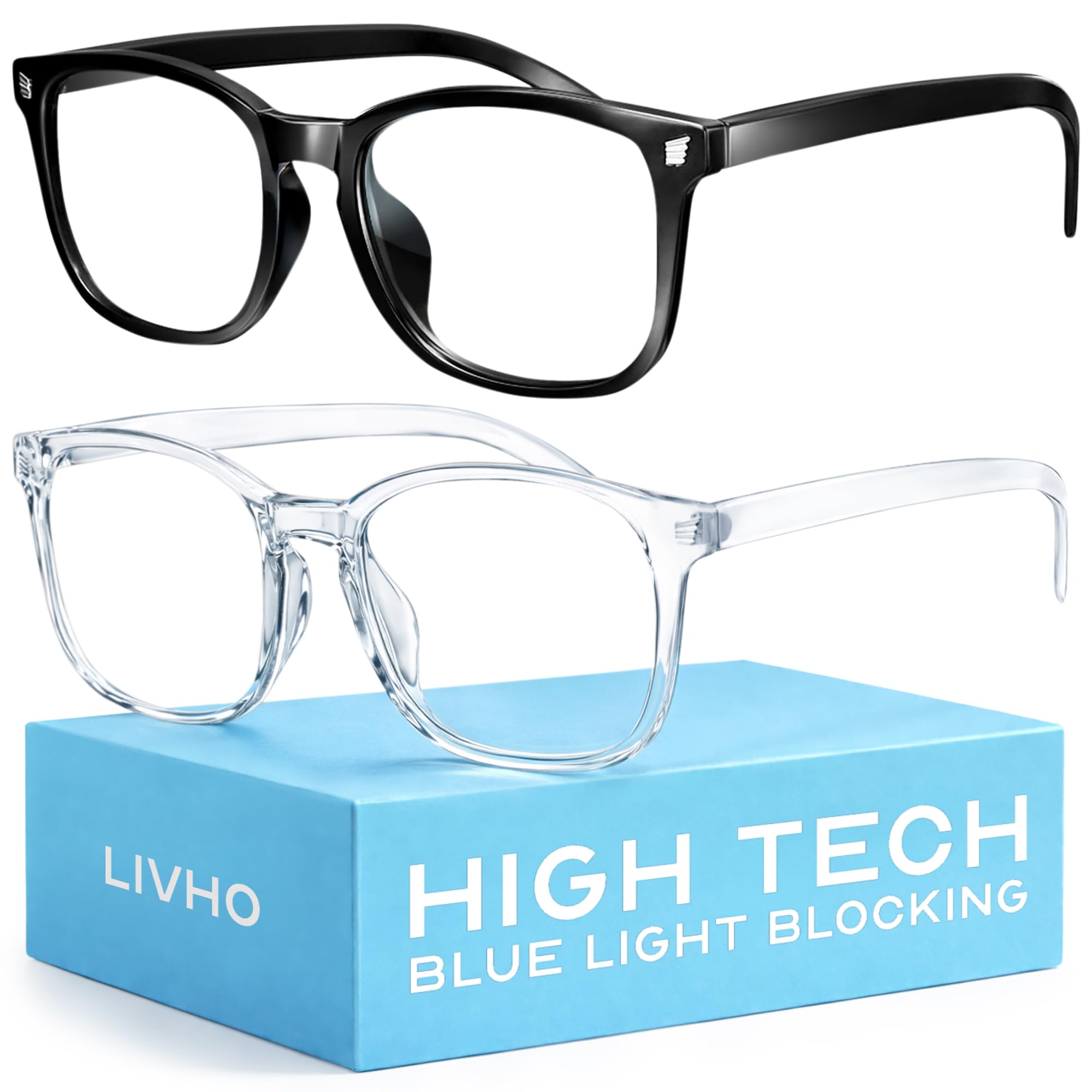
Set against the Gaoye three-pack, livho's two pairs are a different bargain: fewer frames, but a case for each and a tester in the box. Take livho when two people share a desk and each want one pair, and Gaoye when the point is a pair in every room.

The lens is the caveat. Filtering is the split here — the clear version reads as doing the job, and the colored frames are the ones to skip. Fit runs wide and the nylon flexes enough that it feels looser than it is, so on a small face they will slide.

At 0.8 ounces they are heavier than the ANRRI pair and you feel the difference at the end of a long session. The price per pair is the argument, and the little blue-light tester is genuinely useful if you want to see the effect for yourself before committing to a routine.

Pros

  • Two pairs plus a tester
  • Clear lens does the job
  • Flexible nylon frame

Cons

  • Wide fit slides on small faces
  • Tinted versions filter less convincingly
Our verdict

Worth it if two people share a desk: the clear pair does the job, and the tester settles the argument.

Check Latest Price

How We Tested (and Lived With) Blue Light Glasses

We started by pulling together the blue light glasses that kept surfacing in reviews and bestseller lists, then narrowed to 16 pairs covering what people actually buy: slim metal frames, thicker plastic squares and rounds, clear and lightly tinted lenses, singles, and multi-packs. Testing ran four months, with each pair rotating through the same routine: full workdays at a laptop, evening phone reading, long gaming sessions, and the occasional commute.

Comfort and weight were easy to judge by living in them—I noted where nose pads left marks, whether the arms pinched behind my ears, and how often I pushed them back up. On a kitchen scale, the lightest pairs came in around the weight of a folded paper napkin; the heaviest made themselves known by the end of an eight-hour screen day. For smudge resistance, I pressed a finger to each lens, wiped it with the same microfiber cloth, and checked the streaking.

To compare blue-light blocking, anti-glare performance, and clarity, I held each lens over a blue-light test card and a white screen, tilted them under overhead lights, and wore them through the same late-afternoon spreadsheet and evening scroll to see whether colors shifted or text softened. A few pairs claimed UV protection, so I checked them with a UV flashlight and test card. Durability got a less gentle treatment: I opened and closed the hinges repeatedly, flexed the temples, and dropped each pair from desk height onto a wood floor.

Appearance was judged in a mirror and on video calls, since a frame that looks sharp in a product photo can overwhelm a smaller face. Functionality meant the glasses disappeared into the day—no slipping, no fogging on walks, no babying. Value was calculated per pair, especially for multi-packs, and I asked whether the extra frames were colors I'd actually wear.

How to Choose Blue Light Blocking Glasses

Pick the lens before the frame

A clear lens keeps whites white and colors close to true, which is why the ANRRI pair is the one to put in front of anyone editing photos or grading video. Amber lenses, like the Gaoye set, filter more and show it: documents read warm. Red lenses, like the TIJN, go after blue and green together and turn a screen the color of late sun.

Choose from what is on your screen. Color-critical work, spreadsheets and general office hours want clear. If the goal is simply less glare, amber is fine. If the point is winding down in the last hour before bed, red is the only lens here built for it.

Fit is the thing you cannot fix later

Adult frames in this set run 140 to 143 mm across, which is medium. On a narrow face they sit wide and slide; on a wide face they press at the temples. If you already own a pair of glasses that fits well, measure them across the front and buy close to that number.

Wearing them over prescription glasses adds a second constraint: a light pair clears slim metal frames and fights thick acetate ones. The MIGSIR and Benicci frames are the two here that handle layering most comfortably.

Weight decides whether you keep wearing them

The ANRRI pair is 18 grams and the livho pair is closer to 23, and by the fourth hour that difference is the whole experience. Light frames take pressure off the bridge of the nose; stiffer metal frames, like the ANYLUV, put it behind the ears instead.

If you have taken glasses off at 3 p.m. with red marks on your nose, go lighter. If the sore spot is behind your ears, the problem is temple tension, and a flexible plastic frame will treat you better than a metal one.

What a multipack actually buys

A six-pack is not six times the quality — it is six times the coverage. The frames in the cheaper sets are the part that fails, and the arms and hinges go first. Buying several pairs means a broken one is an inconvenience rather than a shopping trip.

Buy the multipack if pairs get lost, shared, or left in cars. Buy a single pair with a warranty, like the ANRRI, if you want one pair to last and you would rather not think about it again.

Frequently Asked Questions

Final Verdict

The ANRRI pair is the one we recommend to most people. A clear lens that does not tint a photograph, 18 grams on the nose, and a warranty that outlasts the return window is the combination that survives daily use. If your screen time is mostly after dark, the TIJN red lens does something no clear pair can, and if the glasses are for a household rather than a person, the MIGSIR six-pack is the better spend.

Match the lens to when you are looking at a screen. Everything after that is fit, and fit is a number you can check before you order.