Best TV Stands of 2026

The feet that come in the box with a new TV are a compromise — wide enough to keep the panel from tipping over, and nothing more. Set one on a dresser and you find out fast whether it clears the wall, whether the screen sits below eye level from the couch, and whether the whole thing shivers when somebody walks past. A dedicated stand fixes all three at once: a height you choose, a screen you can angle toward the sofa, and a footprint small enough for furniture you already own.

We've assembled 12 of these over the past six months, from tabletop bases to wheeled carts, in living rooms, bedrooms, and one apartment where the TV migrates between rooms whenever the furniture gets rearranged. The ones that hold up share a few traits: instructions you can follow without guessing, a tempered glass base heavy enough to stay put through a 90-degree swivel, and a mounting plate that actually fits your TV's VESA pattern. Height settings matter less than where that plate lands, so check your screen will clear a soundbar before you're swayed by nine levels of adjustment.

The picks below split along that same line — bases that sit on a dresser or console, and carts that roll.

Keeper Score summarizes customer ratings and review volume. Read it alongside the product details and trade-offs. How the score works.

1

Best Overall

PERLESMITH PSTVS33

95 /100
Keeper Score Outstanding

Key details

Fits
24–60 in TVs
Swivel
50° left or right
Height Settings
12 positions
Weight Capacity
99 lb
Check Price on Amazon

The problem with most TV legs is that they leave the screen too low or too wide for the furniture. The PERLESMITH PSTVS33 solves both: the column has 12 height positions, and the bracket swivels 50 degrees left or right. On a dresser or low console, that range lets you angle the screen toward a sofa without moving the furniture.

We came away impressed by how stable it feels. The 8mm tempered glass base measures 14.17 by 9.06 inches, which is compact for a 60-inch TV, yet the 99-pound rating leaves room for a heavier panel. A soundbar fits under the screen at the higher settings, which is the main reason to choose the 12-position column over a fixed base. The hardware is labeled, and the basic assembly is straightforward.

The swivel is the feature we use most. It makes rear ports easier to reach and solves side seating without a wall mount. The compact glass footprint is the quieter advantage: it takes up little depth and leaves the top of a console usable.

Pros

  • 12 height positions clear a soundbar
  • 50° swivel each way improves side viewing
  • 99-lb rating supports most 55-inch TVs
  • Tempered glass base feels planted

Cons

  • Bumper placement is poorly explained
Our verdict

Our default pick for most tabletop setups: the PERLESMITH PSTVS33 pairs a 99-pound rating and 12 height positions with a wide swivel, and it feels planted once assembled.
Check Latest Price
2

Best for 65- to 70-Inch TVs

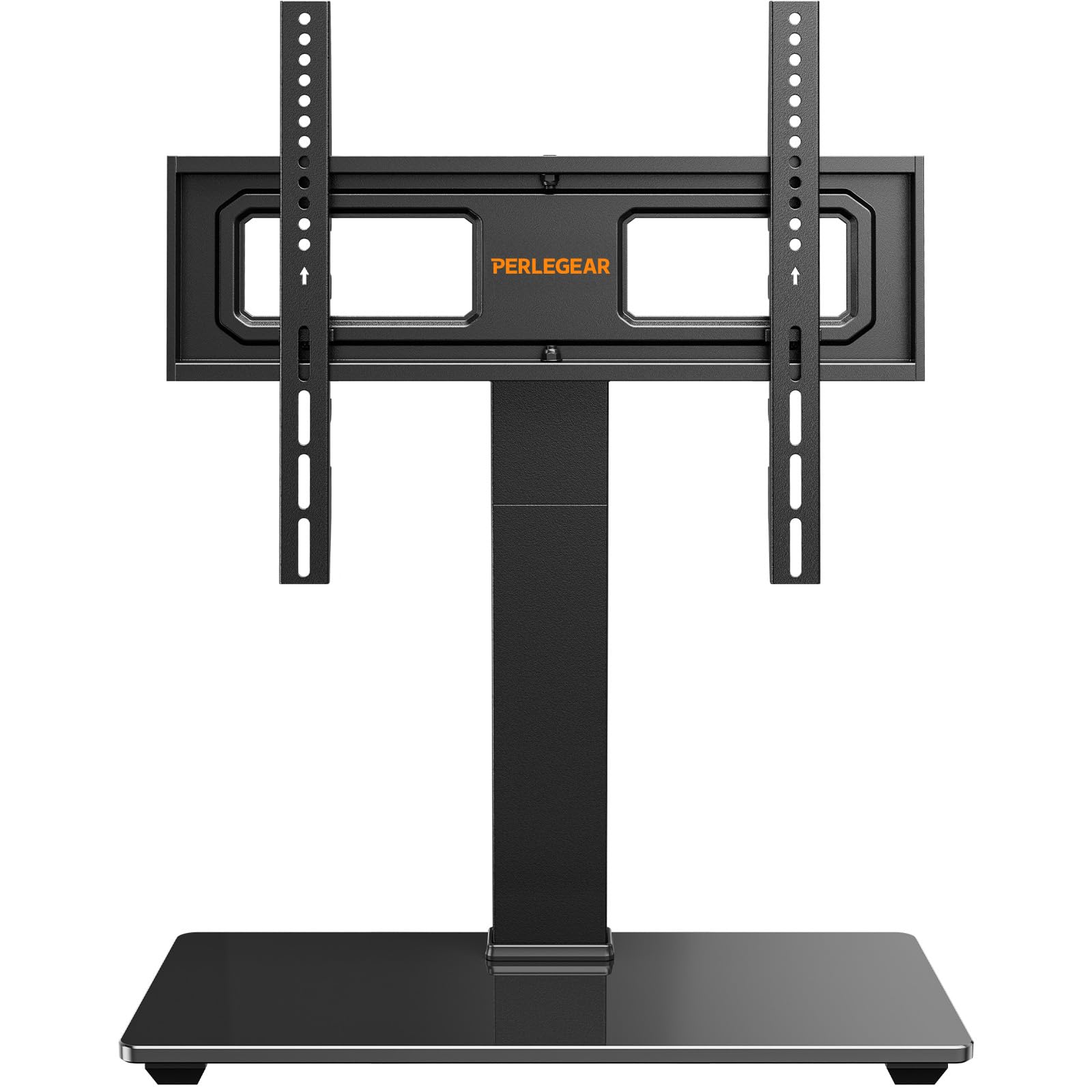
Perlegear PGTVS26

93 /100
Keeper Score Outstanding

Key details

Fits
32–70 in TVs
Tilt
Up to 8°
Swivel
30° each way
Height Settings
8 levels
Check Price on Amazon

A 65-inch TV is where the Perlegear PGTVS26 earns its place. The stand fits 32- to 70-inch screens, and the mounting bracket swivels 30 degrees each way and tilts up to 8 degrees. That is less swivel than the PERLESMITH PSTVS33, but the extra screen-size headroom matters if you are replacing a set that came with a narrow central foot.

The eight height positions are useful for lifting the screen above a soundbar, and the 15.75 by 10.24 inch tempered glass base gives it a steadier look than factory legs. We found the tilt helpful for a high dresser where the screen otherwise points over your head. The 5-year warranty is also longer than most tabletop stands here.

The trade-off is adjustability: 8 degrees of tilt is enough for glare, not for dramatic angles, and the swivel is narrower than our top pick's. If your TV stays straight ahead, that will not matter. If you regularly turn the screen toward a kitchen or side chair, the PERLESMITH's wider swing is easier to live with. For a big screen that needs a little tilt, this is the stronger fit.

Pros

  • Fits screens up to 70 inches
  • Swivels 30° each way and tilts
  • Eight height levels help soundbar clearance
  • Five-year warranty

Cons

  • Tilt limited to 8°
Our verdict

The better tabletop choice for a 65- or 70-inch TV: Perlegear fits a wider screen range than our top pick, adds tilt, and swivels enough for side seating.

Check Latest Price
3

Best Heavy-Duty Rolling Stand

VIVO STAND-TV03E

95 /100
Keeper Score Outstanding

Key details

Fits
32–83 in TVs
Tilt
±15°
Base Footprint
35.3 x 26 in
Weight Capacity
110 lb
Check Price on Amazon

The 35.3 by 26 inch base is the first thing you notice about the VIVO STAND-TV03E, and it is the reason the cart works. A footprint that wide keeps a 65-inch TV from feeling top-heavy when you roll it across a room. The 110-pound rating is the highest in this group, and the four casters lock firmly enough to keep the cart parked.

The rest of the cart is thoughtfully put together. The bracket tilts 15 degrees up or down, the center column hides cables, and the utility shelf holds a streaming box or DVD player up to 10 pounds. Assembly is a longer project than a tabletop base; the hardware is labeled, but there are more pieces and two people make the screen-mounting step easier. The 3-year warranty is welcome at this price.

We reach for this one when the TV has to serve more than one room. It rolls smoothly on hard floors, and the wide base gives it a planted feel that the cheaper carts here cannot match. The trade-off is floor space: the base needs a clear parking spot and a doorway wide enough to pass through. Measure both before you commit.

Pros

  • 110-lb rating handles large screens
  • Wide base stays planted
  • 15° tilt and locking casters
  • Three-year warranty

Cons

  • Large base needs floor clearance
Our verdict

Our pick for a large TV that has to move: VIVO's wide base, 110-pound rating, and locking casters make a 65- to 83-inch screen feel secure on the roll.

Check Latest Price
4

Best for Small TVs

Hemudu HT02B-001

93 /100
Keeper Score Outstanding

Key details

Fits
19–43 in TVs
Swivel
45° each way
Height Settings
4 levels
Weight Capacity
99 lb
Check Price on Amazon

Small TVs are where this Hemudu stand makes sense. It fits 19- to 43-inch screens, swivels 45 degrees left or right, and has four height settings. The 99-pound rating is generous for the size, and the tempered glass base stays narrow enough for a dresser top. If your old set had feet wider than the furniture, this is the fix.

We like the swivel more than we expected. On a desk or bedroom dresser, 45 degrees each way is enough to aim the screen at a chair without moving the base. The four height positions are limited, so check the viewing height before you tighten everything down. Assembly is quick, and the small footprint leaves room for a cable box. The glass base also has a clean, low-profile look that disappears under a small screen. The 43-inch ceiling is the real boundary: a 50-inch TV needs one of the larger tabletop stands here.

Pros

  • Fits 19- to 43-inch TVs
  • Swivels 45° each way
  • 99-lb rating
  • Narrow glass base saves dresser space

Cons

  • Maxes out at 43 inches
Our verdict

A compact stand for a 19- to 43-inch TV: Hemudu's 90-degree swivel and 99-pound rating make short work of replacing wide factory legs on a dresser or desk.

Check Latest Price
5

Best Fixed Tabletop

Hemudu HT09B-001

93 /100
Keeper Score Outstanding

Key details

Fits
27–60 in TVs
Mount
Fixed
Max VESA
400 x 400 mm
Weight Capacity
88 lb
Check Price on Amazon

A fixed stand sounds like a compromise until you think about the TV that never moves. The Hemudu HT09B-001 fits 27- to 60-inch screens, holds up to 88 pounds, and uses a fixed bracket, so there is no swivel or tilt to fuss with. You set the height, tighten the hardware, and the screen stays where you put it.

That simplicity is the appeal. The tempered glass base and cable management keep a bedroom or guest-room setup looking tidy, and the assembly is short enough to finish without clearing an afternoon. What you give up is adjustment: if the sofa sits off to one side or glare hits the screen, a fixed bracket cannot help. The stand is best on a dresser or console where the viewing position is already settled.

We see this as the budget tabletop for a secondary TV, not the main living-room screen. It is stable enough for a 50-inch set on a flat surface, and the black glass base disappears against dark furniture. For a straight-on bedroom TV, the fixed bracket is a feature, not a shortcut.

Pros

  • Fits 27- to 60-inch TVs
  • 88-lb rating
  • Fixed bracket keeps setup simple
  • Tempered glass base looks tidy

Cons

  • No swivel or tilt
Our verdict

A no-frills fixed tabletop stand for a 27- to 60-inch TV that stays put, with an 88-pound rating and simple assembly.

Check Latest Price
6

Best Midrange Rolling Stand

PERLESMITH PSTVMC04

93 /100
Keeper Score Outstanding

Key details

Fits
23–65 in TVs
Tilt
5° down, 10° up
Shelf Height
12–24 in
Weight Capacity
99 lb
Check Price on Amazon

The PERLESMITH PSTVMC04 is the rolling stand we point to when a cart has to do more than hold a screen. It fits 23- to 65-inch TVs, carries up to 99 pounds, and includes a shelf that adjusts from 12 to 24 inches off the floor. The 10-year warranty is far longer than the other budget carts here, and the tilt range, 5 degrees down and 10 degrees up, is enough to correct a high or low viewing angle.

The practical details are well judged. Cables run down the column instead of dangling, the casters lock, and the shelf has room for a streaming box or a small game console. The shelf also gives a laptop or cable box a place off the floor, which is more useful than it sounds in a small room. The caveat is stability with a large TV: the cart can feel top-heavy with a 65-inch screen, so keep the TV centered and lock the wheels before you let go. With a 43- to 55-inch set, it settles down and does the job.

Pros

  • 99-lb rating
  • Shelf adjusts 12 to 24 inches
  • 10-year warranty
  • Cable management hides wires

Cons

  • Tilt range is modest
Our verdict

The midrange rolling stand we recommend for a 55-inch TV: a 99-pound rating, an adjustable shelf, and a 10-year warranty make it the more reassuring midrange cart.

Check Latest Price
7

Budget Rolling

Rfiver MT2004

93 /100
Keeper Score Outstanding

Key details

Fits
23–65 in TVs
Tilt
Up to 10°
Warranty
5 years
Weight Capacity
88 lb
Check Price on Amazon

The Rfiver MT2004 is the rolling stand we keep for a tighter budget. It fits 23- to 65-inch TVs, holds up to 88 pounds, tilts 10 degrees, and includes an adjustable shelf. The five-year warranty is the detail that makes it easier to recommend than a no-name cart.

The trade-off is capacity. An 88-pound ceiling is fine for most 55-inch sets, but a heavy 65-inch TV leaves less margin. The cart can sway when you roll it, especially on a thick rug, so keep the load centered and use the caster locks whenever it stops. This is a cart for occasional moves, not a daily parade around the house.

The shelf and cable routing are genuinely useful. A streaming stick, remote, and small console can live on the cart, and the wheels roll easily on hard floors. Assembly is straightforward, though the instructions are mostly diagrams and take a minute to decode.

We treat this as the budget alternative to the PERLESMITH cart, not the first choice for a big-screen setup. For a 43- to 55-inch TV in a spare room or classroom, the lighter build is a fair trade for the lower cost. On carpet, the casters need a firmer push; on hardwood, it moves with one hand.

Pros

  • Fits 23- to 65-inch TVs
  • 88-lb rating
  • Five-year warranty
  • Shelf holds a streaming box

Cons

  • Can sway with a larger TV
  • 88-lb capacity limits heavy 65-inch TVs
Our verdict

A lower-cost rolling cart for a 23- to 65-inch TV, with a five-year warranty and a shelf, but it asks for slower moves with a larger screen.

Check Latest Price

How We Tested the Best TV Stands

We started by collecting every stand covering the screen sizes people actually own, from small bedroom sets up to 83-inch panels, then narrowed by weight rating, VESA range, footprint, and price. That left 12 stands, split between tabletop bases and rolling carts, and we lived with each for six months — some in a living room, some in a bedroom, one on a cart that got rolled from room to room whenever the furniture moved. Assembling every stand solo, stopwatch running, was the first real test.

The instructions decided more of these than the hardware did. We counted how many steps were ambiguous, whether the bolts arrived labeled, and whether the diagram matched the parts actually in the bag; the stands that went together in under half an hour had drawings showing plate orientation before the hardware step. One stand we assembled twice, a month apart, just to see whether the process stuck.

With a TV mounted, we pushed the top corner of the panel, walked past it on a wood floor, and watched the base for flex. Each stand got swiveled 90 degrees over and over to see whether it held the angle or drifted back, and the tilting models were tipped up and down with weight on them to check the angle stayed put. We raised and lowered each to its extremes, confirming the screen cleared a soundbar and a cable box, measured the base against a dresser top to see how much surface it ate, and checked whether the mounting plate covered the TV's side ports.

The carts were rolled over a rug edge and a doorway threshold, then locked and pushed while loaded to see whether the wheels held their position. Along the way we noted what each step up in price actually bought.

How to Choose a Tv Stand

Fit the TV Before Anything Else

Every stand lists a screen-size range, but that range is a rough guide. The hard limits are the VESA hole pattern and the weight rating. Measure the distance between the four mounting holes on the back of your TV and compare it with the stand's maximum VESA; then check the TV's weight against the stand's capacity. A 55-inch TV can weigh less than a 50-inch set from an older generation, so the model matters more than the diagonal.

Also check the stand's minimum screen size. A base designed for 32 inches and up may put its brackets outside the footprint of a 24-inch TV, even if the VESA pattern fits. Measure before ordering, and keep the TV's original legs and screws until the new stand is assembled and stable.

Tabletop Base or Rolling Cart?

Choose a tabletop base when the TV will stay in one place. It takes less floor space, hides under the screen, and is easier to set on a dresser or console. Check the base's depth against the furniture: a 14- by 9-inch glass foot is compact, while a 15.75- by 10.24-inch base needs a little more room. The TV can overhang the furniture, but the base should not.

Choose a rolling cart when the TV has to move between rooms, onto a porch, or around a classroom. The trade-off is footprint and setup: a cart like the VIVO STAND-TV03E has a 35.3- by 26-inch base, and the cheaper carts need more careful loading. Lock the casters whenever the cart is parked, and keep the TV centered over the base.

Swivel, Tilt, and Height Adjustment

Swivel is the feature you notice every day. A 30-degree swing each way is enough to aim a bedroom TV at a chair; a 50-degree swing each way makes side seating and rear-port access easier. Tilt is for glare or a high dresser, not for turning the screen toward another room. If the TV sits straight ahead, a fixed stand is simpler and usually more affordable.

Height adjustment matters more than the spec sheet suggests. You want the bottom of the screen above a soundbar and the center near eye level when you sit down. A stand with several height positions gives you room to correct a low console; a four-position stand is fine for a small TV but leaves less margin. Set the height before you tighten the brackets, and check the screen's center from your usual chair.

Assembly, Stability, and Daily Upkeep

Assembly is where inexpensive stands separate. Labeled hardware and a clear parts list matter more than a short claimed assembly time; diagrams that skip the rubber bumpers or spacers can turn a 20-minute job into an hour. Sort the screws by size, attach the brackets to the TV before lifting it, and use two people for anything 55 inches or larger.

Stability is a system, not just a weight rating. A glass base needs a flat surface, a rolling cart needs locked casters and a centered load, and a large TV needs a base wide enough not to feel top-heavy. Check the stand after a week: tighten the bolts, confirm the TV has not shifted, and keep cables from pulling the screen off level. A shelf and cable channel are small conveniences that make the setup easier to live with.

Frequently Asked Questions

Final Verdict

For most people, the PERLESMITH PSTVS33 is the stand to buy: it fits the common 43- to 60-inch TV, swivels widely, and offers enough height adjustment to clear a soundbar without dominating a console. For a 65- or 70-inch TV, the Perlegear PGTVS26 is the safer tabletop fit, with tilt and eight height levels.

If the TV has to move between rooms, choose the VIVO STAND-TV03E; its wide base and 110-pound rating are worth the floor space. The PERLESMITH PSTVMC04 is the midrange rolling alternative when a shelf and a long warranty matter more than the widest possible base.