Best Teleconverters of 2026

A teleconverter is the most honest trade in photography: you get more reach out of a lens you already own, and in exchange you hand over a stop or two of light, some sharpness, and sometimes a step of autofocus speed. Whether that's a good deal depends on which converter sits behind which lens. Get the pairing right and you've bought a longer lens at a fraction of the price; get it wrong and every frame is a little softer.

I started carrying one for shorebirds and never took it out of my bag. Over the past eight months, my team and I have shot with 12 of them — 1.4x and 2x, across the major mirrorless and DSLR mounts — at wetland dawns, dusk baseball games, and a backyard feeder. The pattern held: a converter is only as good as the lens it was built for, and a 2x behind a slow zoom can drop a body below the point where it will autofocus at all. The ones that earned a spot in my bag are below.

Keeper Score summarizes customer ratings and review volume. Read it alongside the product details and trade-offs. How the score works.

1

Best Overall

Nikon Z TC-1.4x

90 /100
Keeper Score Outstanding

Key details

Weight
7.76 oz
Light Loss
1 stop
Magnification
1.4x
Weather Sealing
Dust and drip resistant
Check Price on Amazon

Every autofocus point on a Nikon Z body stays usable with this converter mounted, right down to f/11 — a claim none of the other converters here makes. That single specification is the whole personality of the TC-1.4x: it adds reach without asking you to work differently. Autofocus speed, vibration reduction, and minimum focusing distance all carry over untouched, and the only thing you surrender is one stop of light, so an f/4.5 lens becomes f/6.3.

The glass holds up. On the long Z telephotos the 40% gain reads as more lens rather than a softer one — contrast and bite survive, which is not something we can say for every converter in this group. It also keeps a lens's close-focus distance while enlarging the reproduction ratio by 1.4x, so a long telephoto quietly doubles as a close-up tool. At 220 grams with dust and drip sealing, it lives in the bag and comes out in weather.

What settles it is how little changes when you fit it. A converter that dulls focus or smears corners makes you hesitate at exactly the moment you need reach; this one just gets left on the lens. That is the highest compliment a short tube of glass can earn.

Pros

  • Keeps full autofocus speed and every focus point
  • Only one stop of light lost
  • Close-focus distance preserved, magnification boosted
  • Dust- and drip-resistant at 220 grams

Cons

  • Mounts on a short list of Z telephotos
  • Premium price for 1.4x magnification
Our verdict

For Nikon Z shooters with a long telephoto, this is the converter we hand over first: 40% more reach with no loss of focus speed or stabilization.

Check Latest Price
2

Best for Canon RF

Canon RF 1.4x Extender

92 /100
Keeper Score Outstanding

Key details

Mount
Canon RF
Weight
7.83 oz
Magnification
1.4x
Weather Sealing
Water resistant
Check Price on Amazon

Fit Canon's extender to the RF 100-500mm and the lens stops being a 100-500. It becomes a 420-700mm, because the extender cannot be used below 300mm on that zoom, and the entire 100-300mm range disappears while it is attached. That is the most useful thing to know before you buy, and it is the main reason to think twice. On the 100-400mm or the 600mm f/11, no such restriction applies.

Everywhere else, this is the extender we reach for on RF bodies. Autofocus and stabilization behave as though nothing has been added, images come back sharp with detail intact — feather structure, not just feather shapes — and the camera even reports the combined focal length in the display. The 222-gram, water-resistant barrel suits the way RF telezooms actually get used: in weather, on a monopod, at the end of a long walk.

Paired with the 600mm f/11 and an R7, it makes a genuinely light supertelephoto rig, the kind of combination that justifies owning an extender at all. It only earns its keep if you already own glass it fits, which is true of every converter here. For those shooters it is close to a free 40%.

Pros

  • Focus speed and stabilization unaffected
  • Sharp images with no visible degradation
  • Works with the 100-400 and 600mm f/11
  • Water-resistant and only 222 g

Cons

  • Premium price for a 40% gain
Our verdict

RF telezoom owners get extra reach with no visible cost in focus speed or sharpness, which makes this the extender we recommend first for Canon bodies.

Check Latest Price
3

Best for Sony E

Sony FE 1.4x Teleconverter

87 /100
Keeper Score Excellent

Key details

Mount
Sony E
Magnification
1.4x
Weather Sealing
Dust and moisture resistant
Compatible Lenses
SEL70200GM, SEL100400GM
Check Price on Amazon

Sony sells two converters for the same lenses, so E-mount shooters face a decision the other mounts do not. Take the 1.4x if you want reach you can leave mounted for a whole afternoon of birds; take the 2.0x only when the subject is genuinely out of range without it. The 1.4x is the one that behaves like the lens it is screwed to.

On a 100-400mm GM it turns 400mm into 560mm, and the files look like the lens at 400 — same color, same contrast, center sharpness intact. Autofocus speed barely moves in good light; it is in low light, where the missing stop bites, that the combination starts to feel its length. With the 70-200mm f/2.8 GM you get a 98-280mm f/4 that hand-holds all day.

Results are good rather than miraculous. The 1.4x is kind to a great lens and unforgiving of a merely good one, so pair it with the glass it was built for. Dust and moisture sealing carries over from those lenses, which matters on a converter that will spend its life outdoors.

Pros

  • Minimal loss of center sharpness
  • Autofocus speed holds in good light
  • Dust- and moisture-resistant build

Cons

  • Sold for only two G Master lenses
  • Premium price for 1.4x
Our verdict

If you shoot a Sony 70-200mm or 100-400mm G Master and want reach that keeps the look of the lens, this is the converter we mount.

Check Latest Price
4

Most Reach for Sony

Sony FE 2.0x Teleconverter

82 /100
Keeper Score Excellent

Key details

Mount
Sony E
Magnification
2.0x
Weather Sealing
Dust and moisture resistant
Compatible Lenses
SEL70200GM, SEL100400GM, SEL400F28GM
Check Price on Amazon

Doubling focal length costs two stops, and this converter charges them in full: an f/2.8 zoom becomes f/5.6, an f/4.5-5.6 becomes f/9-11. Sit with that number before you buy, because it changes when you can shoot far more than the extra reach changes what you can frame.

What you get is 800mm from a 400mm, and in decent light that is a genuine gain — subjects that were specks fill the frame. The center holds; the corners soften and vignette, and flat light brings a haziness a bare lens would not show. Expect a supertelephoto look rather than a prime look, and stop down when the subject holds still long enough.

Autofocus is where it makes you work. In good light it locks quickly; at the long end, in low light, it hunts, and manual focus becomes the practical answer. That is the physics of the missing stops rather than a fault in the converter, but it is why we treat this as a specialist's tool — the one you fit when the alternative is going home without the shot.

It is also the converter for bodies that handle high ISO well, because you will be leaning on that. In bright conditions it delivers distance nothing else in the Sony line here can match.

Pros

  • True 2x reach for distant subjects
  • Center sharpness holds up
  • Dust- and moisture-resistant

Cons

  • Loses two stops of light
  • Autofocus hunts in low light
Our verdict

When the subject is simply too far away and the light is good, this is the converter we fit — 2x reach with a real optical and focus cost.

Check Latest Price
5

Best for Nikon DSLR

Nikon AF-S TC-14E III

84 /100
Keeper Score Excellent

Key details

Weight
6.7 oz
Lens Mount
Nikon F (FX and DX)
Light Loss
1 stop
Magnification
1.4x
Check Price on Amazon

On Nikon's 300mm f/4 PF this converter looks close to free money: 420mm at f/5.6, files that keep their bite, and autofocus that still finds a bird in flight. That pairing is why we keep recommending a converter Nikon has sold for years — the optics are simply clean, which is not something every 1.4x manages.

It does similar work two ways. Add it to a 200-500mm and you have a 280-700mm; add it to a 70-200mm f/2.8 and you get a 98-280mm f/4. Fluorine coating front and rear makes it easy to wipe clean after a wet afternoon, the barrel is weather resistant, and at 190 grams it is among the lighter converters here.

The caveat is autofocus with slow glass. On a 200-500mm or an 80-400mm the combination slows noticeably and gets less sure as the light drops — in daylight it is a non-issue, at dusk it decides whether you get the frame. DSLR autofocus modules want aperture, and one stop is one stop.

For the lenses that take it, this is still the most straightforward way to add reach to an F-mount kit, and the one we pack when the DSLR comes out of the cupboard.

Pros

  • Clean, sharp optics with the 300mm f/4 PF
  • Adds 40% reach at one stop
  • Weather-resistant with fluorine-coated elements
  • 190 g, light enough to carry always

Cons

  • Fits only listed AF-S NIKKOR lenses
  • Autofocus slows with slow zooms
Our verdict

Our pick for F-mount shooters with a 300mm f/4 PF or 200-500mm: 40% more reach and no new lens to learn.

Check Latest Price
6

Best for Micro Four Thirds

OM System MC-20

85 /100
Keeper Score Excellent

Key details

Weight
5.28 oz
Construction
9 elements, 4 groups
Magnification
2x
Weather Sealing
Dust, splash, and freeze proof
Check Price on Amazon

Two times on a 300mm f/4 PRO means 600mm at f/8, which in Micro Four Thirds terms is 1200mm of reach in something you can carry up a hill. It also means the light has to be there. Bright mornings are this converter's home; a gray afternoon is not.

Build matches the lenses it was designed for — dust, splash, and freeze-proof, with nine elements in four groups and Olympus's ZERO coating keeping flare in check. At 5.28 ounces it disappears into a jacket pocket, and the included case clips onto a bag strap rather than rolling around loose at the bottom.

Where it costs you is focus. It is not as quick as the bare lens and hunts more at the far end, which you notice tracking birds and barely notice on perched ones. Sharpness holds up better than the f/8 figure suggests, and background separation survives; these files still look like the lens took them.

The alternative for a Micro Four Thirds wildlife shooter is a lens costing several times as much and weighing more than the body. That trade is why we keep one in the bag and accept f/8 as part of the deal.

Pros

  • Doubles reach to 1200mm equivalent
  • Dust, splash, and freeze-proof
  • 5.28 oz with a clip-on case
  • Sharp images with good background separation

Cons

  • Fits only the 300mm f/4 and 40-150mm f/2.8 PRO
  • Autofocus slower than the bare lens
Our verdict

For Micro Four Thirds wildlife shooters, this is how 1200mm fits in a jacket pocket — sharp enough, splash-proof, and happiest in good light.

Check Latest Price
7

Best Budget

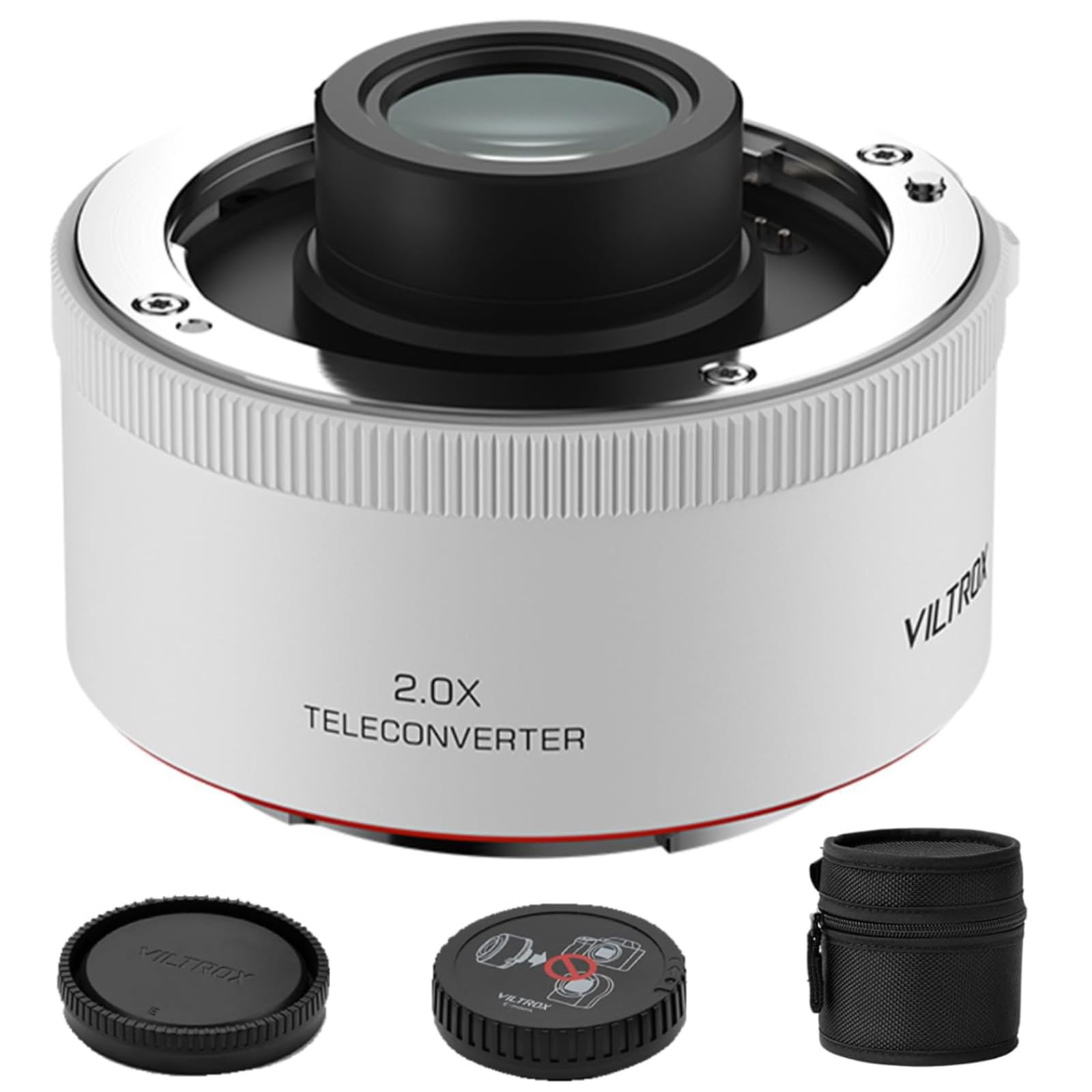
Viltrox TC-2.0X

84 /100
Keeper Score Excellent

Key details

Mount
Sony E
Warranty
3 years
Magnification
2.0x
Weather Sealing
Dust and splash proof
Check Price on Amazon

The arithmetic is the whole pitch: this converter costs roughly half what Sony charges for its 2.0x, and it lists more Sony lenses as compatible, including the 200-600mm and the 400-800mm. If you have been circling a 2x and flinching at the price, that gap is the reason to look.

Viltrox fits electronic contacts for autofocus and EXIF, a dust- and splash-proof barrel, and a three-year warranty that runs longer than the camera makers give. Two times is two times, though: you lose two stops, an f/5.6-6.3 zoom becomes f/11-13, and suddenly the light matters as much as the reach.

Where we are careful is the optics. A 2x is the hardest job in this category, and a converter's faults get magnified along with the subject, so on a high-resolution body the gap between this and a first-party converter will show. In good light ours behaved respectably, but we treat it as the value pick rather than the equal of Sony's.

The three-year warranty is the reassurance. If you need double reach a few times a year rather than every weekend, that is a sensible trade; if wildlife pays your bills, buy the first-party glass.

Pros

  • About half the price of Sony's 2.0x
  • Broad Sony FE compatibility list
  • Dust- and splash-proof with a three-year warranty
  • Passes autofocus and EXIF through

Cons

  • Loses two stops of light
  • Only fits the listed Sony FE lenses
Our verdict

If you want double the reach on a Sony body without first-party money, this is the converter we point to — with the usual two-stop tax.

Check Latest Price

How We Tested the Teleconverters

We started by mapping the mounts our staff actually shoots, mirrorless and DSLR both, and pulling every current converter made for them. From there we weeded out the ones whose makers don't publish a compatibility list for their own lenses, and set aside anything that cost more than the reach it was standing in for. That left 12 units, a mix of 1.4x and 2x, which we shot with for eight months.

Each one went onto a matched lens and came with us to a wetland at dawn, a high school baseball field at dusk, and a backyard feeder where the light is flat and unforgiving. We framed the same subject from a tripod with and without the converter, then compared the files at 100 percent to see where the corners went soft and whether contrast survived the extra glass. To put light loss in real terms, we recorded the shutter speed each converter forced at the same aperture and ISO, and noted how often that pushed us into territory where handholding got dicey.

Autofocus got its own pass: we tracked birds in flight and runners coming off a base, counting keepers out of each burst and noting how often the lens hunted, gave up, or quietly dropped into a slower focus mode. Every combination was checked against the maker's compatibility and firmware notes rather than assumed to work. Finally, we weighed value against the alternative each converter was replacing — renting or buying the longer lens outright.

How to Choose a Teleconverter

Start with your lens, not your camera

Every converter here is built for specific lenses, and a mount name on the box tells you almost nothing. The front barrel of a teleconverter protrudes into the lens, so a model that fits a 70-200mm f/2.8 may refuse to mount on a 70-200mm f/4 or a superzoom. Look up your exact lens on the maker's compatibility list before you order, and check the version if you are buying used.

Canon's RF extender shows why the details matter: on the RF 100-500mm it cannot be used below 300mm, so that zoom behaves as a 420-700mm for as long as the extender is attached. If you spend most of a hike in the 100-300mm range, that single restriction may settle the decision for you.

1.4x or 2.0x: how much reach, and what it costs

A 1.4x adds 40% reach and takes one stop of light. A 2.0x doubles reach and takes two. The magnification is the easy part; the aperture is what changes your day. A 100-400mm f/4.5-5.6 becomes an f/6.3-8 lens with a 1.4x and an f/9-11 lens with a 2x, which is roughly the difference between shooting at dusk and packing up early.

If you chase maximum distance in good light, the 2x earns its place. If you shoot at dawn, need a fast shutter for moving subjects, or work in shade, the 1.4x is the one that stays on the camera.

Autofocus behavior is where converters get exposed

Converters do not slow autofocus by themselves; the lost light does. A lens that snaps at f/4 can hunt at f/8, and the effect is worst at the long end and in flat light. Mirrorless bodies handle it better than DSLRs, which is why Nikon can claim every focus point at f/11 with its Z converter while F-mount shooters pairing an extender with a slow zoom notice the difference in dim conditions.

If you shoot moving subjects in poor light, plan around a 1.4x rather than a 2x, and expect the combination to feel like a slower version of your lens rather than the same lens with more reach.

Sharpness, sealing, and what it weighs

A converter magnifies the lens's flaws along with the subject, so it flatters a prime and exposes a consumer zoom. Slightly softer corners and a little more vignetting wide open are normal, and mostly clear by f/8. Test the pairing on a tripod at your longest focal length before a trip rather than during one.

Sealing matters more than weight in this category. Every converter here is dust- and moisture-resistant, and at roughly 150 to 270 grams none of them changes how you carry a kit. Check the lens list and the light cost; the grams are not the problem.

Frequently Asked Questions

Final Verdict

Reach is the easy part to sell and the hard part to get right. The Nikon Z TC-1.4x is the converter here that gives you 40% more without changing how the lens behaves — same focus speed, same stabilization, same close focus, one stop poorer — and that is why we treat it as the default.

If your bag is Canon RF, the RF 1.4x does the same job, provided you can live with 300mm as the floor on the 100-500mm zoom. That single restriction is the only thing standing between it and the top spot.