Best Sony E-Mount APS-C Lenses of 2026

Part of the appeal of an E-mount APS-C camera is that it can be almost pocketable with the right lens—and maddeningly bulky with the wrong one. I've carried a compact zoom that made me leave the camera at home and a fast prime that made me take it everywhere. The difference usually comes down to build, sharpness wide open, autofocus that keeps up with a moving subject, and bokeh that looks smooth instead of nervous.

Over eight months, we've shot with eight E-mount APS-C lenses, from ultra-wide primes to a superzoom and a couple of constant-aperture zooms. We compared image quality at the center and corners, tracked kids and dogs, weighed each lens, and carried them on day hikes and through city streets. Versatility and zoom performance matter, but so does value: the best lens isn't the cheapest one—it's the one you'll actually use. These are the ones that earned a place in our bags.

Keeper Score summarizes customer ratings and review volume. Read it alongside the product details and trade-offs. How the score works.

1

Best Overall

Tamron 17-70mm f/2.8 Di III-A VC

93 /100
Keeper Score Outstanding

Key details

Weight
1.2 lb
Focal Length
17-70mm (4.1x zoom)
Stabilization
Optical VC
Maximum Aperture
Constant f/2.8
Check Price on Amazon

In full-frame terms this zoom runs from about 25.5mm to 105mm, which is the span that handles most of a normal week: a room, a street, a face across a table. What earns it the top spot here is that f/2.8 holds all the way to 70mm, so you don't lose two stops the moment you zoom in to frame someone.

The VC stabilization is why we hand this one to people shooting on a compact body. Sony's smaller APS-C models lean on lens-based stabilization, and the VC is tuned to work with the subject detection in newer bodies, which shows up most in handheld video. Close focus is the sleeper feature: 7.5 inches at the wide end turns a standard zoom into something you can point at a plate of food or a flower without changing lenses.

Autofocus is the part we stopped thinking about, which is the compliment that counts. The RXD motor picks up eyes quickly, stays quiet through a take, and holds focus when the light drops — the kind of behavior that quietly decides whether you come home with the shot.

Moisture-resistant construction and a fluorine coating on the front element are the quiet reasons it stays on the camera in drizzle and at the beach, where an unprotected front element makes us nervous. It also takes 67mm filters, the same thread as the Sony 70-350 and the Tamron 18-300, so one polarizer covers all three.

Pros

  • Constant f/2.8 from 17mm to 70mm
  • VC stabilization for bodies without IBIS
  • Focuses to 7.5 inches at the wide end
  • Moisture-resistant with a fluorine coating

Cons

  • 1.2 pounds, the heaviest standard zoom here
Our verdict

For most people shooting a Sony APS-C body, this is the lens: constant f/2.8 across the everyday range, with stabilization, close focus, and sealing built in.
Check Latest Price
2

Best Compact Standard Zoom

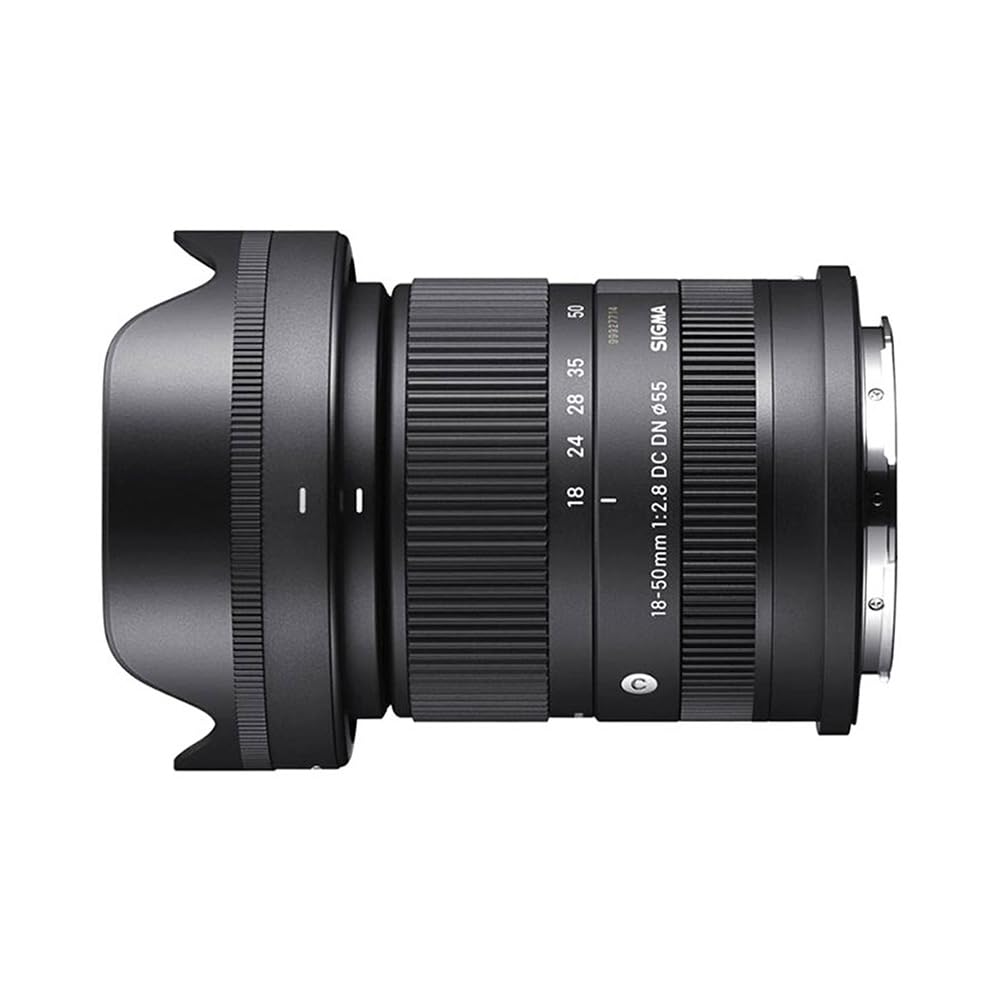
Sigma 18-50mm f/2.8 DC DN

93 /100
Keeper Score Outstanding

Key details

Weight
10.2 oz
Focal Length
18-50mm
Stabilization
None
Maximum Aperture
Constant f/2.8
Check Price on Amazon

At 290 grams, the Sigma 18-50mm f/2.8 makes a small Sony body feel small again. It's a constant-aperture standard zoom you can leave on the camera all day without the forward weight the larger zooms here bring, and it still opens to f/2.8 at 50mm.

Stabilization is the piece that isn't there, so on a body without in-body stabilization you'll be minding shutter speed indoors and after sunset — that's the trade for the size and the lower price, and for a lot of people it's the right one. Two details earn it a place: sharpness holds at the long end, which is where inexpensive zooms usually go soft, and the 55mm filter thread means a polarizer costs less than the 67mm glass the bigger lenses take.

Pros

  • 290 g, the lightest f/2.8 zoom here
  • Constant f/2.8 through the range
  • Sharp at the 50mm end
  • 55mm filters cost less than 67mm

Cons

  • Not weather-sealed
  • Long end stops at 50mm
Our verdict

Buy this one if the camera has to stay small — it's the lightest f/2.8 zoom here, and the missing stabilization is the price.

Check Latest Price
3

Best for Wildlife and Reach

Sony E 70-350mm G OSS

91 /100
Keeper Score Outstanding

Key details

Weight
22 oz
Focal Length
70-350mm (105-525mm equiv.)
Stabilization
Optical SteadyShot
Maximum Aperture
f/4.5-6.3
Check Price on Amazon

Reach is the whole point. This zoom covers 70-350mm, which is 105-525mm in full-frame terms, and it does it in a lens that weighs 22 ounces — the difference between taking it on a walk and leaving it at home.

This is the lens to buy if your subjects are birds, dogs, or a kid on a far touchline. The XD linear motor focuses quickly and near-silently, which matters when you're tracking something that won't sit still, and OSS steadies the viewfinder at 350mm so you can actually see what you're framing. G-series optics hold detail across the frame, and the Nano AR coating keeps flare from washing out backlit shots.

The aperture closes to f/6.3 at the long end, so at 350mm you're trading light for reach and will want brighter days or a higher ISO — pair it with a body that handles high ISO well and it stops being a limitation. What you get in return is a telephoto that doesn't need its own bag, which is the reason this one travels.

Pros

  • 105-525mm equivalent at 22 ounces
  • Optical SteadyShot stabilization
  • Fast, near-silent XD linear autofocus
  • Corner-to-corner G-series sharpness

Cons

  • The most expensive lens in this set
Our verdict

Reach is what you're buying here: 105-525mm equivalent and optical stabilization in a 22-ounce lens that still suits a small body.

Check Latest Price
4

Best Low-Light Prime

Sigma 16mm f/1.4 DC DN

96 /100
Keeper Score Outstanding

Key details

Weight
14.3 oz
Focal Length
16mm prime
Angle Of View
83.2°
Maximum Aperture
f/1.4
Check Price on Amazon

An f/1.4 aperture on a 16mm lens is a specific tool: it lets you shoot a dim interior or a night sky without pushing the ISO until the shadows turn to mush. The 83.2-degree view is wide enough for a room or a treeline without bending the corners into a fisheye.

Of everything here, this is the lens we point at people who shoot after dark. It's the highest-rated lens in this set, and for a boring, useful reason: it's sharp wide open, the autofocus is quick and accurate on newer Sony bodies, and you don't have to stop down to make it usable. Landscapes, aurora, and handheld interiors all lean on the same strength.

At 14.3 ounces it's a substantial prime rather than a pocket lens, and on a compact body you'll feel it on a wrist strap by the end of an afternoon. That's the cost of f/1.4 in a wide barrel — and it's also why the lens looks the way it does in low light. We leave it mounted when the entire shoot happens after dark.

Pros

  • f/1.4 for dim rooms and night skies
  • Sharp wide open
  • Fast, accurate autofocus
  • Wide 83.2-degree view for interiors and landscapes

Cons

  • Fixed 16mm
Our verdict

The lens we point at anyone who shoots after dark: sharp at f/1.4, quick to focus, and wide enough for a room or a night sky.

Check Latest Price
5

Best for Vlogging

Sony E 11mm f/1.8

91 /100
Keeper Score Outstanding

Key details

Weight
10.6 oz
Focal Length
11mm prime
Angle Of View
104°
Maximum Aperture
f/1.8
Check Price on Amazon

A 104-degree view does something specific to a frame: the whole room fits, the horizon pushes out at the corners, and at arm's length your own hand ends up in the shot. It's a focal length that changes where you stand, not just what you see.

Two things make it work for video. The first is f/1.8 in a lens this wide — enough light to keep a dim room from going noisy. The second is the focus design: Sony suppressed the breathing and the angle-of-view shift that usually come with racking focus, so a pull from your face to the room behind you doesn't lurch. Two linear motors handle the focusing, quietly.

For anyone whose output is handheld video, this is the pick of the set, and for stills it's the lens that makes a small room read as a room. At this width the edges stretch — that's the optics rather than a defect, so compose with the stretch or crop it out. The 55mm filter thread matches the Sigma 18-50, a small mercy if you already own filters that size.

Pros

  • 104-degree view with an f/1.8 aperture
  • 10.56 oz and balanced on a small body
  • Suppressed focus breathing for video
  • Fast, quiet dual linear autofocus

Cons

  • Not weather-sealed
Our verdict

If your output is handheld video, start here — 104 degrees, f/1.8, and focus breathing controlled well enough to rack focus mid-take.

Check Latest Price
6

Best One-Lens Travel Zoom

Tamron 18-300mm f/3.5-6.3 VC VXD

87 /100
Keeper Score Excellent

Key details

Weight
21.9 oz
Focal Length
18-300mm (16.6x zoom)
Stabilization
Optical VC
Maximum Aperture
f/3.5-6.3
Check Price on Amazon

16.6x is the number that matters. This lens runs from 18mm to 300mm — 27mm to 450mm in full-frame terms — so a landscape, a portrait, and a bird on a far branch are all the same lens, and it does it in a barrel that weighs 21.9 ounces.

The VXD linear motor is the reason it doesn't feel like a compromise in the hand. Focus is quick and quiet enough for video, the VC steadies the long end for handheld stills, and the moisture-resistant build with a fluorine coating means a damp morning doesn't end the day. It also focuses closer than a lens this shape has any right to, which is how people end up shooting flowers and insects between the long shots.

This is the lens for the trip where you'd rather not change lenses at all. We kept coming back to it on days when the bag stayed in the car — one body, one lens, everything from wide to long covered. The zoom ring takes a firm turn and isn't the smoothest in the set, which is the usual price of a 16.6x barrel.

All-in-ones ask you to accept one lens that does everything competently rather than one thing beautifully, and that's a fair description of this one. Where it earns its keep is the frame you get because you didn't stop to swap glass: fill it with a bird on a feeder across the yard at 450mm equivalent, then zoom back out for the yard itself.

Pros

  • 27-450mm equivalent in a single lens
  • VXD autofocus is quick and quiet
  • VC stabilization at the long end
  • 21.9 oz and moisture-resistant

Cons

  • Aperture drops to f/6.3 at 300mm
Our verdict

Take one lens and stop swapping: 27-450mm equivalent, quick autofocus, and stabilization in a barrel that still fits a day bag.

Check Latest Price
7

Budget Ultra-Wide

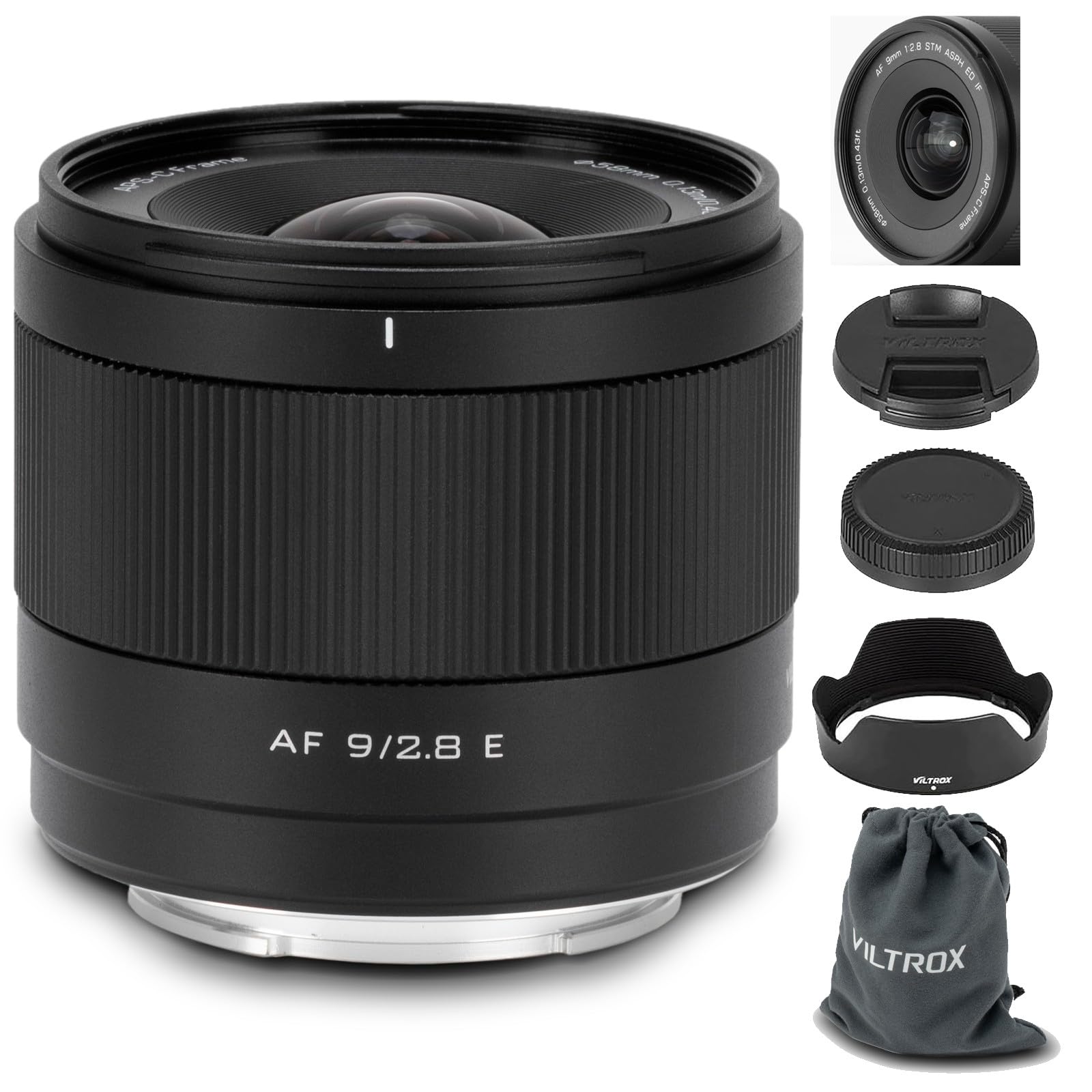
Viltrox 9mm f/2.8

90 /100
Keeper Score Outstanding

Key details

Weight
6.17 oz
Focal Length
9mm prime
Minimum Focus
0.13 m
Maximum Aperture
f/2.8
Check Price on Amazon

113.8 degrees is wider than most people have ever shot. Point the Viltrox 9mm at a room and the walls lean away from you; point it at a landscape and the foreground arrives at your feet. It's a dramatic, slightly strange view, and the whole lens weighs 175 grams.

Autofocus at this price is the surprise. The STM motor is quiet and quick enough to let the eye and face detection on a newer body do its job, and the 0.13 m minimum focus distance lets you put the front element almost against a subject and let the background fall away behind it.

The trade shows up at the edges: at 9mm the corners distort and stretch, and anything near the frame edge gets pulled wide. Some of that corrects in-camera or in a raw profile, and the rest is simply what an ultra-wide looks like, so you compose around it rather than fight it.

For a first ultra-wide, or a second lens for tight rooms and skate-style footage, this is the value pick of the set — 113.8 degrees and working autofocus for a fraction of the Sony 11mm's price. Worth knowing before you order: it takes 58mm filters, an odd size, so a step-up ring to 67mm keeps it on the same glass as the bigger lenses here.

Pros

  • 113.8-degree view at 175 g
  • 0.13 m close focus for dramatic foregrounds
  • Autofocus at a budget price
  • Compact enough to live in the bag

Cons

  • Not weather-sealed
Our verdict

The ultra-wide to try first if the budget is tight: 113.8 degrees, working autofocus, and 175 grams.

Check Latest Price
8

Learning Manual Focus

TTArtisan 25mm f/2

85 /100
Keeper Score Excellent

Key details

Focus
Manual only
Focal Length
25mm prime
Minimum Focus
0.25 m
Maximum Aperture
f/2
Check Price on Amazon

The TTArtisan 25mm f/2 is about 37.5mm in full-frame terms — close to how the world looks when you're not trying, neither wide nor tight. It's a lens that asks you to slow down, and it's the least expensive one here by a wide margin.

The focus ring is damped and turns with a nice weight, the kind of resistance that makes small adjustments easy, and the aperture ring clicks at each stop so you can count them without looking away from the finder. The 0.25 m minimum focus distance gets you close enough for a flower or a cup of coffee on a table.

Wide open at f/2 the corners vignette and bright backlight brings out color fringing; both settle by f/2.8 to f/4, which is where a lens like this mostly lives anyway. What you get in return is a rendering that's a little warm and a little soft at the edges, and a lens you'll actually carry because it's small.

This is the lens for learning to shoot slowly, for a second body, or for the day you want one small prime and nothing else. Note the 43mm filter thread before you order. What it teaches — where to stand, how much depth of field you actually need — transfers to every other lens on this page.

Pros

  • 37.5mm-equivalent view at the lowest price here
  • Clicked aperture ring
  • 0.25 m close focus
  • Small and unobtrusive on a compact body

Cons

  • Manual focus only
Our verdict

A manual 25mm that teaches you to focus and frame, at a price that makes the experiment easy.

Check Latest Price

How We Tested These E-Mount APS-C Lenses

We started with a long list of E-mount APS-C lenses sold for crop-sensor bodies, then narrowed it by focal range, maximum aperture, size, price, and whether the lens was designed for APS-C rather than full frame. That left eight lenses: compact zooms, a superzoom, a telephoto zoom, and ultra-wide-to-normal primes, including a couple of constant f/2.8 zooms. We mounted each on the same two APS-C bodies and used them for eight months—on morning walks, at indoor family gatherings, on weekend hikes, and during video shoots where focus had to hold on a face while the camera moved.

Sharpness and image quality came first: we shot each lens wide open and stopped down, then compared center and corner crops at 100 percent. For the constant-aperture zooms, we also checked sharpness wide open at the long end, where lenses often soften. Autofocus: we tracked a dog running toward the camera, a kid on a swing, and a subject walking through frame, noting whether the lens locked on immediately or hunted. Bokeh: we shot portraits and close-ups against backlit foliage, looking at highlight shape and how smoothly focus fell off.

Zoom performance: we ran each zoom from end to end, checking for creep, stiffness, and softening at the long end. Weight: we weighed every lens on a kitchen scale and carried it in a sling bag for a full day. Build quality: we checked mount fit, focus-ring feel, and whether the barrel felt solid after a week in a bag.

Value: we asked whether the price difference showed up in the files or only on the spec sheet. Versatility: we swapped primes and zooms through the same scenes to see which ones we reached for without thinking.

How to Choose a Sony E-Mount Aps-C Lens

Start With the Range You Actually Shoot

A 17-70mm or 18-50mm covers the everyday: rooms, streets, people, a plate of food. Something like the Tamron 18-300mm covers all of that plus the far distance, and asks you to accept a slower aperture to do it. A prime fixes one view and rewards learning it. Scroll back through your last few hundred frames and see where they cluster before you spend anything.

The trap is buying for the trip rather than the year. A 450mm-equivalent reach is wonderful on a safari and awkward in a kitchen; a 9mm is thrilling for a week and then lives in a drawer. Buy the range you shoot in an ordinary month, then rent the exotic one.

Constant Aperture Is What You Pay For

f/2.8 held across a zoom's range is the difference between a lens you can keep using at dusk and one you put away. The Tamron 17-70mm and the Sigma 18-50mm both hold f/2.8 end to end, while the two superzooms here start at f/3.5 and finish at f/6.3 — two stops gone exactly when your subject is far away and moving.

Constant aperture costs money, size, and weight, and it is usually worth all three. If you shoot at f/8 in daylight and nothing else, take the range instead of the aperture and pocket the difference.

Check Your Body Before You Pay for Stabilization

Lens-based stabilization only earns its price if your camera lacks in-body stabilization. Sony has put IBIS on the higher bodies in its APS-C line; the a6400 and the ZV-E10, two of the most common homes for these lenses, do not have it. If yours doesn't, the Tamron 17-70mm's VC and the Sony 70-350mm's OSS stop being nice-to-haves.

Handheld video is where the difference shows first — the difference between a usable clip and a wobbly one. For stills it buys a couple of stops in dim light, often the gap between a clean frame and a noisy one.

Weight, Balance, and the Filter Thread

A 290-gram lens and a 1.2-pound lens make different cameras in the hand. Weight forward of the mount changes how long you'll carry the thing and how steady it feels at the end of the day, so try the combination before committing to a two-week trip.

Then look at the filter thread, which almost nobody checks before ordering. Four lenses here share 67mm and two share 55mm, and a good polarizer in 67mm costs more than the 55mm version. Buy one good filter in the size most of your lenses use, plus a step-up ring for the odd one out — like the Viltrox 9mm's 58mm thread.

Autofocus and Close Focus

The motor matters more for video than for stills. Linear motors — Sony's XD, Tamron's VXD and RXD, the dual linear units in the 11mm — focus fast and quietly; stepping motors are fine but audible. If you shoot handheld video, also check for focus breathing, the slight zoom as a lens racks focus. The Sony 11mm is the one here built to suppress it.

Close focus is the underrated spec. Seven and a half inches on the Tamron 17-70mm, or 0.13 m on the Viltrox 9mm, turns an ordinary lens into something that can shoot detail — which saves carrying a macro you use twice a year.

Frequently Asked Questions

Final Verdict

If you want one lens for a Sony APS-C body and no further research, buy the Tamron 17-70mm f/2.8. It covers the everyday range, holds f/2.8 all the way through it, stabilizes the bodies that need it, and focuses close enough to spare you a macro. Nothing else here does all four.

Two requirements change the answer. If the camera has to stay small, the Sigma 18-50mm f/2.8 gives up stabilization and 20mm of reach for about half the weight. If your subjects are far away, the Sony 70-350mm is the only lens here built for them.