Best Pentax K-Mount Lenses of 2026

Here's the odd thing about the Pentax K-mount: it hasn't changed since 1975, so nearly every lens ever built for it will still click onto your camera. Fitting, though, isn't the same as working. Two lenses sitting side by side on the same shelf can focus at wildly different speeds, cover different image circles, and handle weather completely differently — none of which is obvious from the box.

I've shot Pentax long enough to have opinions: a cheap 50mm lives on my camera most of the year, and the super-telephoto I borrowed for one trip I complained about carrying, then refused to give back. Over nine months, my team and I shot with 11 K-mount lenses, comparing sharpness wide open and stopped down, how quickly and quietly each one locked focus, contrast in flat light, and how much the weight mattered by hour four of a hike.

The lesson that took me longest to learn: the priciest lens isn't automatically the sharpest copy you'll get. Sample variation is real, and a good copy of an affordable lens beats a soft copy of an expensive one. What follows are the ones that earned a permanent spot in my bag.

Keeper Score summarizes customer ratings and review volume. Read it alongside the product details and trade-offs. How the score works.

1

Best Overall

Pentax DA 18-135mm f/3.5-5.6 WR

87 /100
Keeper Score Excellent

Key details

Weight
14.3 oz
Focal Length
18-135mm
Max Aperture
f/3.5-5.6
Weather Sealing
Weather resistant
Check Price on Amazon

If you want one lens that stays on the camera — a wet trailhead in the morning, a birthday party in the afternoon — the DA 18-135mm is what we hand people first. Eighteen to 135mm covers a room and a ridge line without a swap, it weighs 405 g, and the weather sealing matches a WR body. Nothing else in this group does as much of ordinary life while shrugging off rain, which is why it takes the top spot.

The DC micromotor is quiet enough that we stopped noticing it, and focus lands quickly in decent light. The barrel feels solid in the hand, and the SP coating on the front element earns its place: rain and fingerprints wipe away instead of smearing, which is what you want when you're cleaning up outdoors.

Sharpness is good rather than spectacular, and it improves as you stop down; by f/8 the frame looks even corner to corner. In dim light the f/3.5-5.6 aperture is the real limit — at 135mm you're wide open at f/5.6 and reaching for a higher ISO. That's the trade for a lens this light and this well sealed.

On an APS-C body it's the lens that makes weather sealing worth paying for. If you shoot a K-1, plan around D FA glass instead, because this one is built for the smaller sensor. And if a sealed 18-55mm kit zoom already lives on your camera, the more interesting upgrade is the 55-300mm — a genuinely new range rather than a longer version of the one you have.

Pros

  • Weather-sealed against rain and dust
  • 18-135mm covers wide to short telephoto
  • 405 g is light enough to leave mounted
  • Quiet, quick DC autofocus

Cons

  • Distortion and vignetting at the wide end
  • No lens hood in the box
Our verdict

The lens we recommend first to almost anyone with a sealed Pentax body: a genuinely useful range, honest weather protection, and light enough to carry all day.

Check Latest Price
2

Best Telephoto Zoom

Pentax HD DA 55-300mm PLM WR

89 /100
Keeper Score Excellent

Key details

Autofocus
PLM with electromagnetic diaphragm
Focal Length
55-300mm
Max Aperture
f/4.5-6.3
Weather Sealing
Weather resistant
Check Price on Amazon

Check your camera before you check the lens. The 55-300mm uses Pentax's electromagnetic diaphragm, and on older bodies such as the K-30 the mount fits but the electronics don't, so it won't do the job you bought it for. On anything recent it's the telephoto zoom we reach for first.

What earns it that place is the barrel: it collapses to roughly the size of a standard zoom, so a 300mm lens actually travels. At 16 ounces it doesn't tip a small body forward, and the pulse motor focuses fast and near-silently — quick enough for moving subjects, quiet enough for a quiet room.

Optically it holds up across the range, with the 9-blade rounded diaphragm giving backgrounds a smooth falloff and the HD coating keeping contrast intact when the sun sits near the frame. Close focus at 0.95 m is a bonus you'll use more than you expect: at 300mm you can fill the frame with a flower without backing into the hedge.

The retractable barrel takes a twist to extend before the camera will shoot, which is the small tax on a lens this compact — miss it and you'll spend a minute wondering why nothing happens. Beyond that, there is very little to think about.

Pros

  • Collapses small enough to travel
  • Fast, near-silent PLM focus
  • Weather-resistant barrel
  • Sharp through most of the range

Cons

  • Dim f/6.3 maximum aperture at 300mm
Our verdict

Buy this one if your body is recent: it's the sharpest, lightest way to reach 300mm on a K-mount camera, and it collapses small enough to stay in the bag.

Check Latest Price
3

Best Value Portrait Prime

Pentax DA 50mm f/1.8

93 /100
Keeper Score Outstanding

Key details

Weight
4.3 oz
Focal Length
50mm (76.5mm equivalent)
Max Aperture
f/1.8
Check Price on Amazon

There's no cheaper way into a fast prime on a Pentax body, and that alone would justify a look. The surprise is how little you give up: 122 g, a clean 76.5mm equivalent field of view, and an f/1.8 aperture that turns a dim room into a usable one.

Wide open the depth of field is thin enough to lift a face off a busy background, and the rounded diaphragm keeps out-of-focus highlights circular instead of angular. Stop down to f/2.8 and it sharpens into a genuinely crisp lens; at f/1.8 it's already usable, which is more than budget glass usually manages.

For a first prime, this is the one we point to. It costs less than the 35mm, weighs about the same, and the longer focal length does more for portraits and low light than a wider lens will. Indoors, it's the lens that made us stop reaching for a zoom.

The barrel is plastic and unapologetic about it, which is how it gets down to 122 g and disappears into a jacket pocket. The SP coating on the front element wipes clean after a fingerprint, and paired with a small body it makes a kit you can carry all evening.

Pros

  • Fast f/1.8 aperture for low light
  • Very light at 122 g
  • Smooth bokeh from rounded blades
  • Least expensive lens in this group

Cons

  • Autofocus is audible and unhurried
Our verdict

For portraits, dim rooms, and anyone buying a first prime, this is the lens we point to — fast, light, and the least expensive glass here.

Check Latest Price
4

Best Budget Everyday Prime

Pentax DA 35mm f/2.4 AL

90 /100
Keeper Score Outstanding

Key details

Weight
4.37 oz
Autofocus
Screw drive from camera
Focal Length
35mm (53.5mm equivalent)
Max Aperture
f/2.4
Check Price on Amazon

The mount is plastic and so is the barrel, and that's the first thing anyone notices. It's also why the lens weighs 124 g and keeps its price down. We think that's the right trade for a walkaround prime: this is the least expensive way to put a sharp, fast normal lens on a Pentax DSLR.

Thirty-five millimeters on APS-C works out to 53.5mm in full-frame terms — the field of view that made the 50mm famous — which is why it feels natural for street corners, market stalls, and candid portraits across a table. Wide open at f/2.4 the center is crisp and your subject separates cleanly from what's behind it.

Focus is driven from the camera body rather than by a motor in the lens. In dim light it hunts before it settles, and the fix is boring: aim at an edge with some contrast and recompose. We never lost a frame to it, but we noticed it in quiet rooms.

Against the 50mm f/1.8, this one gives you more context and a wider view; against the Limited macro, it gives up close focus and the metal barrel. What's left is a small prime that turns a DSLR into something you carry without thinking about it.

Pros

  • Sharp wide open at f/2.4
  • Very light at 124 g
  • Small and unobtrusive for street work
  • Lowest-priced way to a fast normal prime

Cons

  • Audible screw-drive autofocus
Our verdict

A plastic mount and a plain barrel buy you a 124-gram lens that's sharp wide open; we think that's the smartest cheap prime in this group.

Check Latest Price
5

Best for Astrophotography

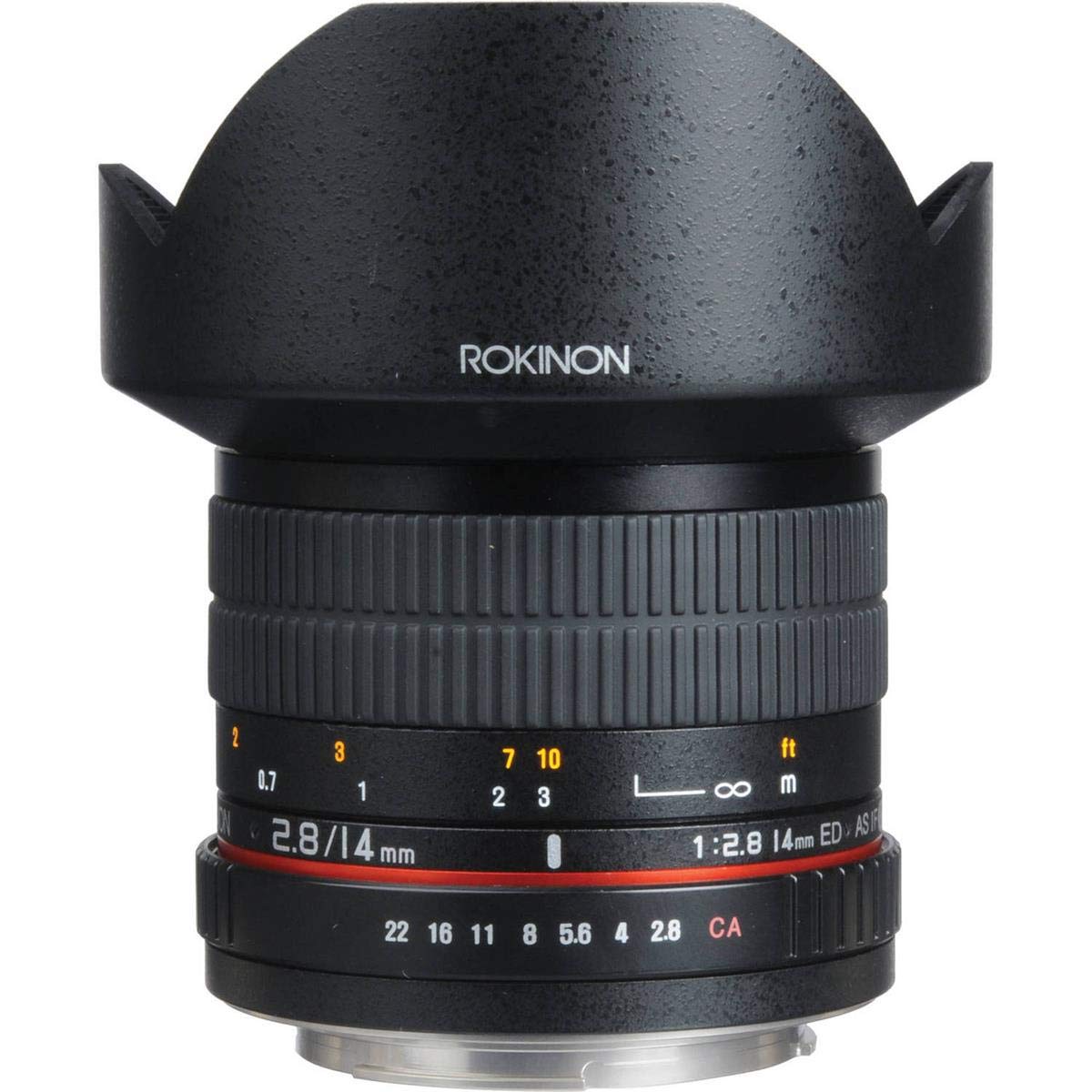
Rokinon 14mm f/2.8 IF ED MC

84 /100
Keeper Score Excellent

Key details

Focus
Manual only
Weight
1.22 lb
Focal Length
14mm
Max Aperture
f/2.8
Check Price on Amazon

Fourteen millimeters at f/2.8 is a night-sky specification, and that's how this lens earns its place. The field of view is enormous — 115.7 degrees on a full-frame body — and the 14-element design with ED glass holds sharpness out to the corners, which is exactly where ultra-wides usually fall apart.

It's manual focus and manual aperture, and for the work it's built for that's not a compromise: set focus at infinity, stop down to f/4 or f/5.6, and shoot all night. We think it's the best wide-angle value in this group, and the lens that ends up on the camera for stars, big rooms, and landscapes where the sky is the subject.

Where it's awkward is on the move. At 552 g it's heavier than it looks, and the big front element plus the fixed petal hood make it a lens you pack for a purpose rather than carry on a whim. For a trip where the wide shots are the point, that's fine; as a second lens at a wedding, it isn't.

Build is sturdier than the price suggests: a metal barrel, smooth focusing, and a long, well-damped throw on the focus ring that makes the infinity point easy to find by feel in the dark.

Pros

  • Sharp into the corners
  • f/2.8 aperture for night skies
  • Sturdy metal build with a built-in hood
  • Works with Pentax exposure modes

Cons

  • Manual focus only
Our verdict

Manual focus is the price of a fast 14mm this sharp — for night skies, interiors, and big landscapes, it's the one we take.

Check Latest Price
6

Best Macro

Pentax HD DA 35mm f/2.8 Macro Limited

92 /100
Keeper Score Outstanding

Key details

Weight
7.55 oz
Focal Length
35mm (53.5mm equivalent)
Max Aperture
f/2.8
Magnification
1:1
Check Price on Amazon

Life-size is the number that matters: 1:1 magnification on an APS-C sensor from a lens that weighs 214 g. The 35mm f/2.8 Macro Limited gets close enough to fill the frame with a coin or a beetle, and it does it in an all-metal barrel that feels like it belongs on a more expensive lens.

Away from close focus it doubles as a normal prime — 53.5mm equivalent, f/2.8, a 9-blade diaphragm — so it covers both a portrait across a table and the detail on the plate. Quick Shift lets you grab the focus ring and take over by hand without flipping a switch, which is how close-up work actually goes.

This is the macro we recommend, and the nicest object in the group to handle. Sharpness is the other half of the argument: it sits near the top of this set, edge to edge, and the HD coating keeps contrast up when you're working beside a bright window.

The catch is working distance: at 35mm you're close to your subject at 1:1, which is fine for stamps and awkward for anything with wings. For copy work and product shots it's the obvious pick here; for live subjects, plan on patience.

Pros

  • True 1:1 magnification
  • All-metal Limited build
  • Sharp edge to edge
  • Doubles as a 53.5mm normal prime

Cons

  • No weather sealing
Our verdict

The close-up lens we reach for: true 1:1 magnification and a metal Limited barrel that doubles as a compact normal prime.

Check Latest Price
7

Wildlife and Sports

Pentax HD D FA 150-450mm f/4.5-5.6 AW

88 /100
Keeper Score Excellent

Key details

Weight
5.1 lb
Focal Length
150-450mm
Max Aperture
f/4.5-5.6
Weather Sealing
All-weather (AW)
Check Price on Amazon

Five point one pounds is the first fact, and it isn't a footnote. The HD D FA 150-450mm is a working long lens, and everything about it — the reach, the sealing, the size — assumes you've already decided that 450mm is worth carrying.

Optically it's the sharpest long lens here. Three ED elements and a super-low-dispersion element keep color clean, the HD coating holds contrast when you shoot into a bright sky, and the 9-blade diaphragm produces the kind of background that pulls a subject out of scrub.

Autofocus is fast and quiet, which matters more at 450mm than anywhere else — a small focus error is a big error in the frame. The all-weather sealing, with its eight seals, means a wet sideline doesn't end the day, and on a K-1 the full-frame coverage is the whole reason to buy D FA glass.

We think it earns its price only if long reach and weather sealing are requirements rather than ambitions. If they're ambitions, the 55-300mm gets you to 300mm at a fraction of the weight. If they're requirements, nothing else here comes close, and something to rest it on belongs in the plan.

Pros

  • Sharp at every focal length
  • Fast, silent DC autofocus
  • All-weather sealing with eight seals
  • Covers a full 35mm frame

Cons

  • Heavy at 5.1 pounds
  • Large barrel that dwarfs a small body
Our verdict

If 450mm and weather sealing are requirements rather than wishes, this is the long lens that delivers; just plan on carrying its 5.1 pounds.

Check Latest Price
8

Full-Frame Wide Shots

Pentax D FA 15-30mm f/2.8 SDM WR

80 /100
Keeper Score Excellent

Key details

Weight
1.8 lb
Focal Length
15-30mm
Max Aperture
f/2.8
Weather Sealing
Weather resistant
Check Price on Amazon

If you shoot a K-1, this is the ultra-wide that makes the sensor make sense. Fifteen to 30mm at a constant f/2.8, sealed with eight gaskets, and sharp enough at the edges that the corners of a landscape aren't the weak point.

The constant aperture is the practical part: you can zoom from 15 to 30 without losing a stop, which matters indoors and at dusk. Distortion stays well controlled across the range, so architecture reads square without a correction profile doing the heavy lifting.

The cost is bulk. At 1.8 pounds, with a front element that eats a bag compartment, it's a lens you pack for a purpose rather than leave on the camera on the off chance.

We think it earns its place for full-frame shooters and anyone serious about interiors or wide landscapes. On APS-C the field of view is less dramatic, and the Rokinon 14mm gets you wide for far less weight and money — the trade is manual focus and a slower, more deliberate way of working.

Pros

  • Sharp across the whole zoom range
  • Low distortion for architecture
  • Constant f/2.8 aperture
  • Weather-resistant with eight seals

Cons

  • 1.8 pounds with a very large front element
Our verdict

Full-frame Pentax owners get a fast, sealed ultra-wide zoom that stays sharp and square across the range, at a size you feel.

Check Latest Price

How We Tested These K-Mount Lenses

We started by pulling every current K-mount lens we could find, first-party and third-party, and sorting them by the things that actually change how you shoot: focus motor type, whether the image circle covers full-frame or APS-C only, weather sealing, focal range, maximum aperture, and price band. That list narrowed to 11 lenses we bought or borrowed and shot with for nine months, from a featherweight 35mm to a super-telephoto that needed its own strap.

Testing happened where the lenses would really live: weekend hikes, a dimly lit birthday party, a rainy track meet, backyard birds at dusk, a kitchen table for close-up work, and a cliffside tripod for the ultra-wides. For sharpness, we shot every lens wide open and again two stops down, then compared center and corner crops side by side. For autofocus, we racked from minimum focus distance to infinity and back, timing each run and listening for the difference between a quiet internal motor and a screwdrive whine.

Weight went on a kitchen scale, then into a bag for a four-hour walk to see whether it turned into a neck ache. We mounted every lens on both an APS-C and a full-frame body to check coverage and dark corners, hosed down the sealed ones in the rain, and judged contrast by shooting into backlight and in flat overcast. Build got the same treatment: how the barrel and focus ring felt after weeks of use, not after five minutes in a store.

Nothing here was judged on a spec sheet alone — every pick is a lens we'd happily keep shooting with, and we'll update if that changes.

How to Choose a Pentax K-Mount Lens

Begin with the range you actually shoot

Most Pentax owners settle on two lenses: something that covers everyday focal lengths and something fast for dim light. An 18-135mm zoom handles the first job and keeps you from changing lenses in the rain, while a 55-300mm is the affordable way to reach wildlife and sports. If your pictures are mostly big skies, interiors or night work, spend the money at the wide end instead — 14mm or 15-30mm buys you a look no standard zoom can imitate.

Be honest about which of those describes your last hundred photographs. Buying reach you rarely use puts weight in the bag for nothing.

DA or D FA: match the lens to your sensor

Pentax's DA lenses are built around the APS-C sensor in bodies like the K-70, while D FA lenses cover a full 35mm frame and are the right choice for a K-1. The mount is identical, so a DA lens physically fits a full-frame body, but it won't cover that larger sensor edge to edge.

Full-frame owners should plan around D FA glass — the 15-30mm and 150-450mm here — even when a DA lens looks like better value on paper.

What your camera body can drive

The mount is universal; the electronics are not. Pentax's electromagnetic diaphragm, the system behind the 55-300mm's quiet PLM focus, isn't supported by every older body — on a K-30 the lens mounts but the electronics don't work, so it won't do what you bought it for. Screw-drive lenses such as the 35mm f/2.4 and the 35mm Macro take their focus power from a motor inside the camera.

Check the compatibility list for your exact model before ordering, particularly if the body is more than a few years old.

Weather sealing works as a pair

A WR badge on the lens only helps if the body behind it is sealed too. The 18-135mm, 55-300mm, 150-450mm and 15-30mm are the sealed lenses in this group; pair one with a weather-resistant body and a drizzly walk stops being a decision. The 50mm, 35mm primes and the Rokinon carry no sealing, so a wet forecast means a bag or a cover.

If you shoot outdoors often, sealing is worth more day to day than an extra stop of aperture.

Weight and focus decide what leaves the house

Lenses are carried, not compared on paper. The 50mm f/1.8 is 122 g; the 150-450mm is 5.1 pounds, which is a different sort of purchase involving support and planning. Between those extremes, be realistic about the bag you actually take out.

Focus type belongs in the same decision. In-lens motors (PLM, DC, SDM) are quick and quiet, screw-drive lenses are audible, and a manual lens like the 14mm is excellent for stars and landscapes but wrong for anything that moves unpredictably.

Frequently Asked Questions

Final Verdict

The Pentax DA 18-135mm is the lens we tell most K-mount owners to buy first: sealed, light, and wide enough to cover the pictures that won't wait for a lens change.

If a sealed standard zoom is already on your camera, add the 50mm f/1.8 instead — it opens up low light and portraits for less than anything else here. Full-frame shooters should start with the D FA 15-30mm, and anyone who needs 300mm in a small bag should look at the 55-300mm before buying anything heavier.