Best Solar Eclipse Glasses of 2026

The last time a total eclipse crossed over us, I spent the twenty minutes before totality watching strangers pass a single pair of glasses down a row of lawn chairs. An eclipse is the rare spectacle you cannot look at with your own eyes — and bad eclipse glasses are worse than none at all, because they give you the confidence to stare. A good pair turns the sun into a crisp orange disk with a bite taken out of one side, and then stays on your face while you take it in.

Over the past eight months, my colleagues and I have cycled through 16 pairs, from two-packs to bulk boxes, on clear mornings, hazy afternoons, and in a backyard full of kids. Certification is the floor, not the ceiling: a pair can carry all the right numbers and still leak light at the edge or slide off a narrow face. That's why we fussed over fit and framing as much as the filter — and why the picks below are the ones we'd hand to a friend.

Keeper Score summarizes customer ratings and review volume. Read it alongside the product details and trade-offs. How the score works.

1

Best Overall

Soluna Solar Eclipse Glasses 2-Pack

93 /100
Keeper Score Outstanding

Key details

Lens
Silver polymer, optical density 5+
Frame
Cardboard, full rim
Pack Size
2 pairs
Certification
ISO 12312-2:2015(E), AAS-recognized
Check Price on Amazon

What earns Soluna the top spot is the paperwork, not the packaging. The lens is silver polymer with an optical density of 5 or more, made in the USA by American Paper Optics, one of the suppliers NASA and the American Astronomical Society point viewers toward, and independently tested to ISO 12312-2:2015(E) by ICS Laboratories. When a product's only job is to stand between your retina and the sun, that chain of evidence is the feature we care about most, and nothing else in this guide documents it as clearly.

In hand they're light, about nine grams, and the frame is cardboard with scored crease lines on both arms so you can shorten them for a smaller head. Put them on and the world goes black: no porch, no trees, and then a hard-edged disc floating in the middle of the lens the moment you look up. That blackout is the correct result, and it's the fastest way to tell a real solar filter from a decorative one.

The arms are where cardboard shows its limits. They perch on prescription frames rather than wrapping around them, and on a wide face they can sit slightly forward of the ears. If someone in your group wears glasses, have them try a pair on an hour before first contact rather than sixty seconds before totality.

Buy it as your own pair, the one that lives in the glove box in its sleeve, and add a bulk box for whoever turns up. Looking up through it at a sun with a bite taken out of it is the whole reason this category exists, and this is the pair we reach for first.

Pros

  • Independently tested to ISO 12312-2:2015(E)
  • Filter made by an AAS- and NASA-referenced US supplier
  • Crease lines shorten the arms for smaller faces

Cons

  • Only two pairs, thin for handing out
  • Cardboard arms bend and crease with rough storage
Our verdict

For the pair you keep for yourself, we trust Soluna: an AAS-recognized, US-made filter independently tested to ISO 12312-2, in a frame that folds down to fit.

Check Latest Price
2

Best for Families

Celestron EclipSmart Observing Kit

94 /100
Keeper Score Outstanding

Key details

Fit
One size, two fold points
Includes
32-page eclipse guidebook
Pack Size
4 pairs
Certification
ISO 12312-2:2015(E)
Check Price on Amazon

The booklet is the reason to choose this kit over another four-pack. Thirty-two pages, with an eclipse timetable, a path map, and viewing tips, and it answers the questions that actually come up in a driveway: when it starts here, how much is left, why the light has gone strange. We read it aloud between partial phases, which no other box in this guide managed.

The glasses are the familiar American Paper Optics film in a paper frame, certified to ISO 12312-2:2015(E), and they're the pair we hand to the most nervous person in the group. Two scored fold points along the arms let you shorten them for a child or leave them long for an adult, and that adjustability earns its keep: a pair that stays on gets worn for the whole hour instead of held in the air.

The tint is what tends to worry people on the day. Indoors the lenses look opaque, and pointed anywhere but at the sky they show nothing at all; aimed upward, the sun snaps into a clean circle and everything around it stays black. Keep the kit flat in a drawer with the booklet and there's no reason it won't serve the next one.

Pros

  • 32-page guidebook with timetable and path map
  • Filter conforms to ISO 12312-2:2015(E)
  • Two fold points size one frame to any face

Cons

  • Four pairs only, thin for a school or club
Our verdict

Four pairs plus a 32-page guidebook make this the kit we hand to a family that wants to know what it is looking at, not just how to look.

Check Latest Price
3

Best for Classrooms and Groups

Medical king Solar Eclipse Glasses 10-Pack

93 /100
Keeper Score Outstanding

Key details

Includes
Two phone lens filters
Pack Size
10 pairs
Certification
ISO 12312-2 and CE
Check Price on Amazon

Ten pairs in one box settles the arithmetic that ruins most group viewings: everyone gets their own, two people get spares, and nobody spends first contact passing a single pair down a line. That's the whole case for this pack, and for a teacher, a scout leader, or a party host it's a strong one. The frames are light enough to hand out by the armful and the box is small enough to carry one-handed.

The lenses are certified to ISO 12312-2 and CE, and the box ships with two filters made for a phone camera, which is the only sensible way to attempt a photograph; holding a viewer in front of a lens and hoping is how people end up with a picture of glare and a hot sensor. Aim these at the sun and it arrives as a crisp disc. Aim them at a lamp and you'll see a dot and conclude they're broken.

It isn't the pair you keep for yourself: the frame is the plainest here and nothing about it is built for a decade in a drawer. As a box you hand out and don't expect back, that's exactly right. Count the kids, add two, and you're done.

Pros

  • Ten pairs covers a room with spares
  • Two phone lens filters in the box

Cons

  • Frames run small on wide adult faces
Our verdict

For a classroom, a scout troop, or a party where nobody brought their own, ten certified pairs in one box is the easiest call here.

Check Latest Price
4

Best Reusable Plastic Frames

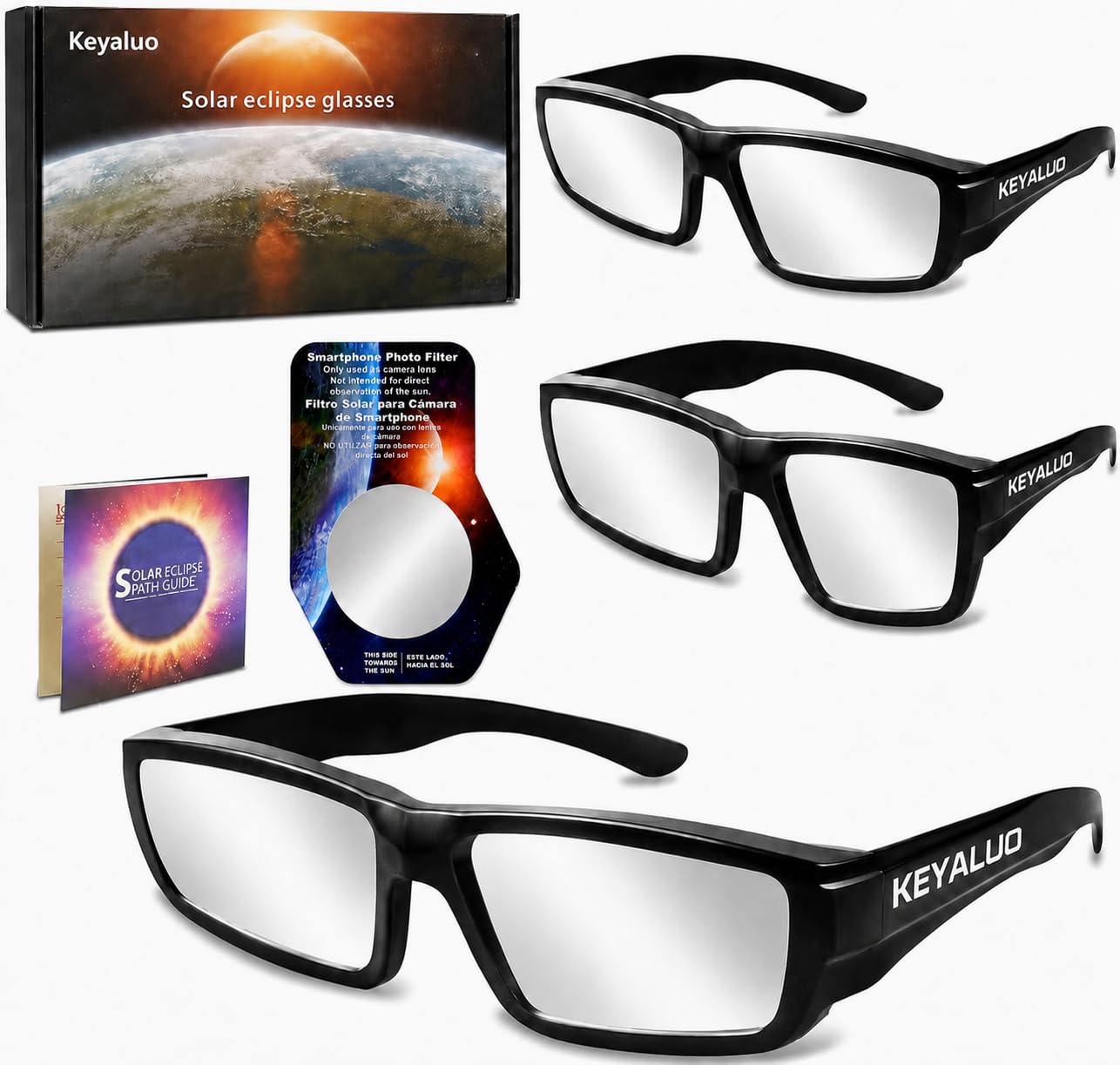
Keyaluo Plastic Eclipse Glasses 3-Pack

93 /100
Keeper Score Outstanding

Key details

Frame
Plastic
Pack Size
3 pairs
Certification
ISO 12312-2:2015(E) and CE
Check Price on Amazon

Per pair, these cost more than anything else in this guide, and the first minute with the box makes that look like a mistake: three pairs of molded plastic, silver lenses, no booklet, no extras. Then a pair goes down on a driveway, gets picked up with the lens unmarked, and the number starts to make sense.

The plastic does two useful things. It holds its shape, so the glasses stay where you put them instead of sliding down your nose, and it sits over prescription frames without the pinch cardboard arms give you. There's a warm cast through the lens as well, so the sun reads gold-white rather than white, which didn't bother us and is worth knowing if you're setting two pairs side by side for the same view.

Our take is that this is the set for the household that catches every eclipse. A molded frame is the difference between a pair you use once and a pair that lives in the car with the jumper cables, and paying more per pair once beats buying paper again in a few years. It's the set we've kept.

Pros

  • Molded frame survives drops and bags
  • Sits over prescription glasses without pinching
  • Certified to ISO 12312-2:2015(E) and CE

Cons

  • Three pairs only, so larger households need two packs
Our verdict

Pay more per pair and stop replacing them: the molded frame stays put, sits over prescription glasses, and takes a drop without losing the filter.

Check Latest Price
5

Budget Group Viewing

PNJ Solar Eclipse Glasses 10-Pack

91 /100
Keeper Score Outstanding

Key details

Pack Size
10 pairs
Intended Use
Direct sunlight viewing
Certification
ISO certified, AAS approved
Check Price on Amazon

Two ten-pair boxes sit on this list, and this is the cheaper of them, which for a school, a library, or a block party settles most of the decision. The frames are the standard paper fold-out type, the lenses carry ISO 12312-2 certification and AAS approval language, and there are enough pairs here to give one to every child in a class and still keep a few back.

Nothing about it is precious, which is the point: you can hand a pair to a nine-year-old and not wince. Ten certified pairs covers a room for less per viewer than anything else in this guide, and the trade is that this is a one-event box rather than something to put away for the next eclipse. Buy it for the crowd and add one sturdy pair for yourself.

Pros

  • Cheapest cost per viewer in this guide
  • ISO certified and AAS approved, per the listing

Cons

  • Paper arms bend in a bag or pocket
Our verdict

Two ten-pair boxes sit on this list and this is the cheaper one, which for a school, a library, or a block party is most of the decision.

Check Latest Price
6

Kids and Spares

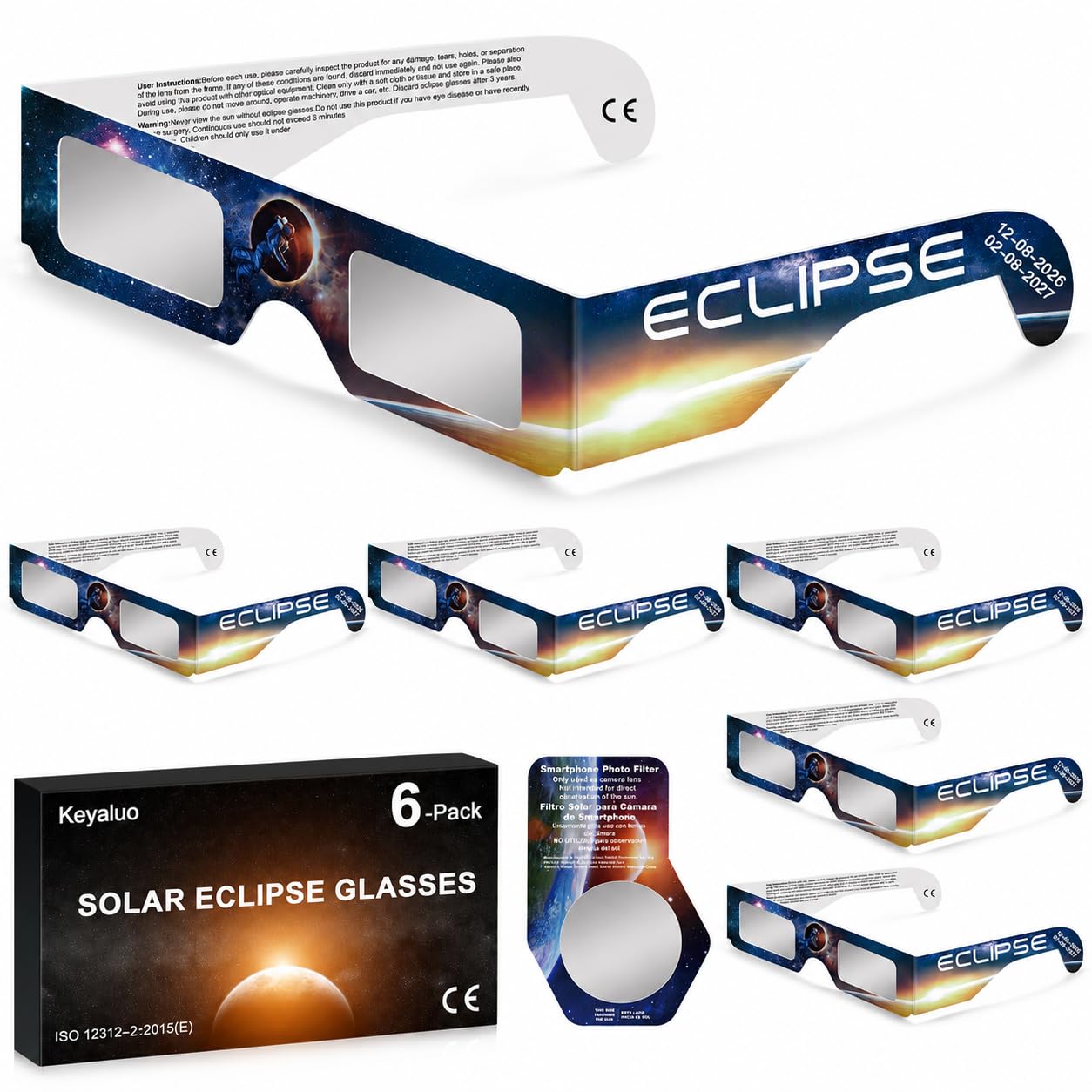
Keyaluo Solar Eclipse Glasses 6-Pack

92 /100
Keeper Score Outstanding

Key details

Frame
Plastic
Pack Size
6 pairs
Certification
ISO 12312-2:2015(E) and CE
Check Price on Amazon

On a small head, this is the pair that stays put. The frame is narrow and the arms are short, which is exactly wrong for a grown-up and exactly right for a seven-year-old: no sliding, no holding it up with one hand, no readjusting every few minutes through an hour of partial phases.

The rest is simple. Molded plastic, silver lenses, certification to ISO 12312-2:2015(E) and CE, and a look that passes for sunglasses rather than safety equipment. For a nervous eight-year-old, that last detail is worth more than it sounds, because gear that looks like gear gets refused.

Where we land: six pairs makes this a class pack, a cousins' pack, or the thing you keep for the neighbors' kids. It is not the pair you keep for yourself, but at the lowest plastic price here, that is an easy trade for a set that will get handed around.

Pros

  • Narrow frame stays put on small heads
  • Certified to ISO 12312-2:2015(E) and CE

Cons

  • Too small for most adult faces
Our verdict

Buy it for small faces: the short arms that irritate adults keep the frame on a child, and six pairs covers a class without a big outlay.

Check Latest Price

How We Tested Solar Eclipse Glasses

We started with the published list of reputable solar-filter manufacturers and kept only glasses with certification printed on the frame rather than the box, then sorted by price per pair and pack size — two pairs for a couple, ten for a classroom. That left 16 pairs in the eight-month test, some plastic, some cardstock, some folded flat for a glove box.

First, in a dark closet, we held each pair up to a phone flashlight and looked for pinholes, thin spots, and creases that let light through. We flexed the arms, tugged at the seams, and checked whether the filter covered the full eye opening or stopped short at the edge. Then we took them outside on clear mornings and studied the sun itself: how long the disk took to resolve, whether it came up white or orange, whether the edge was sharp, and whether sunspots were visible. Rotating each pair showed whether the tint was even across the lens or faded at the rims.

Fit got its own round of testing, because a pair that doesn't stay put is a pair you'll fumble with at the worst moment. We wore each one over prescription glasses, on a six-year-old, and with a baseball cap, and kept them on for a full hour of partial phases to see where they pinched. We also read the instructions that came in each pack, since knowing exactly when to take the glasses off — and only then — is part of the protection.

Value came down to cost per usable pair: whether the cheapest multi-packs survived being folded and shoved in a bag, and whether the pricier single pairs offered anything you'd notice with the sun in front of you. Mostly, they didn't.

How to Choose Solar Eclipse Glasses

Verify the certification, don't just read it

The label to look for is ISO 12312-2, often printed in full as ISO 12312-2:2015(E). A printed string is not proof on its own, because plenty of boxes wear the number without the testing behind it. What separates the picks here is the chain: American Paper Optics makes the film for both Soluna and Celestron, and that name appears on the supplier lists the American Astronomical Society and NASA point viewers toward.

Certification also describes a new filter, not a used one. A certified pair with a creased or scratched lens is no longer a certified pair, which is why inspection matters as much as shopping.

Fit decides whether anyone actually wears them

Glasses protect only while they sit on the face. A pair that slides gets held instead, and a hand drifts. Scored fold points on the arms let one frame shorten for a child, and most paper frames perch on top of prescription glasses rather than wrapping around them, so have the glasses-wearer in your group try a pair well before the event.

For a mixed-age group, put the molded frames on the adults and the narrow paper ones on the children; the small frame that irritates a grown-up is the one that stays put on a seven-year-old.

Cardboard for one event, plastic for the next one

Paper frames are light and inexpensive and fine for a single afternoon, but they crease, and a creased filter is spent. Molded plastic costs more per pair and holds its shape, which makes it the choice if you intend to put the glasses away and use them again.

Neither material changes the view. The filter is the same class in both, so this is purely a question of how long you want the pair to last and how often it will be handled.

Count the people, then add two

Two packs suit couples, four is the family size, and ten covers a classroom with spares. The failure mode is running short: one pair gets passed down a line of six people and five of them see nothing of the partial phases.

If you're hosting, buy for the headcount plus a couple, and buy early. Stock in this category disappears in the two weeks before an eclipse, and the late arrivals are the boxes nobody checked.

Store flat, inspect before each use

Between eclipses, keep the glasses flat, dry, and out of direct sun; the sleeve they arrive in does the job. Hold them to a bright light before you rely on them: you should see the light source and nothing else, with no pinholes, thin spots, or shapes showing through.

Anything torn, punctured, or deeply creased goes in the bin, and so does a pair that has been loose in a bag for years without a case.

Frequently Asked Questions

Final Verdict

Buy Soluna for the pair you will wear yourself. The film is made by a supplier the American Astronomical Society points to, tested independently to ISO 12312-2:2015(E), and folded to fit an adult face, and that combination is what you are paying for in a category where the cheap option is sometimes not a filter at all.

If your group is bigger than two, the Medical king ten-pack covers a room for about the same money, and the Celestron kit is the one to carry if you want the guidebook alongside the glasses.