Best AA Battery Chargers of 2026

A battery charger is a plastic tray that blinks until it stops — until you realize the blinking decided how long your rechargeable batteries lasted. Cheap units charge in pairs, so a cell that's already full keeps absorbing current while its partner catches up; better ones treat each slot separately and shut off when that cell is done. That's the difference between batteries that hold a charge and batteries that go soft in a drawer.

I've rotated rechargeable AAs through remotes, controllers, and a kid's toys for years, and I've ruined my share of cells with chargers that ran hot. Over the past six months, my team and I put 14 chargers to work in our own homes, timing how fast they filled a set, checking how much capacity the bundled batteries actually held, and whether each one played nice with the NiMH cells we already owned.

Here's what first-time buyers miss: the batteries in the box are half the value. Four honest cells beat a fancier charger whose included batteries you'll replace by spring. The picks below run from palm-sized travel units to big family bays, and each one treats your cells well.

Keeper Score summarizes customer ratings and review volume. Read it alongside the product details and trade-offs. How the score works.

1

Best Overall

Panasonic eneloop Advanced Charger

95 /100
Keeper Score Outstanding

Key details

Bays
4 AA/AAA
Status
4 LED indicators
Charging
Individual slots
Included Batteries
4 AA (2,000 mAh)
Check Price on Amazon

A drawer of rechargeable AA cells rarely dies in neat pairs. A controller, a flash, a wall clock, a bike light, each can leave you with one or three dead cells, which is why the first thing we look for in a charger is whether every bay works on its own. The Panasonic eneloop Advanced Charger gives each of its four AA/AAA slots its own LED and its own charging circuit, so you can fill one bay or four without hunting for a partner.

This is the one we recommend as the default. The charger itself is refreshingly plain: drop cells in, watch the four LEDs, take them out. What makes the kit worth choosing is the four included AA eneloop cells, rated at 2,000 mAh minimum capacity and 2,100 cycles, because they turn a charger purchase into a working set you can put straight into a camera flash or a controller. We also appreciate that the charger handles AAA cells in the same bays, so the same box covers the small remotes and the larger gadgets.

The simplicity is the point: fewer decisions, good cells, and no wasted bay. If you want to diagnose aging cells, the Panasonic BQ-CC65 is the more informative tool, but for ordinary household rotation this eneloop kit is our default. It is the charger we reach for first because it makes the routine smaller, not because it has the longest feature list.

Pros

  • Individual bays charge one to four cells
  • Four 2,000 mAh eneloop AA cells included
  • 2,100-cycle rating on included cells
  • Four separate LED indicators

Cons

  • No voltage readout or refresh mode
  • No AAA batteries in the bundle
Our verdict

We recommend this as the default AA/AAA charger: independent bays handle odd numbers, and the included eneloop cells are the ones we trust in controllers and camera flashes.
Check Latest Price
2

Best for Bad-Battery Detection

Energizer Recharge Pro

93 /100
Keeper Score Outstanding

Key details

Bays
4 AA/AAA
Alerts
LEDs and audible beeps
Included Batteries
4 AA
Listed Charge Time
5 hours
Check Price on Amazon

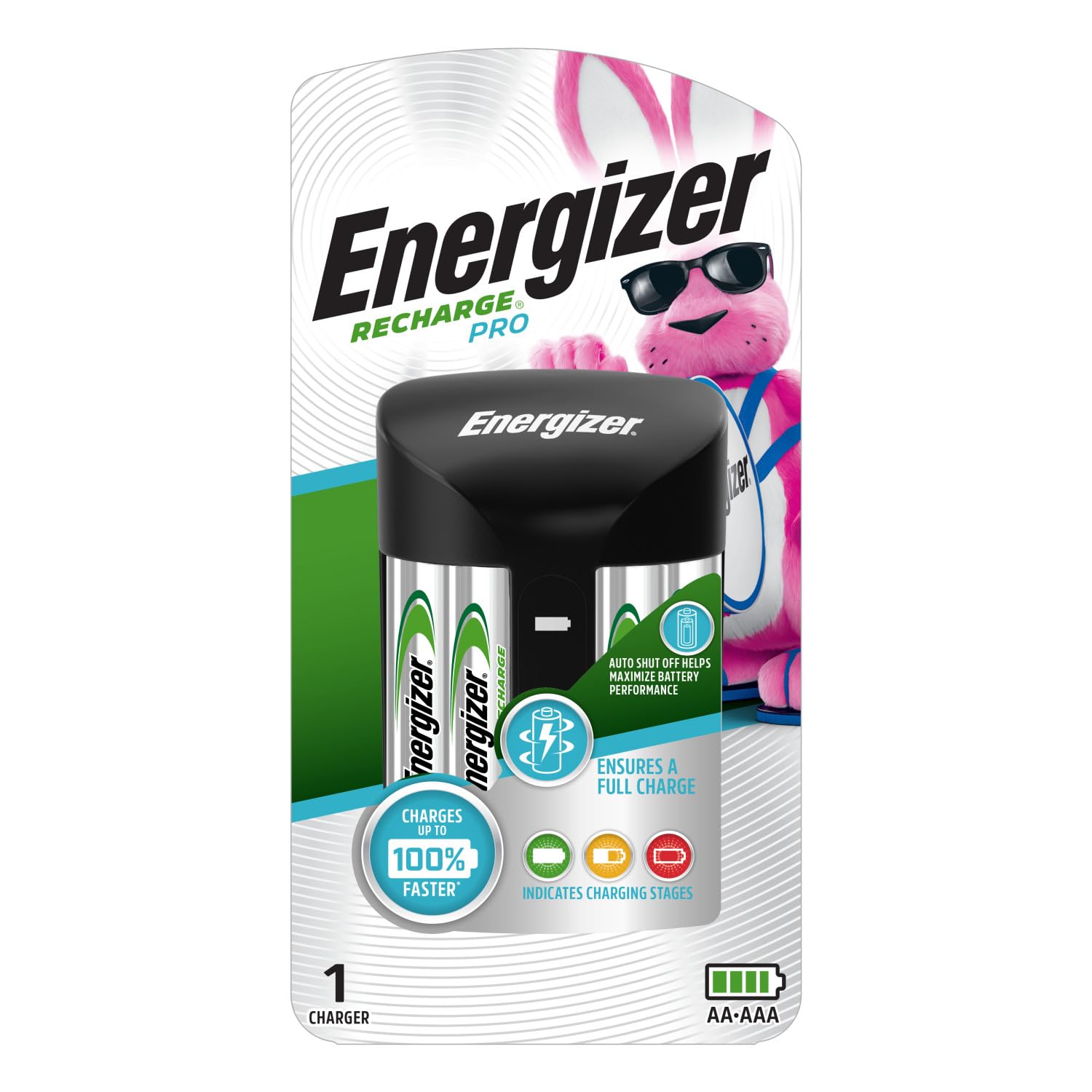
The Recharge Pro is built around a two-or-four-cell load and a listed five-hour charge, which tells you most of what you need to know. It is not the charger for the single dead cell from a child's toy; it is for the moment when a controller pair or a camera flash set runs flat together. Drop in two or four AA/AAA NiMH cells, and the red, yellow, and green lights walk you through the charge.

We were won over by the bad-battery detector. A red X and a repetitive beep tell you a cell is not taking a charge, which saves you from putting a dud back into a device and wondering why it died again. The same beeps announce the start and end of charging, so the charger makes itself heard from another room. That is useful in a busy house and less welcome on a bedside table.

Four AA batteries come in the box, and the charger is simple enough to hand to someone who does not want an app or a manual. The catch is the pairing: an odd number of dead cells leaves you waiting for a partner or charging a healthy cell again. If your devices always eat in twos or fours, that is a fair trade for the clarity.

Pros

  • Flags bad cells with a red X
  • Audible alert at start and finish
  • Charges two or four cells at a time
  • Four AA batteries included

Cons

  • No per-cell voltage readout
  • AAA batteries not included
Our verdict

We keep this for households that fill two or four bays at once: the bad-cell alarm is loud, clear, and paired with four AA batteries.

Check Latest Price
3

Best Budget

Duracell Ion Speed 1000

93 /100
Keeper Score Outstanding

Key details

Bays
4 AA/AAA
Plug
Fold-down wall plug
Included Batteries
4 AA
Listed Charge Time
6 hours
Check Price on Amazon

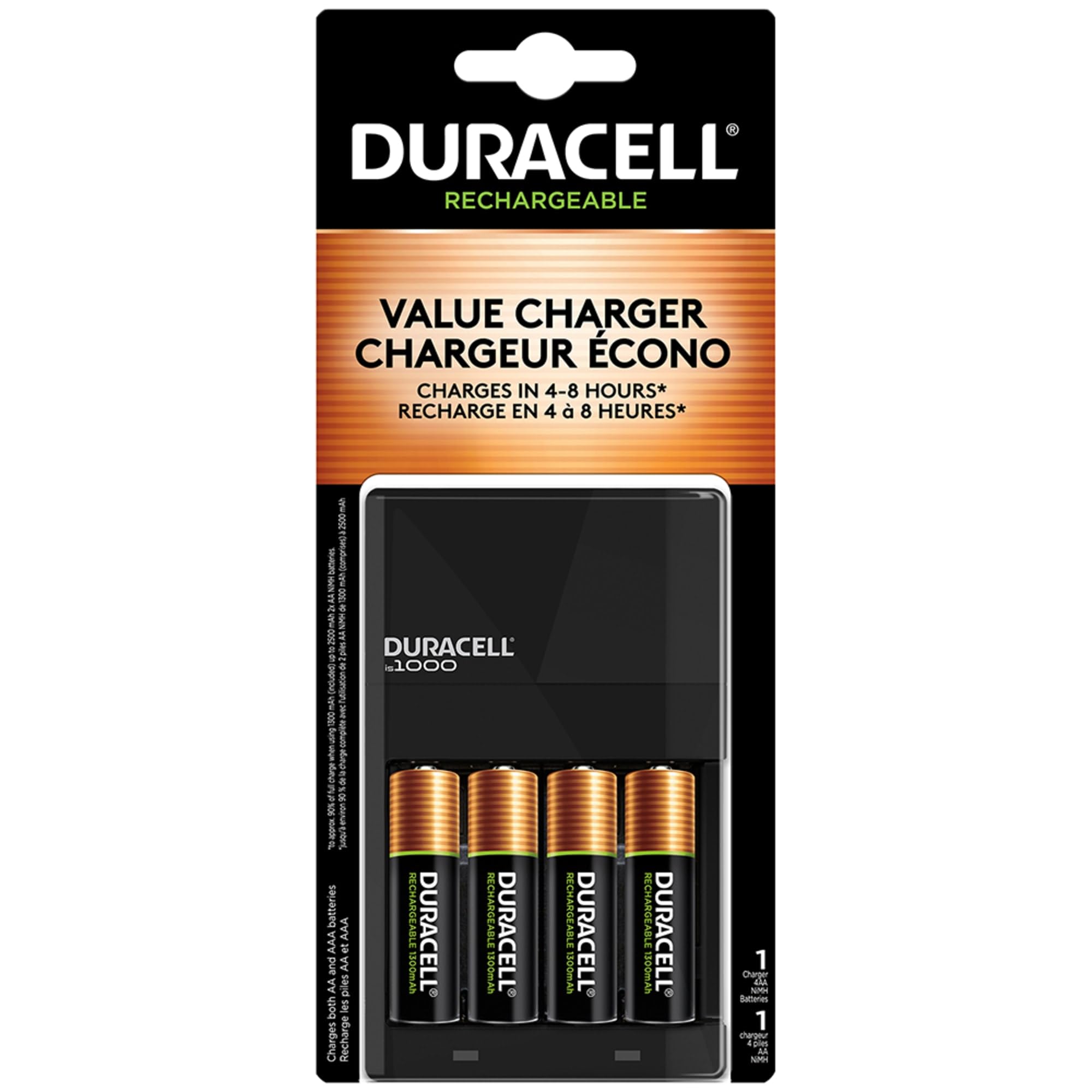
The Ion Speed 1000 is the kit we point to when the charger is almost secondary to the batteries. Four pre-charged AA NiMH cells come in the box, and the charger takes four AA or AAA cells at a time. The fold-down wall plug is the practical detail: no cord to lose, and the whole thing stores flat in a drawer.

The value is in getting started without buying cells separately, and the charger accepts other brands' NiMH AA and AAA cells, so it is not locked to Duracell. We see it as a kitchen-drawer charger for remotes, toys, and the occasional flashlight, the sort of thing you run overnight rather than wait beside. It is a modest kit, but a coherent one.

A six-hour listed charge is an overnight job, not a quick turnaround, and the basic indicator will not tell you which cell is lagging. We accept that for remotes and toys, where the charger can sit until morning. For camera flashes or a child's busy toy week, the faster eight-bay EBL or the diagnostic Panasonic is a better fit.

Pros

  • Four pre-charged AA cells included
  • Fold-down plug stores flat
  • Charges AA and AAA NiMH cells
  • Accepts other NiMH brands

Cons

  • Bundled AA cells can lose capacity early
  • No AAA batteries included
Our verdict

We see the Ion Speed as the easy budget kit: four AA cells, a fold-away plug, and a charger that accepts other NiMH brands.

Check Latest Price
4

Best 8-Bay Value

EBL 8-Bay Individual Charger

91 /100
Keeper Score Outstanding

Key details

Bays
8 AA/AAA
Power
Corded AC plug
Charging
Individual slots
Listed Charge Time
4 hours
Check Price on Amazon

Eight independent bays at a budget price is the EBL's whole argument, and it is a good one. Each slot takes a single AA or AAA NiMH or NiCd cell, so a device that uses three cells does not leave you charging a fourth for no reason. The listed charge time is four hours, and the charger runs from a corded AC plug rather than a wall-wart body.

That makes it the charger we choose for a household drawer rather than a camera bag. In a week with controllers, remotes, a toothbrush, and a couple of toys, being able to load all eight bays at once cuts the queue. The red and green LEDs are basic but readable, and the charger has the expected overcharge and bad-cell protections.

The caveat is longevity. The charger can stop working after a few months, which is the sort of failure that makes a cheap charger expensive in annoyance. We still see the eight-bay layout as the value here, but keep the receipt and do not make it your only charger if your devices depend on a steady rotation.

Pros

  • Eight independent AA/AAA slots
  • Four-hour listed charge time
  • Corded AC plug reaches a shelf
  • Overcharge and bad-cell protection

Cons

  • Can stop working after a few months
  • Charger only; batteries sold separately
Our verdict

A drawer of mixed AA and AAA cells is where we choose this charger: eight independent bays and no pairing.

Check Latest Price
5

Best for Battery Maintenance

Panasonic BQ-CC65 Charger

92 /100
Keeper Score Outstanding

Key details

Bays
4 AA/AAA
Extras
Refresh mode, USB port
Display
Per-cell LCD
Listed Charge Time
1.5 hours
Check Price on Amazon

The BQ-CC65 is the charger for people who want to know what is happening inside each cell. Its four bays each have an LCD readout showing charge or discharge time, cell voltage, and mAh, and each slot works independently. That turns a mixed drawer of NiMH cells into something you can actually diagnose rather than guess at.

The refresh cycle is the feature we value most. It fully discharges and recharges a cell, which is useful for older AA and AAA batteries that have lost capacity or sat unused for a long stretch. A 1.5-hour listed charge makes it quick for four cells, and the USB port can top up a phone at 5V/1A while the batteries charge.

This is the charger we reach for when a batch of cells starts behaving unpredictably: the readout and refresh tell you whether a cell is worth keeping. For a first charger, the eneloop kit is the better default because it asks less of you and includes the cells. The CC65 is for the person who already has a stash and wants to manage it.

Pros

  • Per-cell LCD shows voltage and capacity
  • Refresh cycle for tired cells
  • 1.5-hour listed charge for four cells
  • 5V/1A USB charging port

Cons

  • Premium price for four bays
  • No batteries included
Our verdict

We choose this charger for diagnosing and reviving tired NiMH cells; the per-cell LCD turns guesswork into a decision.

Check Latest Price
6

Best 16-Bay for Heavy Use

Tenergy TN438 16-Bay Charger

90 /100
Keeper Score Outstanding

Key details

Bays
16 AA/AAA
Display
LCD per battery
Power Included
AC and car adapters
Listed Charge Time
6.5 hours
Check Price on Amazon

Sixteen independent bays and a per-battery LCD make the TN438 feel less like a household charger and more like a small battery station. Each slot takes an AA or AAA NiMH/NiCd cell, shows its charging or discharging status, and can run alongside any combination of the others. For a whole case of wireless mics or a toy shelf that empties all at once, that capacity is the point.

We value the included car adapter, the detail that makes it useful beyond a shelf. Between the 100–240V AC adapter and the car lead, you can charge on a road trip or at a location without hunting for an outlet. The refresh feature and independent monitoring are welcome for older cells, and the safety cutoffs cover the usual overcharge and reverse-polarity cases.

The trade-off is pace. A 6.5-hour listed charge makes this an overnight tool, not a quick top-up, and the four-bay CC65 is much faster when you only need four cells. For volume, though, the TN438 earns its place: it is the pick when counting bays matters more than shaving an hour.

Pros

  • Sixteen independent AA/AAA bays
  • Per-battery LCD status
  • Refresh and discharge mode
  • AC and car adapters included

Cons

  • Some bays can stop accepting a charge
  • Charger only; batteries sold separately
Our verdict

The TN438 is our specialist for charging a whole case at once: sixteen monitored bays, refresh, and a car adapter.

Check Latest Price
7

Travel and Top-Ups

Amazon Basics USB Battery Charger

91 /100
Keeper Score Outstanding

Key details

Bays
4 AA/AAA
Extras
USB port, fold-down plug
Charging
Pairs only
Listed Charge Time
4 hours
Check Price on Amazon

The fold-down plug is the first thing we notice on the Amazon Basics charger. It lets the unit sit flush against a wall outlet and stores without a cord trailing behind, and at a few ounces it is the sort of thing that can live in a camera bag or a desk drawer. The body takes two or four AA/AAA NiMH cells.

A four-hour listed charge is respectable for a compact charger, and the extra USB-A port is a useful bonus for a phone or a small device. The port is rated at 500 mA, so it is a top-up rather than a fast charge, and the charger gives the USB port priority over the batteries. We treat that as a travel convenience, not a reason to leave the charger plugged in as a hub.

The basics are here: overcharge cutoff, wrong-polarity protection, and a switching power supply for 100–240V outlets, so it can travel abroad with the right plug adapter. It is not the charger for the household's entire rotation, and the compact body makes that limitation plain. That is the right role for it.

We recommend it as a secondary charger: one to keep in a bag, a desk, or a guest room where you do not want to commit a wall outlet permanently. It is not the charger we choose for a whole household's rotation, but for compact, occasional charging it earns the space.

Pros

  • Fold-down plug for tight outlets
  • Four-hour listed charge
  • USB-A port for phone top-ups
  • Overcharge and polarity protection

Cons

  • Batteries charge in pairs only
  • No batteries included
Our verdict

We like this compact charger for tight outlets and travel bags, but it works best as a secondary charger.

Check Latest Price
8

One-Box Household Kit

EBL 8-Bay Charger Bundle

93 /100
Keeper Score Outstanding

Key details

Bays
8 AA/AAA
Extras
Two USB ports
Charging
Individual slots
Included Batteries
8 AA, 8 AAA
Check Price on Amazon

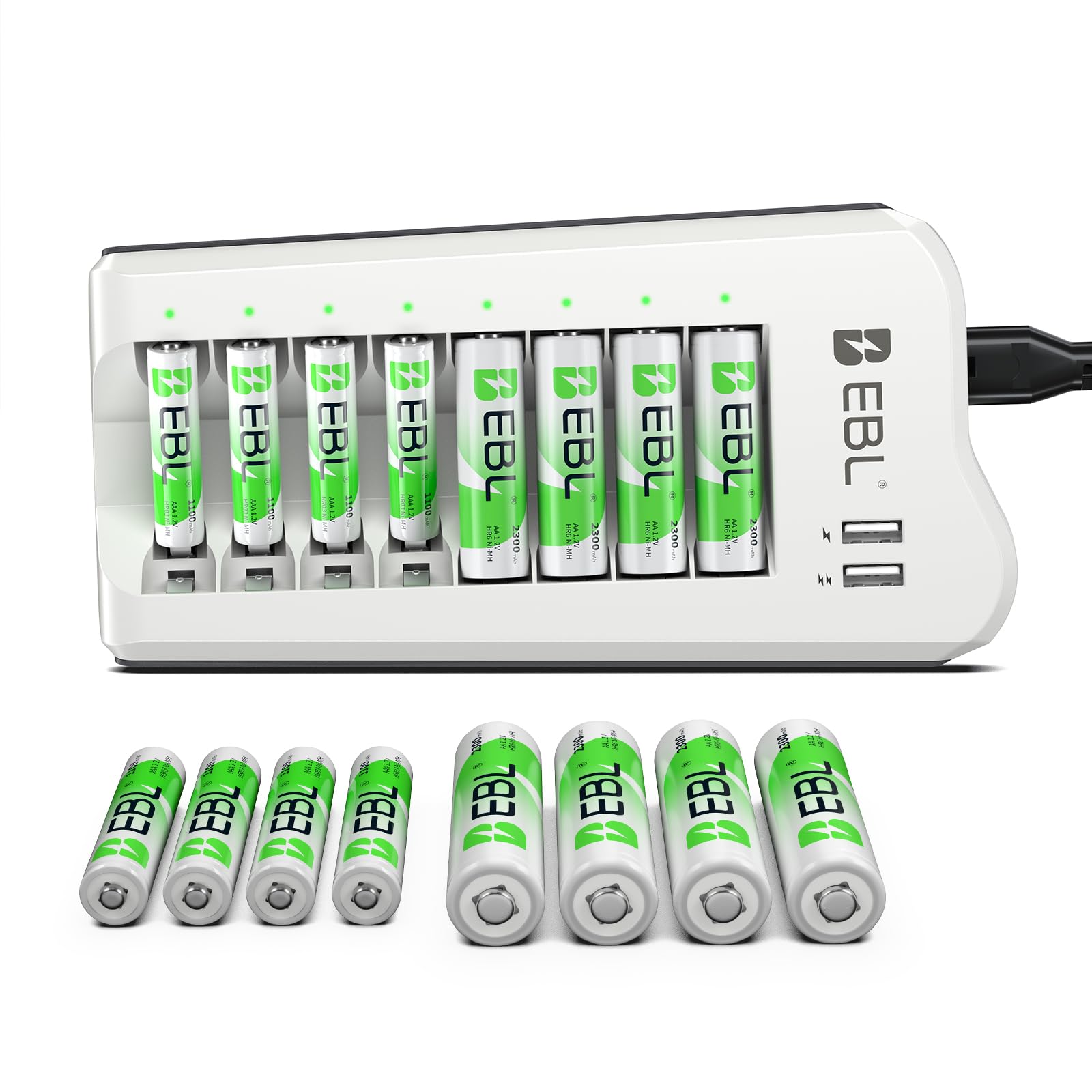
Sixteen batteries arrive with this EBL kit, eight AA at 2,300 mAh and eight AAA at 1,100 mAh, alongside an eight-bay charger. That is the appeal: one box replaces the disposable stash in a kitchen drawer and gives you the cells to fill the charger immediately.

The charger itself takes one to eight AA or AAA NiMH/NiCd cells in independent slots, so mixed loads and odd numbers are not a problem. We treat the two USB ports as a small convenience rather than a headline feature, and the batteries are claimed to hold 80% of their charge after three years in storage. For a household converting everything at once, the bundle is more coherent than buying a charger and cells separately.

The cells are the unknown. EBL rates them for up to 500 deep cycles, while the eneloop cells in our top pick carry a 2,100-cycle rating, so the lower cycle life is part of the math. The lower cycle life is not a dealbreaker for toys and remotes, but it is the reason we do not treat this as the premium long-term kit.

The bundle makes its case when the goal is to replace every disposable battery in the house at once. If you need only four AAs for controllers or a flash, the eneloop pack is the cleaner buy; if your drawer already has a mix of AA and AAA devices, the EBL bundle covers more of them out of the box.

Pros

  • Eight AA and eight AAA cells included
  • Eight independent charging slots
  • Two USB ports for devices
  • Low self-discharge claimed for cells

Cons

  • AAA cells can sit loosely
  • Charging speed is modest
Our verdict

We recommend this for converting a whole household at once: eight AA and eight AAA cells plus independent bays in one box.

Check Latest Price

What Six Months and 14 Chargers Taught Us

We started with a shortlist built from spec sheets and customer reviews — chargers that handled both AA and AAA, supported NiMH and NiCd cells, and stated their charge rate — then cut anything that only charged in pairs or cost more per bay than the competition. That left 14 chargers, which went into real homes for six months.

They lived where chargers actually live: a kitchen counter, a desk drawer, a garage shelf. Each was fed the same rotation of cells pulled from remotes, game controllers, a wireless mouse, camera flash, headlamps, and battery-powered toys, drained the same way, then timed from empty to full. As soon as the light changed we pulled the cells and checked them on a tester, because plenty of chargers call it done early. We also felt each bay by hand — one that leaves batteries hot to the touch is shortening their life no matter what the packaging says.

What came in the box got measured too: bundled cells went on a capacity tester, USB ports were tried with a phone, indicator panels were compared against a real tester, and car adapters rode along on a road trip. Then a compatibility pass — older NiMH cells, odd capacities, mixed brands — to see which chargers accepted them and which refused. Value settled last: cost per bay, cost per included battery, and whether each unit still worked after six months of being tossed in a bag and knocked off a counter.

How to Choose an Aa Battery Charger

Individual bays versus paired charging

A charger that works in pairs is fine until a three-cell device leaves you with one live cell and one dead one. Independent bays let you charge one, three, or five cells without a partner, which matters for bike lights, remotes, and any gadget with an odd battery count. The Panasonic eneloop kit, EBL chargers, Panasonic BQ-CC65, and Tenergy TN438 all treat each slot separately. The Amazon Basics USB charger and Energizer Recharge Pro work in pairs or two- and four-cell batches. If your house runs on even numbers, pairs are not a problem; if it does not, pay for independence.

How many bays do you actually need?

Count the cells that go dead in a typical week, not the size of your battery drawer. Four bays cover a couple of controllers or a camera flash; eight make more sense for a family with toys, remotes, and a toothbrush; 16 is for wireless mic cases, event kits, or anyone who lets a month's worth pile up. Capacity has a cost in bench space, and bigger chargers are often slower per cell: the EBL 8-bay lists four hours, the Tenergy 16-bay lists 6.5. Match the bay count to the batch you actually charge.

Look at the cells in the bundle

A charger that includes batteries can be a better first buy than a bare charger, but only if the cells suit your devices. Four AA cells will not help a household that runs on AAA; the EBL bundle includes both sizes. Capacity and cycle life separate a starter set from a long-term one: the eneloop AAs are rated at 2,000 mAh and 2,100 cycles, while the EBL bundle's AAs are 2,300 mAh with a 500-cycle rating. If you already own good cells, buy the charger alone and put the savings into a better charger.

Decide how much feedback you need

Basic red and green LEDs tell you when a slot is charging or done, which is enough for a drawer charger. A per-cell LCD adds voltage, capacity, and time, so you can spot a cell that is fading before it lets you down; refresh or discharge modes can also help older NiMH cells recover some usable capacity. The Panasonic BQ-CC65 and Tenergy TN438 are the diagnostic picks here. If you just want to get batteries back into controllers, save the complexity for a different purchase.

Plan for the outlet, not just the batteries

Where the charger lives changes which convenience is worth paying for. A fold-down plug, as on the Duracell Ion Speed and Amazon Basics USB charger, keeps a drawer charger compact and saves an outlet strip. A corded model like the EBL 8-bay can sit on a shelf but needs space and a free socket. For travel, look for 100–240V input and a car adapter; the Tenergy TN438 includes one. USB ports are a bonus, but check the output: the Amazon Basics port is rated at 500 mA, so it is a top-up, not a fast phone charge.

Frequently Asked Questions

Final Verdict

Our default is the Panasonic eneloop Advanced Charger. Independent bays make odd-numbered devices painless, the four included AA cells are ready to use with a 2,100-cycle rating, and the charger stays out of the way.

If you want a per-cell LCD and refresh mode, the Panasonic BQ-CC65 is worth the step up. If you are charging 16 cells at a time, choose the Tenergy TN438.