Best Dual Battery Kits of 2026

A second battery is a great idea right up until the morning it leaves you stranded. An isolator lets the alternator fill both batteries while you drive, then cuts the link so your fridge, winch, or stereo can't flatten the one that turns the engine over. Wire it badly and you find out at the ramp, with a dead start battery and warm bait.

I've wired these into a diesel pickup, a camper van, and a side-by-side, and over the past six months my team has installed and lived with 12 dual battery kits across trucks, boats, and UTVs.

The specs that actually decide it are duller than the packaging: relay headroom that suits your alternator, cable thick enough to carry the charge, terminals you can get a wrench onto, and instructions that don't assume you've done this before. Two kits with the same amp rating can behave very differently once a winch joins the circuit — the picks below are the ones that held up.

Keeper Score summarizes customer ratings and review volume. Read it alongside the product details and trade-offs. How the score works.

1

Best Overall

KeyLine 140A Dual Battery Kit

91 /100
Keeper Score Outstanding

Key details

Waterproofing
IP65
Positive Cable
20 ft
Switching Points
13.3 V in / 12.8 V out
Continuous Rating
140 A
Check Price on Amazon

The box is the argument for this one: a 140-amp voltage sensitive relay, 20 feet of red positive cable, lugs, terminals and the hardware to land it all, arriving together. That matters the first time you are under a truck with a half-filled shopping list. For a single auxiliary battery — a fridge, some lights, a trailer winch — nothing else here gets you from unboxing to charging with less running around.

The switching is what earns the spot. The relay joins the two batteries at 13.3 volts, so it waits until the alternator is genuinely charging before sharing, and it separates them again at 12.8. Your accessories can flatten the second battery and the relay has already cut it loose from the one that starts the engine. IP65 sealing handles road spray and the occasional hose-down, and at eight ounces the relay hangs off a bracket without extra bracing.

Plan the install rather than improvising it. The wiring is simple — positive to each battery, ground to ground — but the eyelet lugs want a proper crimping tool, not pliers and optimism. Measure your run before you cut: 20 feet reaches a bed-mounted battery in most pickups, and knowing that saves you a splice.

Two things we noted while living with it. On a vehicle whose charging system tapers early, the relay can hover near its thresholds and cycle more than it should. And the failure to watch for is a unit that quietly stops switching after a few months; the 12-month warranty covers the part, not the tow.

Pros

  • Complete kit: cable, lugs, terminals, hardware
  • Automatic 13.3 V cut-in, 12.8 V cut-out
  • IP65 housing survives engine-bay spray
  • Installation goes quickly for a 12-volt kit

Cons

  • Positive cable is light for long runs
  • Instructions get mixed marks
Our verdict

Our pick for most trucks, vans and UTVs: everything arrives in one box, installation is straightforward, and the 13.3-volt cut-in keeps the starting battery out of the accessory circuit.

Check Latest Price
2

Best for Boats

Blue Sea Systems Add-A-Battery 120A

94 /100
Keeper Score Outstanding

Key details

Control
Dual Circuit Plus switch + ACR
Waterproofing
IP54
Continuous Rating
120 A
Emergency Combine
Yes
Check Price on Amazon

Most kits here are a relay and a length of cable. The Add-A-Battery is a different animal: a Dual Circuit Plus battery switch and an SI-ACR charging relay in one box, wired so a single ON/OFF motion looks after both banks. On a boat that is the appeal — one thing to turn at the dock instead of a sequence to remember.

What you are paying for is the combine position. If the starting battery is flat, the switch links the banks so the house battery cranks the engine. No plain relay here does that, and it is the difference between a delayed start and a ruined morning. The rest of the time the ACR does the automatic work, combining when it senses charge and isolating at rest, and the tin-plated copper studs are made for a damp compartment rather than a dry cab.

Wiring is a bigger job than a two-cable relay — switch, ACR, grounds — though the diagram is one of the clearer ones in this set. With an IP54 housing it wants a locker rather than an open console where spray sits. Both are fair asks on the boat this was designed for.

Pros

  • Emergency combine links both banks
  • One ON/OFF switch controls both banks
  • Tin-plated copper studs resist corrosion
  • ACR combines and isolates automatically

Cons

  • No cable, lugs or terminals in the box
  • 120 A continuous rules out high-output builds
Our verdict

Buy this one for the switch as much as the relay — a single ON/OFF for both banks and a combine position that starts the engine off the house battery.

Check Latest Price
3

Best for High-Current Setups

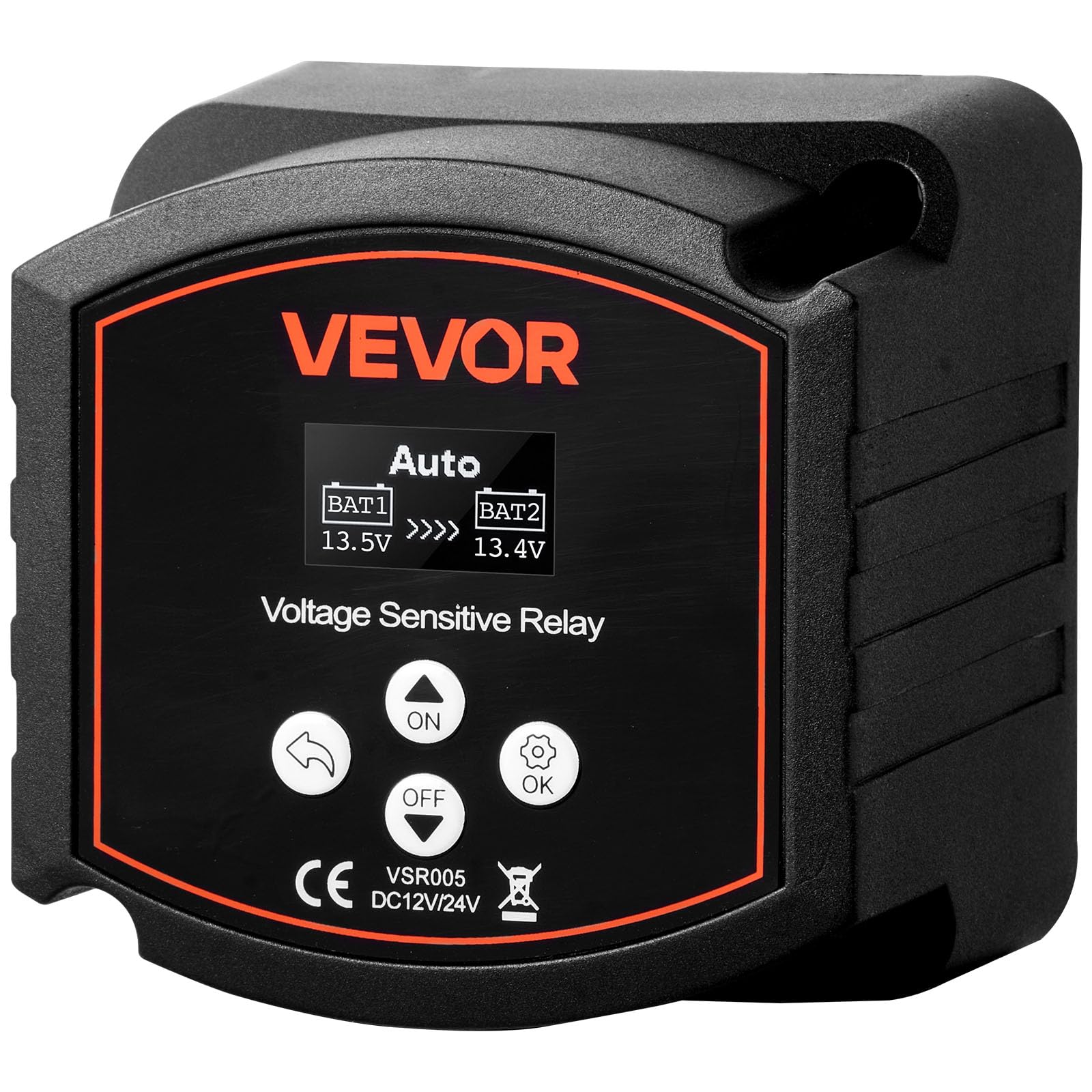
VEVOR 300A VSR Isolator

86 /100
Keeper Score Excellent

Key details

Modes
Automatic and manual
Display
Dual voltage LCD
Battery Types
Lithium and lead-acid
Continuous Rating
300 A
Check Price on Amazon

Fixed thresholds are the quiet problem with voltage sensitive relays: the unit decides when your alternator counts as charging, and you live with the number it picked. This one lets you move the cut-in and cut-out, and after a few kits that do not, we think adjustability is worth more than the amps on the label.

The display is the other reason we keep coming back to it. It reads both batteries at once across a 4.5 to 20 volt range, so you can watch a draw overnight or catch the moment the relay joins. There is an adjustable delay of 3 to 60 seconds as well, which stops the relay chattering when voltage sits near the threshold — exactly what makes cheaper units click in and out at idle.

At 300 amps it handles work the 140-amp kits cannot: an inverter, a big winch, a lithium bank. It is rated for lithium and lead-acid both, which matters because a lead-acid-only relay will leave a LiFePO4 bank short of a full charge. Two cautions. No IP number is published, so mount it out of direct spray. And a relay that gives up under load can fail hot, so fuse the positive cable at the battery and keep the unit where you can see it.

Pros

  • Adjustable cut-in and cut-out voltages
  • Dual display reads both batteries
  • 300 A for inverters and winches
  • Rated for lithium and lead-acid

Cons

  • Screen plastic scratches, with no replacement cover sold
Our verdict

What we recommend when the load is big: 300 amps, adjustable thresholds and a display that shows both batteries at once.

Check Latest Price
4

Best Value Complete Kit

Mata1 140A Isolator Kit

86 /100
Keeper Score Excellent

Key details

Footprint
2.7 x 2.7 x 2 in
Kit Contents
13 pieces
Waterproofing
IP67
Continuous Rating
140 A
Check Price on Amazon

The relay is a 2.7-inch cube, which sounds like a spec-sheet detail until you are standing in an engine bay working out where a box can live. It slots into the space beside a battery tray that the bigger units cannot use, and the IP67 sealing is the best in this set — dust-tight, and able to take a dunking.

Thirteen pieces come in the box, including long leads that reach a battery at the back of a wagon without a splice, plus the terminals and lugs to finish the job. Nothing in this kit left us hunting for a part, which is more than we can say for the relay-only option here.

What you give up is information. There is no display, no manual override and no adjustable threshold; it cuts in at a fixed point and does its job without telling you about it. If you want to watch voltages from the cab, the VEVOR or the KEMIMOTO will show you more. What this one does instead is disappear — you find out it worked when the fridge is still cold on Sunday morning.

Pros

  • Complete kit with long cable runs
  • IP67 sealing is the best in this set
  • Small footprint fits tight bays
  • Costs less than our top pick

Cons

  • No voltage display or manual override
Our verdict

A complete, tightly sealed 140-amp kit for a straightforward second-battery install, and the one we point first-timers to when the top pick is more than they need.

Check Latest Price
5

Best for Honda Pioneer

ATVMaster Pioneer Dual Battery Kit

83 /100
Keeper Score Excellent

Key details

Fitment
Honda Pioneer 1000/700/500
Replaces
UTV-SBI-CM
Monitoring
Digital dual voltmeter
Check Price on Amazon

Pioneer owners are not shopping for a universal relay. They want a second battery on the factory accessory circuit without a harness full of splices, and this is the one kit here shaped around a single machine.

You get the isolator and a digital double voltmeter, so both batteries read from the dash instead of from under the seat. It replaces part number UTV-SBI-CM, which means it takes the spot an OEM-style kit would and works with the machine's existing wiring rather than asking you to run new circuits. What we did not expect to care about is that display: a permanent readout turns is-something-wrong into a glance.

The catch is the obvious one. On a Pioneer it is the neatest option in this guide; on anything else it is not an option at all. The current rating is not published either, so if you are feeding a winch or a plow, confirm the relay can carry it before you commit. For lights, a stereo and a sprayer, it is a tidy fit.

Pros

  • Built specifically for the Honda Pioneer
  • Dash voltmeter reads both batteries
  • Replaces OEM part UTV-SBI-CM

Cons

  • Fits Honda Pioneer 1000/700/500 only
  • No published current rating
Our verdict

If you ride a Pioneer, this is the tidy answer: factory fitment and a dash readout for both batteries, without a universal relay bracket to improvise.

Check Latest Price
6

Best for Can-Am Maverick X3

UTV Stereo Can-Am X3 Battery Kit

87 /100
Keeper Score Excellent

Key details

Fitment
Can-Am Maverick X3
Connection
Factory accessory plug
Cranking Amps
270 CA
Battery Included
12 V AGM, 18 Ah
Check Price on Amazon

This is the only kit in the guide with a battery in the box: an 18-amp-hour, 270-cold-cranking-amp sealed AGM, along with the bracket and hardware to hang it.

For a Maverick X3 running a stereo, a light bar and a winch, that changes the job. The kit plugs into the factory accessory plug instead of asking you to build a harness, the isolator charges the second battery while the engine runs, and the battery ships fully charged, so the install ends with a machine you can drive.

It is not cheap and it is not universal — one machine, premium money. For a loaded X3, though, we think the bundle is the sensible call: a separate battery, a bracket and an isolator add up to a similar bill and a fabrication job at the end of it. AGM is sealed and maintenance-free, but it is still lead-acid, so put it on a maintainer if the machine sits for months.

Pros

  • Battery, bracket and isolator in one box
  • Plugs into the factory accessory plug
  • Ships fully charged
  • Charges the auxiliary battery automatically

Cons

  • Can-Am Maverick X3 fitment only
Our verdict

For a Maverick X3 with a stereo and a light bar, this is the shortest path to a second battery, because the battery is in the box.

Check Latest Price
7

Large Lithium Banks

KeyLine Pro HD 300A Isolator

82 /100
Keeper Score Excellent

Key details

Warranty
3 years
Peak Rating
1000 A
Waterproofing
IP65
Continuous Rating
300 A
Check Price on Amazon

Same maker as our top pick, twice the relay. Where the 140-amp kit covers one auxiliary battery and a handful of accessories, this one is built for installs that outgrow it: more than 150 amp-hours of auxiliary capacity, a big inverter, a winch that pulls hard.

The specification that matters most is not the 300 amps — it is that KeyLine rates this for lithium and LiFePO4 as well as lead-acid. Plenty of cheap relays switch at lead-acid voltages and leave a lithium bank short of a full charge. It is IP65 and carries a three-year warranty, the longest here, which you appreciate when the relay is buried behind a panel.

Going bigger costs you space. The package measures 15.4 by 12.9 inches and weighs 8.6 pounds, so it is a box of cable and hardware as much as a relay, and it needs somewhere to live. Installation is more of a project than the 140-amp kit — the trade for the capacity. What it does not cost you is charging output: a diode-based isolator drops voltage, and KeyLine quotes almost 2 amps that a diode unit gives away.

Pros

  • 300 A continuous, 1000 A peak
  • Rated for lithium and LiFePO4 banks
  • Three-year warranty, the longest here
  • IP65 sealed housing

Cons

  • Bulky 8.6-pound package needs mounting space
  • More relay than a 150 Ah auxiliary bank needs
Our verdict

Choose this over our top pick when your auxiliary bank tops 150 amp-hours or runs lithium; the extra capacity and the three-year warranty justify the size.

Check Latest Price
8

Tight Budgets

Nilight 140A Isolator

78 /100
Keeper Score Very Good

Key details

Display
LED voltage
Warranty
2 years
Waterproofing
IP66
Continuous Rating
140 A
Check Price on Amazon

Open the box and you will find the relay, mounting hardware and a ring terminal — and no cable. That is the whole proposition rather than a complaint: this is the least expensive way into a dual-battery setup here, and it assumes you already own a reel of heavy cable and a way to crimp it.

What you get is neat. A 140-amp VSR with IP66 sealing, a live LED readout of system voltage, and a two-year warranty that runs longer than the top pick's. At two inches square, it fits behind a panel where the bigger units will not go.

The trade is that you are doing the engineering — gauge, fuse, lugs and the run from the front battery to the back. That suits someone who has already wired a winch or a trailer. Everyone else is buying a Saturday back by choosing a complete kit.

Pros

  • Least expensive entry into dual batteries here
  • Live LED voltage display
  • IP66 sealed housing
  • Two-year warranty

Cons

  • No cable or lugs in the box
  • Automatic only, with no manual override
Our verdict

The pick for anyone who already owns cable and a crimper: a sealed 140-amp relay with a voltage readout for less than any complete kit here.

Check Latest Price
9

Universal UTV Fit

KEMIMOTO 140A UTV Kit

81 /100
Keeper Score Excellent

Key details

Warranty
12 months
Monitoring
Digital dual voltmeter
Waterproofing
IP65
Continuous Rating
140 A
Check Price on Amazon

The extra here is a digital dual voltmeter: two readings, one per battery, mounted where you can see them. On a UTV that is more useful than it sounds — you find out the auxiliary battery is low while you are still parked, not when the winch stalls.

Around it you get a 140-amp isolator in an IP65 housing sealed against mud and vibration, and fitment that covers the usual machines: Polaris, Can-Am, Cfmoto, Talon, Pioneer, Kawasaki. The relay charges the starting battery before it tops the auxiliary, which is the right order on something that has to start.

The one thing we flag on this kit is the crimps on the included positive leads. Lugs that pull off turn a twenty-minute job into an afternoon, and a two-second tug on each one before you mount anything tells you whether yours are sound. Past that the install is straightforward, and the two-reading display is the reason to pick this over a bare relay.

Pros

  • Dual voltmeter shows both batteries
  • IP65 housing handles mud and vibration
  • Fits Polaris, Can-Am, Cfmoto and more
  • Charges the starting battery first

Cons

  • Lugs on the positive leads can pull loose
Our verdict

A well-equipped UTV kit with two voltmeter readings and broad machine compatibility, as long as you check the factory crimps before bolting it down.

Check Latest Price

How We Tested These Dual Battery Kits

We started with a shortlist of nearly 30 kits and cut it by reading the fine print: relay type and amperage, whether the housing was actually sealed, what came in the box (cable, fuse, switch, terminal hardware), and whether it would take lithium as well as lead-acid. Kits that shipped a bare relay were judged against kits that arrived ready to wire, since that gap is most of the value question. Twelve made the cut.

Each one went into a real vehicle — a diesel pickup with a winch, a camper van running a 12-volt fridge, a side-by-side on a hunting lease, and a small boat at a marina. I installed every kit myself in a driveway with hand tools and timed it, reading the instructions first as a first-timer would and noting whether they named a fuse rating and a cable gauge. Every cable in the box got measured against the actual run from start battery to aux.

Then we drove with them for six months. Each morning I checked resting voltage on both banks with a multimeter before the engine turned over and compared it to whatever readout the kit displayed. Overnight, the fridge and stereo ran off the aux bank while I watched whether the relay dropped out cleanly and left the start battery above threshold. Winch pulls and cold starts showed which relays held their rated amperage without heat or chatter, and engine-bay hose-downs separated the genuinely sealed housings from the ones that only claim it.

At the end we pulled a few apart to check terminal corrosion and housing wear. The best kits weren't the cheapest or the most powerful — they had headroom over the alternator, instructions you could follow at 9 p.m. with a flashlight, and hardware that didn't strip.

How to Choose a Dual Battery Kit

Match the Continuous Rating to Your Loads

Every kit here quotes amps, and the number that matters is continuous, not peak. A 140-amp relay is plenty for charging a second battery and running lights, a fridge, a stereo or a sprayer. It is not enough for a large inverter or a winch pulling at stall.

If your auxiliary bank runs past 150 amp-hours, or your accessory list draws more than the alternator comfortably replaces, step up to a 300-amp unit like the VEVOR or the KeyLine HD. Check which figure the box is quoting: a peak rating tells you nothing about steady work.

Look at What's in the Box

A complete kit means relay, positive cable, lugs, terminals and hardware. A relay-only kit means buying cable by the foot, cutting it, and finding a crimper that can swage a heavy lug — a job most people do once. Measure the run before ordering; 20 feet reaches a bed-mounted battery in most pickups.

Our top pick and the Mata1 kit both ship complete. The Nilight does not, and that is the entire reason it costs so little.

Automatic Switching or a Switch You Flip

A voltage sensitive relay does the thinking: it joins the batteries above roughly 13.3 volts and separates them below about 12.8, so nothing needs your attention. A switch-based system like the Blue Sea Add-A-Battery puts a physical ON/OFF in your hand and adds an emergency combine that links both banks to start an engine off a flat battery.

For a daily driver, a van build or a UTV, automatic is what you want. For a boat with a dedicated house bank, the switch and the combine position earn their extra wiring.

Check the Chemistry and the Thresholds

Lead-acid, AGM and lithium want different charging voltages. A relay with fixed lead-acid thresholds will leave a LiFePO4 bank short of a full charge. If you run lithium, choose a unit rated for it, like the VEVOR or the KeyLine HD, or one with adjustable cut-in and cut-out.

On AGM or flooded lead-acid, a fixed 13.3/12.8 relay is fine, and the money is better spent on cable and a proper crimper.

Waterproofing and Mounting Position

Ratings in this set run from IP54 to IP67. Engine bays and UTV frames see spray, mud and vibration; a locker or a bilge sees damp. Mount the relay where you can see a display and reach the terminals, and keep it out of direct spray.

If a product page publishes no IP number at all, assume it wants a sheltered spot. And always fuse the positive cable at the battery end — the isolator protects your starting battery, not your wiring.

Frequently Asked Questions

Final Verdict

Buy the KeyLine 140-amp kit if you want one box, one afternoon and a second battery that charges itself. It is the kit we recommend to anyone whose accessory list fits behind a 140-amp relay, which covers most trucks, vans and UTVs.

Step up to the VEVOR if you are feeding an inverter or a lithium bank and want to watch the voltages. Choose the Blue Sea if the second battery lives on a boat and you want a switch with an emergency combine under your hand. Everything else here is a variation on those three decisions.