Best Kodak Cameras of 2026

Every camera box leads with a zoom number, and almost none explain the part that actually matters: whether that number comes from glass or from software. Optical zoom moves the lens; digital zoom crops the middle out of the frame and blows it up. That's the difference between a real photo of your kid on stage and a soft smudge you'll end up apologizing for.

My phone handles the everyday stuff, but it runs out of reach at the school play and out of battery by mid-afternoon at a theme park. Over the past six months, my team and I have shot with 11 cameras from the Kodak lineup — pocket point-and-shoots, long-zoom bridge bodies, a waterproof one, even a reusable film model — at birthday parties, on a beach weekend, and up a few trails. The ones worth carrying all turn out clean 1080p video and fit in a jacket pocket without a fight.

What separates them is mostly unglamorous: whether the battery survives a full day out, whether the body holds up in a tote bag, and how much of that big zoom you can actually use without a tripod. Every pick was judged on the photos it made rather than on the spec sheet, and a couple of the least expensive ones earned their place outright.

Keeper Score summarizes customer ratings and review volume. Read it alongside the product details and trade-offs. How the score works.

1

Best Overall

Kodak PIXPRO FZ55

89 /100
Keeper Score Excellent

Key details

Sensor
16MP 1/2.3-inch CMOS
Weight
3.7 oz
Battery
Rechargeable Li-ion, USB charging
Optical Zoom
5x (28mm wide)
Check Price on Amazon

At 3.7 ounces the FZ55 adds almost nothing to a jacket pocket, and that single fact is why it tops our list. A camera only changes how a day looks if it's with you when the light does something interesting, and this is the one in the range we stopped thinking about carrying. The 5x optical zoom runs from a 28mm wide angle to 140mm — enough for a beach panorama and a face at the other end of a table, without the bulk of a bridge body.

The 16MP 1/2.3-inch sensor isn't going to beat a modern phone in a dim room, and we won't pretend otherwise. What it does give you is a distinct look: slightly contrasty JPEGs, a flash that flattens and brightens in the way people are buying these cameras for, and a fixed 2.7-inch screen that keeps framing simple. The built-in flash covers auto, fill, slow synchro, and red-eye, and slow synchro after dark is the setting worth learning first.

Two practical things decide whether the first week goes smoothly. There's no card in the box and the 63MB of internal memory holds a handful of frames, so buy a Class 10 SD card at the same time. And the LB-012 battery charges inside the camera over USB in about two hours, but the first charge needs at least four hours — if the pack doesn't hold after that, the fault shows up while the return window is still open.

Pros

  • 3.7 ounces, genuinely pocketable
  • 5x optical zoom, 28mm to 140mm equivalent
  • Recharges over USB with the included adapter
  • Flash modes that produce the look buyers want

Cons

  • Digital stabilization only, no optical
  • 2.7-inch, 230,000-dot screen is small
Our verdict

We recommend the FZ55 to almost anyone buying a Kodak: it's light enough to carry daily, zooms optically to 140mm, and charges over USB.

Check Latest Price
2

Best for Long-Distance Zoom

Kodak PIXPRO AZ528

83 /100
Keeper Score Excellent

Key details

Sensor
16MP BSI CMOS
Connectivity
Built-in Wi-Fi
Optical Zoom
52x (24mm wide)
Stabilization
Optical image stabilization
Check Price on Amazon

Some subjects simply don't come to you — a warbler in the hedge, a kid at the far end of a field, a singer at the back of a stage. The AZ528 is the camera in this group built for that gap: 52x optical zoom starting from a 24mm wide angle, so the same body covers the group shot and the bird. The reach is the entire argument for owning it.

What makes that reach usable is the pairing of optical image stabilization with a 6fps burst. At full zoom, small movements get magnified along with the subject, and our habit became simple: brace, half-press, then fire a short sequence and keep the sharpest frame on the 3-inch LCD. The 16MP backside-illuminated sensor holds color better than we expected in shaded daylight, and the wide end is genuinely wide rather than a token 28mm.

Built-in Wi-Fi is the convenience that separates it from the AZ425: photos go to a phone through Kodak's app without a cable or a card reader, and the phone can act as a remote viewfinder for a group shot you want to be in. One quirk to plan around — the app has no zoom control, so frame and zoom on the camera before you connect. It charges over USB with the supplied adapter and cable rather than on a separate dock.

Pros

  • 52x optical zoom from a 24mm wide angle
  • Optical stabilization plus 6fps burst
  • Wi-Fi transfer and remote viewfinder
  • 16MP BSI CMOS sensor

Cons

  • 1.1 pounds needs a strap, not a pocket
Our verdict

We point long-distance shooters at the AZ528: 52x optical zoom with stabilization is the reason to pick it over every other Kodak here.

Check Latest Price
3

Best Waterproof

Kodak PIXPRO WPZ2

85 /100
Keeper Score Excellent

Key details

Sensor
16MP BSI CMOS
Memory Card
microSD, microSDHC, microSDXC
Optical Zoom
4x (27–108mm)
Waterproof Rating
15m (49ft) for up to 1 hour
Check Price on Amazon

The most important part of the WPZ2 isn't its sensor or its lens. It's a rubber gasket about the width of a fingernail, and everything the camera promises depends on it being clean and seated. The rating itself is serious for a camera with no housing: waterproof to 15m (49ft) for up to an hour, shockproof from 2m, and dustproof enough for a sandy trail.

In the water it behaves like a tool rather than a toy. The 4x optical zoom runs from 27mm to 108mm, there's a dedicated underwater scene mode, and 1080p video records swims and paddleboard wobbles without fuss. Wi-Fi means you can post from the beach instead of waiting to get home, and the yellow body is easy to spot in a bag full of towels. Stabilization is digital, so brace against something solid when you're zoomed in and treading water.

The maintenance ritual is short but not optional: inspect the gasket for grit or a nick, close and lock the battery door while everything is dry, and never open it underwater or while it's wet. After salt water or chlorine, rinse the body in clean water and let it dry before opening anything. It takes thirty seconds and it's the difference between a second season and a dead camera.

Two small things we noted for the first trip. The battery needs at least four hours before its first use, so charge it the day before rather than in the car. And condensation can form on the lens and screen when you walk from air-conditioned air into Florida humidity — give the camera a few minutes in a bag to acclimatize before you start shooting.

Pros

  • Waterproof to 15m for up to an hour, no housing
  • 4x optical zoom above and below water
  • Wi-Fi transfer and 1080p video

Cons

  • Screen is hard to read in bright sun
  • Takes microSD, not full-size SD cards
Our verdict

For beach days, pool sessions, and snorkeling, the WPZ2 is the Kodak we trust — as long as you check the seal and lock the door dry before every swim.

Check Latest Price
4

Best High-Resolution Bridge

Kodak PIXPRO AZ425

82 /100
Keeper Score Excellent

Key details

Sensor
20MP BSI CMOS
Weight
15.7 oz
Optical Zoom
42x (24mm wide)
Stabilization
Optical image stabilization
Check Price on Amazon

The AZ425 makes no apology for being a bridge camera: a grip that fills your hand, a barrel that stays out once you've zoomed, and 15.67 ounces that pull on a neck strap. We kept picking it up anyway, because 42x optical zoom backed by optical stabilization is the closest thing here to pointing a telescope at something and getting a photo out of it.

The extra reach sits on a 20MP backside-illuminated sensor rather than the 16MP unit used elsewhere in the range, and the difference shows in how far you can crop a frame before it falls apart. Full manual control is available alongside program, aperture-priority, and shutter-priority modes, a 7fps burst helps with anything that moves, and the rechargeable pack is rated for roughly 240 shots per charge — enough for a long morning without a spare.

At full reach the camera needs light and a still subject. Stabilization steadies your hands, not the heron, so expect to shoot a short burst and pick the keeper, and expect a beat of focus hunting when you're aiming through reeds. It costs about the same as the AZ528 here, and the choice between them is simple: the AZ528 gives you more reach and Wi-Fi, the AZ425 gives you more pixels per frame.

Pros

  • 42x optical zoom with optical stabilization
  • 20MP BSI CMOS sensor crops well
  • Full manual plus priority exposure modes
  • Around 240 shots per charge

Cons

  • Lens cap slips off inside a bag
Our verdict

We suggest the AZ425 when you want 20 megapixels and 42x reach in one body and don't mind a pound of camera in your bag.

Check Latest Price
5

Best Value Bridge

Kodak PIXPRO AZ255

82 /100
Keeper Score Excellent

Key details

Sensor
16MP BSI CMOS
Weight
16 oz
Battery
4 AA batteries
Optical Zoom
25x (24–600mm equivalent)
Check Price on Amazon

Four AA cells is the whole idea behind the AZ255, and it's a better idea than it sounds. A bridge camera that dies at a campsite or in a rental car with one USB port is a paperweight; this one takes cells from a gas station, a hotel front desk, or the bottom of your own bag. Kodak even includes four alkalines to get you started.

The lens runs 25x from a 24mm wide angle to a 600mm equivalent, with optical stabilization to keep the long end usable, and the 16MP backside-illuminated sensor produces the bright, slightly punchy color these cameras are known for. The 3-inch, 460,000-dot screen is the best we've used on a Kodak at this level, and the mode dial covers program, aperture, shutter, and manual if you want to grow into it. The 360-degree panorama mode is a genuinely fun afternoon.

It's the least expensive bridge in this group, and the compromise is weight and power rather than reach: 16 ounces won't go in a pocket, and alkalines are a stopgap. Feed it rechargeable AAs and a spare set, and you have the most forgiving travel camera here — one that keeps working on the third day of a road trip when everything else is hunting for a socket.

Pros

  • Runs on AA cells available anywhere
  • 25x optical zoom with stabilization
  • Bright 3-inch, 460,000-dot LCD
  • Manual and priority modes for learning

Cons

  • Rechargeable AAs are an extra purchase
  • 16-ounce body won't fit a pocket
Our verdict

The AZ255 is the bridge we take where outlets are scarce: 25x zoom, a 3-inch screen, and four AA cells you can buy anywhere.

Check Latest Price
6

Best for Selfies

Kodak PIXPRO C1

84 /100
Keeper Score Excellent

Key details

Lens
26mm f/2.0 fixed focus
Screen
2.8-inch 180° flip
Sensor
13MP BSI CMOS
Charging
USB-C, built-in battery
Check Price on Amazon

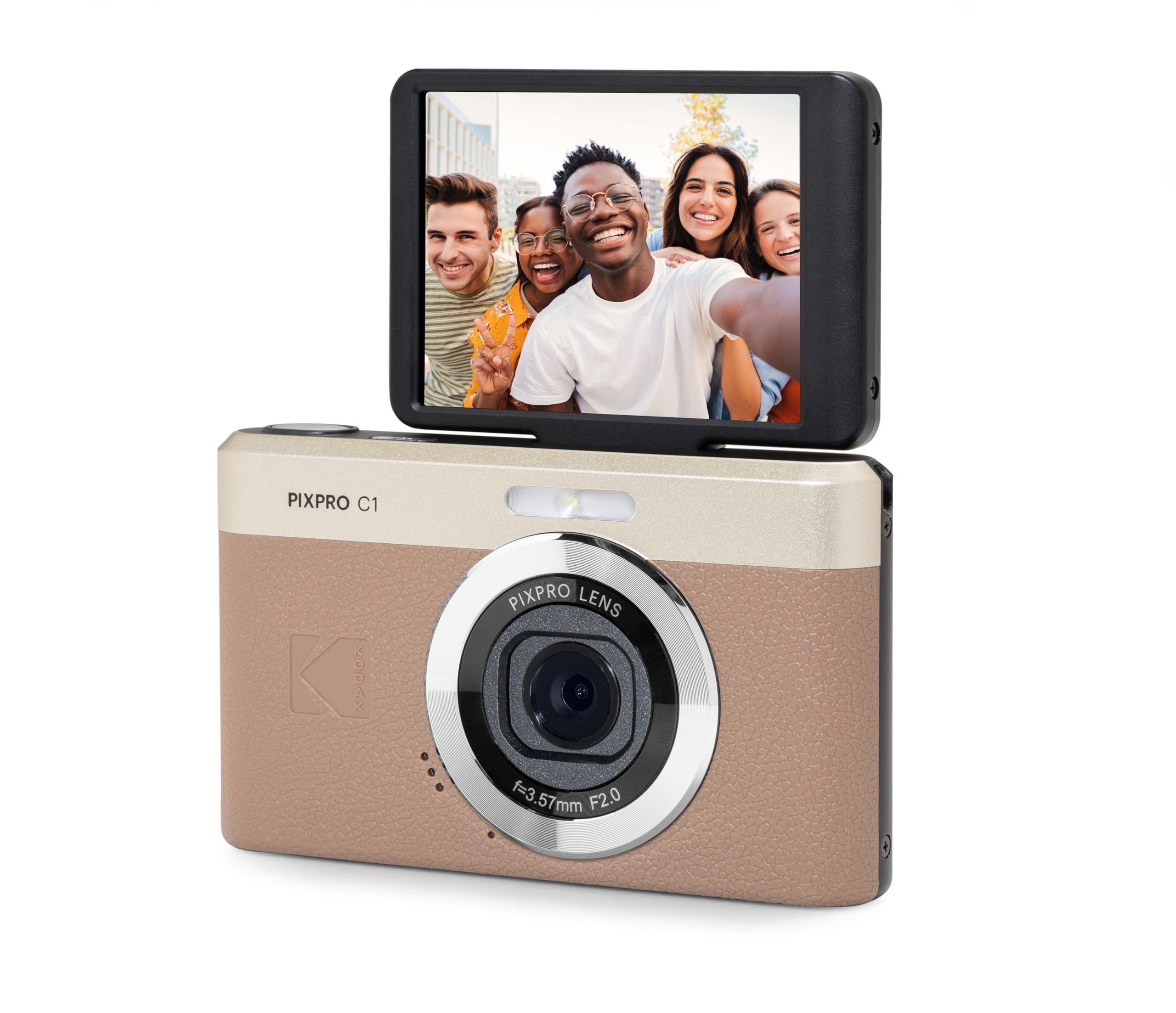
The screen flips up through 180 degrees so it faces you, and that one hinge rewrites how the camera gets used. Hand it to a group and everyone can see themselves before the shutter goes; prop it on a table and it becomes a self-timer camera that actually frames correctly. In a range where nearly every other model has a fixed LCD, it's the feature that makes the C1 feel designed for a purpose.

The rest of the camera is deliberately simple. A 13MP backside-illuminated sensor sits behind a 26mm fixed-focus f/2.0 lens — no optical zoom at all, only 4x digital, so you compose with your feet. That f/2.0 aperture helps indoors more than the sensor size suggests, but the 1/3-inch chip is small, and dim rooms are where the images start to look processed. The 4.05-ounce body in its brown retro finish is the one people comment on.

Where it earns its place is convenience per dollar. The battery is built in and charges over USB-C, the same cable as most phones, and there's no lens cap or protruding barrel to lose or snap off. It's the cheapest camera here and it shoots like one in low light — but as a selfie and group camera that lives in a purse, it's the one most likely to come home with photos on it.

Pros

  • 180-degree flip screen for selfies
  • USB-C charging from a phone cable
  • 4.05 ounces and pocketable

Cons

  • Fixed 26mm lens, digital zoom only
  • Small 1/3-inch sensor limits low-light shots
Our verdict

We hand the C1 to selfie and group-shot shooters on a tight budget: the flip screen and USB-C charging make it the easiest Kodak here to pass around.

Check Latest Price
7

Trying 35mm Film

Kodak EC35

85 /100
Keeper Score Excellent

Key details

Lens
25mm fixed focus
Flash
Built-in
Dimensions
4.69 x 1.63 x 2.56 inches
Film Format
35mm
Check Price on Amazon

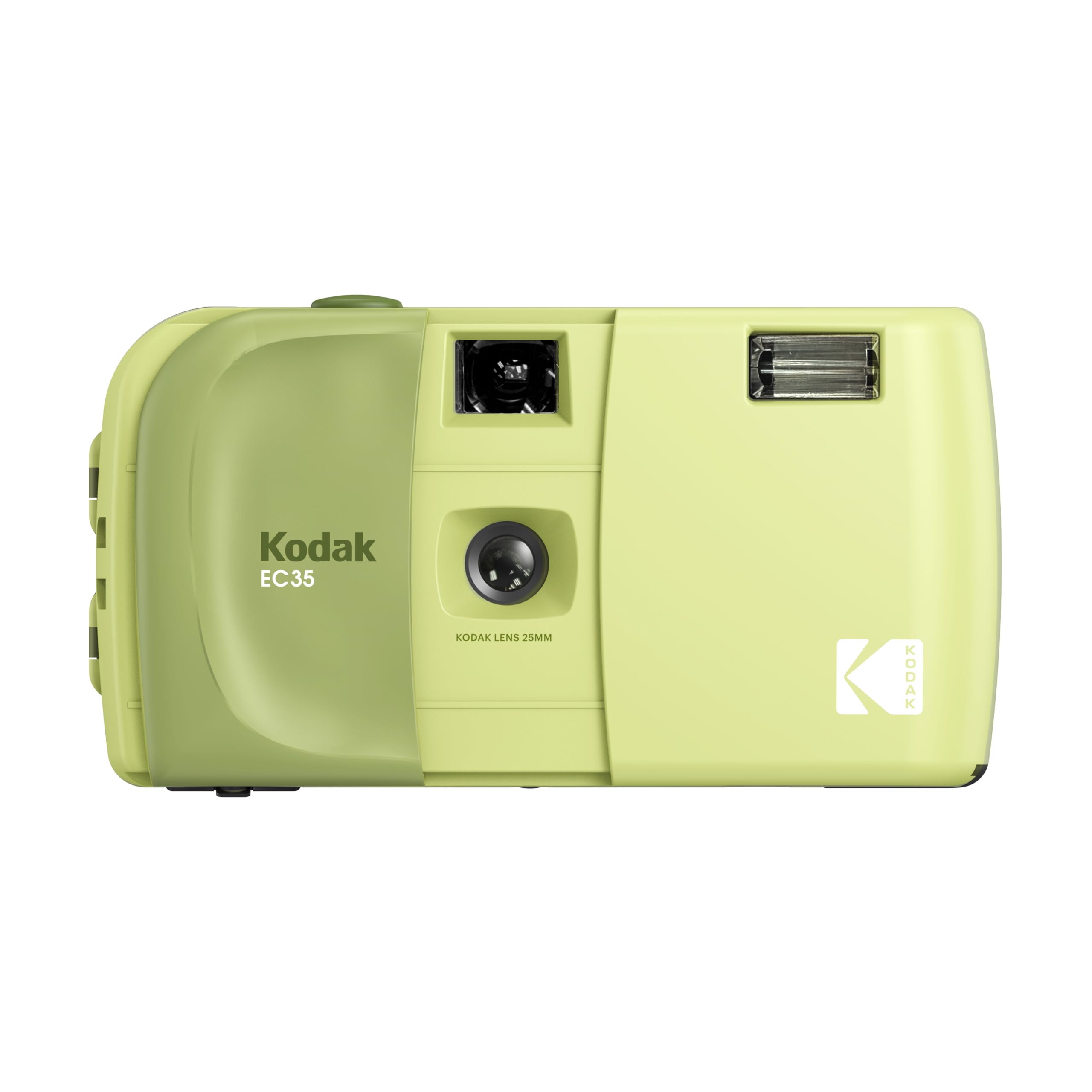
A roll of film commits you to thirty-six decisions and then a wait. That's either the appeal or the dealbreaker, and the EC35 is the cheapest honest way to find out which. It's a reusable 35mm body with a 25mm wide-angle focus-free lens, a built-in flash, and a sliding cover that protects the lens in a bag — no settings, no menus, no battery-sapping screen.

We like the slide cover more than we expected. It's the difference between a camera you can throw in a tote with keys and one that needs a case, and on a camera this cheap the lens is the part you can't fix. The focus-free lens also means what it says: this isn't a close-up camera. It's happiest at street and group distances, where a wide angle and a flash do most of the work and depth of field covers the rest of your mistakes.

The purchase is small and the running cost isn't. Film and an AA battery are not included, so budget for both plus developing and scanning, which is where the real money goes and where most people decide whether film is for them. What you get back is the look — soft grain, flash-lit skin, colors that read as memory rather than data — and a camera that fits in four and a half inches of bag.

Pros

  • Cheapest route into reusable 35mm
  • Slide cover protects the lens in a bag
  • Built-in flash and nothing to configure

Cons

  • Film, battery, and processing are ongoing costs
  • No zoom and no exposure control
Our verdict

We think the EC35 is the low-risk way into 35mm: a reusable body, built-in flash, and nothing to set — just film, an AA battery, and processing to budget for.

Check Latest Price

How We Chose and Tested These Cameras

We started with a spreadsheet of every current model in the lineup, then cut anything that leaned on digital zoom, anything offering a long zoom without optical stabilization, and anything whose battery or memory card was a proprietary dead end. That left 11 cameras, which we bought at retail rather than accepting loaners, and we've been shooting with them for six months.

They went where cameras actually go: a cousin's birthday party in a dim living room, two Saturdays at a youth soccer field, a beach weekend with sand and salt spray, a few hikes, and a lot of ordinary evening walks. Each one rode in a tote bag beside keys and a water bottle for a week so we could watch the body, lens cover, and paint hold up, and cameras that sat in a drawer between outings had to wake up with their settings intact. The waterproof model came into the surf, got dropped onto a boardwalk from waist height, and sat in a cooler of ice water before we checked the lens for fogging.

In the field we shot the same three scenes on every camera: a backlit subject, a sign at full zoom, and a fast-moving dog. We reviewed the files at full size on a laptop instead of trusting the rear screen, and compared full-zoom frames shot with stabilization on and off to see how much handshake survived. Battery life got timed rather than estimated — full charge, screen on, flash as needed, shooting until the camera died — with a separate note on which models take AA batteries and which use a rechargeable pack. We also weighed each camera and tried it in a jeans pocket: the true compacts disappeared, the bridge bodies needed a bag.

Video got its own pass, a minute of handheld 1080p walking footage to watch for autofocus hunting and to hear how the microphone handled wind. We handed every camera to someone who'd never picked it up and counted the seconds to their first photo, then asked whether they could find the flash and playback menus unaided. At the end, we lined up the best images from each camera next to what it cost, which is how a few cheaper models climbed over pricier ones.

How to Choose a Kodak Camera

Match the zoom to the distance you shoot from

Most people buy either too little reach or far more than they'll ever use. A 4x or 5x pocket zoom covers streets, plates, and people at arm's length; 25x and up is for subjects that won't come closer. The trap is digital zoom, which crops the frame and calls it reach — only the optical figure counts. Past roughly 25x, optical stabilization matters as much as the glass, which is why the AZ528 and AZ425 both pair long reach with OIS. Handheld shooting at full zoom without it wastes the burst you just took.

Choose between a lithium-ion pack and AA cells

Two power philosophies run through this range. Lithium-ion bodies such as the FZ55, AZ425, AZ528, and C1 charge over USB, so one cable covers camera and phone and a full charge takes a couple of hours. The AZ255 runs on four AA cells you can buy at a gas station. Neither is better in the abstract: if the camera lives in a car or a rucksack for weeks at a time, AA is more forgiving; if you shoot often and remember to plug in, lithium-ion is cheaper to run. Whichever you pick, buy rechargeable AAs rather than alkalines.

Budget for the card before the camera arrives

No Kodak here ships with a memory card, and the internal memory — 63MB on the FZ55, 67MB on the AZ255 — is a placeholder that holds a handful of frames. Buy a Class 10 card at the same time. Format matters too: the compacts and bridges take full-size SD, SDHC, or SDXC, while the waterproof WPZ2 takes microSD, so a card from your phone's drawer may fit one and not the other. Two mid-size cards beat one enormous one, and they cost less than the camera strap you'll never use.

Treat waterproofing as maintenance, not a spec

The WPZ2 is rated for 15m for up to an hour, shockproof from 2m, and needs no housing at all. That rating holds only while the seal does. Before every swim, check the rubber gasket for grit or a nick, then close and lock the battery door while everything is dry. Never open it underwater or while wet, and rinse the body in clean water after salt or chlorine. A flooded camera is nearly always a door that was opened on a damp towel.

Expect point-and-shoot pace at long zoom

These are small sensors with contrast-detection autofocus, and at 42x or 52x the lens has a lot of travel. Expect a beat before focus locks in flat light, and expect hunting if you shoot through branches. Half-press to lock, take a short burst at 6 or 7fps, and give up on the far shot once the light goes. If your photos happen indoors at arm's length, a pocket model will feel quicker — and so will your phone.

Frequently Asked Questions

Final Verdict

The FZ55 is the Kodak we tell most people to buy. It's light enough to live in a jacket pocket, its 5x optical zoom covers everything from a wide street to a face across a table, and USB charging means one less cable in the bag.

Change the requirement and the answer changes with it: the AZ528 if your subjects are genuinely far away, the WPZ2 if the camera's job is surviving a beach and a snorkel trip, and the C1 only when selfies are the whole point. Everything else here is a reasonable second choice to one of those four.