Best Photography Books of 2026

Photography books split into two camps, and the split is the problem: the ones that teach you something are printed like textbooks, and the ones beautiful enough to leave on a coffee table rarely teach you a thing. I've spent six months with 14 of them stacked on my coffee table and, eventually, my nightstand, checking whether the pretty ones held up and whether the instructional ones were actually readable.

A few things only show up after living with these. Paper and print quality matter more than page count: a big collection printed on thin, glossy stock flattens every image, while a modestly priced guide on good matte paper can look better than books twice the cost. Bindings matter too — a heavy hardcover that cracks at the spine on the second read isn't a gift, whatever the photographs inside.

Some of the picks below are built to be worked through a chapter at a time; others are meant to lie open on a table. Plenty of people end up wanting one of each, which is how the list is shaped.

Keeper Score summarizes customer ratings and review volume. Read it alongside the product details and trade-offs. How the score works.

1

Best Overall

Digital Photography Complete Course

95 /100
Keeper Score Outstanding

Key details

Pages
360 pages
Weight
2.81 lb
Published
2015
Trim Size
7.99 x 1.1 x 9.49 inches
Check Price on Amazon

Twenty weeks is the promise on the cover, and it's why this is our top pick. The book is built as a course rather than a reference: each lesson takes one idea, explains it with example photographs, and then sends you out to shoot an assignment that uses it. We found that rhythm matters more than page count — by the third lesson you're shooting with a purpose instead of reading about one.

It earns its 360 pages. The teaching starts at the basics in plain language and adds a layer at a time, so nothing arrives before you have the vocabulary for it, and the explaining is done with pictures — annotated frames, diagrams, side-by-side examples — rather than long stretches of theory. We never felt talked down to, and we never felt lost.

Where it lives is worth planning for. At 2.81 pounds and roughly the footprint of a sheet of letter paper, it's a desk book: it sits beside a laptop, not inside a camera bag. That's fine for a course you work through at home, and less fine if you wanted something for a commute — the DK Beginner's Guide below is a better shape for that.

One caveat before you order: this printing dates from 2015, so the equipment passages describe cameras of that era. Exposure, light, and composition haven't changed, and the assignments work with any camera you own, but when a section walks you through a menu, use your own manual instead. Treat the gear talk as background and the lessons as the book.

Pros

  • Turns every lesson into a shooting assignment
  • Builds from the basics in a clear order
  • Explains with photographed examples and diagrams

Cons

  • Needs weekly shooting time to pay off
Our verdict

If you want one book that actually teaches you to shoot, start here: the lessons build week by week and each one sends you out to practise.

Check Latest Price
2

Best Photography Collection

The Photo Ark

98 /100
Keeper Score Outstanding

Key details

Pages
400 pages
Weight
4.32 lb
Publisher
National Geographic
Trim Size
9.61 x 0.71 x 9.69 inches
Check Price on Amazon

Four hundred pages in, the surprise isn't the famous animals — it's the ones you've never heard of. The Photo Ark is one photographer's campaign to document species while they're still here, and the book is full of creatures most of us couldn't name, a good number of them endangered.

We recommend it as the collection to buy when you want the pictures to mean something beyond decoration. Each animal gets a proper portrait and a short description, so the book works as a browse and as something to actually read, and the range is the point: you're still meeting new species deep into the back half. It's also the rare big photo book that works for a toddler on a lap and for the adult reading the descriptions.

It's the easiest of the collections here to give, too — the least expensive of the four, and the one with the broadest reach, whether the recipient is a child, a nature lover, or a photographer who mostly shoots buildings. The catch is that it's a table book. This is not one for a commute or a bedside stack.

Pros

  • Hundreds of species, including rare ones
  • Portraits paired with short descriptions
  • Works for children and adults at once

Cons

  • At 4.32 pounds it lives on a table
Our verdict

Our collection pick for anyone who wants the photographs to add up to something: 400 pages of animals, several of which you'll have to look up.

Check Latest Price
3

Best for Mastering Exposure

Understanding Exposure

94 /100
Keeper Score Outstanding

Key details

Pages
176 pages
Weight
1.54 lb
Published
2016
Trim Size
8.54 x 0.43 x 10.55 inches
Check Price on Amazon

Fewer than half the pages of the DK course, one subject, and a case for buying it anyway: aperture, shutter speed, and ISO, explained until the relationship between them stops being mysterious. If your pictures come out too dark, too bright, or soft in the wrong places, this is the book that names the cause.

We rate it as the best deep dive on the fundamentals in this set. The writing is patient and free of jargon, the examples are photographs rather than diagrams, and the revised printing brings flash into the conversation, which earlier versions left out. It rewards being read with a camera in your hand rather than on a train.

The scope is the limit, and it's deliberate. This isn't the book that teaches composition or what to do with a person in front of the lens — the DK course covers the first, and Adler's posing guide covers the second. What it does, it does more thoroughly than either: we go back to it every time a frame comes out wrong and we can't say why.

Pros

  • Explains the exposure triangle in plain language
  • Example photographs rather than abstract diagrams
  • Revised edition adds flash coverage

Cons

  • Gear references date from 2016
Our verdict

Buy it if your exposures are the thing going wrong: 176 pages on one subject, explained until aperture, shutter speed and ISO stop being a mystery.

Check Latest Price
4

Best Quick-Start Guide

The Beginner's Photography Guide

93 /100
Keeper Score Outstanding

Key details

Pages
192 pages
Weight
1.29 lb
Published
2024
Trim Size
7.75 x 0.51 x 9.19 inches
Check Price on Amazon

Published in 2024, this is the newest book on the list, and that's the reason to pick it: camera menus, autofocus modes, and connectivity have moved a long way since the older guides here were printed, and this one was updated to match the cameras you can buy now.

It's compact and visual — 192 pages, 1.29 pounds, a picture or diagram next to almost every explanation — and it behaves like a reference. We kept it in a camera bag and pulled it out mid-shoot to look up a single control, read half a page, and get back to shooting. That's a different job from the DK course's twenty-week program, and it's the job most people actually need in their first month.

The trade is depth: at roughly half the length of the course, the explanations stop sooner, and there's no week-by-week structure pushing you to practise. If you learn by reading a manual and then experimenting, that suits you fine. What you do get is the clearest set of diagrams here for the controls that quietly ruin shoots — drive modes, metering, white balance — the unglamorous settings nobody explains well.

Pros

  • Updated in 2024 for current cameras
  • Light enough to keep in a camera bag
  • A diagram for nearly every setting

Cons

  • Less depth than a full course
Our verdict

The newest and most portable of the guides here: buy it if you want answers at the camera, not a course to work through.

Check Latest Price
5

Best for Portraits

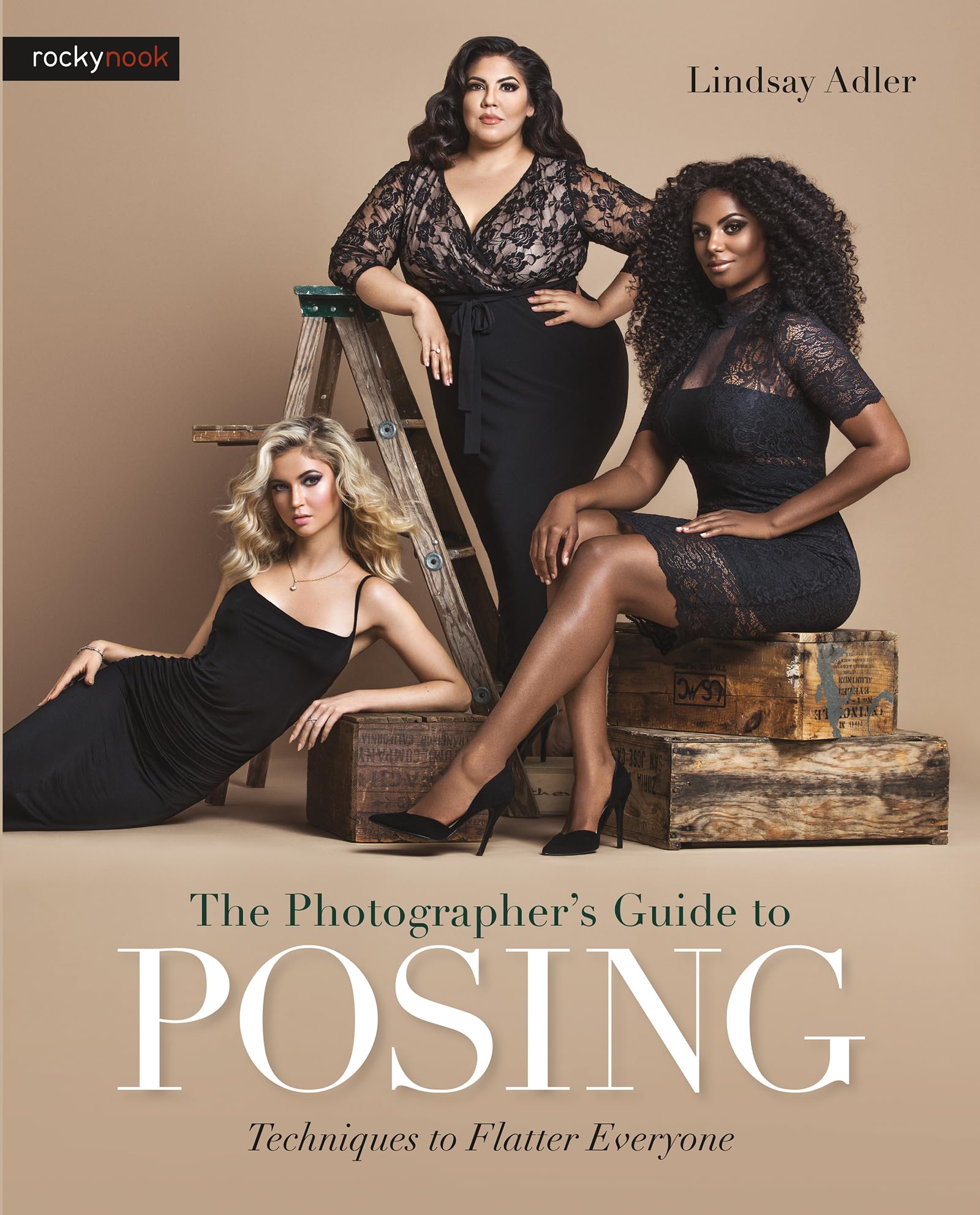
The Photographer's Guide to Posing

95 /100
Keeper Score Outstanding

Key details

Pages
448 pages
Weight
2.31 lb
Published
2017
Trim Size
7.75 x 1 x 9.75 inches
Check Price on Amazon

Every other book here teaches you the camera. This one starts on the far side of the lens, with a person standing in front of you waiting to be told what to do with their hands.

Four hundred and forty-eight pages on posing alone — women, men, couples, families — and the method is comparison. The same subject appears shot badly and shot well, side by side, with an explanation of what changed and why. We found those pairs more useful than any list of rules, because after a while you start seeing the pattern instead of recalling a pose.

The Train Your Eye sections are what we kept coming back to: short exercises that ask you to look at a subject and predict which approach will work before you shoot. That's the part that transfers to a real session, when nobody is posing for a book and you have about four seconds to say something useful.

It's the one pick here that changes how you work rather than what you know, and it's cheap to test: open to any page, find the bad version of a pose, and look at what the good one fixed. The limit is equally clear — landscapes and wildlife get nothing from it, and it's a second book, not a first.

Pros

  • Shows the same pose done badly and well
  • Covers men, women, couples, and families
  • Train Your Eye exercises build real judgement

Cons

  • Only useful when there are people in the frame
Our verdict

For anyone whose photographs of people look stiff, this is the book that changes what you say out loud and where you put your hands.

Check Latest Price
6

Best Adventure Monograph

There and Back

93 /100
Keeper Score Outstanding

Key details

Pages
320 pages
Weight
4.24 lb
Publisher
Ten Speed Press
Trim Size
9.84 x 1.18 x 12.2 inches
Check Price on Amazon

At 9.84 by 12.2 inches and 4.24 pounds, this is the biggest thing on the list. It needs a table, it won't travel, and it isn't trying to — the format is part of the point.

Inside are 320 pages drawn from two decades of climbing and shooting, mixing full-bleed mountain spreads with the stories behind them. Every frame is captioned with who is in it and where it was taken, which sounds like housekeeping until you notice how much it changes the looking: you're not admiring a ridge, you're understanding what it took to be standing on it.

This is the one we kept picking up. The photographs carry the book on their own, but the writing between the plates is what makes it stick — enough of it that an afternoon disappears, and enough restraint that the pictures still lead. The behind-the-scenes material is the part we didn't expect to like as much as we did.

It's also the most expensive book here, and the price buys paper, printing, and size rather than more pages. Our take: worth it if the book will live out on a table for years, less so if you mainly want something to read on a plane — Accidentally Wes Anderson is far smaller and a better travel companion.

Pros

  • Two decades of climbing photographs
  • Every image captioned with person and place
  • Photo spreads balanced with real stories

Cons

  • Too large to read anywhere but a table
Our verdict

The one to buy if you want the stories as much as the summits — just clear a table before it arrives, because it won't fit anywhere else.

Check Latest Price
7

Best for Style and Travel

Accidentally Wes Anderson

96 /100
Keeper Score Outstanding

Key details

Pages
368 pages
Weight
2.55 lb
Published
2020
Trim Size
7.6 x 1.45 x 9.3 inches
Check Price on Amazon

Leave this one open on a side table and someone will pick it up, turn a page, and ask where the photograph was taken. That's the book in miniature: you look, and then you want the story.

The premise is a narrow visual grammar applied worldwide — symmetry, pastel facades, a single figure in a frame — sustained across 368 pages. A style exercise would wear out in fifty; what keeps this going is the text, which gives each building its history and enough practical detail that you could go and stand in front of it yourself.

We were surprised by how much the writing carries. A pale hotel front is a pleasant picture; knowing what the building has been turns it into a place you remember. And because every entry is short, the book survives being read in five-minute stretches, which is more than the big monographs here can claim.

At 7.6 by 9.3 inches it's the most portable of the collections, the one that works on a plane tray and a bedside table both. Buy it for the charm, and be honest about whether you like the palette — if symmetry and sherbet colors leave you cold, it's a lot of buildings in the same mood, and the Photo Ark covers more ground.

Pros

  • Distinct visual style sustained throughout
  • Real history and travel detail with each image
  • Small trim makes it genuinely readable

Cons

  • Style first, with little technical takeaway
Our verdict

Buy it for the charm of the pictures and stay for the notes on each place; if the palette leaves you cold, choose the Photo Ark instead.

Check Latest Price
8

Coffee Table Decor

Beaches

94 /100
Keeper Score Outstanding

Key details

Pages
144 pages
Weight
2.31 lb
Publisher
Abrams Books
Trim Size
13.39 x 10.24 x 0.98 inches
Check Price on Amazon

Every photograph in this book is taken from above — beaches, umbrellas, swimmers, and surf seen from the air, arranging themselves into patterns that aren't visible from the sand.

It's a picture book in the purest form: 144 pages, minimal text, and a 13.39-by-10.24-inch trim that makes it the widest thing here. Left open on a coffee table it covers a good part of it, and the color is the point — bright water, striped umbrellas, all of it closer to a poster than to a documentary.

We've handed out more copies of this one than anything else on the list. It asks nothing of the reader: no interest in photography, no camera, no prior. That makes it the safest housewarming or host gift here, and the one most likely to still be looked at six months later.

As a photography book with something to teach, it's the thinnest thing here — no technique, no argument, one subject. As an object that earns its table space, it's hard to beat. We keep it in the second category, and we're comfortable with that.

Pros

  • Aerial images unlike anything else here
  • Oversized trim carries a room
  • The easiest gift in the set

Cons

  • One subject and no technique to take away
Our verdict

A pure pleasure object: buy it as a gift or for a table, and expect to flip through it rather than learn anything from it.

Check Latest Price

How We Tested 14 Photography Books

We built the shortlist from publisher catalogs, bestseller lists, and the shelves of a couple of camera stores, then cut anything out of print, anything padded with gear advertisements, and anything that duplicated a book already on the list. The 14 that survived ran from slim technique guides to oversized hardcovers, and each got six months of ordinary use rather than a single afternoon.

Instructional titles were tested at the kitchen table with a camera beside them: I worked the exercises in order and noted where a chapter assumed gear or a setting I didn't have. I timed how long it took to find a specific technique using only the index, and read each one in a single sitting to see whether the prose held up or slid into glossary-speak. Collections got different treatment — I studied the darkest plates under a lamp and again in daylight to check for blocked shadows and color casts, and left each heavy hardcover open flat on the table for an hour to see whether the spine relaxed or the pages fanned shut.

Construction was tracked the whole way: scuffed jackets, corners bumped in a tote, spines re-checked after a month of being left open. For value and gift appeal, I handed the beginner titles to a friend who shoots entirely on her phone and asked her to follow two chapters unaided, weighed what each book delivered against what it cost, and left the collections out to see which ones guests actually picked up. The winners were the ones people kept coming back to.

How to Choose a Photography Book

Lessons or Images

Most people searching for a photography book want one of two things: to take better pictures, or to own a collection worth opening twice. Those are different purchases. A teaching book is judged on whether it changes what you do with a camera; a collection is judged on the photographs and how well they're printed.

Be honest about which you're after. A beautiful monograph will not fix your exposures, and a course will not sit well on a coffee table. The strongest shelves here have one of each.

Match the Book to Your Next Step

Buy for the problem you have now. A total beginner with a new camera needs a visual reference or a structured course. Someone comfortable with settings but unhappy with their pictures of people needs a posing guide. Someone bored of their own photographs needs a collection with a point of view.

The common mistake is buying a specialist book too early. A 448-page posing manual cannot help a photographer who hasn't worked out why the frames are dark, and it will sit unopened while the real problem goes unsolved.

Check the Edition Date, Then Ignore Most of It

Photography books age unevenly. Menu walk-throughs, autofocus modes, and connectivity advice go stale within a few years; light, exposure, and composition don't. Our oldest teaching pick dates from 2015 and remains the best course in the group, while our newest was updated in 2024.

Look at the date, decide whether you need current gear advice, and don't reject a book for its age if the craft is all you're after.

Buy for the Shelf It Will Live On

Page count tells you how much book you're getting; trim size and weight tell you where it can go. Around a pound and a half and eight by ten inches, a book can live in a camera bag and come out mid-shoot. Past four pounds and twelve inches, it's furniture — lovely furniture, but plan the table before you order.

The trap is the label. Coffee table book describes a size and a printing budget, not a quality, so read the dimensions rather than the marketing.

Look at the Reproduction, Not Just the Photographs

Photo-heavy books live or die on printing, and the differences show up in shadows and skin tones long before they show up in a description. If you can handle a copy, open to a dark image and look for detail in the blacks.

Buying unseen, favor publishers with a photography reputation and check whether the pages are described as glossy or matte. Matte looks classier but flattens contrast, which matters most in a book you're buying for the pictures.

Frequently Asked Questions

Final Verdict

If you're buying one book to get better at photography, buy Digital Photography Complete Course. Twenty weeks of lessons, each with an assignment attached, will do more for your pictures than any single setting or accessory, and it's the book we hand to anyone who asks where to start.

If the book you want is one to leave open rather than work through, The Photo Ark is our collection pick — 400 pages that reward a second and third pass. And if you've just bought a camera and want a guide that matches it, the 2024 Beginner's Photography Guide is the more current companion to the course.