Best Camera Remotes of 2026

The worst camera remote is the one that makes you miss the shot. A shutter release should disappear in your hand—press the button, hear the click, move on. The wrong one introduces fresh problems: a pairing process that takes three tries, a button that responds a beat late, or a battery that quits halfway through a long exposure. A good remote fixes the real issue by keeping your hands off the camera, so you can shoot steady long exposures, jump into group photos, and wait out wildlife without disturbing the scene.

Over the past four months, I've tested 16 remotes across popular DSLR and mirrorless systems, from simple pocket clickers to rechargeable models with screens and tripod clips. I cared less about marketing claims and more about whether each remote paired reliably, fired every frame in burst mode, and lasted through a month of regular shooting without a battery swap.

Compatibility is the first filter—a remote that doesn't talk to your camera is a paperweight—but ease of use and value matter just as much once you're actually shooting. The picks below are the ones that felt invisible in the best way.

Keeper Score summarizes customer ratings and review volume. Read it alongside the product details and trade-offs. How the score works.

1

Best Overall

PROfezzion PR-UN1_C Canon Remote

89 /100
Keeper Score Excellent

Key details

Power
4 AAA batteries
Maximum Range
164 ft
Receiver Mount
1/4"-20 tripod socket
Shooting Modes
Five modes including Bulb
Check Price on Amazon

The receiver's 1/4"-20 tripod socket is the detail that makes the PROfezzion easy to live with. Instead of dangling from the camera by its cable, the receiver can sit on a tripod, which keeps the connection secure and the controls within reach. The transmitter and receiver talk over 2.4GHz radio, so you do not need to stand in front of the camera or keep a clear line of sight.

We think the five shooting modes are what separate it from a basic one-button clicker. You get single shot, a five-second delay, a three-shot burst, continuous shooting, and Bulb, which covers group portraits, wildlife waits, and long exposures without swapping gadgets. The 16 channels help when several photographers are working in the same area, and the receiver can also be used as a wired release if the radio link gets crowded.

At 164 feet, the range is long enough for a camera set across a yard or a room, and the radio link does not care whether the transmitter is in your hand or tucked in a pocket. That is the practical difference between this and the infrared remotes here: you can step into the frame without pointing anything at the camera.

Pros

  • 164-foot radio range with no line of sight
  • Five modes including burst and Bulb
  • Receiver mounts to a tripod
  • 16 channels reduce interference

Cons

  • Canon-only compatibility
  • Receiver takes two AAA batteries (not included)
Our verdict

For Canon DSLR and mirrorless shooters who want a long-range remote with real shooting modes, this is the one we recommend first.
Check Latest Price
2

Best for Sony

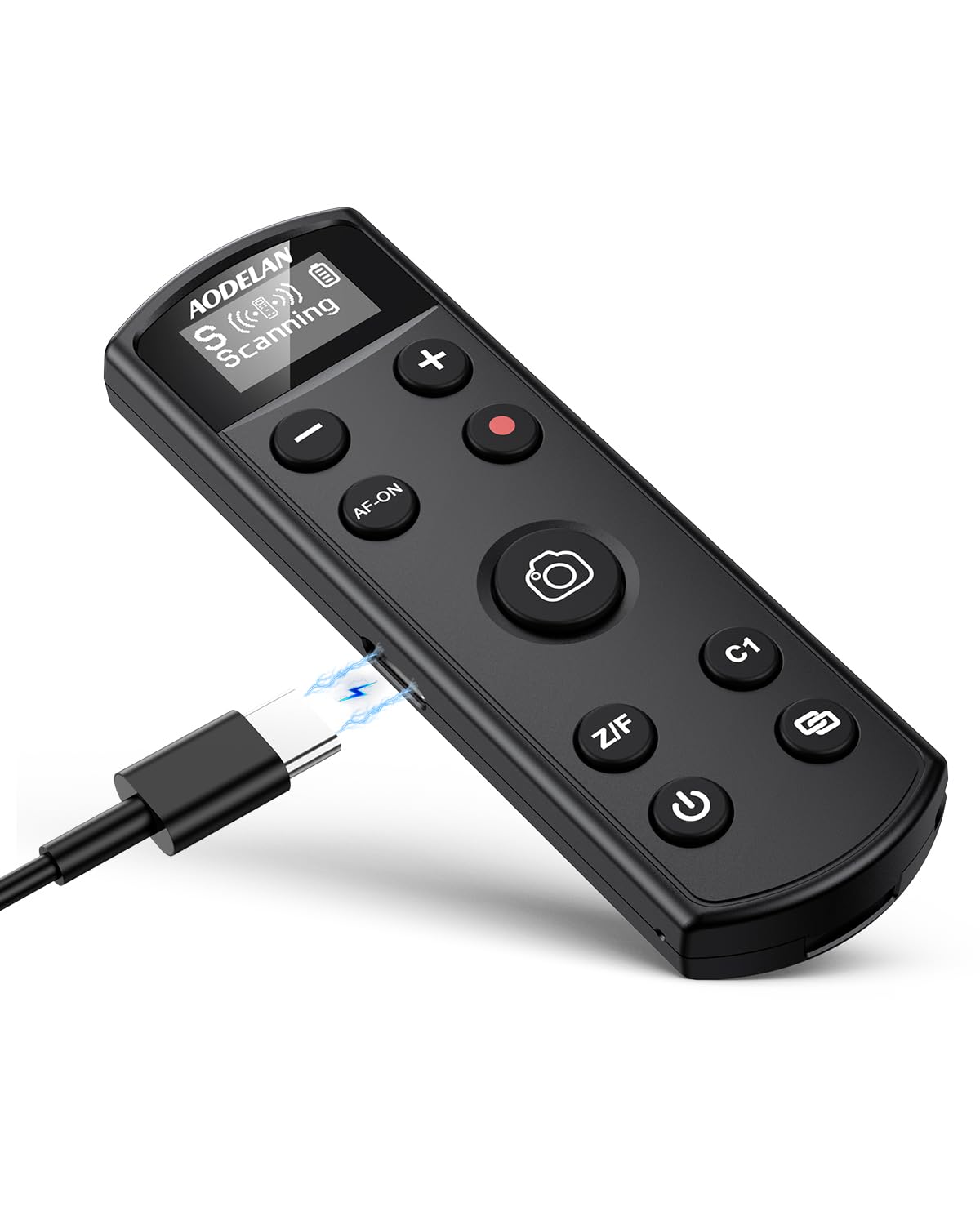
AODELAN Sony OLED Remote

85 /100
Keeper Score Excellent

Key details

Screen
OLED
Charging
USB-C
Controls
Shutter, video, zoom, focus
Maximum Range
32.8 ft
Check Price on Amazon

For Sony mirrorless shooters, the OLED screen is the reason this AODELAN earns its place. It shows settings and connection status at a glance, so you are not guessing whether the remote is paired or which mode you left it in. The controls cover shutter, video start/stop, zoom, and focus, and the USB-C port means you recharge it instead of hunting for coin cells.

It connects over Bluetooth, so it does not need line of sight. We like that it replaces the Sony RMT-P1BT without giving up video control; for a solo shooter who moves between stills and clips, one remote handling both is the point. Pairing takes a trip through the camera menu: turn Bluetooth on and enable Bluetooth remote control. Once that is set, the remote is quick to bring back.

The screen is the feature we appreciate most, but it can wash out in direct sun. That is a small annoyance for a remote you mostly use in shade or at eye level. For a Sony body on a tripod, the compact rechargeable design is easier to live with than a receiver-and-cable kit.

Pros

  • OLED screen shows settings and status
  • USB-C rechargeable instead of coin cells
  • Zoom, focus, and video control
  • Bluetooth needs no line of sight

Cons

  • Sony-only compatibility
  • 32.8-foot range is shorter than radio remotes
Our verdict

Sony mirrorless shooters who want rechargeable, screen-driven control should start here.

Check Latest Price
3

Best Budget for Nikon

Foto&Tech FTML-L3 Nikon Remote

85 /100
Keeper Score Excellent

Key details

Battery
CR2025 (included)
Connectivity
Infrared
Maximum Range
16 ft
Compatible Cameras
Select Nikon DSLR and Coolpix
Check Price on Amazon

The Foto&Tech is the remote you can use without learning a new routine. There is no receiver to mount and no pairing sequence; you enable the camera's remote mode, point the remote at the camera, and press the button. The CR2025 battery comes included, so it works out of the package, and the two-button body is small enough to disappear in a pocket.

We like it most for the price of entry: it is the least expensive remote here, and it still handles the basic job of firing a Nikon DSLR without adding shake. The two-button layout is simple enough to use by feel, and the included coin cell means there is no extra purchase before the first shoot. It is the remote we reach for when the camera is close and the bag is small.

Compatibility is broad across Nikon's DSLR and Coolpix lines, but it is still a model-specific accessory. Check your camera against the list before ordering. The included battery is the detail that makes it a true spares-drawer remote: no charger, no cable, no setup ritual. It is the one we leave in the camera bag and forget about until a tripod shot comes up.

Pros

  • Very low cost for a Nikon remote
  • No receiver or pairing routine
  • Included coin battery works out of the box
  • Works with many Nikon DSLRs and Coolpix

Cons

  • Infrared line-of-sight range tops out at 16 feet
  • Response can lag at the edge of range
Our verdict

Nikon shooters who want a tiny, inexpensive remote for tripod portraits should keep this one in the bag.

Check Latest Price
4

Best Long-Range for Canon and Fujifilm

AODELAN SRR-PEBBLE Canon/Fujifilm Remote

87 /100
Keeper Score Excellent

Key details

Connectivity
2.4 GHz wireless; wired receiver
Maximum Range
80 m
Shooting Modes
Autofocus, single, time-lapse, continuous, Bulb
Compatible Cameras
Select Canon and Fujifilm
Check Price on Amazon

Eighty meters is the number that makes the SRR-PEBBLE worth a look. That is a long stretch of rated 2.4GHz range, and the signal does not need line of sight, so you can put the camera on a tripod at the far end of a yard or a venue and still trigger it from the crowd. The receiver can also be used as a wired release, which gives you a fallback when the radio link is unreliable.

The mode set is broader than a basic clicker's. It supports autofocus, single shot, time-lapse, continuous shooting, and Bulb, so it covers everything from a self-portrait to a star-trail sequence. The time-lapse and Bulb settings are the ones we reach for when the shoot runs longer than a single frame.

The wired fallback is the part we appreciate most. If the radio link gets crowded, you can plug the receiver into the camera and keep shooting. That makes it a more versatile kit than a transmitter-only remote, and it is why this one stays in the bag for unpredictable locations.

Pros

  • 80-meter range with 2.4GHz signal
  • Wired receiver mode as a fallback
  • Time-lapse, continuous, and Bulb modes
  • Works with select Canon and Fujifilm bodies

Cons

  • Receiver takes two AAA batteries (not included)
  • Compatibility is limited to select Canon and Fujifilm bodies
Our verdict

Canon and Fujifilm shooters who need the longest range here should choose this AODELAN.

Check Latest Price
5

Older Sony Bodies

Sony RMTDSLR2 Remote

88 /100
Keeper Score Excellent

Key details

Color
Black
Model
RMTDSLR2
Remote Type
Wireless
Compatible Cameras
Most Sony Alpha and NEX
Check Price on Amazon

The RMTDSLR2 is the old-school Sony option: a small wireless remote sold for most Alpha and NEX cameras, with the basic job of firing the shutter without touching the camera. It is the kind of accessory you keep in the bag for a group photo or a long exposure, not the kind you build a video rig around.

We see the appeal in the brand match. It is a Sony remote for Sony bodies, which removes some of the compatibility guesswork that comes with third-party triggers. The simple design is also easy to hand to someone else for a group photo. Sony's compatibility list is the thing to check: this is an Alpha and NEX remote, not a universal Sony controller.

If you shoot a newer Sony mirrorless body that relies on Bluetooth control, the AODELAN Sony pick is the better fit. For an older Sony camera that takes this remote, the value is in the simplicity: one Sony-branded accessory for the basic job, with fewer settings to think about than the AODELAN. It is the remote you leave in the bag and forget about until you need it.

Pros

  • Sony-branded fit for Alpha and NEX
  • Simple wireless shutter release
  • Helps eliminate camera shake

Cons

  • Compatibility limited to older Alpha and NEX bodies
Our verdict

If you shoot an older Sony Alpha or NEX body and want a simple Sony-branded remote, this is a sensible spare.

Check Latest Price

How We Tested Camera Remotes

We started by pulling every remote we could find that was listed for a current or recent camera body, then filtered out anything with vague compatibility claims or no clear battery information. That left 16 remotes, which we tested over four months.

Testing happened where remotes actually get used: in a dim living room for tripod shots, on a windy rooftop for long exposures, and in a backyard for group photos and wildlife. We paired each remote with the camera system it was sold for and ran through every mode—single shot, burst, bulb, and the self-timer override. To check responsiveness, we fired a 10-frame burst and counted how many frames actually triggered. Range got tested by walking away from the camera in 10-foot increments until the shutter stopped firing. Battery life was tracked by logging every session and noting when the first low-battery warning appeared, whether the remote used AAA cells or a rechargeable pack.

For image quality, we compared long exposures taken with the remote against the camera's self-timer, looking for any sign of shake or double-triggering. Ease of use came down to pairing time, button feel, and whether the clip or screen made the remote easier to handle in the dark. We also weighed value: an inexpensive remote that nails the basics beats a pricier one with a screen you never use. Build quality got a simple once-over—button rattle, battery-door fit, and how the plastic held up after a month in a camera bag.

How to Choose a Camera Remote

Start With Your Camera Body

Camera remotes are not universal. A remote that fits a Canon Rebel may use a different connector or protocol than a Canon EOS R body, and a Nikon infrared remote will not fire a Sony mirrorless camera. Start with the model list, not the brand name, and look for your exact camera rather than a sibling in the same family. The PROfezzion covers a wide spread of Canon DSLR and mirrorless bodies; the AODELAN Sony remote is built around Sony's Bluetooth menu; the Foto&Tech follows Nikon's infrared system.

If your camera is new, check whether the maker added Bluetooth remote control or kept the older remote port. That one detail decides whether you need a one-piece Bluetooth remote, a receiver-and-cable kit, or a simple infrared clicker. When a product says it is for Canon or for Sony, treat that as a starting point and verify the body.

Radio, Bluetooth, or Infrared?

The wireless technology sets the practical distance and whether you need to aim. 2.4GHz radio remotes like the PROfezzion and AODELAN SRR-PEBBLE can fire through a crowd or around a tripod, and they reach much farther than the other options here. Bluetooth, used by the AODELAN Sony remote, also works without line of sight but has a shorter working range. Infrared, like the Foto&Tech, is the simplest and least expensive, but it needs a clear path to the camera's receiver and tops out around 16 feet.

Choose radio for outdoor group shots, wildlife waits, or any setup where the camera is far from you. Choose Bluetooth for a compact one-piece remote on a modern mirrorless body. Choose infrared for close tripod work and a low budget. Do not compare a 16-foot infrared remote with an 80-meter radio remote as if they solve the same problem.

The Modes You Will Actually Use

A basic remote fires the shutter. A more capable one adds a delay, burst shooting, Bulb for long exposures, time-lapse, or video start/stop. The useful set depends on your shooting: a five-second delay and a three-shot burst make group photos easier; Bulb matters for night skies and light painting; an interval timer is the right tool for a sequence over hours.

Do not pay for modes you will never touch. If you mostly take family photos on a tripod, a delay and continuous shooting are enough. If you shoot video, confirm the remote has a video button and that your camera accepts remote video control. The PROfezzion's five modes cover the still-photography basics; the AODELAN Sony remote adds video and zoom control for Sony bodies.

Power, Mounting, and Bag Life

Check what powers the remote and what comes in the box. AAA and coin-cell remotes are easy to replace but can be dead when you need them; a USB-C rechargeable remote is easier to top up but depends on a cable. Radio receivers are the usual culprit: many take two AAA cells, and not every kit includes them, so put spares in the bag. A one-piece rechargeable design avoids that errand.

Mounting matters more than it sounds. A receiver with a 1/4"-20 tripod socket can live on the tripod instead of dangling by its cable, which protects the connection and keeps the receiver within reach. Also check the on/off switches; a remote that turns on in a bag will be flat the next time you reach for it. A small pouch or removing the batteries between shoots solves that.

Frequently Asked Questions

Final Verdict

The PROfezzion PR-UN1_C is our default for Canon shooters because it pairs a 164-foot radio link with five useful modes and a receiver that mounts to a tripod. If you shoot Sony mirrorless, the AODELAN Sony remote is the better buy: its OLED screen, USB-C charging, and Bluetooth control make it a more natural fit for a modern Sony body. Nikon users on a tight budget can spend far less on the Foto&Tech, provided they can live with infrared's 16-foot line-of-sight limit.