Best Camera Rain Covers of 2026

The first time rain ruins a shoot, it's rarely a downpour — it's a drizzle you decide to ignore for twenty minutes, and then the front element is beaded, the zoom ring is slick, and you're drying the body with the inside of your jacket. A rain cover is a cheap fix for an expensive problem, but only if it goes on fast enough that you actually bother with it in the moment. We've spent four months putting 16 of them through real weather, from pocket-sized clear sleeves to nylon jackets with hand openings.

Sizing is where most first-time buyers get tripped up. Covers are sold by the lens they'll swallow, and one that's too roomy turns into a sail in a crosswind; one that's too tight won't clear a hood. A cover also traps humid air inside, which is why a clear window that stays clear matters as much as the fabric.

The ones worth carrying go on one-handed, let you see the top LCD and reach the zoom ring, and cost less than the filter screwed to the front of your lens. You'll find those below.

Keeper Score summarizes customer ratings and review volume. Read it alongside the product details and trade-offs. How the score works.

1

Best Overall

OP/TECH USA Rainsleeve Original

89 /100
Keeper Score Excellent

Key details

Weight
1.76 oz
Viewfinder
Dedicated eyepiece opening
Lens Closure
Drawstring
Lens Coverage
Up to 18 in long, 7 in diameter
Check Price on Amazon

Almost every rain cover on this list asks you to compose through a sheet of wet plastic. The Rainsleeve has an actual eyepiece opening: you put your eye to the finder, the sleeve gathers around it, and you shoot the way you normally do. That's the detail that made it our default pick. The rest is deliberately plain — a clear polyethylene sleeve, a drawstring at the lens end, and enough length for a lens up to 18 inches long.

In the bag it takes up about as much room as a folded pair of socks, which is why it travels. We kept one in a jacket pocket through a wet weekend of shooting and stopped checking the forecast. The plastic is thin enough that you can see the buttons and press them, and it doesn't fight the camera — nothing to thread, nothing to strap.

Wind is where it gives ground. The drawstring holds well on a lens hood, but on a bare barrel a gust will walk the cuff forward, and there's nothing else to hold it. Keep the hood on and it behaves, which is also what keeps rain off the glass. For a shower that arrives ten minutes from the car, that's plenty.

Pros

  • Dedicated eyepiece opening for viewfinder shooting
  • Fits lenses up to 18 in long
  • Folds to pocket size at 1.76 oz
  • Clear enough to see and press controls

Cons

  • No hand sleeves, so wrists stay exposed
Our verdict

The one we tell most people to buy: two pocketable sleeves, a genuine viewfinder opening, and room for an 18-inch lens.

Check Latest Price
2

Best Attachment System

Think Tank Emergency Rain Cover

90 /100
Keeper Score Outstanding

Key details

Weight
4 oz
Window
Oversized LCD window
Lens Fit
70-200mm lens attached
Mounting
Hot-shoe strap and hood hook-and-loop
Check Price on Amazon

The cheap sleeves here are bags you drop over a camera. This one is built to stay where you put it: hook-and-loop tabs grab the lens hood, a strap runs into the hot shoe, and a cord-and-stopper opening gives your hand a way in without leaving the front of the cover loose. On a day when rain is coming at an angle, that difference is the whole point.

What we appreciated most is how little you have to fight it. The Medium is cut around a body with a 70-200mm attached, so the cover has room for the lens to extend while you zoom, and the oversized LCD window means checking a histogram doesn't require undoing anything. It packs into a small pouch and weighs about four ounces, so it earns a place in the bag even when the sky looks fine.

Sizing is the thing to get right. The same generosity that lets a zoom breathe will bury a compact mirrorless with a short prime in spare fabric, and there's a small version for exactly that reason. Rain protection is not where this cover is thin.

Pros

  • Hood tabs and hot-shoe strap keep it mounted
  • Cord-and-stopper hand opening
  • Oversized window for LCD and controls
  • Four ounces and packs into a small pouch

Cons

  • The priciest cover in this group
Our verdict

For steady rain and a long lens, this is the cover we trust to stay mounted; budget shoppers can skip it, but nothing else here holds on like this.

Check Latest Price
3

Best for Two-Handed Control

Altura Photo Camera Rain Cover

89 /100
Keeper Score Excellent

Key details

Access
Two hand sleeves, full-length double zipper
Weight
6.4 oz
Material
Waterproof nylon
Lens Coverage
Lenses up to 8 in
Check Price on Amazon

The moment you need both hands inside a rain cover — zooming with one, thumbing the shutter with the other — most sleeves stop being helpful. Altura Photo solves that with two adjustable hand sleeves, one on each side, plus a full-length double zipper for when you'd rather open the front than reach through fabric.

We liked how well it holds its shape. An exterior hook-and-loop strap and rubber grips inside the shell keep the cover from sliding around the barrel, which is the failure that turns a cover into a rag after ten minutes of shooting. The nylon feels like something that will still be in your bag in three seasons, and it folds flat enough to slot into a pocket.

The clear panel at the back is where our enthusiasm cools. It starts clear and, after enough handling, can cloud enough that reading the top-plate settings through it becomes guesswork, and a wipe doesn't reliably bring it back. The zipper openings are the workaround: reach in rather than squint through.

Pros

  • Two hand sleeves for control on both sides
  • Full-length double zipper for access
  • Strap and rubber grips stop it sliding
  • Nylon shell folds flat in a bag

Cons

  • Lens coverage stops at 8 inches
Our verdict

Our pick when you need both hands on the camera in the rain: the sleeves and zipper make it the most usable cover here, as long as your lens stays under eight inches.

Check Latest Price
4

Best Clear Window

K&F Concept BR01 Rain Cover

84 /100
Keeper Score Excellent

Key details

Access
Waterproof zipper
Weight
9.17 oz
Window
Anti-fog TPU with anti-static coating
Securing
Hook-and-loop straps and elastic bands
Check Price on Amazon

A clouded window is the classic rain-cover failure: the camera stays dry and you still can't see the shutter speed. K&F Concept built this cover around that problem, with a TPU window carrying a dual-layer anti-fog barrier and an anti-static coating, plus a waterproof zipper so you can reach in for controls instead of mashing buttons through plastic. We think that's the most sensible place to spend extra in the middle of this group.

The straps are the other half of the story. Hook-and-loop straps and elastic bands hold the lens, a textured grip panel stops the cover sliding on the barrel, and a webbing loop at the back lets you sling it over a shoulder when the shower passes. At 0.26 kg it's heavier than a sleeve and still light enough to forget in a bag — the right trade for something you'll use repeatedly rather than once.

The zipper is the part we kept coming back to. Reaching through an opening you can close again beats working through a fold, especially with cold hands and a camera you can't quite see.

Pros

  • Anti-fog TPU window with anti-static coating
  • Waterproof zipper for control access
  • Straps and grip panel hold the lens
  • Shoulder loop for carrying between showers

Cons

  • Roomy cut on compact mirrorless bodies
Our verdict

If you shoot off the screen and hate fogged plastic, this is the cover we point you to; it costs more than a sleeve and earns it back on visibility.

Check Latest Price
5

Best for Long Lenses on a Budget

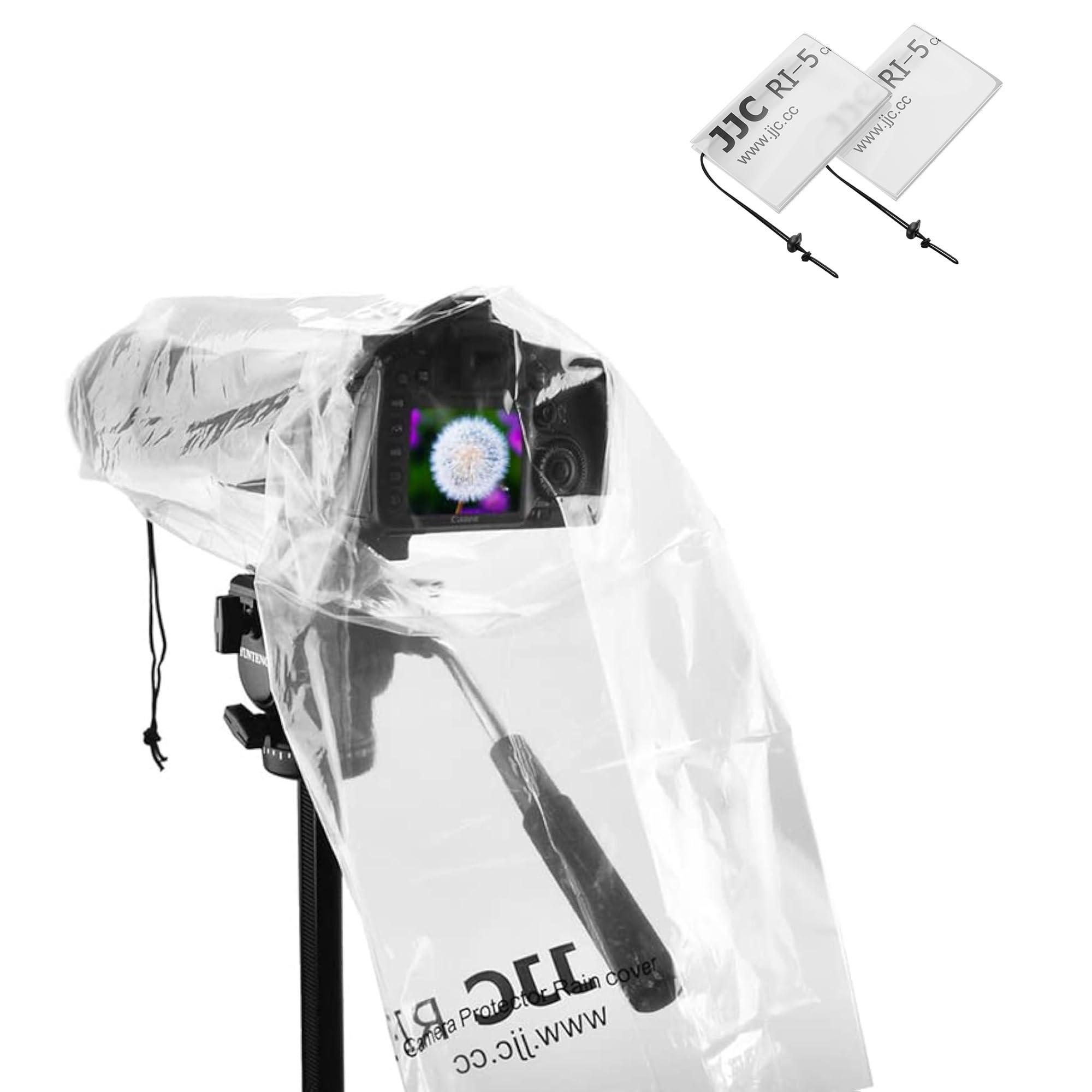
JJC Camera Rain Cover 2-Pack

86 /100
Keeper Score Excellent

Key details

Tripod
Works with tripod and lens hood
Material
See-through PE
Pack Count
2 sleeves
Lens Coverage
Up to 18 in long, 7 in wide
Check Price on Amazon

Eighteen inches of lens coverage is the number that matters here, and it's what makes this pair our budget answer for long glass. A long telephoto with the hood fitted is an awkward object, and the smaller sleeves here stop well short of it; this one swallows it and cinches at the hood.

What you're buying is a loose see-through sleeve — no structure, no hand sleeves, no window beyond the plastic itself — and for a long lens that's the right trade, because a fitted cover on a big telephoto is a wrestling match every time you zoom. The plastic reads clearly enough to see the top plate and the markings on the barrel, and it goes over a tripod plate without fuss.

We treated these as the just-in-case layer: the flat folded sleeve in the bottom of a bag that asks nothing of you until it rains. Two sleeves per pack is the sensible part — leave one in the car and one in the bag, and a cheap cover actually gets used.

Pros

  • Fits lenses up to 18 in long and 7 in wide
  • Two sleeves per pack
  • See-through enough to read settings
  • Works over a tripod plate and lens hood

Cons

  • Slides forward on a bare lens in wind
Our verdict

Our choice for a long zoom on a tight budget: an 18-inch sleeve that covers a big telephoto and a second one for the bag.

Check Latest Price
6

Cheap Full Coverage

WANBY Waterproof Camera Rain Cover

89 /100
Keeper Score Excellent

Key details

Access
Dual sleeves, full-length double zipper
Weight
5.29 oz
Material
Waterproof nylon
Lens Coverage
Up to 35 cm
Check Price on Amazon

This is the cheapest structured cover in the group, which is worth saying plainly. Nylon shell, clear viewing window, two adjustable sleeves, and a full-length double zipper down the front. If you want hand access without paying premium money, we think it's the value answer.

It covers a full DSLR and a lens up to 35 cm, and the sleeves and zipper do what the description promises — open the front, work, close up again. The cut runs roomy: on a compact mirrorless body there's more cover than camera, and it's happiest on a DSLR with a zoom mounted.

Where we think it earns its place is the working position. With the front zipped open, your hands are on the camera and the top and back stay covered, which is the arrangement that keeps a shoot going instead of ending it.

Pros

  • Nylon shell with a clear viewing window
  • Dual sleeves and full-length double zipper
  • Covers a lens up to 35 cm

Cons

  • Bulky to handle compared with a sleeve
Our verdict

A sensible spend if you want sleeves, zippers, and a window without premium prices; just expect more fabric than you need on a small body.

Check Latest Price
7

Wildlife and Field Work

NEEWER PB021 Rain Cover

85 /100
Keeper Score Excellent

Key details

Weight
4.59 oz
Material
Reversible camouflage nylon
Securing
Touch fasteners
Cover Size
23.6 x 23.6 in (600 x 600 mm)
Check Price on Amazon

Wildlife shooters have a problem the rest of us don't: the cover has to disappear. NEEWER's answer is a reversible camouflage nylon square, 23.6 inches on a side, that drapes over camera and lens and fastens with touch-fastener tabs. Against a hedge or a reed bed, it reads as terrain rather than gear.

At 130 g with a storage bag it's light enough to carry all day, and the cut is deliberately unspecific: the same square folds around a body with a short lens or a long telephoto, with an enlarged opening that leaves room for your hands. That flexibility is the appeal — one cover for whatever you happen to carry that morning.

The part we watch on any cover like this is the front. Here the fit is made with touch-fastener tabs rather than a cinched cuff at the lens, so the leading edge is what to test before you trust it in a crosswind, and a hood still does most of the work of keeping rain off the glass.

Pros

  • Reversible camouflage nylon
  • 600 x 600 mm square suits different setups
  • 130 g with a storage bag
  • Enlarged opening for hand access

Cons

  • Costs more than the other nylon covers here
Our verdict

Our pick for hide-and-seek work: a reversible camo square that covers a rig, breaks up its shape, and weighs almost nothing in the bag.

Check Latest Price
8

Compact Mirrorless Kits

Kiorafoto Clear Camera Rain Cover 2-Pack

88 /100
Keeper Score Excellent

Key details

Closure
Drawstring
Material
See-through PE
Pack Count
2 sleeves
Lens Coverage
Up to 11 in (28 cm)
Check Price on Amazon

If your everyday kit is a mirrorless body and a short zoom, an 18-inch sleeve is mostly empty air. Kiorafoto's smaller two-pack is sized for that kit rather than for a telephoto, with less plastic to manage, and the see-through material keeps the top plate visible while you work.

The drawstring cinches a wide barrel well enough; on a slim prime it leaves slack in the cuff, so keep the hood on and the sleeve stays where you put it. That's the whole mechanism — drawstring, sleeve, done — and it's why the pair folds flat and disappears into a bag pocket.

We've kept a pair in a bag for the drizzle that doesn't deserve a forecast check, and that's the honest use case: a short walk, a sudden shower, five minutes of protection rather than an afternoon of it. The covers that actually get used are the ones that take no decision to carry.

Pros

  • Two sleeves per pack
  • See-through material keeps controls visible
  • Folds flat in a bag

Cons

  • Covers lenses up to 11 in only
Our verdict

The right sleeve for a compact mirrorless kit: less fabric to fight than an 18-inch cover, and a spare in the bag for the walk home.

Check Latest Price

How We Tested Camera Rain Covers in Actual Rain

We started with every cover sold through the usual camera-accessory channels, then narrowed to 16 by looking at how each one sizes (short sleeves for a compact zoom, 18-inch sleeves for a telephoto), what it's made of, whether it ships two to a pack, and whether there's an opening for your hands. Then we took them outside.

Each cover went onto a body with a 70-200mm mounted and, separately, a smaller prime, and spent at least 20 minutes in steady rain. We watched whether water beaded or soaked through, whether it pooled in the folds, and whether the front element came back wet. Back inside, we ran a hose over each one for five minutes and then wiped a paper towel around the body and lens mount to see if anything had gotten past the seams. One cover from each pack also lived loose in the bottom of a camera bag for a week.

For usability, we timed putting each one on one-handed, in gloves, without looking, then timed folding it back down to pocket size. We noted whether the top LCD and rear screen stayed readable through the window and whether it fogged over after half an hour. Durability came down to folding and unfolding each cover 20 times and checking the drawstrings and elastic afterward, and bulkiness to whether the fabric flapped into the frame in a crosswind.

How to Choose a Camera Rain Cover

Start With Your Longest Lens

Covers are sized by how much lens they'll swallow, and that figure is the first thing to check. An 11-inch sleeve covers a mirrorless body and a standard zoom and nothing longer; an 18-inch sleeve takes a telephoto with the hood fitted but leaves a small kit swimming in fabric. Add the hood to your measurement, because the hood is what keeps rain off the front element and gives a drawstring something to grip.

If you own both a short kit and a long lens, buy for the long lens. A big sleeve bunched around a small camera still works; a small sleeve on a long lens doesn't. That's the argument for a two-pack: long sleeves for the planned shoot, a small one for the bag you carry anyway.

Sleeve or Structured Cover

The honest dividing line is how long you'll be out. A thin polyethylene sleeve weighs an ounce or two, folds flat, and protects as well as anything for a shower or half an hour on a sideline. A structured nylon cover with hand sleeves and a zipper is what you want when you're working for hours, changing settings constantly, and standing in it.

The trap is buying the structured cover and then leaving it at home because it doesn't fold into a jacket pocket. If you won't carry it, it can't help you. Plenty of photographers own both and consider the cheap sleeve the important one.

Windows, Fogging, and What You Can Actually See

A clear panel that fogs is worse than no panel: you've paid for a window you can't read. TPU windows with an anti-fog coating hold up better than plain vinyl, which goes cloudy with handling and doesn't always come back. The other route is to skip the window entirely — an eyepiece opening lets you compose through the viewfinder, which is how plenty of photographers work in rain anyway.

Decide which one you are before you buy. Screen-first shooters should pay for the window; viewfinder shooters should pay for the opening.

Keeping the Cover on the Lens

Drawstrings hold on a lens hood and slide on a bare barrel. If you shoot in wind, or you're moving between positions, look for hook-and-loop tabs that grab the hood, an internal grip panel, or a hot-shoe strap; the Think Tank cover uses all three and stays where you put it.

A lens hood earns its keep twice here — it sheds rain off the glass and gives the cover a lip to close around. A cover that fits well over a bare barrel will fit better over the hood.

Tripod, Flash, and How Many to Buy

Most sleeves open at the bottom, so a tripod plate isn't the obstacle. A shoe-mounted flash is, because it adds height underneath the cover, and long-lens users should look for the flash-compatible version of a sleeve rather than forcing the standard one over the top.

Two-packs are worth having. Thin sleeves are consumables, and the spare in the car is what turns a torn cover into an inconvenience instead of the end of a shoot.

Frequently Asked Questions

Final Verdict

Most people should buy the OP/TECH Rainsleeve and stop there: it packs to nothing, gives you a real viewfinder opening, and covers a lens long enough for most kits. Spend more only for a reason.

The Think Tank medium is the one for a 70-200 in wind, when the cover has to stay mounted without a hand on it. The K&F Concept is for anyone who has been burned by a fogged window and reads settings off the screen. The Altura Photo is for long sessions where both hands need to be inside. Everything else here is a variation on those four decisions.