Best Nikon Zoom Lenses of 2026

Every zoom lens is a tradeoff you agree to before you mount it: reach against light, light against weight, weight against your budget. A superzoom that goes everywhere is usually softer at the long end, while a fast constant-aperture zoom is heavier and stops short of the bird on the far bank. The right one makes that tradeoff for you, and stays on the camera.

I've shot with plenty of glass over the years, and the spec sheet tells you almost nothing about how a lens feels at hour three of a hike. So we spent nine months with eight lenses — superzooms, a constant-aperture standard, long telephotos — on bodies from a compact crop-sensor camera up to full frame, watching sharpness wide open, how fast focus caught a running dog, and how the rig hung on a sling strap.

Before you fall for a focal range, settle the mount question: a crop-sensor zoom on a full-frame body trades away a big chunk of your resolution, and the right pairing matters more than the numbers suggest. The picks below cover both.

Keeper Score summarizes customer ratings and review volume. Read it alongside the product details and trade-offs. How the score works.

1

Best Overall

Nikon Z 24-120mm f/4 S

91 /100
Keeper Score Outstanding

Key details

Weight
1.4 lb
Close Focus
1.15 ft
Focal Length
24-120mm
Maximum Aperture
f/4
Check Price on Amazon

The 24-120mm f/4 S is built around a simple idea: cover the focal lengths most people use in a day without letting the aperture drift. It starts at 24mm for rooms and landscapes and reaches 120mm for portraits and details, and the f/4 maximum stays put across the whole range. That consistency is why it is our top pick for Nikon Z shooters who want one zoom that handles most of what they shoot.

We recommend it because the range and the constant aperture solve more problems than a longer superzoom. The S-line optics are crisp, the two STM focusing motors are quiet, and the lens focuses down to 1.15 ft at every zoom position. It weighs 1.4 pounds, which is light enough to carry all day but substantial enough to balance a full-frame Z body.

The trade-off is that there is no VR in the lens. On a full-frame Z body with in-body stabilization, that is a minor issue; on a DX Z body without IBIS, you will need to keep shutter speeds up. On DX it also behaves like a 36-180mm lens, so the wide end is less wide than the number suggests.

We also like that it takes 77mm filters, the same thread as the 28-400mm and 100-400mm. If you already own a filter kit for one of those lenses, it transfers here without a step-up ring.

Pros

  • Constant f/4 across the zoom
  • 24-120mm covers wide to portrait
  • Close focus of 1.15 ft
  • Sharp S-line optics

Cons

  • No on-lens VR
Our verdict

We recommend the 24-120mm f/4 S as the default Nikon Z zoom: it covers the useful everyday range with a constant aperture and sharp S-line optics, and it is the one we pack first.

Check Latest Price
2

Best Superzoom

Nikon Z 28-400mm f/4-8 VR

90 /100
Keeper Score Outstanding

Key details

Weight
1.6 lb
Focal Length
28-400mm
Maximum Aperture
f/4-8
Vibration Reduction
5.0 stops
Check Price on Amazon

The one-lens travel promise of a 14.2x zoom is easy to sell and hard to execute, but the 28-400mm makes a convincing case. It goes from a wide 28mm view to a 400mm reach in one barrel, weighs about 1.6 pounds, and adds 5-stop VR for hand-held shooting. We choose it for travel when changing lenses is the thing most likely to cost us a shot.

The compromises are at the long end. Maximum aperture drops to f/8 at 400mm, so it is a bright-light lens when fully extended, and autofocus can feel slow when the subject is small or low-contrast. The close-focus distance of 0.2 m at 28mm and the 0.35x reproduction ratio are genuinely useful for details, though, and the lens stays sharp enough to justify carrying it instead of a bag of primes.

Against the 24-120mm, this is the pick when 400mm matters more than a constant aperture; against the 24-200mm, it buys another 200mm at the cost of weight and a slower long end. The 28mm wide end is the part we appreciate most: it lets you photograph a room or a landscape before zooming to a distant subject.

Pros

  • 14.2x zoom covers 28-400mm
  • Light for its reach at 1.6 pounds
  • 5-stop VR
  • 0.35x close focus at 28mm

Cons

  • f/8 at 400mm
  • Autofocus can lag at times
Our verdict

For a one-lens Nikon Z travel kit, we choose the 28-400mm: its 14.2x range and 5-stop VR cover wide landscapes and distant subjects, as long as you accept the slow long end.

Check Latest Price
3

Best Travel Zoom

Nikon Z 24-200mm f/4-6.3 VR

89 /100
Keeper Score Excellent

Key details

Weight
1.3 lb
Focal Length
24-200mm
Maximum Aperture
f/4-6.3
Vibration Reduction
Optical
Check Price on Amazon

The 24-200mm is the lighter, lower-cost alternative to the 24-120mm, and for a lot of travel kits that is the more sensible trade. It covers 24mm to 200mm in an 8.3x zoom, weighs 1.3 pounds, and includes built-in VR. You give up the constant f/4 aperture and some S-line build, but you gain 80mm of reach and a smaller carry.

The lens is sharp through its range, and the VR helps at the long end. The aperture is the limitation: it is an f/4-6.3 lens, so at 200mm you are at f/6.3 and need good light or a higher ISO. That is the price of the compact size, and for landscapes, travel, and family photos it is a reasonable one.

We prefer the 24-200mm for a one-lens Z travel kit when the 24-120mm's extra aperture is not worth the cost and shorter reach. It is also the easier lens to hand to someone who wants one zoom and does not want to think about swapping. The 67mm filter thread keeps a polarizer or ND kit smaller than the 77mm lenses here.

Pros

  • 24-200mm all-in-one range
  • Built-in VR
  • Light 1.3-pound body
  • Sharp through the range

Cons

  • f/6.3 at 200mm
  • Autofocus can miss at times
Our verdict

We recommend the 24-200mm for Nikon Z travelers who want a lighter, lower-cost all-in-one and can live without 400mm reach.

Check Latest Price
4

Best Premium Telephoto

Nikon Z 100-400mm f/4.5-5.6 VR S

91 /100
Keeper Score Outstanding

Key details

Weight
3.2 lb
Focal Length
100-400mm
Maximum Aperture
f/4.5-5.6
Vibration Reduction
5.5 stops
Check Price on Amazon

The 100-400mm f/4.5-5.6 VR S is the telephoto zoom we reach for when 400mm needs to be sharp, hand-holdable, and ready for a teleconverter. It covers 100-400mm, adds 5.5 stops of VR, and weighs 3.2 pounds. The S-line build and 77mm filter thread make it feel like a working lens rather than a compromise.

We recommend it for Z shooters who want a premium wildlife and action lens without jumping straight to a 600mm barrel. It accepts the 1.4x and 2x Z teleconverters, turning it into a 140-560mm or 200-800mm lens, and the 100mm start is long enough for portraits and compression but short enough to find a subject. Autofocus is quick, and the lens stays sharp across the range.

The obvious trade-off is reach: the 180-600mm goes 200mm longer for less money. The 100-400mm answers with a faster maximum aperture at the long end and a lighter, more portable package. If you shoot distant birds, the 180-600mm is the better tool; if you shoot larger wildlife, sports, and travel, this one is easier to live with. For a two-lens Z kit, it picks up near where the 24-120mm stops, so the pair covers 24-400mm with only a small overlap.

Pros

  • 5.5-stop VR
  • Teleconverter compatible
  • 100-400mm S-line sharpness
  • 3.2-pound portability

Cons

  • Less reach than 180-600mm
  • Premium price
Our verdict

We recommend the 100-400mm S for Nikon Z shooters who want premium telephoto sharpness and teleconverter flexibility without the bulk of a 600mm zoom.

Check Latest Price
5

Best for Wildlife Reach

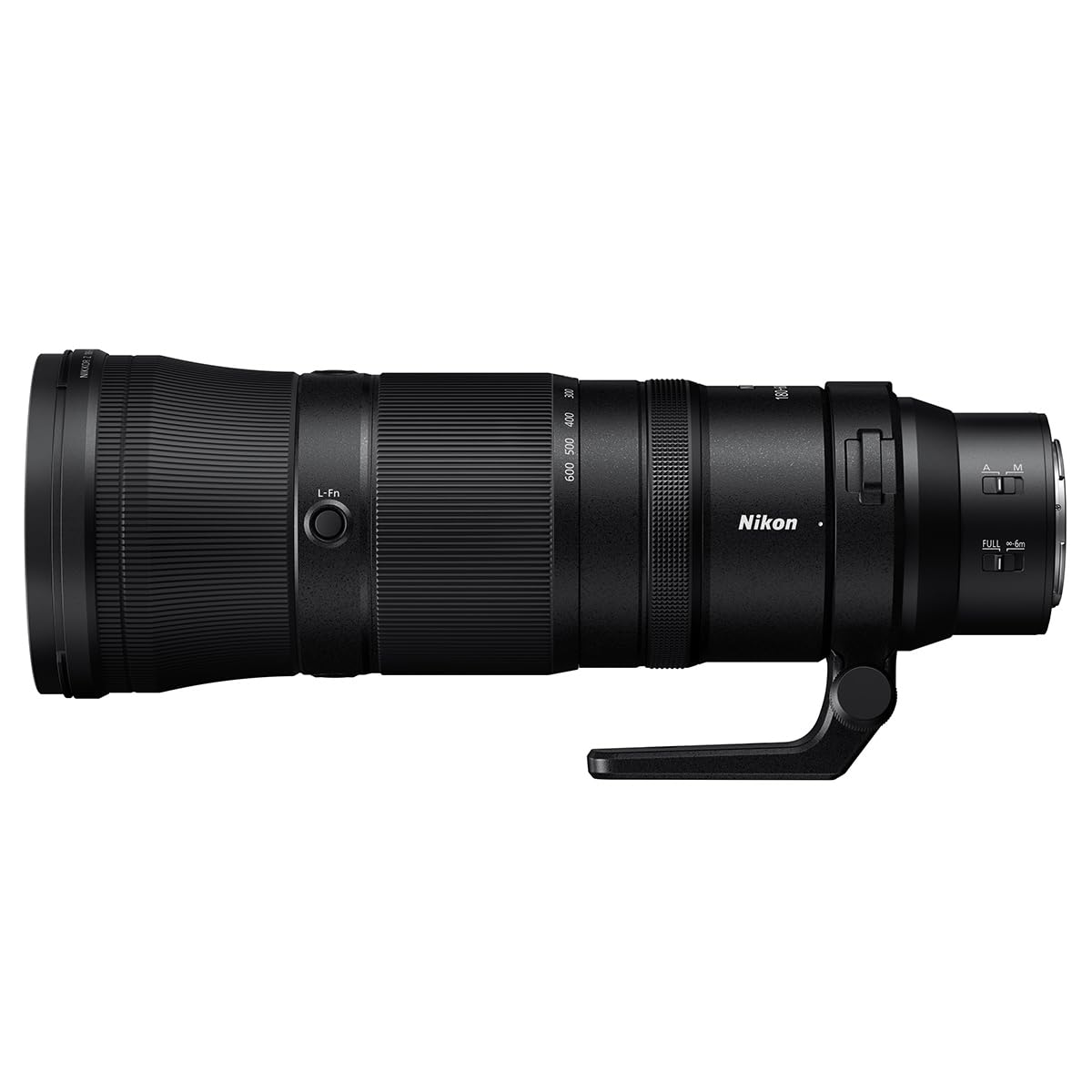
Nikon Z 180-600mm f/5.6-6.3 VR

88 /100
Keeper Score Excellent

Key details

Weight
4.7 lb
Focal Length
180-600mm
Maximum Aperture
f/5.6-6.3
Vibration Reduction
5.5 stops
Check Price on Amazon

Six hundred millimeters on a Z body, without the barrel growing as you zoom: that is the appeal of the 180-600mm. It covers 180-600mm, adds 5.5 stops of VR, and uses an internal zoom design that keeps the lens the same length throughout the range. At 4.7 pounds, it is a serious supertelephoto, not a travel lens.

The 70-degree zoom ring takes you from 180mm to 600mm in a short twist, which makes it easier to find a subject at the wide end before zooming in. The minimum focus distance is 4.27 ft at 180mm with a 0.25x reproduction ratio, so it can handle a close encounter without switching lenses. The tripod foot and strap eyelet are the kind of details that matter once the lens is on a gimbal.

We choose it when maximum reach matters more than portability. The internal zoom keeps the balance steadier on a tripod and reduces dust intrusion, and the 5.5-stop VR makes hand-held shots possible in good light. Autofocus is the weak point: it can lag with erratic or low-contrast subjects, so it is not the lens we pick for fast, unpredictable action.

At 4.7 pounds, it is a monopod or tripod lens for long sessions. If you want a lighter 400mm, the 100-400mm is the better carry; if you need 600mm on a Z body, this is the one that gets you there without a teleconverter.

Pros

  • 180-600mm maximum Z reach
  • Internal zoom keeps length fixed
  • 5.5-stop VR
  • 0.25x close focus at 180mm

Cons

  • 4.7 pounds is heavy
  • Autofocus can lag on erratic subjects
Our verdict

We choose the 180-600mm when 600mm reach matters more than portability: it delivers internal zoom, strong VR, and Z-mount reach, though it is a heavy lens for handheld sessions.

Check Latest Price
6

Best DSLR Wildlife Value

Nikon AF-S 200-500mm f/5.6E VR

93 /100
Keeper Score Outstanding

Key details

Mount
Nikon F
Focal Length
200-500mm
Maximum Aperture
f/5.6
Vibration Reduction
4.5 stops
Check Price on Amazon

The 200-500mm f/5.6E is the DSLR lens that makes long-range wildlife photography feel within reach. It holds a constant f/5.6 across 200-500mm, adds 4.5 stops of VR, and works with Nikon's TC-14E teleconverters on DSLRs that support f/8 autofocus. On a DX body it behaves like a 300-750mm lens, which is a lot of reach for the money.

The constant aperture is the reason to choose it over a variable superzoom. At 500mm you are still at f/5.6, so you get faster shutter speeds and a brighter viewfinder than an f/6.3 lens. The VR is effective, and the lens is sharp enough that it has become a reference point for affordable wildlife glass.

It is also big and heavy. The weight shifts forward as you zoom, and hand-holding it for a long session is tiring; a monopod or tripod collar makes a real difference. Autofocus is not sports-fast, and it can hunt when the background is busy. That is the trade for the reach and the constant aperture.

We recommend the 200-500mm for DSLR shooters who want a dedicated wildlife lens and do not need the faster autofocus of a pricier prime. It is the value choice in this set for 500mm on an F-mount body. The 95mm filter thread is large, so factor in the cost of any front filters.

Pros

  • Constant f/5.6 aperture
  • 200-500mm telephoto range
  • 4.5-stop VR
  • TC-14E teleconverter support

Cons

  • Heavy and front-heavy
  • Autofocus not sports-fast
Our verdict

We recommend the 200-500mm f/5.6 for DSLR wildlife shooters who want a constant-aperture supertelephoto at a value price, and can carry its weight.

Check Latest Price
7

Best Budget DX Zoom

Nikon Z DX 50-250mm VR

90 /100
Keeper Score Outstanding

Key details

Weight
14.2 oz
Focal Length
50-250mm
35mm Equivalent
75-375mm
Vibration Reduction
5 stops
Check Price on Amazon

The 50-250mm is the telephoto we hand to a DX Z owner who wants reach without a heavy bag. On an APS-C Z body it covers a 75-375mm equivalent, weighs 14.24 ounces, and adds up to 5 stops of VR. That combination makes it a natural second lens for a Z 30, Z 50, or Z fc kit.

It focuses quickly in good light and stays sharp enough for a kit telephoto. The limitation is the long-end aperture, which is modest, so it is not the lens for indoor sports or dusk wildlife. The VR helps with stationary subjects, but it cannot make up for a slow shutter speed when the subject is moving.

The lens hood is not included, and that is an easy thing to overlook. Add one before your first trip; it helps with flare and protects the front element. The 62mm filter thread is the smallest among the Z zooms here, so a polarizer or ND filter costs less than it would for the full-frame lenses.

Pros

  • 75-375mm equivalent reach
  • 5 stops of VR
  • 14.24-ounce weight
  • Fast focus in good light

Cons

  • No lens hood included
  • Slow long-end aperture
Our verdict

We recommend the 50-250mm for DX Z shooters who want a light, affordable telephoto with 375mm-equivalent reach, provided they add a hood and shoot in decent light.

Check Latest Price
8

DSLR All-In-One

Nikon AF-S DX 18-300mm f/3.5-6.3 VR

91 /100
Keeper Score Outstanding

Key details

Weight
1.21 lb
Zoom Ratio
16.7x
Focal Length
18-300mm
Maximum Aperture
f/3.5-6.3
Check Price on Amazon

The 18-300mm f/3.5-6.3 is the do-everything zoom for a DX DSLR: a 16.7x range that starts at a true wide angle and reaches a 450mm equivalent at the long end. It weighs 550 g and uses VR II, so it is a one-lens travel solution for a D3500, D5600, or similar body.

The convenience is obvious. You can shoot a landscape, a portrait, and a distant animal without changing lenses, and the 18mm wide end is wide enough for interiors and group shots. The lens is compact for its range, and the VR II helps at the long end.

The image quality is the compromise. The long end is softer than the short end, and autofocus can be slow and inconsistent, especially in low light. That is a fair trade for a lens that keeps you shooting, but it is not the choice for critical telephoto work.

We recommend it for DX DSLR owners who want one lens for travel and family use and would rather carry less than chase the sharpest 300mm image. If you shoot wildlife seriously, the 55-200mm or 200-500mm is the better tool. The 67mm filter thread is common, so a polarizer is easy to share with the 24-200mm.

Pros

  • 16.7x 18-300mm range
  • VR II stabilization
  • 550 g compact carry
  • One-lens travel convenience

Cons

  • Soft at the long end
  • Autofocus can be slow
Our verdict

We recommend the 18-300mm for DX DSLR owners who want one lens for everything and accept softer long-end images in exchange for never swapping glass.

Check Latest Price
9

Budget Telephoto

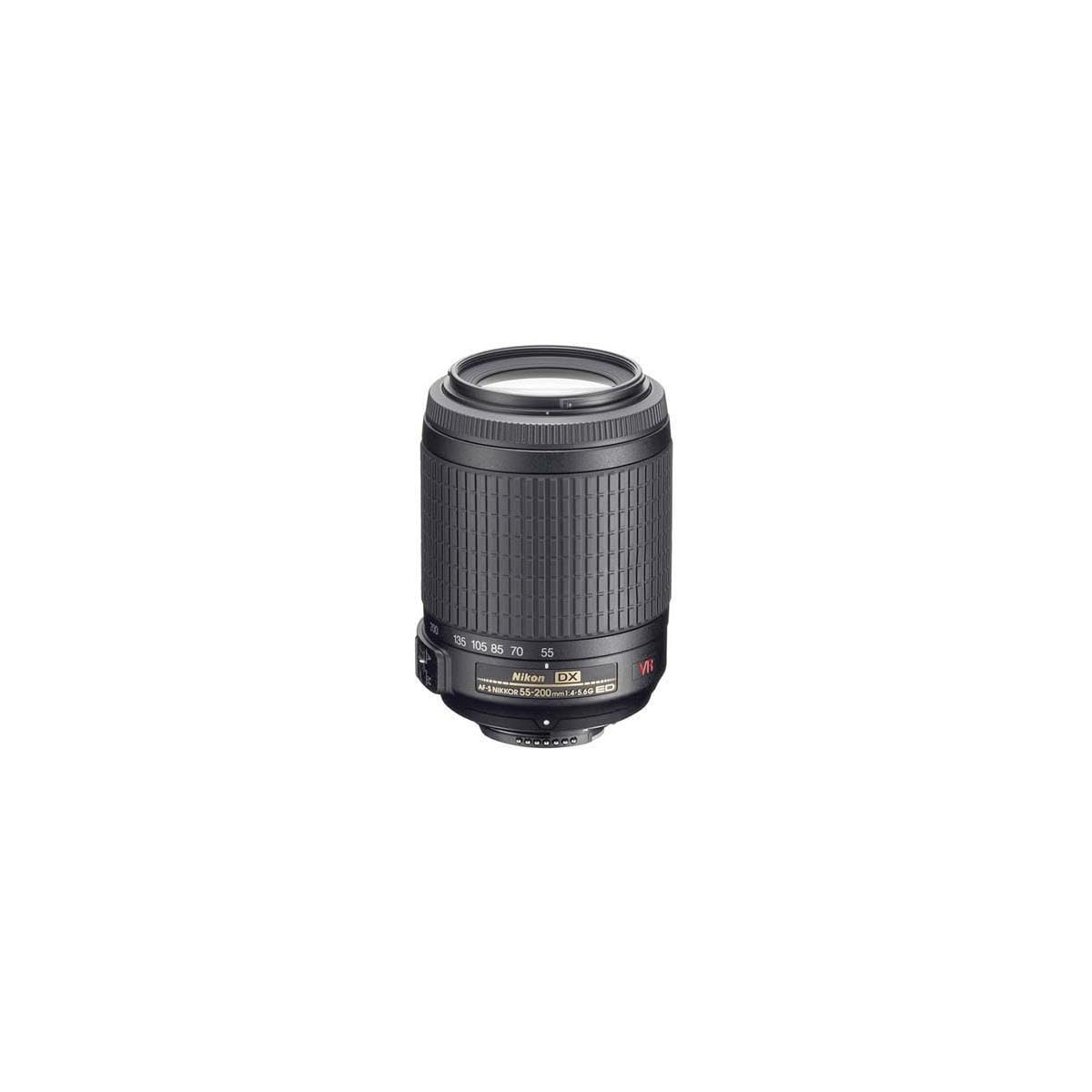
Nikon AF-S DX 55-200mm f/4-5.6 VR

93 /100
Keeper Score Outstanding

Key details

Weight
9 oz
Focal Length
55-200mm
Maximum Aperture
f/4-5.6
Vibration Reduction
Up to 3 stops
Check Price on Amazon

At 9 ounces, the 55-200mm is the lens we suggest when someone wants a first telephoto without committing to a heavy kit. It covers 55-200mm, adds VR, and uses a 52mm filter thread. On a DX DSLR it gives an 82.5-300mm equivalent, which is enough for portraits, pets, and daylight sports.

It is sharp for the money, and the VR helps steady the view at 200mm. The autofocus is the weak point: it is not quick enough for fast action, and it can hunt when light drops. For a beginner who is learning to track subjects, that is a real limitation, but it is also why the lens is so light and inexpensive.

The lens ships in bulk packaging with caps only, so do not expect a retail box or a hood. Treat it as a first telephoto rather than a lifetime lens, and give it a padded spot in the bag.

Compared with the 18-300mm, it gives up range and convenience but saves weight and cost. It is the lens we keep for a light DSLR kit when the goal is to carry less and change lenses rarely.

We recommend the 55-200mm for budget DSLR shooters who want a light, sharp first telephoto and can work around slow autofocus. It is not the lens for birds in flight or indoor sports, but it is an easy way to add reach without doubling the weight of the bag. The 52mm front thread means a protective filter costs less than the 67mm or 77mm lenses, which is a small win for a budget kit.

Pros

  • 9-ounce lightweight build
  • VR stabilization
  • Sharp for the price
  • Low-cost first telephoto

Cons

  • Slow autofocus for action
  • Bulk packaging, no hood
Our verdict

We recommend the 55-200mm for budget DSLR shooters who want a light, sharp first telephoto and can work around slow autofocus.

Check Latest Price

How We Tested: Nine Months, Eight Zooms

We started by pulling every current zoom that fits a Nikon body — both the mirrorless mount and the older DSLR mount — then cut the list by what people actually shoot: a walkaround range, a travel superzoom, and something long enough for wildlife. That left eight lenses at very different price points, from a lightweight crop-sensor kit zoom to a big telephoto that needs its own strap. Each one lived on a camera for weeks, not an afternoon.

Most of the shooting happened where these lenses actually get used. I brought them to a Saturday youth soccer game in flat gray light, on two hikes, to a dim indoor birthday party, and to a wildlife blind before sunrise. Two colleagues who are newer to photography borrowed setups for a weekend each, which is how we learned which controls you can work with cold hands and which ones send you to the manual.

Every session started wide open, and we looked at the corners rather than the center, since that's where a zoom shows its compromises. We timed focus on kids and dogs running toward the camera, then listened to the motor in a quiet room. Stabilization got judged handheld at dusk at the long end, where a lens either holds the frame steady or doesn't. Each one went on a kitchen scale, got carried for a full day, and was shot into the sun with the hood on and off to see how it handled flare.

Last came durability: a few lenses rode in a tote bag without a case, got caught in light rain, and were wiped down and remounted. Nothing failed, but the tighter zoom rings and better-sealed mounts clearly felt like the longer-term buy.

How to Choose a Nikon Zoom Lens

Match the mount before you shop

A Z lens will not mount on a Nikon DSLR, and an F-mount lens needs an FTZ adapter on a Z body. That makes the camera the first decision, not the focal length. Within each mount, DX lenses are built for APS-C bodies; they work on full-frame cameras in crop mode, but you give up resolution, while an FX lens on DX gives extra reach. If you split time between systems, buy for the body you shoot most and treat the other as the exception.

Choose reach around your subjects

Most people overbuy reach. A 24-120mm or 24-200mm covers street, travel, family, and portraits, while a 28-400mm or 18-300mm makes sense when changing lenses is the enemy. For wildlife, 100-400mm is a versatile starting point; 180-600mm or 200-500mm is for distant subjects and tighter crops. On DX, multiply by 1.5 for the equivalent view, so a 50-250mm behaves like a 75-375mm. Pick the range you will use weekly, not the longest number you can afford.

Aperture and stabilization set your low-light limit

A constant f/4 lens like the 24-120mm keeps exposures and autofocus consistent as you zoom; a variable f/4-6.3 or f/4-8 lens gets smaller and lighter but loses light at the long end. Built-in VR helps with static subjects, while in-body stabilization helps with every lens. We prioritise a constant aperture for indoor people and events, and accept a slower long end for travel and wildlife in good light. If you shoot moving subjects at dusk, aperture matters more than VR.

Weight and handling decide how often you carry it

A 1.3-pound travel zoom and a 4.7-pound supertelephoto solve different problems. The heavy lenses need a monopod, tripod, or gimbal for long sessions, and their tripod collars and balance matter as much as sharpness. Internal zoom designs keep the lens the same length and shift less weight forward; extending zooms are more compact to pack. If you handhold for hours, choose the lighter lens and accept less reach; if you work from support, the bigger lens earns its weight.

Autofocus and close focus are the quiet differences

Autofocus speed varies more than the specs suggest. Newer Z lenses with STM motors focus quietly and quickly, while high-ratio zooms can slow down at the long end or in low contrast. Close focus is the other underrated number: the 24-120mm focuses to 1.15 ft at every position, and the 28-400mm reaches 0.2 m at 28mm with 0.35x magnification. If you shoot details, check the minimum focus distance; if you shoot action, test the lens on your body before a critical trip.

Frequently Asked Questions

Final Verdict

Most Nikon Z shooters should buy the 24-120mm f/4 S. It covers the everyday range with a constant aperture, focuses close, and delivers the S-line sharpness that makes a one-lens kit feel complete; the lack of VR is the one caveat, and full-frame Z bodies handle that with IBIS.

If you want one lens for travel and never want to change glass, the 28-400mm is the alternative. If you are shooting a DSLR and need reach, the 200-500mm remains the value wildlife choice.