Best Standard Zoom Lenses of 2026

A standard zoom is the lens that stays on the camera — the one you leave mounted because you don't know what the day will ask for. The old compromise was light: kit glass that dims to f/5.6 as you zoom in, and pictures that go soft at sunset. A good one holds a fast aperture across the range, keeps focus on a kid who won't stand still, and gets you from a group shot to a tight portrait without a lens change in the middle.

I've kept a zoom bolted to my camera for years and never regretted leaving the primes home. My team and I have spent six months shooting with eight standard zooms, from wide-aperture workhorses to a pancake that disappears in a jacket pocket. Two things worth knowing: sharpness wide open matters far more than sharpness at f/8, and a few ounces between two similar-looking lenses is what you feel on hour four of a walk. The picks below earned their place in the bag.

Keeper Score summarizes customer ratings and review volume. Read it alongside the product details and trade-offs. How the score works.

1

Best Overall

Tamron 17-70mm f/2.8 VC

93 /100
Keeper Score Outstanding

Key details

Mount
Sony E (APS-C)
Focal Length
17-70mm
Max Aperture
f/2.8
Stabilization
VC optical
Check Price on Amazon

On an APS-C Sony body the 17-70mm behaves like a 25.5-105mm, which is the range most of us actually shoot: a whole room at the wide end, a head-and-shoulders portrait at the long one. The part that matters is the constant f/2.8. Nothing changes as you zoom — no exposure jump halfway through the ring, no scrambling for a slower shutter speed just because you framed tighter.

Put the three headline specs together and this lens is hard to argue with. A 4.1x range, a fast constant aperture and in-lens stabilization usually arrive separately, or together at a much higher price. Tamron's VC is set up to cooperate with Sony's in-body stabilization, which is exactly what you want for handheld video, and the minimum focus distance of 7.5 inches at 17mm gets you close to a flower or a plate without a lens swap.

Handling is where the compromises surface. At 1.2 pounds it is not a light lens, and on a compact body the weight sits out front, so a wrist strap earns its keep. What we appreciated: the moisture-resistant construction and fluorine-coated front element, which turn a splash into a wipe rather than a panic. It takes 67mm filters, so a polarizer you already own stands a good chance of fitting.

Set it beside the Sigma 18-50mm and the trade is clean: the Sigma is about half the weight and gives up the 70mm end and the stabilization to get there. If your camera lives in a bag that gets carried all day, that trade makes sense. If it hangs on a strap and you shoot in whatever light you find, the extra reach and the steadier framing are worth carrying.

Pros

  • Constant f/2.8 through the whole zoom
  • In-lens VC tuned to work with Sony IBIS
  • 25.5-105mm equivalent covers rooms and portraits
  • Moisture-resistant with fluorine-coated front element

Cons

  • 1.2 pounds sits heavy on a small body
Our verdict

Constant f/2.8, in-lens stabilization and a 25-105mm-equivalent range make this the Sony APS-C zoom we recommend first.
Check Latest Price
2

Best for Small Kits

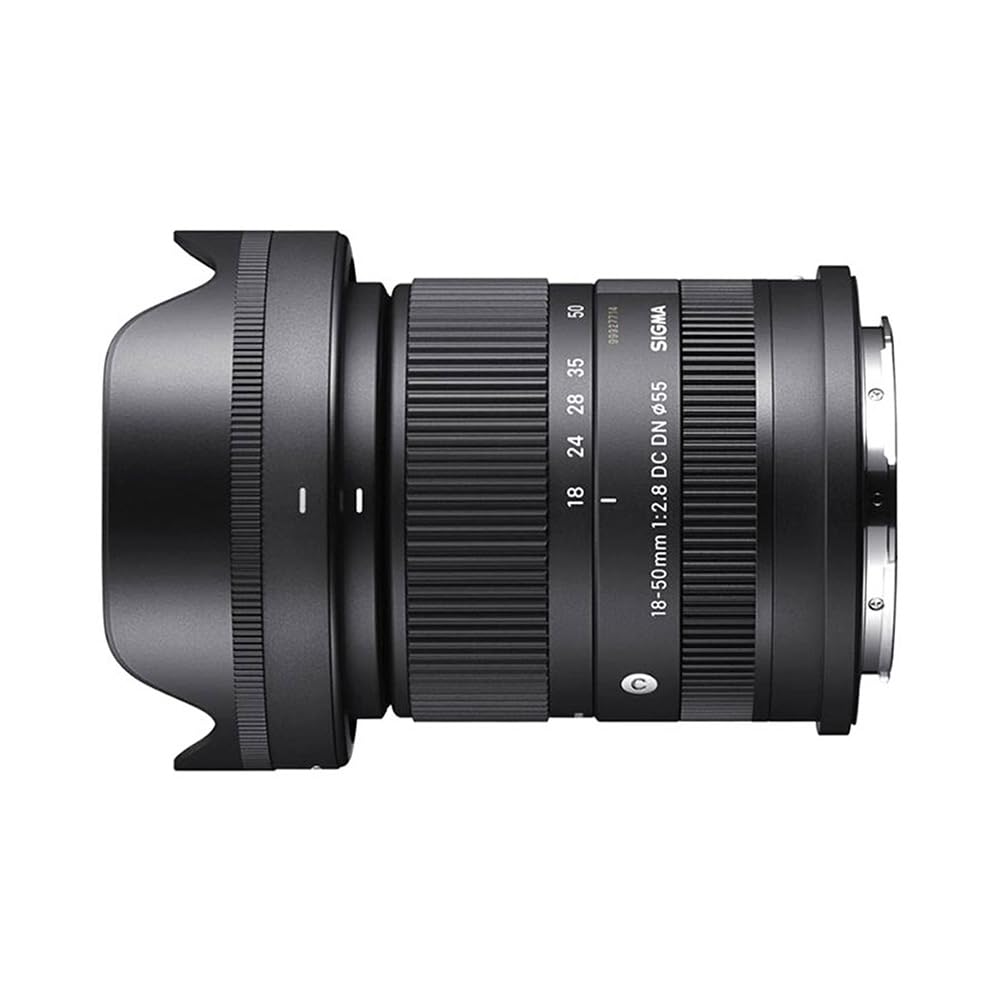
Sigma 18-50mm f/2.8 DC DN

93 /100
Keeper Score Outstanding

Key details

Mount
Sony E (APS-C)
Weight
10.2 oz
Focal Length
18-50mm
Max Aperture
f/2.8
Check Price on Amazon

Two hundred and ninety grams is the whole argument. Screw the 18-50mm onto a small Sony body and the pair fits in a bag you would otherwise leave at home; on a long day walking, that is the difference between having a camera and wishing you had brought one. The files hold up, too — this is a constant f/2.8 zoom in a barrel barely bigger than a kit lens.

The range works out to 27-75mm in full-frame terms, which covers street, environmental portraits and most of a family gathering. It is at its sharpest toward the long end, which is where you will be shooting portraits anyway, and f/2.8 there is what separates a subject from the background. There is no optical stabilization, which is the honest catch: on a body with in-body stabilization it costs you nothing, and on an older body without it you will be minding your shutter speed after dark.

Compared with the Tamron 17-70mm you give up the 105mm-equivalent reach, the stabilization and a millimetre at the wide end, and you get a lens you will genuinely carry. The 55mm filter thread keeps a polarizer small and inexpensive, which suits the rest of the package.

Pros

  • 290 g keeps a small body genuinely portable
  • Constant f/2.8 across the range
  • Sharp toward the long end

Cons

  • No optical stabilization
  • Less reach at both ends than the top pick
Our verdict

The smallest and lightest f/2.8 zoom here, and the one we reach for when the camera has to disappear into a small bag.

Check Latest Price
3

Best Full-Frame Value

Tamron 28-75mm f/2.8 G2

90 /100
Keeper Score Outstanding

Key details

Mount
Sony E (full-frame)
Weight
19 oz
Focal Length
28-75mm
Max Aperture
f/2.8
Check Price on Amazon

Sony's 24-70mm f/2.8 GM II is a magnificent lens with a price to match. This one covers 28-75mm at the same f/2.8, weighs 19 ounces, and leaves a serious gap in the budget — enough for a fast prime, or a tripod and a bag. That gap is the entire reason it is here.

The specifications hold up under use. The VXD linear motor focuses quickly and quietly, the 7.1-inch close-focus distance at the wide end comes with a 1:2.7 magnification ratio that makes it useful for details, and the barrel is 4.6 inches long — short enough that it does not dwarf a compact full-frame body. Moisture-resistant construction and a fluorine coating on the front element mean it can come out in weather the camera can handle.

Two things to weigh. There is no optical stabilization, so handheld work depends on the body's in-body system, and the wide end starts at 28mm rather than 24mm — noticeable when you are backed into a corner shooting a room. Neither has bothered us at events or on the street, where 28mm is plenty and the light is usually good enough to keep the shutter speed up. As a first full-frame zoom, this is the value pick of the group.

Pros

  • Full-frame f/2.8 at 19 ounces
  • 1:2.7 close-focus magnification at the wide end
  • Moisture-resistant with fluorine coating

Cons

  • No optical stabilization
  • Wide end starts at 28mm, not 24mm
Our verdict

The full-frame f/2.8 we recommend before anyone spends G Master money: 19 ounces, sharp files, and enough left over for a second lens.

Check Latest Price
4

Best Premium

Sony FE 24-70mm f/2.8 GM II

89 /100
Keeper Score Excellent

Key details

Mount
Sony E (full-frame)
Weight
24.6 oz (695 g)
Focal Length
24-70mm
Max Aperture
f/2.8
Check Price on Amazon

Four XD linear motors is the detail worth starting with. It is what makes the 24-70mm GM II focus quickly and quietly, and it is why the lens is designed to suppress focus breathing — the slight change in framing as you pull focus that ruins a video shot otherwise. If you shoot stills and motion on the same body, that is not a marketing footnote; it is the difference between usable footage and a re-shoot.

The rest of the design follows the same logic. Sony trimmed the lens to 24.6 ounces (695 g), over 20% less than the previous version, and 16mm shorter — a real difference on a camera you handhold for an hour. Two extreme aspherical elements and two ED elements are there to hold contrast and resolution wide open at f/2.8, where a cheaper zoom starts to soften.

At 24mm the wide end is the widest of the full-frame lenses here, and for interiors, tight rooms and architecture those four millimetres are worth more than they sound. The nine-blade aperture keeps out-of-focus highlights round, and the constant f/2.8 means the lens behaves identically at 24mm and at 70mm.

Our reservation is the obvious one: nothing else here costs remotely as much, and for a hobbyist the Tamron 28-75mm gets you most of the way for far less money. What the Sony buys is the last few percent — a 24mm end, quieter focus, and the build a working photographer can bill for. If you are being paid, it earns its place; if you are not, be honest about that.

Pros

  • Smallest and lightest f/2.8 24-70mm Sony has built
  • Four XD motors, quiet focus, minimal breathing
  • 24mm wide end, the widest full-frame option here

Cons

  • By far the most expensive lens here
Our verdict

The reference standard zoom for Sony full-frame: the smallest, lightest f/2.8 24-70mm Sony has built, and priced like the professional tool it is.

Check Latest Price
5

Best for Canon RF

Canon RF 28-70mm f/2.8 IS STM

90 /100
Keeper Score Outstanding

Key details

Mount
Canon RF
Focal Length
28-70mm
Max Aperture
f/2.8
Weather Resistance
L-series equivalent
Check Price on Amazon

Weather sealing used to be the thing you paid L-series money for. Canon has put an L-equivalent sealed construction, a constant f/2.8 aperture and a newly designed image stabilization unit into the 28-70mm, and kept it light enough to leave on the camera — just over a pound. On an R8 or an R6 that makes a one-lens kit that handles a rainy street and a dim reception without a change of plan, which is exactly what a standard zoom is for.

The compromise sits at the wide end. Twenty-eight millimetres is not twenty-four, and in a small room you feel it: you step back, or you accept a tighter frame. In exchange you get a 2.5x range that runs to a flattering 70mm for portraits, an STM motor quiet enough for video, and two UD plus two aspherical elements doing the work that keeps the edges clean.

Pros

  • Constant f/2.8 with optical IS
  • Weather-resistant to L-series standard
  • Quiet STM focus for video

Cons

  • Wide end stops at 28mm
Our verdict

Canon RF shooters get f/2.8, optical stabilization and weather sealing without L-series money; this is the everyday zoom for an R body.

Check Latest Price
6

One-Lens DSLR Travel

Canon EF-S 18-135mm f/3.5-5.6 IS

88 /100
Keeper Score Excellent

Key details

Mount
Canon EF-S
Focal Length
18-135mm
Max Aperture
f/3.5-5.6
35mm Equivalent
29-216mm
Check Price on Amazon

Eighteen to 135mm is 29-216mm in full-frame terms, which sounds like a strange thing to call a standard zoom until you have travelled with one. A street scene at the wide end, a face across a table, a bird in a tree — all without opening the bag. What you give up for that reach is the fast aperture the rest of this group is built around.

The stabilization earns its keep at the long end. Canon rates it at four stops, which is what makes 135mm handheld in less than bright sun a reasonable proposition, and at 455 grams the lens hangs off a strap all day without complaint. It takes 67mm filters, the same as both Tamrons here, and the 16-element construction is a clear step past the 18-55mm kit lens it usually replaces.

Focus is the part to understand before you buy. This is a gear-driven micro motor rather than ring USM, so it is slower and noisier than the linear motors in the mirrorless lenses here. For landscape and travel that is fine; for a child running at you it is the weak link.

So the setting this lens does not serve is a dim interior — f/3.5-5.6 will have you pushing the ISO where a constant f/2.8 zoom would not. Everything else about it is a sensible answer for an APS-C DSLR owner who wants one lens and a small bill. The version here is white box: new glass without retail packaging, with a one-year warranty, so confirm the seller's terms before ordering.

Pros

  • 29-216mm equivalent in a single lens
  • Four-stop image stabilization
  • 455 g with common 67mm filters

Cons

  • Variable f/3.5-5.6 aperture limits low light
  • Gear-driven focus, not ring USM
Our verdict

For an EF-S DSLR that travels, this is the one lens that covers a street scene and a distant subject without a swap.

Check Latest Price
7

Budget Full-Frame Entry

Sony FE 28-70mm f/3.5-5.6 OSS

85 /100
Keeper Score Excellent

Key details

Mount
Sony E (full-frame)
Weight
15 oz
Focal Length
28-70mm
Max Aperture
f/3.5-5.6
Check Price on Amazon

Renewed is the first thing to get straight. This is a used lens that has been checked and resold with a 90-day limited warranty, not the year or more a new lens carries. For a first full-frame body that is often the right trade, but go in knowing that cosmetic marks are normal and the guarantee is short.

Optically it is the lens that shipped alongside Sony's early full-frame bodies, and it behaves like one: a 28-70mm range, optical SteadyShot, a 0.19x maximum magnification for close details, and three aspherical elements plus one ED element keeping things clean. At 15 ounces it disappears on a body. The aperture is the limit — f/3.5-5.6 makes this a daylight and flash lens, and every f/2.8 zoom here will gather far more light indoors. As a way to learn full-frame on a budget, though, it is hard to beat.

Pros

  • Cheapest full-frame E-mount zoom here
  • Built-in optical SteadyShot
  • 0.19x maximum magnification

Cons

  • f/3.5-5.6 is slow indoors
  • 90-day renewed warranty only
Our verdict

The least expensive way onto a full-frame Sony body, with OSS and a 90-day renewed warranty — a starter zoom at a starter price.

Check Latest Price
8

Micro Four Thirds Pockets

Panasonic Lumix G Vario 12-32mm

77 /100
Keeper Score Very Good

Key details

Mount
Micro Four Thirds
Weight
2.47 oz
Focal Length
12-32mm
Max Aperture
f/3.5-5.6
Check Price on Amazon

Seventy grams and about an inch deep when it is collapsed — Panasonic's 12-32mm is the reason a Micro Four Thirds body can go in a jacket pocket and still take a proper photograph. On a small Lumix it is the lens that turns a camera you own into a camera you carry.

The range works out to 24-64mm in full-frame terms, the same territory as the full-frame 24-70mm lenses here, only smaller and slower. MEGA OIS steadies the lens end of the equation, the 0.2-metre minimum focus distance handles close details, and 37mm filters cost almost nothing. Eight elements in seven groups is a simple design, and the results are sharper than the size suggests.

Two things to know. There is no focus ring, so manual focus happens on the camera's screen rather than the barrel, which rules it out for anyone who racks focus by hand. And f/3.5-5.6 is a fair-weather aperture — indoors you lean on the stabilization and raise the ISO. Neither matters much for the travel and street shooting this lens is built for; both would matter if it were your only lens on a dark winter trip.

Pros

  • 70 g and roughly an inch deep
  • 24-64mm equivalent range
  • Optical stabilization built in

Cons

  • No focus ring for manual focus
  • f/3.5-5.6 aperture is dim indoors
Our verdict

The lens that makes a Micro Four Thirds body fit in a jacket pocket: 70 grams, a 24-64mm-equivalent range, and stabilization built in.

Check Latest Price

How We Tested Standard Zooms in Real Light

Every lens here started as a spec sheet and got cut down from there. We listed what's available in each major mirrorless and DSLR mount, filtered by zoom range, aperture, weight, and price, then read owner reviews to see which lenses people kept mounted — and which ones they said hunted in low light. Eight made the cut, and we've been shooting with them for six months.

Testing happened where these lenses actually live. We brought them to an engagement session that ran from golden hour into dark, shot a dim dinner at ISO 6400, and photographed an indoor basketball game from the bleachers. Weekends went to hikes and a four-hour walk with the camera on one shoulder, plus a carry-on packability check.

Sharpness got checked the boring way: the same brick wall and newsprint chart at every aperture and zoom position, then 100 percent crops of the corners against the center, because a lens that's only crisp at f/8 is no use at dusk. For focus, we had a friend run a dog at the camera, tracked a kid on a swing, and shot cyclists crossing frame, counting keepers per burst and noting when a lens racked past the subject and had to come back. In low light we shot handheld at 1/15 and 1/8 sec to see what stabilization was actually buying.

We weighed each one with hood and caps on a kitchen scale and set the price against what comes in the box. The lenses that scored best weren't the sharpest or the lightest — they were the ones that got out of the way.

How to Choose a Standard Zoom Lens

Match the Mount Before the Spec Sheet

Standard zooms are mount-specific, and the three families in this guide do not overlap: Sony E, Canon RF and EF-S, and Micro Four Thirds. Within Sony E there is a second split — the 17-70mm and 18-50mm are APS-C lenses, while the 28-75mm and 24-70mm cover a full-frame sensor. An APS-C lens physically mounts on a full-frame E-mount body, but the camera drops into crop mode and throws away a large share of your pixels.

We treat the body as the fixed decision and the lens as the variable. Settle that first and most of the confusion about focal lengths disappears.

Work Out the Range You Actually Shoot

Barrel numbers mean different things on different sensors. The Tamron 17-70mm covers 25.5-105mm in full-frame terms, the Sigma 18-50mm covers 27-75mm, the Panasonic 12-32mm covers 24-64mm, and the Canon 18-135mm reaches 29-216mm. The wide end decides whether you can shoot a room without backing into a wall; the long end decides how tight a portrait you can frame without cropping.

In our order of priorities the wide end comes first and the long end second. If most of your pictures are people at close range, 24 or 25mm is worth more to you than 105mm.

Constant f/2.8 or a Slower Variable Aperture

A constant f/2.8 lens holds the same aperture from wide to long; a kit-style f/3.5-5.6 zoom is already two stops slower by the time you zoom in, and two stops is four times the light. That is the difference between 1/30 and 1/125 in the same dim room, or between a clean file and a smeared one.

You pay for it in size, weight and price — every constant-aperture pick here is heavier than the variable-aperture ones. If you shoot indoors or after dark, this is the specification worth stretching for before any other.

In-Lens Stabilization or In-Body?

Tamron's VC, Sony's OSS, Canon's IS and Panasonic's MEGA OIS steady the image at the lens; most current bodies also stabilize the sensor. The two work together well, and on Sony the Tamron 17-70mm's VC is designed to cooperate with the body's system for handheld video.

The catch matters more than the marketing: the Tamron 28-75mm and the Sigma 18-50mm have no optical stabilization at all and lean entirely on in-body stabilization. If your camera lacks it, that reorders the list — the 17-70mm becomes the safer handheld choice, and the Panasonic's OIS is the reason the little 12-32mm still works on an older Lumix.

Weight, Balance, and Whether It Comes With You

Seventy grams and 24.6 ounces are both standard zooms, and that gap decides which one leaves the house. Light lenses suit small bodies and long days; a 695 g lens on a compact camera feels front-heavy unless you carry it by the barrel rather than the grip.

Our rule of thumb: if the lens and body together weigh more than you are happy to hold for an hour, you leave it behind. Buy the one you will still be carrying in six months, even if its specifications are a step down on paper.

Frequently Asked Questions

Final Verdict

Start with the Tamron 17-70mm f/2.8. A constant aperture, in-lens stabilization and a range that runs from a whole room to a tight portrait make it the standard zoom we recommend first for Sony APS-C — and the one most buyers will never need to replace.

Full-frame Sony shooters should look at the 28-75mm G2 and count on in-body stabilization, since it has none of its own. And if the camera only comes along when the bag is small, the 290-gram Sigma 18-50mm is the one that actually gets carried.