Best Nikon Standard Zoom Lenses of 2026

My camera bag used to be a negotiation: a wide prime, a short telephoto, and a fresh decision every time the light changed. A standard zoom settles that argument with one barrel that covers everything from a doorway to a face across the room, but it does ask you to give something up. Chase reach and you usually surrender aperture; chase a fast f/2.8 and you usually surrender the long end. Over the past seven months my team has shot with 10 of these lenses on both F-mount DSLRs and Z-series mirrorless bodies, and the trade-offs turn out to be far more workable than the spec sheets make them sound.

Two things I'd tell anyone shopping this category for the first time. Mount matters more than the badge on the barrel — a lens built for a DSLR won't talk to a mirrorless body without an adapter, so confirm what you're actually attaching it to before you fall for a zoom range. And stabilization is the quiet feature people either overpay for or badly miss: at the long end in a dim room, it's the difference between a keeper and a smear of color. Constant aperture and vibration reduction showed up across enough of these lenses that we folded both into testing rather than treating them as bonuses.

What ties the good ones together isn't sharpness on a chart so much as how little they make you think about the lens while you're shooting. The list below splits along mount, aperture, and how much weight you're willing to hang off your shoulder all day — the rest is a matter of which compromise you'd rather live with.

Keeper Score summarizes customer ratings and review volume. Read it alongside the product details and trade-offs. How the score works.

1

Best Overall

Nikon NIKKOR Z 24-120mm f/4 S

91 /100
Keeper Score Outstanding

Key details

Mount
Nikon Z
Close Focus
1.15 ft
Focal Length
24-120mm
Max Aperture
f/4
Check Price on Amazon

Twenty-four to 120 millimeters covers four of the focal lengths most of us actually reach for — 24, 35, 50, and 85 — and that range is the case for this lens in a single number. What we paid most attention to was whether f/4 holds up across it, and it does: files stay crisp into the corners instead of softening as you zoom, which is what usually happens when a zoom stretches this far. It is the rare lens that earns a wide range on image quality rather than convenience.

In the hand it feels like the S-line lens it is: 1.4 pounds, damped rings, and a control ring you can assign to aperture or ISO so your thumb never leaves the barrel. Close focus runs to 1.15 feet at every zoom position, 120mm included, which turns the long end into a genuine stand-in for a macro when you are shooting flowers, food, or product details. Fluorine coating on the front element means a fingerprint or a raindrop wipes off with a sleeve. The barrel does extend noticeably as you head toward 120mm — it does not hurt the pictures, but it shifts the balance and makes the lens longest exactly when you are framing tightest.

The cost is light. f/4 sits roughly a stop and a half behind the f/2.8 zooms here, so receptions and evening streets will push your ISO up, and there is no stabilization inside the lens — steady handheld shots at slow shutter speeds are the camera body's job. On a body with in-body stabilization that is an easy trade for the range and for a 77mm filter thread that matches the rest of the S-line zooms. If most of your work happens indoors after dark, the Tamron below is the more sensible purchase.

Pros

  • 24-120mm covers wide to short telephoto
  • Sharp into the corners at f/4
  • Close focus of 1.15 ft at every zoom position
  • Weather resistant with a fluorine-coated front element

Cons

  • f/4 only, so low light means higher ISO
  • Barrel extends a long way toward 120mm
Our verdict

For a Z body, this is the standard zoom we hand people first: 24 to 120mm, sharp at f/4, and light enough to stay mounted all day.

Check Latest Price
2

Best Fast Aperture for Z Mount

Tamron 28-75mm f/2.8 Di III VXD G2

87 /100
Keeper Score Excellent

Key details

Mount
Nikon Z
Weight
19.4 oz
Focal Length
28-75mm
Max Aperture
f/2.8
Check Price on Amazon

Twenty-eight millimeters at the wide end is the compromise that shapes this lens. Compared with the 24mm start of the Nikon and both Sigmas here, you lose width at the bottom; what you get back is a constant f/2.8 in a barrel 4.7 inches long and 19.4 ounces heavy. That is small for fast glass, and it is the reason this is the one we pack when the bag has to stay light.

Indoors is where it pays off. f/2.8 across the whole range keeps the ISO down at a reception, a workshop, or a dim restaurant in a way an f/4 zoom cannot, and the VXD linear motor is quick and quiet — we never heard it hunting in a silent room. Sharpness holds through most of the range, with the long end the place to look if you print big. The sleeper specification is close focus: 7.1 inches at the wide end with 1:2.7 magnification gets you near-macro on a flower or a product without packing a second lens.

Sealing is the other reason it stays on the camera. Moisture-resistant construction and a fluorine coating on the front element cover wet days, and the six-year limited warranty is the longest coverage of anything here. Filters are the one place it diverges from the rest: a 67mm thread, where the Nikon and both Sigmas take 77mm, so a set of filters will not move across without a step ring.

Pros

  • Constant f/2.8 at just 19.4 oz
  • 7.1-inch close focus with 1:2.7 magnification
  • Fast, quiet VXD linear autofocus
  • Moisture-resistant with a six-year warranty

Cons

  • Starts at 28mm, so tight interiors need a wider lens
Our verdict

For indoor events and travel on a Z body, the constant f/2.8 and low weight make this the lens we reach for ahead of an f/4 zoom.

Check Latest Price
3

Best for DX DSLRs

Sigma 17-50mm f/2.8 EX DC OS HSM

90 /100
Keeper Score Outstanding

Key details

Mount
Nikon F (DX)
Weight
1.25 lb
Focal Length
17-50mm
Max Aperture
f/2.8
Check Price on Amazon

A constant f/2.8 through 17-50mm is the entire argument for this lens. On a crop body that behaves like roughly 25.5-75mm, the everyday range, and the aperture does not drift as you zoom — no other DX zoom here holds it. We spent most of our time with it indoors, and the gap between f/2.8 and a kit zoom's f/5.6 at 50mm is the gap between getting the shot and not.

The glass earns its place too. FLD elements and a 17-element, 13-group design keep images crisp from 17mm through 50mm, and the 28cm minimum focus distance gets close enough for detail shots of food or flowers. Build is a step above what the rest of this list offers at the budget end: a metal mount, a zoom ring with real damping, and a 77mm front thread that takes the same filters as a full-frame standard zoom, which is unusual on a DX lens.

Autofocus is the thing to test on your own body. In good light the HSM motor is quick and locks cleanly; in dim rooms it is the weakest focusing lens here, and we ended up on a single center point with a half-press to confirm before pressing through. Back-focus on some bodies is the other variable, and Nikon's AF fine tune settles it where the camera offers the feature. Neither is a reason to skip the lens — it is the only f/2.8 DX zoom in this group — but both are worth a test run before you rely on it.

Pros

  • Constant f/2.8 through the whole 17-50mm range
  • Sharp images from a 17-element, 13-group design
  • Metal mount and a well-damped zoom ring
  • Stabilization rated to about 4 stops

Cons

  • Reach stops at 50mm, about 75mm equivalent
  • 565 g feels heavy on small DX bodies
Our verdict

Our DX pick for shooting indoors and after dark: constant f/2.8 across the everyday range, sharp glass, and a metal mount.

Check Latest Price
4

Best Budget DX Lens

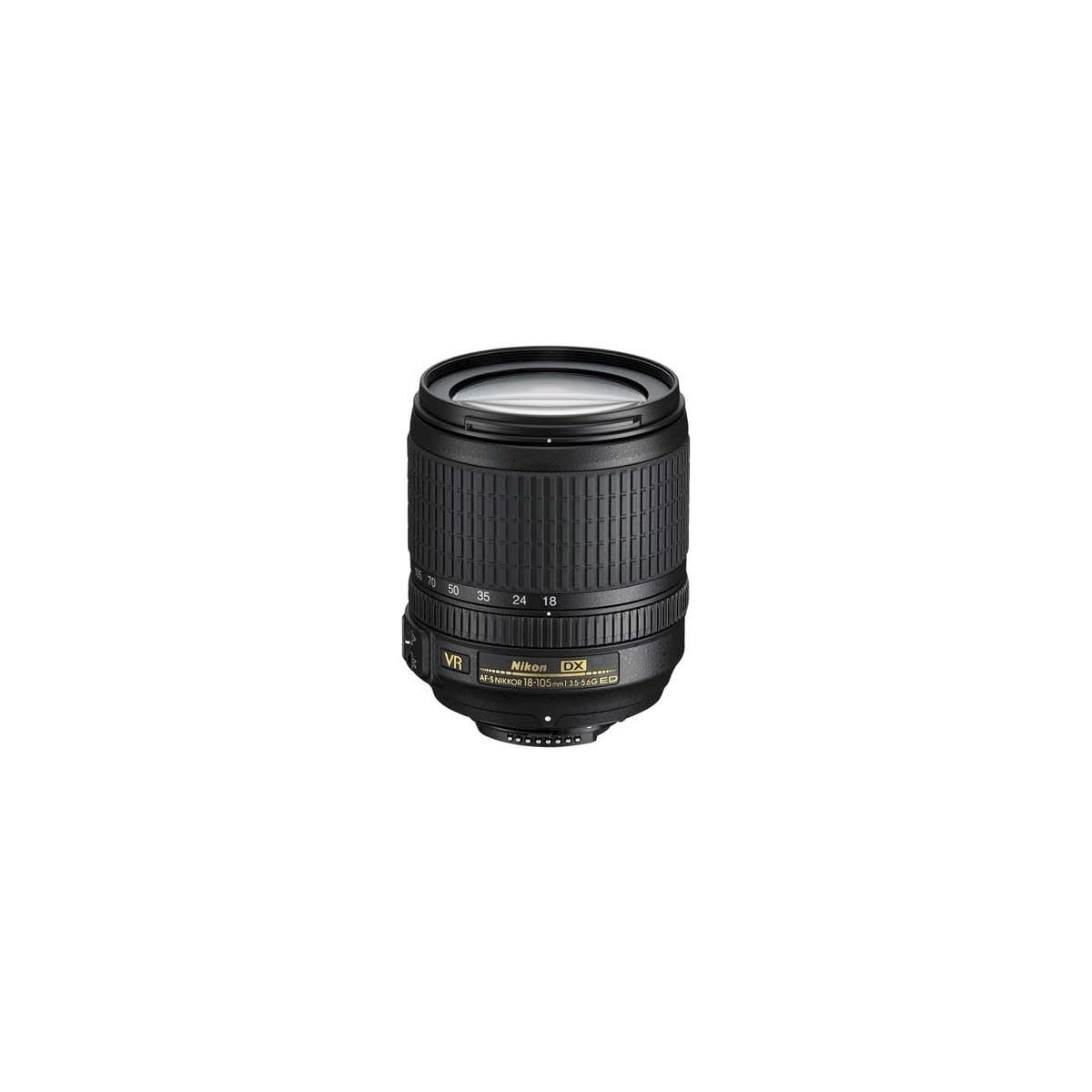
Nikon AF-S DX 18-105mm f/3.5-5.6G ED VR

88 /100
Keeper Score Excellent

Key details

Mount
Nikon F (DX)
Focal Length
18-105mm
Max Aperture
f/3.5-5.6
Vibration Reduction
Up to 3 stops
Check Price on Amazon

The plastic mount ring is the first thing we check on this lens, because it is the part that decides how long the lens survives a knock — and it is also a big reason the whole thing weighs 14.88 ounces. Support the barrel when you mount and unmount and the ring stays out of trouble. Take a fall onto a hard floor and the ring is what lets go rather than the camera.

What the ring buys you is reach. 18-105mm is a 5.8x zoom, roughly 27-157mm on full frame, which covers a wide hotel room, a group shot, and the head-and-shoulders end of a school concert without a lens change. Vibration reduction is rated at up to three stops and behaves that way: at the long end indoors we held shutter speeds lower than we expected and still came away with clean frames. Close focus is 1.48 feet, and the 67mm filter thread keeps accessories easy to find.

Images are crisper than the kit zoom's, and the last 50mm is what sells it: 105mm isolates a face in a crowd without moving your feet, which is the shot most people buy this lens for. It also disappears into a small bag, which is more than can be said for any of the f/2.8 zooms on this list.

Pros

  • 5.8x range from wide angle to short telephoto
  • Vibration reduction rated to about three stops
  • Light at 14.88 ounces on a DX body
  • Sharper files than the standard kit zoom

Cons

  • f/5.6 at 105mm makes indoor evenings harder
Our verdict

The upgrade we suggest for a DX body still wearing its kit lens: far more reach, real stabilization, and sharp files without added weight.

Check Latest Price
5

FX DSLR Standard

Sigma 24-70mm f/2.8 IF EX DG HSM

80 /100
Keeper Score Excellent

Key details

Mount
Nikon F (FX)
Weight
1.74 lb
Focal Length
24-70mm
Max Aperture
f/2.8
Check Price on Amazon

This is the only full-frame F-mount f/2.8 standard zoom in this group, and for a D750 or D850 owner that single fact does a lot of work. 24-70mm at a constant f/2.8 is the classic working range, and this Sigma is the version that keeps the outlay down instead of asking what Nikon's own f/2.8 costs.

Our read is that it is a value-first lens rather than a flawless one, and the place that shows is sharpness: it is at its best around f/4, so we treat f/2.8 as the aperture for when the light gives you no alternative and stop down for anything critical. What it does well is the look. Nine rounded diaphragm blades turn busy backgrounds into something smooth, and the constant aperture holds that rendering steady from 24mm all the way to 70mm.

Focus is the part to plan around. The ring-type HSM motor is quiet and reasonably quick, but its autofocus sits near the bottom of this group and can miss on moving subjects, so we shoot single-point and confirm with a half-press before a burst. On a body with an AF fine-tune menu, spend a session there before a trip. Portraits, landscapes, and slow-moving subjects at moderate apertures are where this lens makes sense — the buyers who never chase a running child or a dog at f/2.8.

Pros

  • Constant f/2.8 across the classic 24-70mm range
  • Nine rounded blades give smooth background blur
  • Full-frame coverage without premium outlay

Cons

  • Heavy at 790 g for an everyday zoom
  • 15-inch minimum focus rules out close-up work
Our verdict

Our choice for a full-frame DSLR: the classic 24-70mm f/2.8 range at a price that leaves room for the rest of the kit.

Check Latest Price

How We Tested the Best Nikon Standard Zooms

We began by listing every standard zoom currently sold for Nikon's two main mounts, then cut anything we couldn't mount on a body we already had on hand, since a DSLR-era lens and a mirrorless lens are not interchangeable without an adapter and that single fact rules out half the field for most shoppers. From there we sorted by zoom range, maximum aperture, stabilization, and price, and brought in 10 lenses that spanned the spread from budget all-in-ones to constant-aperture glass.

Testing ran for seven months on a full-frame Z body and a DX DSLR. Each lens shot the same five scenes: an overcast farmers market, a friend's indoor birthday party, a backlit trail at golden hour, a dim church hall, and a plain brick wall for edge sharpness. We shot every lens wide open and again at f/5.6, at its widest, middle, and longest focal length, then compared the files side by side on one monitor. Autofocus got timed on a runner moving toward the camera and again in low light, where we counted how often it hunted before locking. We shot handheld at 1/15 second to see whether stabilization earned its keep, and judged bokeh on string lights and backlit leaves rather than test charts.

Weight we settled two ways: on a kitchen scale, and by carrying one lens on a strap for a full day. The heaviest were fine for a planned shoot and tiring by hour six. Build quality got checked by feel and by time — how much drag the zoom ring had, whether the barrel crept outward when the camera hung at my side, how the mount felt after a few hundred swaps. For value, we weighed what each lens delivered at its price against the reach and aperture it asked us to trade away.

How to Choose a Nikon Standard Zoom Lens

Mount and Format Come First

Z-mount glass fits Z bodies only. F-mount glass mounts directly on a DSLR but needs Nikon's FTZ adapter to reach a mirrorless body, which adds length and an extra joint between camera and lens. Within F-mount, DX lenses are built for crop sensors like the D3500, D5600, and D7500, while FX lenses cover the full frame of a D750 or D850.

A DX lens on an FX body is the wrong pairing, and an FX lens on a DX body works but is bulkier than it needs to be. If you are still deciding whether to move to mirrorless, buy F-mount now and adapt later rather than replacing a kit twice.

Decide How Much Range You Actually Need

The two ends of the zoom matter for different reasons. At the wide end, 24mm versus 28mm is the difference between fitting a room into the frame and stepping back into a doorway. At the long end, 50mm, 75mm, 105mm, and 120mm are four different ideas of enough reach.

On a crop body the numbers stretch: the 17-50mm behaves like 25.5-75mm on full frame, and the 18-105mm like 27-157mm. Look at the focal lengths in your last few hundred frames. If most of them sit between 24 and 70mm, a 24-120mm covers everything you already shoot and gives you room to grow into tighter framing.

Aperture Is a Light Budget

A constant f/2.8 zoom buys roughly a stop and a half over f/4, and around three stops over f/5.6. Indoors, that is the difference between a clean file and a noisy one, or between 1/60 and 1/250 when someone is moving.

Stabilization does not close that gap: VR and in-body stabilization steady the camera, not the subject. For travel, landscape, and daylight family work, a slower zoom with more range is the better use of weight. For events, restaurants, and evenings, pay for the aperture and accept the extra mass.

Match the Weight to the Body

A 565-gram f/2.8 zoom balances well on a D7500 and feels nose-heavy on a D3500, and 790 grams is a lot of glass to hang off a small grip. Mirrorless makes the arithmetic kinder — the 28-75mm f/2.8 comes in at 19.4 ounces on a Z body — but the balance question does not disappear.

Look at the mount ring too. A metal mount takes knocks that a plastic one will not, which matters if the camera lives loose in a rucksack. Where you can, handle the camera and lens together before committing, because a lens that feels wrong in the hand stays in the bag.

Close Focus and Sealing

Close-focus distances among these lenses run from 7.1 inches to 15 inches. Only the shortest of those lets you fill the frame with a flower or a plate of food without adding an extension tube, so check the figure if detail work is part of your shooting.

Sealing matters if you work in rain or dust. Fluorine coating on a front element makes a wet or smeared lens wipe clean quickly, and moisture-resistant construction helps with everything else. Neither makes a lens waterproof, so a rain cover still earns its place in the bag.

Frequently Asked Questions

Final Verdict

On a Z body, the NIKKOR Z 24-120mm f/4 S is where we start: 24 to 120mm, sharp at f/4, and light enough to leave on the camera for a full day out. The deciding exception is light. If you shoot events, interiors, or evenings, the Tamron 28-75mm f/2.8 G2 is the better buy — a stop and a half more aperture in a smaller lens, paid for with the 24mm end and the long reach.

On a DSLR the same logic holds: the Sigma 17-50mm f/2.8 is our DX default when the light is uncertain, and the Nikon 18-105mm is the one to take when reach and weight matter more than aperture.