Best Microscopes of 2026

A microscope does one thing: bends light through glass and hands your eye a version of the world too small to see. Everything that separates a good one from a frustrating one happens in that handoff. Magnification is printed in the largest font on the box and matters least — push a mediocre lens past its comfort zone and you get a big, gray, fuzzy nothing.

I've kept 14 of them set up around my house for six months — kitchen table during homework, a dim basement corner, a folding table at a school science night — and the ones that kept getting switched on were never the loudest on paper. They focused smoothly, held position, and felt solid enough that nobody handled them like china.

That matters double when the scope is a gift. A slide kit and a phone mount do more for a beginner than another 500X of unusable power, and we weighed both. Here are the eight that earned their shelf space, from a first real microscope for a curious eight-year-old to a bench instrument an adult won't outgrow.

Keeper Score summarizes customer ratings and review volume. Read it alongside the product details and trade-offs. How the score works.

1

Best Overall

SWIFT SW380B

89 /100
Keeper Score Excellent

Key details

Head
Siedentopf binocular
Stage
Mechanical X-Y stage
Weight
11 lb
Magnification
40X–2500X
Check Price on Amazon

Binocular viewing is the first thing that separates the SWIFT SW380B from the budget scopes here, and it is why this is our top pick for anyone who plans to use a microscope more than once a month. Two eyepieces let you keep both eyes open, which makes longer sessions less tiring, and the Siedentopf head rotates for a second viewer. The mechanical stage is the other detail we care about: you move the slide with the knobs instead of nudging it by hand, so you can track a specimen at higher power.

The 40X–2500X range comes from 10X and 25X wide-field eyepieces paired with four achromatic objectives. We treat the top of that range as a ceiling, not a promise; most everyday work happens well below it, and the clear views at 100X to 400X are what make the scope useful. The coarse and fine focus controls have a precise feel, and the adjustable condenser and iris let you tune contrast instead of just brightness.

Build quality is where the SW380B earns its price. The metal body weighs 11 pounds, so it stays put when you turn the focus knobs, and the 30-degree eyepiece tilt is kind to your neck. It is not a scope you toss in a backpack. It also arrives without slides, so budget for a prepared set if you want to start immediately.

If you need to capture images, the AmScope below is the more sensible buy. For everyone else, the SW380B is the one we keep on the desk: binocular comfort, a real mechanical stage, and optics that do not run out of resolution at the first interesting slide.

Pros

  • Binocular Siedentopf head reduces eye strain
  • Mechanical stage and fine focus for tracking slides
  • Sturdy 11-pound metal body stays put

Cons

  • No trinocular port for camera work
Our verdict

Our top pick for serious students and hobbyists: the binocular Siedentopf head, mechanical stage, and sturdy build give you room to grow, and the optics stay clear at the powers you'll actually use.
Check Latest Price
2

Best for Photo Documentation

AmScope B120C-E5

85 /100
Keeper Score Excellent

Key details

Head
Siedentopf binocular
Camera
5MP USB
Warranty
5 years
Magnification
40X–2500X
Check Price on Amazon

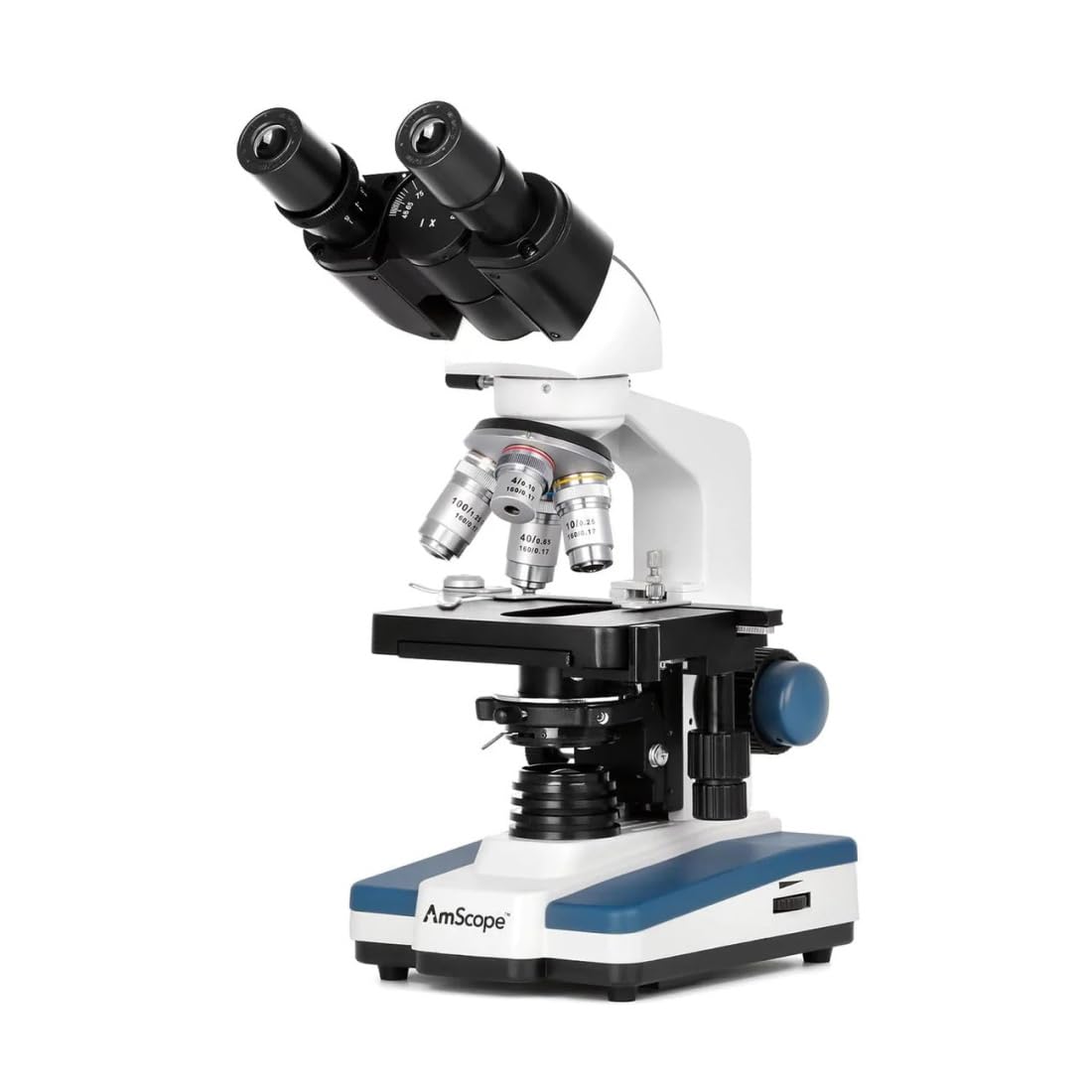
The B120C-E5 is the only scope in this group that arrives with a 5MP USB camera and software in the box. Mount the camera, connect to a laptop, and you can capture stills or video without buying an adapter or aligning a phone over the eyepiece. The LED illuminator uses a fly-eye lens to spread light evenly, which matters when you are photographing a prepared slide rather than just looking at it.

That combination is why we recommend it for photo documentation. A classroom teacher who wants a record of student work, or a hobbyist who shares images with a group, gets a complete path from eyepiece to screen. The camera is not the reason to buy the scope on its own; the optics and stage have to hold up, and they do.

The 40X–2500X magnification range comes from a Siedentopf binocular head with 10X and 25X eyepieces and four achromatic objectives. The mechanical stage moves smoothly enough for precise slide positioning, and the coarse and fine focus controls let you settle an image without fighting it. The 5-year manufacturer warranty is longer than most here and adds real value if the scope will be used hard.

The slide holder needs a firm hand; seat the slide carefully and it holds. If you mainly want to look, the SWIFT SW380B is the better value; if you need a record, this is the one.

Pros

  • Includes 5MP USB camera and software
  • Bright, daylight-balanced LED illumination
  • Siedentopf head and mechanical stage
  • 5-year manufacturer warranty

Cons

  • Camera images can look uneven
Our verdict

We recommend the B120C-E5 when you need to capture what you see; the included camera, bright LED light, and five-year warranty make it a complete documentation setup.

Check Latest Price
3

Best Budget All-In-One

PalliPartners All-in-One

86 /100
Keeper Score Excellent

Key details

Head
Monocular
Slides
28 included
Lighting
Top and bottom LED
Magnification
100X–2000X
Check Price on Amazon

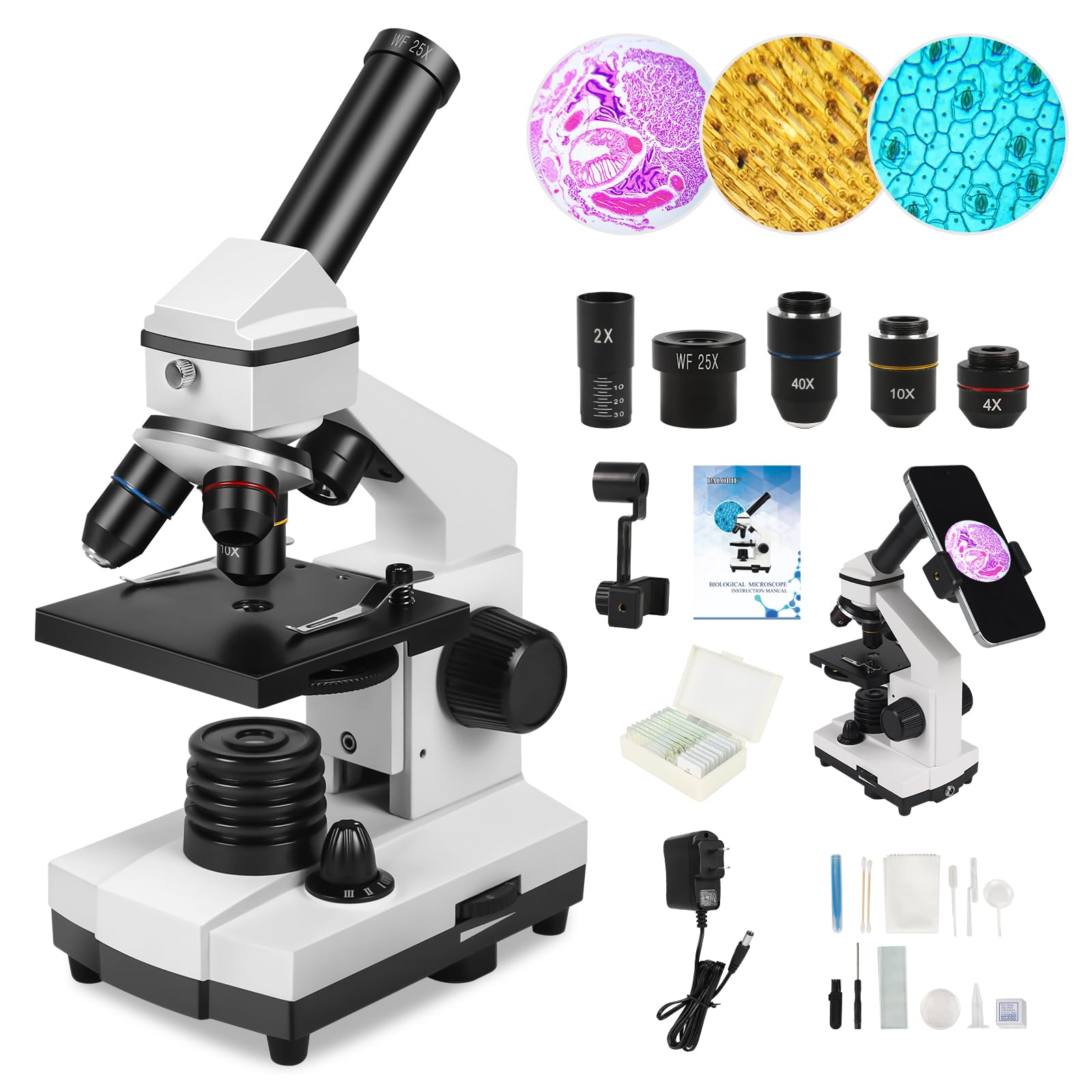
The PalliPartners arrives as a kit rather than a bare scope: 28 slides, a phone adapter, a remote, and both top and bottom LED illumination are in the box. For a family that wants to start on a kitchen table without ordering accessories separately, that is the appeal. The SGS safety certification and the 8-to-18 age guidance also make it easier to hand over to an older child with supervision.

We recommend it as the low-cost all-in-one for beginners. Setup is straightforward, the dual light lets you switch between prepared biological slides and opaque objects like coins or insect wings, and the phone adapter is useful for sharing a view without crowding around the eyepiece. It is not a lab-grade instrument, but it is a sensible first scope.

Magnification runs from 100X to 2000X using 4X, 10X, and 40X objectives, a WF25X eyepiece, and a 2X lens. We found the lower and middle powers the most useful; the highest settings need a very thin, well-lit specimen and a steady hand. The top light is the feature we appreciate most for impromptu nature finds, because you can look at a leaf or a stamp without preparing a slide.

The polycarbonate body keeps the scope light and easy to move, but it will not feel like a metal lab instrument. If you want binocular viewing or a mechanical stage, step up to the SWIFT or the PALOBIL. If you want a complete starter kit with minimal fuss, this is the one we hand to a beginner.

Pros

  • Complete kit with 28 slides and phone adapter
  • Dual top and bottom LED lighting
  • SGS-certified materials and electrical safety

Cons

  • Lights or power can fail
Our verdict

We recommend this as the low-cost all-in-one for families: slides, phone adapter, and dual LED lighting arrive together, and setup is simple.

Check Latest Price
4

Best for Young Beginners

National Geographic Dual LED

92 /100
Keeper Score Outstanding

Key details

Weight
2 lb
Lighting
Dual LED
Accessories
50+ pieces
Magnification
20X and 50X
Check Price on Amazon

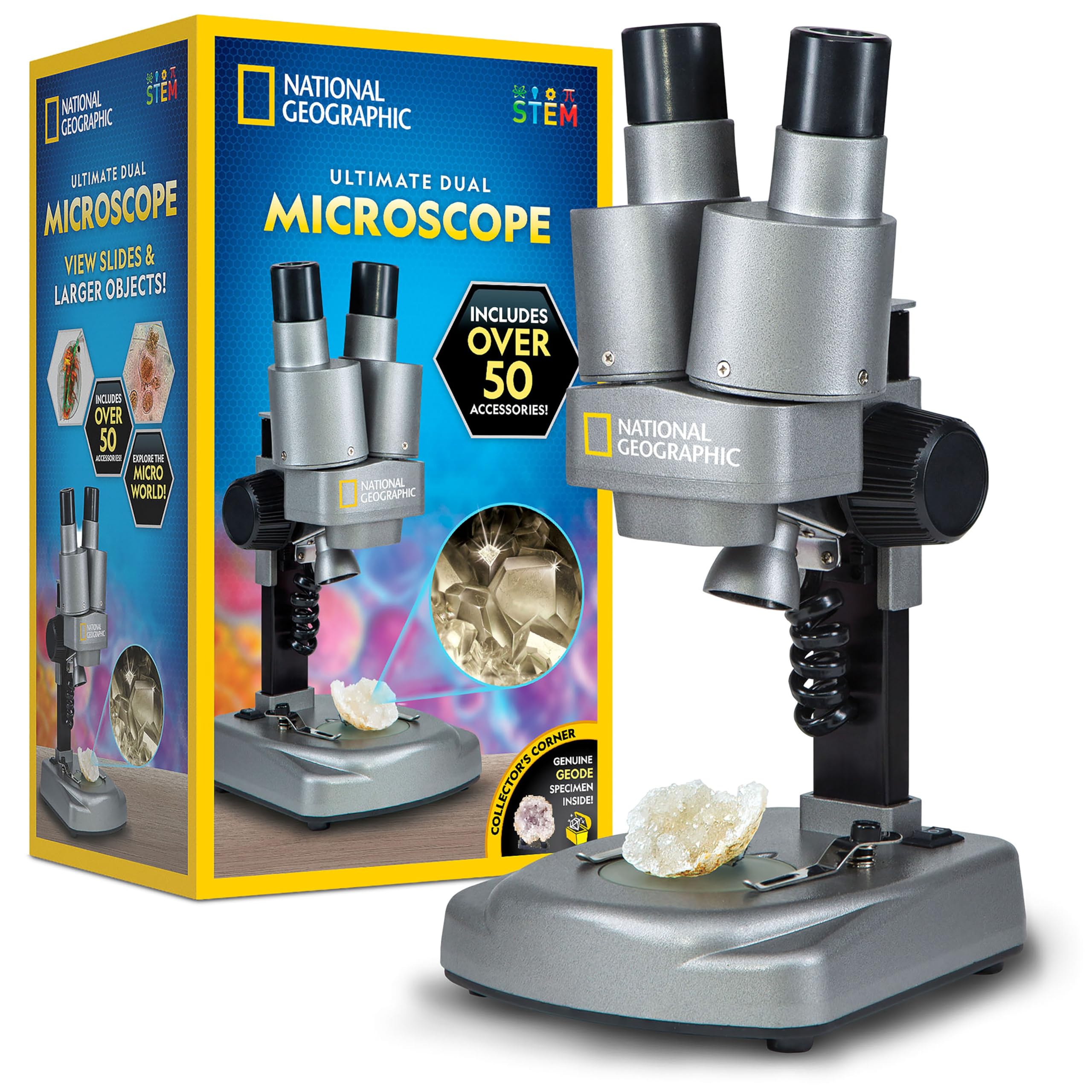
National Geographic aims this microscope at children around 8 to 12, and the design follows through: two large eyepieces, a simple focus knob, and a body small enough for a child to carry. The 20X and 50X magnification is deliberately modest. That is the right call for a first scope, because a young user can find a focused image without learning oil immersion or precision stage control.

The dual LED system is the feature that makes it more than a toy: use the bottom light for prepared slides and the top light for solid objects like leaves, coins, or insect wings. The kit includes 10 prepared slides, 10 blank slides, and more than 50 accessories, so there is something to look at before anyone learns to make a slide.

For a young child's first microscope, this is our pick. It is simple enough to use without a parent hovering over every adjustment, and the accessory load means a rainy afternoon has a ready activity. The two-light design also introduces the difference between looking through a specimen and looking at its surface, which is a useful habit to build early.

The 20X and 50X power is the boundary. You can see the structure of a leaf, the fibers in paper, or the details of an insect, but you will not see cells. For that you need a compound scope with a 40X objective and a 10X eyepiece. We like this one as a bridge to that next step, and for a curious kid who wants to look at everything in the yard, the simple controls are a fair trade for the low power.

Pros

  • Dual LED for slides and solid objects
  • 50+ accessories and prepared slides
  • Simple 20X–50X power for young beginners

Cons

  • Focus can drift during use
Our verdict

For a young child's first microscope, this is our pick: the dual LED light and big accessory kit make exploration immediate, and the low power suits small hands.

Check Latest Price
5

Best for Shared Labs

SWIFT SW380T

88 /100
Keeper Score Excellent

Key details

Head
Siedentopf trinocular
Stage
Mechanical stage
Weight
9.48 lb
Magnification
40X–2500X
Check Price on Amazon

The SW380T looks almost identical to the SW380B until you notice the third tube on top. That trinocular port is the whole reason to choose it: mount a camera and you can record or livestream while a second person looks through the eyepieces. For a classroom, a lab, or a hobbyist who wants to share findings, that changes the way the scope gets used.

The rest of the package is familiar SWIFT territory. The Siedentopf head rotates and carries 10X and 25X wide-field eyepieces, the four achromatic objectives run from 40X to 2500X, and the mechanical stage moves the slide smoothly. The coarse and fine focus controls have the precise, geared feel we want for higher-power work. The metal body weighs 4.3 kilograms, so it stays planted on the bench.

We recommend this one for a shared classroom or a hobbyist who already owns a camera. The binocular SW380B is the better buy if you only look through the eyepieces, because it costs less and gives up nothing visual. The SW380T earns its place when the camera port will actually be used, not as a spec to admire.

The head rotates for a second viewer, and the 30-degree eyepiece angle is comfortable over a long session. If you want a complete imaging setup in one box, the AmScope is the more direct route; if you already have a camera, this is the cleaner optical platform.

Pros

  • Trinocular port for camera or livestream
  • Rotatable Siedentopf head for shared use
  • 40X–2500X with wide-field eyepieces
  • Mechanical stage and precise focus

Cons

  • Camera and adapter sold separately
  • Light can feel dim at high power
Our verdict

We recommend the SW380T for a shared classroom or a hobbyist who already owns a camera; the trinocular head and precise stage are the reasons to step up.

Check Latest Price
6

First Home Lab

PALOBIL Compound

86 /100
Keeper Score Excellent

Key details

Head
Monocular
Frame
Metal
Lighting
Adjustable dual LED
Magnification
100X–2000X
Check Price on Amazon

The PALOBIL opens with a metal frame, which is the first thing that separates it from the plastic-body starter kits here. The body feels steadier when you turn the focus knobs, and the base has enough weight to stay put on a table. The dual LED system is adjustable across eight levels for the top light and separately for the bottom light, so you can tune the illumination to the specimen instead of accepting one brightness.

Magnification runs from 100X to 2000X with 4X, 10X, and 40X objectives, a WF25X eyepiece, and a 2X lens. The kit includes a phone adapter and an 11-piece beginner experiment set, which is enough to start without a separate order. We like the top light for opaque objects and the bottom light for prepared slides; being able to dim each one is more useful than a single on-off switch.

We recommend this as a first home-lab scope for a student who wants a metal frame without jumping to a research-grade binocular. The controls are simple, the accessory kit is complete, and the adjustable lighting makes it easier to show a specimen to someone else. It is a monocular scope, so long sessions are less comfortable than with the SWIFT, but the price is easier to justify for a beginner.

The metal frame and adjustable lighting are the reasons this one feels more serious than a toy, and the included experiment kit means a beginner can start the same day. It is a monocular scope, so a second viewer has to take turns, but the image is bright enough for shared viewing at lower powers. For a first home lab, that is a fair set of priorities.

Pros

  • Metal frame with steady base
  • Adjustable dual LED with eight levels
  • Experiment kit and phone adapter included

Cons

  • 40X image can be soft
Our verdict

We like this metal-frame starter for a first home lab: the adjustable dual light and included experiment kit make it easy to begin.

Check Latest Price
7

Portable Study

MAXLAPTER 2000X

88 /100
Keeper Score Excellent

Key details

Head
Monocular
Weight
1.37 lb
Battery
USB-C, 4 hours
Magnification
40X–2000X
Check Price on Amazon

The MAXLAPTER's USB-C rechargeable battery and carry case are the first clues that it is built for a table that has to clear. It weighs 0.62 kilograms, has an aluminum-alloy frame, and runs for up to four hours per charge. The shockproof carrying box holds the scope and slides, so it can go from shelf to table and back without a dedicated setup.

The 40X–2000X range uses WF10X and WF25X eyepieces, a 2X lens, and 4X, 10X, and 40X achromatic objectives. The metal frame is a step up from the all-plastic kids' scopes here, and the monocular head keeps the package small. We like the phone holder for showing a friend what is on the slide, though aligning a phone takes patience.

The kit includes a starter set of prepared slides and a storage bag. A young user can begin with the prepared slides, then move to leaves, fibers, or pond water with blank slides and covers. The rechargeable battery is the feature that makes it genuinely portable; there is no cord to hunt for and no outlet needed at the table.

We recommend it for a kid who moves between table and backpack, or for a small home where the scope has to be put away after each session. The rechargeable battery and carry case make it the one we reach for when the scope has to travel. If you want a scope that lives on a desk, the SWIFT is the more capable instrument; if it needs to go back in a bag, this is the one.

Pros

  • USB-C rechargeable battery rated four hours
  • Lightweight aluminum frame and carry case
  • 40X–2000X with wide-field eyepieces
  • Phone holder for sharing views

Cons

  • Only five prepared slides included
Our verdict

We recommend this rechargeable scope for a kid who moves between table and backpack; the rechargeable battery and carry case make it genuinely portable.

Check Latest Price
8

Budget Binocular

Herwicm Compound

85 /100
Keeper Score Excellent

Key details

Head
Binocular
Stage
Two-layer mechanical
Lighting
Dual LED
Magnification
40X–2500X
Check Price on Amazon

The Herwicm is the binocular option for a buyer who wants two eyepieces and a mechanical stage without paying SWIFT money. The binocular head gives a more comfortable view than a monocular tube, and the two-layer mechanical stage lets you position a slide with the knobs rather than pushing it around by hand. For a shared desk, that is a useful combination.

The 40X–2500X range comes from 4X, 10X, and 40X objectives with WF10X and WF25X eyepieces, and the dual LED system has top and bottom illumination. The body mixes metal and plastic, with glass lenses, and the footprint is wider than the monocular starters. We like the adjustable light for opaque objects and the separate bottom light for slides; it makes the scope more versatile than a single-light model.

The controls take some learning. The manual is thin, so plan on finding a setup video or walking through the focus and lighting adjustments yourself. Once you are comfortable, the coarse and fine focus knobs and the mechanical stage make sense together. The binocular head is the reason to choose this over the cheaper monocular kits, not a feature you ignore.

We recommend it for a shared desk on a tighter budget. It is not as refined as the SWIFT SW380B, but the binocular view and mechanical stage are real advantages at this point in the market. If you want the most reliable optics here, spend more; if you want the binocular experience for less, this is the one.

Pros

  • Binocular head and two-layer mechanical stage
  • Dual LED top and bottom lighting
  • 40X–2500X with wide-field eyepieces

Cons

  • Image sharpness can vary
Our verdict

We recommend this binocular scope for a shared desk on a tighter budget; it delivers the two-eyepiece view and mechanical stage without the SWIFT price.

Check Latest Price

How We Chose and Tested 14 Microscopes

We started with about 40 compound and stereo models and cut the list by reading for the things that change daily use: wide-field eyepieces, a stage driven by knobs rather than a clip you nudge by hand, LED illumination with a dimmer, and whether a camera or phone adapter came included or could at least be mounted. That left 14, ranging from simple kits to binocular and trinocular heads with Siedentopf eyepiece tubes.

Each one spent at least a week on a kitchen table during homework sessions, went down to a dim basement corner, and traveled to a school science night. We racked from the lowest objective to the highest and timed how long it took to reach a sharp edge on a prepared onion-root slide, then watched whether the image drifted after we let go of the knob. The same thick stained slide and a thin wet mount went under every brightness setting, and we wrote down the power at which the image turned grainy.

Then we handed each scope to a nine-year-old and a twelve-year-old with no instructions and watched where their hands went wrong. Every model got carried up and down stairs by its arm, its lenses wiped, and its stage knobs checked for wobble after a few weeks of use. We counted what came in the box, too, since a real slide set and a working phone holder are worth more to a beginner than a bigger number on the front.

How to Choose a Microscope

Match Magnification to the Specimen

The biggest number on the box is the least useful place to start. A 20X or 50X scope is plenty for a young child looking at leaves, insect wings, and fibers. For cells and pond water, you want a compound scope that reaches 400X, which comes from a 40X objective and a 10X eyepiece. Magnification above 1000X needs a very thin specimen, strong illumination, and usually oil immersion; treat 2000X or 2500X as a ceiling rather than a working setting. We prefer a clean 400X image to a dim 2000X one.

If high power matters, put the money into illumination, a condenser, and fine focus before you chase a bigger number. The SWIFT SW380B lists 2500X, but its value is the clear, usable midrange.

Choose the Head and Camera Path

Monocular scopes are the least expensive and the simplest, but one eyepiece is tiring over a long session and awkward to share. Binocular heads are the better default for students and hobbyists; the SWIFT SW380B and Herwicm both use two eyepieces. A trinocular head adds a camera port, which is the cleanest way to record or livestream. If you only want to send a phone snapshot, a phone adapter over the eyepiece is enough. Decide whether you are buying a viewing instrument or an imaging setup before you pay for a third tube.

Look at the Stage, Focus, and Light

A mechanical stage is the feature that separates a serious student scope from a starter kit. It lets you move the slide in two directions with knobs, so you can track a specimen at 400X without losing it. Coarse and fine focus are equally important: coarse brings the objective close, fine settles the image. For lighting, bottom LED is for prepared slides and top LED is for opaque objects. Adjustable brightness, a condenser, and an iris help at higher power. A simple on-off light is fine for a young child; a student will outgrow it.

Weigh Build, Portability, and the Kit

A microscope that stays on a desk can be heavy and stable; one that travels needs a smaller footprint and a battery. Metal frames resist wobble when you turn the focus knobs, while plastic bodies are lighter and less expensive. A kit with prepared slides, blank slides, and a phone adapter gets you started faster, but the accessories may be basic. If the scope will be shared or moved often, check the weight and storage case before you choose. We treat weight and storage as a real lifestyle decision, not a spec-sheet detail.

Frequently Asked Questions

Final Verdict

The SWIFT SW380B is the microscope we recommend first for a student or hobbyist who wants one scope to grow with. Its binocular view, mechanical stage, and solid metal body make everyday work comfortable, and the optics hold up at the powers you will actually use. If you need to capture images, choose the AmScope B120C-E5 for its included camera or the SWIFT SW380T if you already own one. For a young child, the National Geographic dual LED is the simpler first step.