Best Overall

Rs' Science All-in-One Slide Kit
Key details
- Stains
- Ready-to-use methylene blue and eosin Y droppers
- Kit Size
- 40 pieces
- Slide Mix
- Prepared slides, blank slides, and coverslips
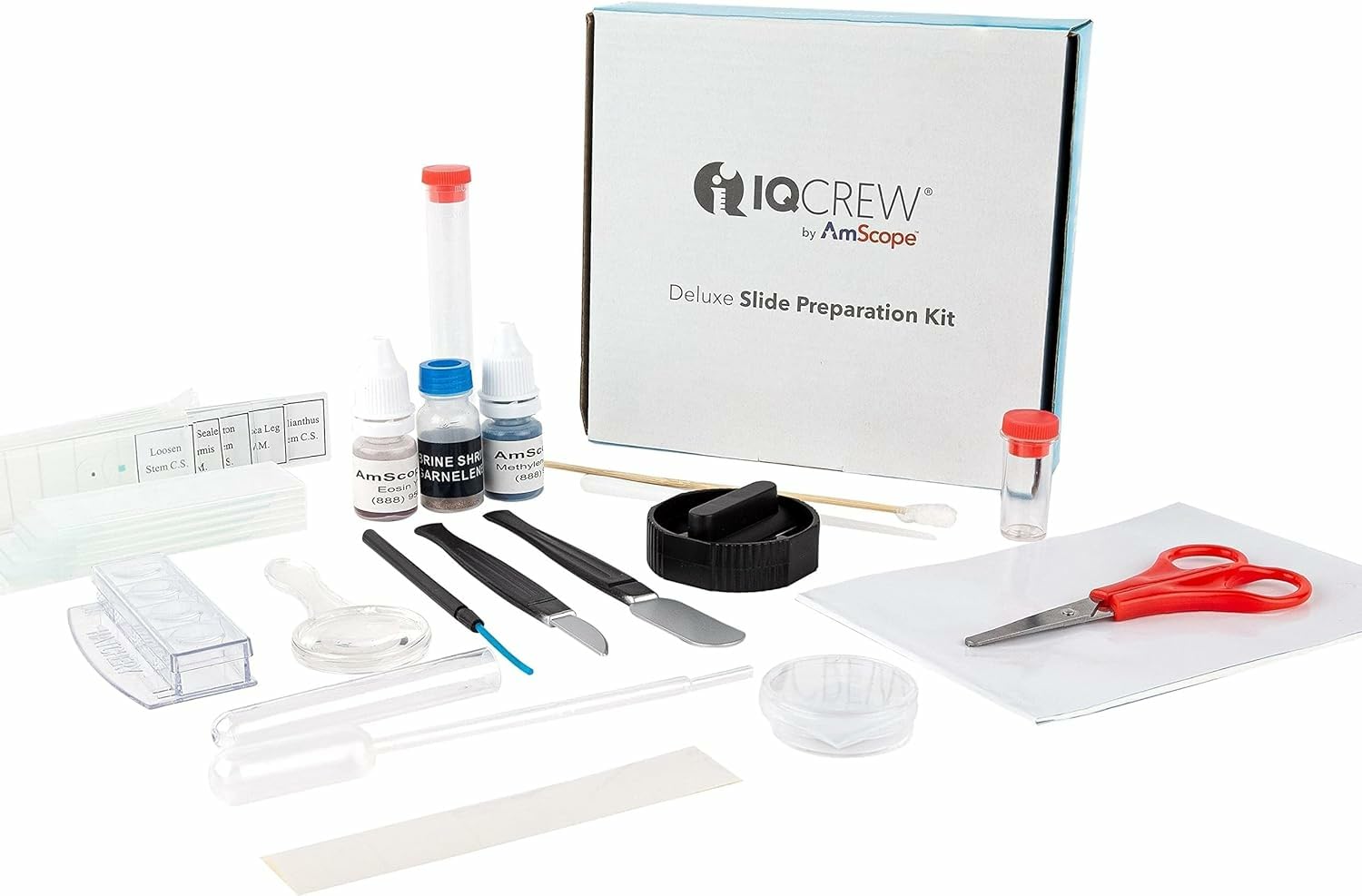
Two squeezable dropper bottles of stain, not envelopes of powder, are the first thing we noticed when the Rs' Science kit came out of the box, and they are a large part of why it is our top pick. Mixing a stain from powder is one more step before you have looked at anything, and it is the step a beginner is most likely to get wrong.
What we like most is the balance of the contents. There are prepared slides to look at immediately, blanks and coverslips for your own samples, and the tools that actually change what you can do: transfer pipettes, plastic tweezers, a petri dish, gloves, lens papers, and a handheld microtome that cuts a section thin enough to be worth putting under a lens. The instruction booklet is the piece that ties it together; without one, a box with this many small parts is a puzzle rather than a kit.
The honest caveat is scale. A 40-piece kit can only carry so many prepared slides, so treat the specimens as a sampler and the preparation as the main event. If a broad specimen library is what you are after, the LAKWAR set covers that ground far better. Check the contents against the list when it arrives, too, and keep the small parts together in the tray rather than loose in a drawer.
The microtome deserves its own sentence: it is the tool that turns a stem or a carrot into a section you can see through, and the AmScope SP-14 kit does not include one. That is the difference between a kit you look at and a kit you use.
Pros
- Ready-to-use stain droppers, no mixing
- Includes a handheld microtome
- Prepared and blank slides in one box
- Instruction booklet included
Cons
- Prepared slide count is a sampler, not a library
For a first slide kit, this is the one we recommend: ready-to-use stains, working tools, and a booklet that explains them, for about what a bare-bones kit costs.