Best Macro Ring Lights of 2026

A ring light does one thing: it puts the light around your lens so the subject gets hit from every side at once and the lens barrel stops throwing its own shadow across the frame. That's the whole appeal for anyone shooting insects, coins, watch movements, or the inside of a flower. Two lights that look identical in a product photo can behave nothing alike, though — one fires a flash you meter by hand, the other glows continuously so you can see your exposure before you press the shutter.

I've shot close-ups on my kitchen table for years, and the failures are always mundane: no adapter ring that fits your filter thread, a power dial that jumps from murky to blown out, a battery door that quits by month two. My team has spent the past seven months with 12 of these lights, and the pattern is clear. Flash wins on power and on freezing a twitching subject; continuous LED wins on letting you see what you're doing. TTL saves you time, manual keeps exposures consistent frame to frame. The picks below are the ones still mounted on lenses around here.

Keeper Score summarizes customer ratings and review volume. Read it alongside the product details and trade-offs. How the score works.

1

Best Overall

Godox MF-R76 Macro Ring Flash

83 /100
Keeper Score Excellent

Key details

Output
76W dual-tube flash
Battery
660 full-power flashes
Control
Manual 1/128–1/1
Lens Adapters
49-77mm (8 rings)
Check Price on Amazon

Two separate flash tubes are what make the Godox MF-R76 our top pick. You can fire both for even light or one at a time to shape a subject, and the controller lets you balance the two sides independently. That matters in macro, where a completely shadowless frame can look flat and a little direction can separate a beetle from the leaf it is sitting on.

The 76W output and the listed 660 full-power flashes make it the most capable stills tool here. A long focus-stacking session or a morning in the field does not leave you nursing the battery, and the 1/128 to 1/1 range gives fine control over close subjects. The eight adapter rings cover 49–77mm, which takes care of most macro lenses without extra parts.

At 0.9 kg, the MF-R76 is the heaviest flash in this group, and you feel that on a small lens or a long handheld session. The LCD and controller are clear enough to adjust without taking your eye off the subject, though you need a free hand for the controls. We came to think of the weight as the cost of the bigger battery and dual-tube hardware, not as a flaw in the light itself.

The controller gives you ten manual output steps, and the LCD shows the setting clearly when you are working close. We found the ring's coverage even across the 77mm adapter, with no awkward hotspot at the edges. The MF-R76 is the flash we choose when we want maximum control over the light.

Pros

  • Dual tubes let you shape light on close subjects
  • 76W output and 660 full-power flashes
  • Eight adapter rings cover 49–77mm lenses
  • Clear LCD and ten manual power steps

Cons

  • No TTL metering for automatic exposure
Our verdict

We recommend the MF-R76 when you want a serious macro flash and will trade TTL for dual-tube control, high output, and long battery life.
Check Latest Price
2

Best for Nikon TTL

Neewer RF1-N Macro Ring Flash

83 /100
Keeper Score Excellent

Key details

Modes
TTL, manual, MULTI
Mount
Nikon TTL
Output
76Ws, GN15
Adapters
8 lens rings
Check Price on Amazon

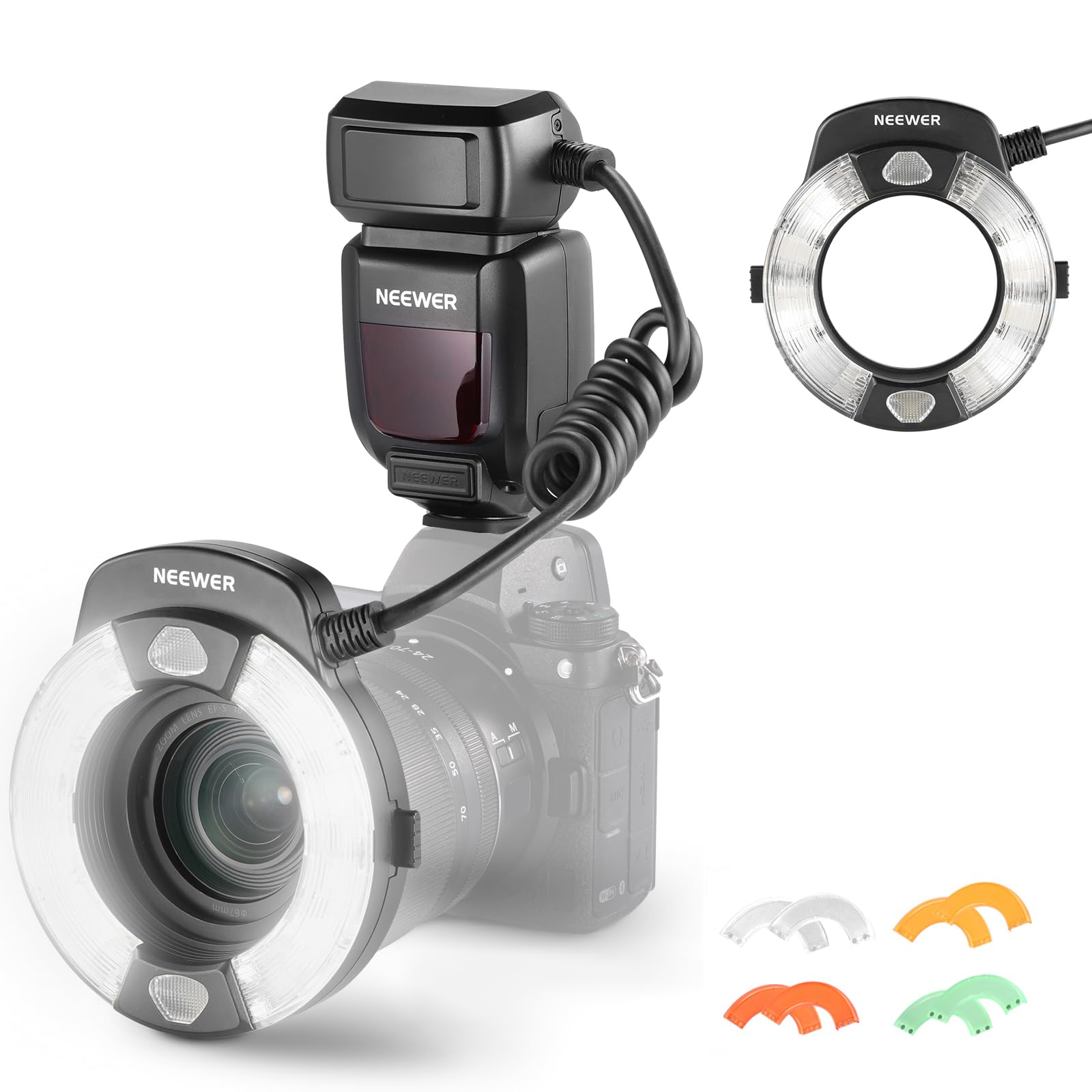
The RF1-N is built around Nikon TTL, and that is the first thing to know about it. The 76Ws output and GN15 rating give it real close-up punch, while TTL metering takes care of exposure when a subject will not sit still. For a Nikon body, it is a more forgiving starting point than a manual-only ring.

The kit is more complete than the price suggests: eight adapter rings, four color gels, and two assist focus lights. We used the focus lights more than expected when working in dim corners, and the gels are a simple way to warm a scene without adding a separate filter. The 0.5 kg weight is manageable on a mid-size macro lens.

Where the RF1-N earns its place is the combination of TTL, manual, and MULTI modes in a light kit. TTL is a fast way to get a usable frame, and manual gives you repeatability once the light is set. Compared with the MF-R76, you give up dual-tube independent control and some output, but you gain automatic exposure and a lighter bag.

We kept it on the camera for a run of handheld flower shots because the TTL kept up as the background changed. The focus lights and gels are the extras that make it feel like a kit rather than a bare ring, and the whole thing fits in a small pouch.

Pros

  • Nikon TTL metering simplifies changing close-up scenes
  • 76Ws output with GN15 guide number
  • Eight adapter rings plus four color gels
  • Two assist focus lights help in dim light

Cons

  • Nikon-only mount limits it to one system
Our verdict

For Nikon shooters who want TTL without spending a lot, the RF1-N is the one we reach for.

Check Latest Price
3

Best Continuous LED

Godox RING72 Macro LED Ring Light

78 /100
Keeper Score Very Good

Key details

Color
5600K, CRI 96+
Power
AA or lithium battery
Output
8W continuous
Lens Adapters
49-77mm (8 rings)
Check Price on Amazon

The RING72 is the one we switch on when we want to see the light before the shutter. Continuous 5600K output, ten brightness levels, and a CRI of 96+ make it easy to judge color and shadow on a plant, a coin, or a watch face before you commit to the frame.

We think it is the better choice for video and for learning macro lighting, because what you see is what you get. The ring shape wraps light around a close subject and keeps the background from going black, and the ten steps are enough to fine-tune without a manual. It is a continuous light, not a flash, so it suits a slower, more deliberate way of working.

Power flexibility is the practical detail we appreciate: four AA batteries in a pinch or the detachable lithium pack. The AA holder is a useful backup, though it adds another battery type to pack. Eight adapter rings cover 49–77mm, and the ring body is light enough to leave on the lens between shots.

The controller is simple and the light is easy to dim without a manual. It will not give you the punch of the MF-R76, but it is the one we reach for when the shot is as much about motion and color as it is about freezing a moment.

Pros

  • Continuous 5600K light shows shadows before the shot
  • CRI 96+ keeps colors true in close-ups
  • Ten brightness levels with AA or lithium power
  • Eight adapter rings cover 49–77mm lenses

Cons

  • 8W output is modest for deep-focus stills
Our verdict

We keep the RING72 for continuous light: it is the pick when you need to see shadows before the shot or shoot video.

Check Latest Price
4

Best Lightweight Manual

Godox ML-150II Macro Ring Flash

79 /100
Keeper Score Very Good

Key details

Output
GN12 flash
Weight
14.8 oz
Brightness
11 levels
Lens Adapters
49-77mm (8 rings)
Check Price on Amazon

At 0.42 kg, the Godox ML-150II is the flash we pack when the bag is already full. It is a manual ring flash with GN12, eleven brightness levels, and eight adapter rings, so it covers the same lens range as the bigger Godox without the same bulk.

The ring sits around the lens axis and gives the shadowless look macro shooters expect, with a 5800K color temperature that matches daylight. The eleven levels make it easy to trim output between full and low power, and the controller is simple enough to learn without the manual.

Compared with the MF-R76, you lose output and dual-tube control, but the weight difference is the point. We carried it on a small lens without feeling the camera tip forward, and the 3-hour battery rating is enough for a long walk.

The ML-150II is not the flash for a studio stack where every watt matters. It is the one that disappears into the bag and still delivers a proper ring flash when you find something worth stopping for.

Pros

  • Light 0.42 kg body is easy to carry
  • Eleven brightness levels fine-tune the output
  • Eight adapter rings cover 49–77mm lenses
  • GN12 flash delivers shadowless close-up light

Cons

  • Manual only, with no TTL metering
Our verdict

The ML-150II is our lightweight manual flash for travel macro, provided you do not need TTL.

Check Latest Price
5

Nikon Budget TTL

Meike MK-14EXT-N Macro Ring Flash

82 /100
Keeper Score Excellent

Key details

Modes
Manual, A/B, all flash, LED
Mount
Nikon i-TTL
Sync Speed
1/320 sec
Guide Number
14
Check Price on Amazon

The MK-14EXT-N is a straightforward Nikon i-TTL ring flash: it mounts in the hot shoe, gives you TTL or manual, and adds an LED AF assist lamp for low light. The A/B lamp modes are the interesting part, letting you fire one side, the other, or both.

We see it as a capable occasional-use flash rather than a heavy-duty workhorse. The guide number 14 and 1/320 sync are enough for close-up work, and the A/B modes give you more control than a plain ring. The reliability record is mixed enough that we hesitate to make it the only flash in a paid kit.

At 0.59 kg, it is lighter than the MF-R76 but heavier than the Neewer. We liked the AF assist lamp for dim tabletop work, where the camera needs a little help to lock, and the manual modes are simple to cycle when you are crouched over a subject.

For a Nikon DSLR owner who wants TTL and does not need the last word in output, it is a sensible choice. The metal shoe is a small detail that makes it feel less disposable than the budget rings.

Pros

  • Nikon i-TTL metering for quick close-up exposures
  • A/B lamp modes let you fire one or both sides
  • Guide number 14 and 1/320 sync
  • LED AF assist lamp helps in low light

Cons

  • Nikon-only mount
  • Diffuser can vignette at frame corners
Our verdict

We see the MK-14EXT-N as a simple Nikon TTL flash for occasional macro work, not a heavy-duty workhorse.

Check Latest Price
6

Budget Continuous LED

Digital Nc 48 LED Macro Ring Light

77 /100
Keeper Score Very Good

Key details

LEDs
48
Control
Manual with LCD
Includes
4 diffusers
Lens Adapters
49-77mm (8 rings)
Check Price on Amazon

The Digital Nc 48 is the least expensive way here to get a continuous ring light with eight adapter rings, four diffusers, and an LCD controller. That combination is why it stays in the budget conversation: you get the full mounting kit rather than a single thread size.

The 48 LEDs give a soft, even light for small-object macro. The controller is wired, so you are not reaching around the lens to change output, and the LCD lets you see the setting without counting clicks. We liked the four diffusers for taking the edge off the ring, especially on shiny subjects.

For tabletop work, it is a sensible starter: the light is steady, the controls are simple, and the eight rings cover the same 49–77mm range as the pricier kits. We kept it on a small tripod rig and adjusted output from the controller without disturbing the camera.

At this end of the range, the finish and switches are basic, but the light does the job. The four diffusers are the part we reach for first on shiny objects, and the LCD is a small convenience that makes the kit feel less like a mystery box.

Pros

  • Eight adapter rings and four diffusers included
  • 48 LEDs give soft continuous light
  • Wired LCD controller is easy to read
  • Lower-cost entry to continuous macro light

Cons

  • Adapters stop at 77mm
Our verdict

We recommend the Digital Nc 48 for a low-cost continuous ring with plenty of adapter rings and a readable control box.

Check Latest Price
7

Phone Macro Light

SmallRig Vibe P30 Ring Light

81 /100
Keeper Score Excellent

Key details

Color
3200–5600K
Mount
67mm thread
Output
3W bi-color
Weight
1.39 oz
Check Price on Amazon

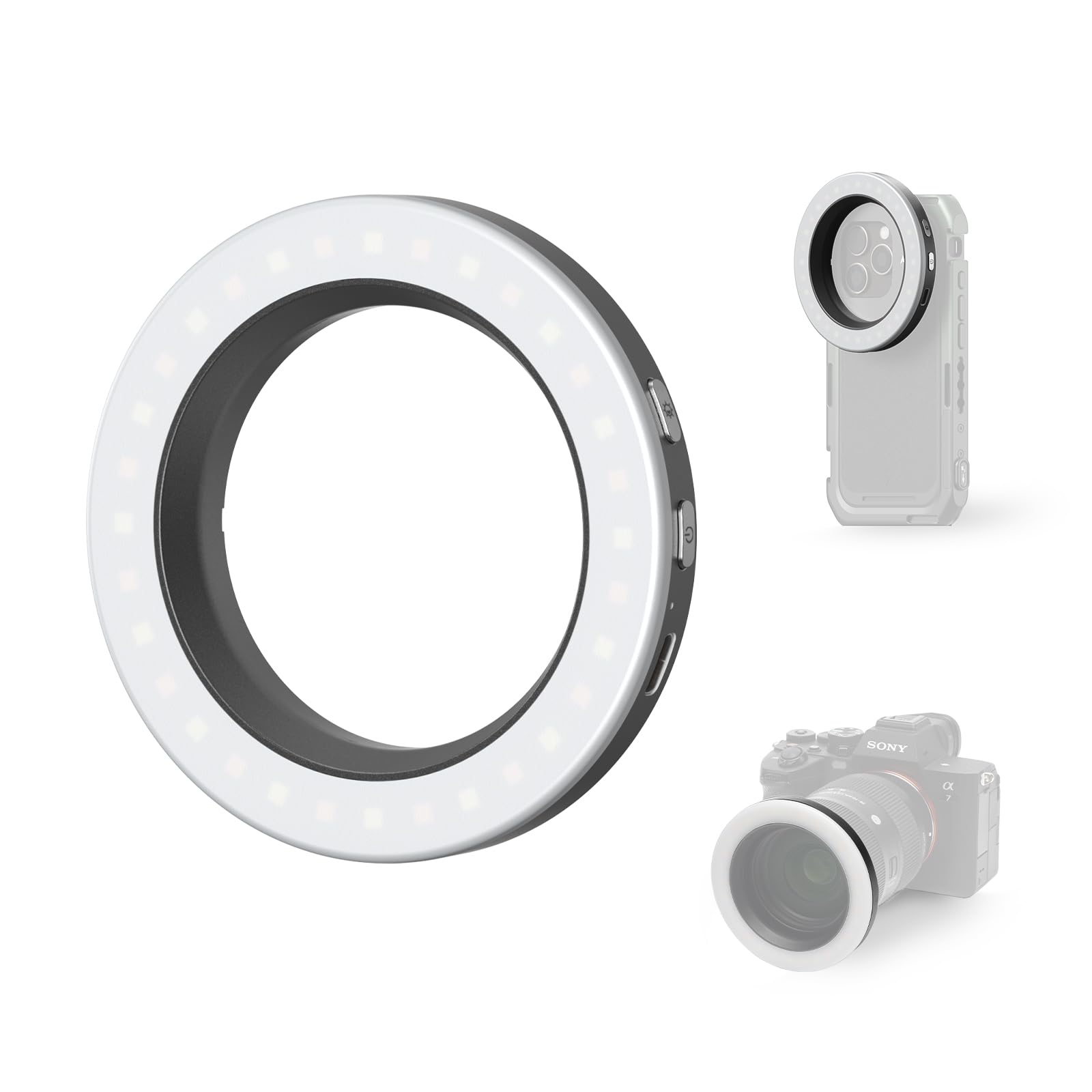
The Vibe P30 is the one we reach for when the light has to disappear into a pocket. At 39.5 g and about the size of a powder compact, it is a 3W bi-color ring with three brightness steps and a 3200–5600K range, and it charges over USB-C.

We found the sandblasted finish grippy and the 67mm thread easy to seat on a matching lens or phone mount. The 440mAh battery gives about 30+ minutes at full power, enough for a quick session but not a long shoot. The three steps are simple to cycle with one button.

The ring sits close to the lens, so it can show at the edges of the frame on wide lenses. On macro and normal focal lengths it is less of an issue, and the small size is the reason to use it. It is not a replacement for a DSLR macro flash; it is the light you add to a phone or a compact kit without making the bag heavier.

We kept it in a jacket pocket and forgot it was there, which is the best thing we can say about a light this small. It will not light a whole room, but it will put a catchlight in a close-up when the available light is almost gone.

Pros

  • 39.5 g body fits in a pocket
  • 67mm thread mounts to phone or lens
  • Bi-color 3200–5600K output
  • USB-C charging with 30+ minutes runtime

Cons

  • 67mm thread only
  • Lowest brightness can be too strong for close work
Our verdict

The Vibe P30 is our pick for phone-based macro and 67mm lenses when a tiny, dimmable ring matters more than raw power.

Check Latest Price

How We Tested Macro Ring Lights at the Kitchen Table and in the Garden

I started with a list of about 40 lights sold for close-up work and cut it to 12. What got a light through the first pass: adapter rings included for common filter threads (49mm through 77mm), a clear answer on whether it was flash or continuous, and output you could dial down in steps instead of a single on/off setting. Anything that couldn't get dim enough for a subject six inches away at a small aperture was out.

After that the lights moved into my actual shooting — a kitchen table after dark with coins, watch movements, and a stamp; the backyard garden at dusk, chasing insects along leaf edges; a tabletop tent in the basement for anything shiny. I mounted each one on my own camera and timed how long it took to screw on, how badly the adapter rings fumbled in low light, and whether the light sat square to the lens or drifted into the focus ring.

To judge brightness, I shot the same watch dial at every power level from full output down to the smallest step, then looked at where the highlights clipped and whether the light fell off evenly at the frame edges. I also checked reflections, since a ring light leaves a donut in a watch crystal and some are uglier than others. Along the way I noted whether the power dial moved when my hand brushed it, whether the setting was readable in a dim room, and whether I could still see the subject through the viewfinder with the light running.

Recycle time got tested by firing bursts until a flash missed a frame; the continuous lights ran a full evening to see how fast they ate batteries and how hot the housing got. Reliability was the long game — three sessions a week for seven months, carried loose in a camera bag. Value came down to whether the extra money bought more even light or just a nicer box.

How to Choose a Macro Ring Light

Flash or continuous light?

A macro ring flash delivers a short, bright burst that freezes a moving insect and lets you stop down for depth of field. A continuous LED ring is easier to learn on and is the only option when you are shooting video, but its output is lower. We choose a flash for stills that need sharpness and a continuous ring for tabletop video or for judging reflections before the shutter. The Godox MF-R76 and RING72 show the two approaches clearly; if you shoot both, plan for two lights rather than expecting one ring to do both jobs well.

Mounting and adapter rings

Every ring light here attaches through the lens filter thread or a hot-shoe controller, and the adapter set decides whether it fits your lens. Check the filter thread printed inside your lens cap, then compare it with the included rings; 49–77mm covers most macro lenses, but an 82mm or 95mm front thread needs extra parts. A Nikon-specific TTL flash like the Neewer RF1-N will not give you the same automation on a Canon body, so match the mount first. The trap is assuming a ring with eight adapters fits everything: it does not.

Control, output, and the look of the light

Power levels and tube control matter more than the ring shape once you are close. A single ring gives even, shadowless light; independent tubes or a movable arm let you put more light on one side. TTL is convenient for moving subjects, while manual steps are more repeatable for focus stacks. The MF-R76's dual tubes and the Neewer's TTL are two different answers, and neither is automatically better. For a first macro light, prioritise clear manual control and at least a few fine steps; for paid work, independent tube control is worth the extra weight.

Power, weight, and where the controller sits

Lithium packs last longer and recycle faster; AA power is a useful backup but adds weight and waste. A ring that is light enough to leave on the lens gets used more, while a heavy controller and battery pack can tip a small camera forward. Think about where the controller hangs: a wired box is fine on a tripod but can swing when you handhold. The ML-150II is the travel-minded end of this group, while the MF-R76 carries more hardware for longer sessions.

Frequently Asked Questions

Final Verdict

The Godox MF-R76 is the macro ring light we recommend first for stills. Its dual tubes give you control over the shape of the light, the 76W output and long battery life make it a working tool, and the eight adapter rings cover most macro lenses. It asks you to set power manually, which is a fair trade in close-up work. For Nikon TTL, choose the Neewer RF1-N; for continuous light and video, the Godox RING72.