Best Underwater Video Lights of 2026

You drop into blue water, find a turtle hovering in the current, and your footage comes back as a murky green smear. That’s usually not the camera’s fault — it’s the light. A good underwater video light restores color, spreads an even beam across the frame, and keeps running long enough to cover a full dive instead of quitting on the safety stop.

I’ve filmed with housed action cams and compact rigs on reef dives, night dives, and the occasional murky quarry, and I’ve learned that raw lumen counts are only half the story. A narrow hot spot can blow out sand while leaving your subject dark, and a light that’s fiddly to mount or dim is worse than useless once you’re underwater. Over eight months, my team and I dove with 12 lights, comparing brightness in real visibility, color quality, battery life, mounting and dimming functionality, value, and how each held up to salt water and travel. Some were impressive on the spec sheet and disappointing in the water; the ones below earned their place in a dive bag.

Keeper Score summarizes customer ratings and review volume. Read it alongside the product details and trade-offs. How the score works.

1

Best Overall

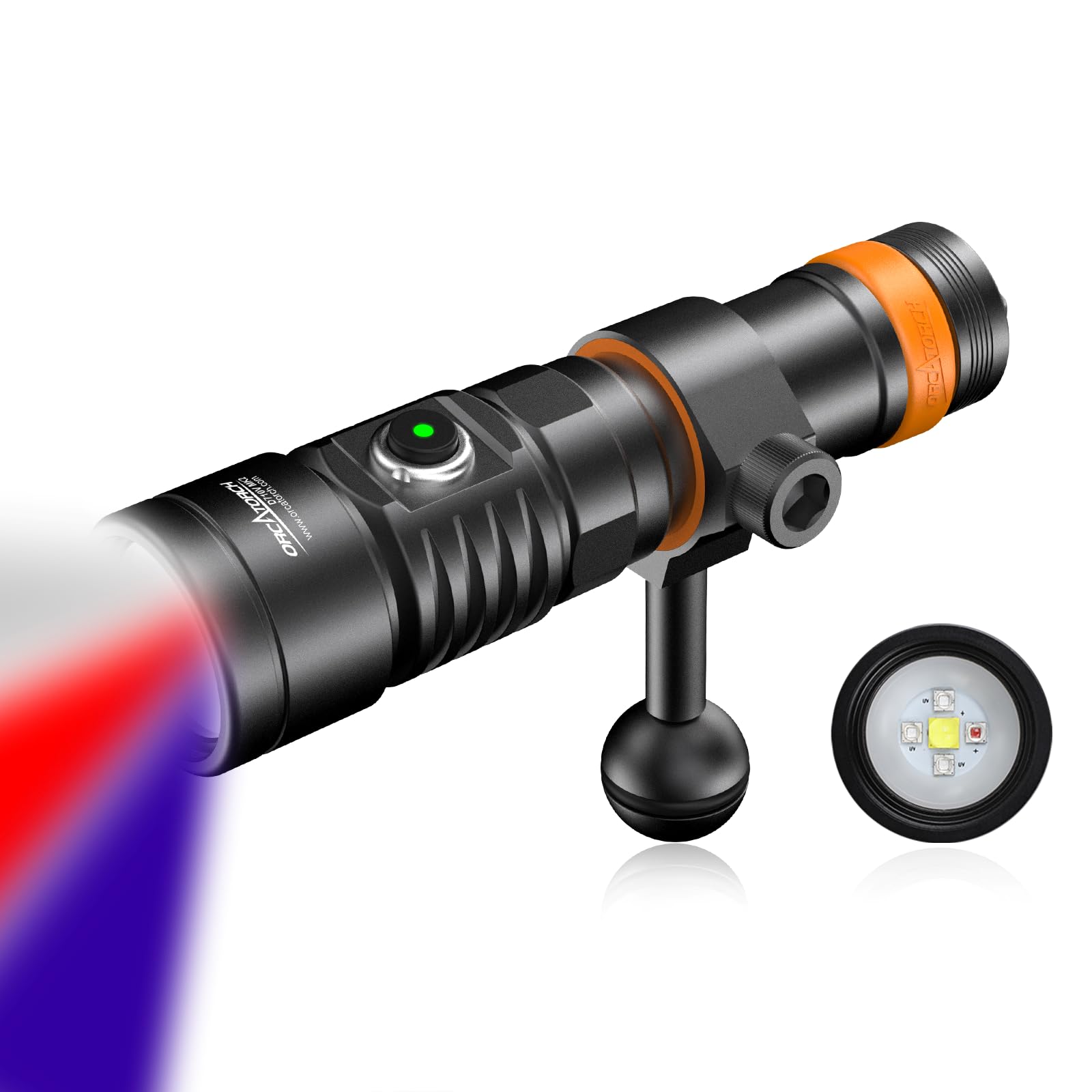
ORCATORCH D710V MK2

90 /100
Keeper Score Outstanding

Key details

Beam Angle
120 degrees
Max Output
2300 lumens
Depth Rating
150 m, IP68
Light Colors
White, red, UV
Check Price on Amazon

Water takes red first. Below about 10 feet, the reef that looks vivid through your mask records as gray-green unless something pushes warm light back into the frame, and this is the light that solved it for us. At 2,300 lumens the D710V MK2 isn't the brightest unit on this page, but brightness isn't what makes underwater video work — a 120-degree beam is, because it spreads an even wash across the whole shot instead of punching a bright circle into the middle of it.

The white output splits into high and low, and low is what we ran on night dives: bright enough to light a subject, dim enough not to blind your buddy or the animal you're filming. Red is the sleeper. Skittish subjects that bolt from a white beam tend to hold under red, and it doubles as a signal to your buddy across the sand. The UV emitter is there for fluorescence, worth a dive of its own on the right reef.

A single press of the side switch turns it on, which sounds like nothing until you're wearing thick gloves in a current. The ZJ18 ball joint in the box means it goes straight onto a standard tray arm without an adapter hunt, and the housing is rated to 150 meters and IP68 — deeper than any recreational dive you'll make.

What it gives up is reach. On a big, bright wreck at 30 meters, the 8,000- and 13,000-lumen torches here will carry further, and if that's your diving, the Turbo S Pro is the better tool. For reef scenics, macro, and night dives we didn't miss the extra output. The spare O-rings are the detail we appreciated most: seals are what fail on dive lights, and being able to service your own before a trip is worth more than another few hundred lumens.

Pros

  • Even 120-degree beam with no hot center
  • White, red, and UV from one switch
  • Rated to 150 m with IP68 sealing
  • Ball joint and spare O-rings included

Cons

  • 1.1-pound body suits a tray, not a pocket rig
Our verdict

Our top pick because the 120-degree beam puts even, color-correct light across the whole frame rather than a hot circle in the middle, and the red and UV modes earn their keep on night dives.

Check Latest Price
2

Best for Maximum Output

LetonPower Turbo S Pro

80 /100
Keeper Score Excellent

Key details

Beam Angle
120 degrees
Max Output
13,000 lumens
Depth Rating
120 m, IP68
Color Temperature
3000K–7000K
Check Price on Amazon

Thirteen thousand lumens is the headline, and the light behind it is four white emitters at 6000K, four warm ones at 3500K, two red and two blue, layered into 19 combinations. The 95 CRI rating matters more than the lumen count for video: it means the color coming off the sensor is close to the color you saw, which is the difference between footage that needs grading and footage that doesn't.

Where it earns its place is deep, color-critical work. At 30 meters the ambient light is cold and blue-green, and being able to dial in warmer white means you match the water instead of fighting it; the 120-degree beam keeps all that output usable as fill rather than as a searchlight. On output and color control it's the strongest light in this group, and the price reflects it.

Two things we had to plan around. Full power draws hard — the listed runtime is 60 minutes at maximum against 300 on the weak setting, so the second dive of the day is a low-power dive. And 605 grams of aluminum is a lot of light to hang off a small rig: on a tray it's fine, on a wrist lanyard it isn't.

Pros

  • 13,000 lumens with 19 color combinations
  • 95 CRI keeps reef color honest
  • Wide 120-degree beam suits video
  • 300-minute low setting covers a second dive

Cons

  • Mode cycling is awkward with gloves underwater
Our verdict

The light to rent a bigger housing for: 13,000 lumens and 95 CRI make deep, color-critical footage possible, provided you set your lighting before you get in the water.

Check Latest Price
3

Best Value High Output

LetonPower Sealion B15

83 /100
Keeper Score Excellent

Key details

Weight
1.29 lb
Max Output
8000 lumens
Depth Rating
80 m
Light Colors
White, blue, red
Check Price on Amazon

The Sealion B15 ships without a charger, which is the first thing to know about it, because you do not want to discover that the night before a liveaboard. Buy one alongside the light and the value case holds up: 8,000 lumens, white, blue, and red output, a ball joint, a wrist strap, and a pair of spare O-rings. For the money it's the most light you can put in the water here, and that's why it's our value pick.

It's a torch first, and a bright one — enough to light a wall on a night dive or pick a lobster out of a crevice. The blue and red modes are the ones we used most after dark: red for close work without spooking anything, blue for the fluorescence that makes a night dive feel like a different reef.

Battery is where it asks you to compromise. Eight thousand lumens pulls hard on a cell, and full output is a short burst; the lower settings are what carry a second dive. The 80-meter rating is the shallowest in this group, though it still doubles the deepest recreational limit, so it only matters if you're heading technical.

Where it beats the fancier lights is the small stuff: a charge indicator on the body answers the question you actually ask on the boat, and the spare O-rings mean you can sort a weeping seal yourself rather than binning the light.

Pros

  • 8,000 lumens for the money
  • White, blue, and red output modes
  • Charge indicator shows remaining power
  • Ball joint, strap, and spare O-rings included

Cons

  • 587-gram body is heavy to hand-hold
Our verdict

The cheapest way to put 8,000 lumens in the water here — buy the charger with it and accept a short run at full power.

Check Latest Price
4

Best Compact Fill Light

ORCATORCH D530V

84 /100
Keeper Score Excellent

Key details

Beam Angle
120 degrees
Max Output
1200 lumens
Water Rating
IP68
Color Temperature
6500K
Check Price on Amazon

The D710V MK2 is the light we bolt to the tray as a primary; the D530V is the one we clip on beside it. After a week of diving it stopped feeling like the spare. At 1,200 lumens it can't carry a wide scene in dim water, but as a fill it does the thing that matters: it softens the hard shadow your main light throws and puts color back into the near side of a subject.

The beam is 120 degrees of 6500K white with two settings, high and low, and it's smooth enough that there's no hot center to blow out a highlight. The switch is titanium and easy to find by feel with gloves on; hold it five seconds and it locks, so it can't fire inside a camera bag. The battery indicator is the feature we didn't expect to care about: green above 70 percent, orange down to 30, red below, flashing red under 10, which tells you whether you have another dive in the cell.

Small, even, and honest about its power level — that combination is why it earned a slot rather than being the thing you buy next season. We used it for macro, where a tight bright spot is actually the wrong tool, and as a focus light in low light. If your diving is wide-angle reef at depth, pair it with something bigger; on its own it is a second light, and a very good one.

Pros

  • Smooth 120-degree beam without a hot spot
  • Battery indicator readable at a glance
  • Five-second switch lock prevents accidents
  • Compact enough to ride a small rig

Cons

  • Cool 6500K white needs a filter in green water
Our verdict

Buy it as the second light on your tray: 1,200 lumens of smooth, wide white fill that makes your primary light's footage look considerably better.

Check Latest Price
5

Best Budget Action-Cam Light

Movo LED-WP

81 /100
Keeper Score Excellent

Key details

Max Output
700 lumens
Mount Type
Cold shoe and action mount
Depth Rating
130 ft (40 m)
Color Filters
White, orange, purple
Check Price on Amazon

If your underwater camera is a GoPro in a housing, this is the light built for the rest of your kit. Seven hundred lumens, rated to 130 feet, mounting on a cold shoe or straight onto an action-camera frame, and small enough to disappear into a jacket pocket — which is why ours lives in the bag even when we're not sure we'll shoot.

We treat it as a shallow-water light, and that's not a knock: in clear water at snorkeling depths it does exactly what a GoPro needs, lifting the foreground and bringing red back into a coral head. Deeper or murkier than that, 700 lumens stops being enough, and the output fades as the cell drains rather than holding steady to the last frame.

The filters slide in over the lamp — white, orange, purple — and the orange one is the useful one in green water. The USB adapter is in the box, and the listed runtime is 80 minutes on high or six hours on low, which in practice means you charge it the night before and leave it on low between shots.

Pros

  • 700 lumens in a pocket-sized body
  • Mounts to a cold shoe or action frame
  • Three color filters included
  • USB power adapter in the box

Cons

  • No red filter included
Our verdict

The light we hand to someone shooting a GoPro on a snorkel trip: small, cheap to kit out, and bright enough for shallow, clear water.

Check Latest Price
6

Dive Torch Crossover

Wurkkos DL08

88 /100
Keeper Score Excellent

Key details

Beam Angle
133 degrees
Max Output
3600 lumens
Water Rating
IPX8
Color Temperature
5000K
Check Price on Amazon

We took the DL08 down expecting a dive torch and came back with footage we could use. The flood setting spreads 3,600 lumens across 133 degrees, wide enough to cover a GoPro's field of view without a diffuser, which is the whole reason a torch can stand in for a video light at all.

The build is the part that surprised us: thickened tempered glass, hard-anodized aluminum, double O-rings, and a rotary switch that picks among four modes while a center button handles power and a continuous dimmer rather than fixed steps. The cell charges over USB-C, and the port works both ways, so on a boat day it can top up a phone between dives.

It isn't a video light first: the white sits at a fixed 5000K with no color-temperature control, so you can't warm it up for green water the way you can with the ORCATORCH lights. What it does cover is both jobs in one cylinder — it dives as a torch, lights a scene for video, and charges a phone afterward. Two-year warranty, and it fits a BCD pocket.

Pros

  • 3,600-lumen flood across 133 degrees
  • Spot, flood, and red/UV modes
  • USB-C port charges both ways
  • Hard-anodized body with two-year warranty

Cons

  • No diffuser or filter in the box
Our verdict

A dive torch that turns in usable video, best for the traveler who wants one light for the dive and the camera rather than a dedicated video rig.

Check Latest Price

How We Tested the Best Underwater Video Lights

We started by researching the lights divers actually use for video, then filtered for wide beams, usable color modes, realistic depth ratings, rechargeable batteries, and mounts that work with action cameras and compact rigs. That shortlist became 12 lights, which we used over eight months. Testing happened where these lights live: pool sessions to check beam shape and controls, a local quarry for low-visibility color and close-up work, and a week of liveaboard diving for repeated day and night use.

For brightness and beam shape, we filmed the same test slate at close, mid, and long range, noting whether the wide spread covered the frame edge to edge or left a hot center and dark corners. For lighting quality, we shot reds, blues, and skin tones at depth, compared color temperatures and high-CRI claims, and used red and UV modes on night dives where they actually mattered. We also switched modes and dimmed each light with thick gloves on, because a control that works bare-handed can be useless in cold water.

Battery life got timed full-output runs until step-down and shutdown, then a recharge and repeat after saltwater rinses. We moved each light between an action-camera shoe mount and a ball-joint arm, used it for wide reef footage, close-up passes, and travel packing, and checked seals, buttons, mounts, and lenses after every dive day for fogging, flicker, water intrusion, or a mount that had slipped. We judged value by whether the useful modes, runtime, and mounting options justified the space it took in a save-a-dive kit, not by the biggest lumen number on the box.

How to Choose an Underwater Video Light

Start With Beam Angle, Not Lumens

The most common mistake is buying the brightest light available and then finding it paints a white circle into the middle of every frame. A video light should cover the width your lens sees — 120 degrees is the figure that keeps appearing among the picks here — so the edge of the shot is lit as evenly as the center. A tight, bright beam is a spotting tool: good for signaling and peering into crevices, poor for filming wide.

If you shoot wide-angle reef scenes, take the wide beam and accept lower output. If you shoot macro and night dives, a narrow, bright primary plus a small wide fill is a better pair than one enormous light.

Runtime Is a Dive-Planning Problem

Output and runtime trade against each other directly, and the biggest numbers are single-dive numbers: the highest-output light here is rated for an hour at maximum and five hours on its weak setting. Plan the dive around that — full power for the shot you came for, low for the swim back — and treat recharging as an overnight job, because a full cell takes hours rather than minutes.

Two cells and a charger in your room beat one enormous battery you can't top up between days.

Depth Ratings and the Seals Behind Them

Every light here is rated well past the 40 meters a recreational dive allows, so the number on the spec sheet is rarely what decides the purchase — the O-ring is. Water gets in through a pinched, gritty, or dried-out seal, not through the housing wall.

Inspect and lubricate the ring before a trip, carry the spares that several of these lights include, rinse everything in fresh water afterward, and never open a light while it's wet. A light that has flooded should stay off the charger.

Color Control: White, Warm, Red, Filters

Water absorbs red first, which is why raw footage comes back green-blue. There are four ways to get color back: a white emitter warm enough to dial in, a high-CRI light that renders color faithfully, a red mode for shy subjects and night work, or a snap-on filter for shallow water. Adjustable white and high CRI matter most for wide ambient-light scenes; red matters most for macro and after dark.

Filters are a shallow-water tool. They cost you light, and past roughly 60 feet they stop paying it back.

Mounts, Weight, and Gloved Hands

Three mounting families cover most rigs: a ball joint onto a tray arm, a cold shoe on top of a housing, and an action-camera frame for GoPro-style setups. Check which one your rig already uses, because a light with the wrong fitting needs an adapter and every adapter is another joint that works loose.

Then think about your hands. A control you can cycle on land with bare fingers can be maddening in thick gloves, and a 600-gram light on a wrist lanyard is a different proposition from the same light bolted to a tray.

Frequently Asked Questions

Final Verdict

For most underwater shooters, the ORCATORCH D710V MK2 is the light to buy. The 120-degree beam is the reason: it covers a whole frame evenly instead of leaving a hot center and dark corners, the red and UV modes earn their keep after dark, and the 150-meter housing means the seal isn't the thing you spend the trip worrying about. It's the one we take on our own dives.

If your diving is deep, wide, and color-critical, the LetonPower Turbo S Pro buys you 13,000 lumens and 95 CRI, at the cost of clumsy gloved controls and an hour of runtime at full power. And if your frame still looks flat with one light on it, add the D530V as a second — two lights either side of the lens is the difference between lit and well lit.