Best Lomography Cameras of 2026

A lomography camera isn't trying to be a good camera, and that's the entire point: a plastic body, a lens that smears the corners, a fisheye bend or a half-frame crop, and pictures that look like they fell out of a shoebox from 1978. What you're actually buying is the surprise of the scans.

The catch is that cheap film cameras are cheap in ways that aren't charming — flashes that whine and misfire, four lines of translated instructions standing in for a manual, bodies that crack after one drop, kits that arrive a piece short. Over the past four months my team and I have shot 14 of them, and the gap between delightful and disposable is far wider than the prices suggest.

Judge these on the scans, not the spec sheet. A soft lens is a style; a camera that scratches your film or leaks light across every frame is a return. And if a build-it-yourself kit appeals to you, set aside an evening and check the parts list before you start, because assembly is where these become either a hobby or a headache. The picks below lean toward the first.

Keeper Score summarizes customer ratings and review volume. Read it alongside the product details and trade-offs. How the score works.

1

Best Overall

Kodak EKTAR H35

87 /100
Keeper Score Excellent

Key details

Flash
Built-in
Weight
3.53 oz
Film Format
35mm half-frame
Frames Per Roll
About 72 from a 36-exposure roll
Check Price on Amazon

Half-frame is the trick that makes this the camera we point almost anyone toward. Each exposure uses half of a standard 35mm frame, so a 36-exposure roll gets you around 72 pictures, and the frames come out as tall verticals rather than wide horizontals. Two shots sit side by side on the negative, which means you can plan pairs — a face, then the thing the face is looking at — and a single roll lasts long enough to be worth sending off.

At 100 grams and a shade over four inches wide, it goes into a jacket pocket and comes back out without a second thought, and the flash is switched by turning the silver ring around the lens rather than by digging through a menu. There is no exposure to set: you frame, you press, you advance. We paid close attention to the flash, because a half-frame negative is small and dim rooms punish it — with the flash on, a birthday party is usable; without it, an overcast afternoon is about the limit.

The lens is soft at the edges and low in contrast, which is the look you came for and also the ceiling on what the camera can do; it is not the body for a crisp landscape. What surprised us is how quickly the format changes your habits — you stop spraying frames and start arranging them. Add an AAA battery and a roll of film, since neither is in the box, shoot the whole thing in an afternoon, and one development cycle will tell you whether lo-fi film is your thing.

Pros

  • Around 72 shots from a 36-exposure roll
  • Pocketable 100 g body
  • Built-in flash for indoor and night shots
  • Focus-free, so there is nothing to set

Cons

  • Film and an AAA battery are not included
  • Automatic exposure with no override
Our verdict

Our default pick for anyone starting out in lo-fi film: half-frame doubles your shots per roll, the body disappears in a pocket, and the flash lets you shoot after dark.

Check Latest Price
2

Best for Fisheye Effects

Lomography Fisheye No.2

84 /100
Keeper Score Excellent

Key details

Flash
Built-in
Film Format
35mm
Field Of View
170 degrees
Creative Modes
Multiple exposure and long exposure
Check Price on Amazon

Where the EKTAR H35 stretches a roll, this one stretches the picture. The lens covers 170 degrees, so a face a foot away fills the frame and the walls bend off behind it. The first thing you learn is to get closer than feels polite, because at this width a distant subject shrinks into a small figure in the middle of a lot of curved background.

The creative tools are where it earns a place beyond one gag: multiple exposure lets you stack a second frame on the first, and the bulb setting holds the shutter open for light trails after dark. We had the most fun with that pairing on a lit street, where one frame of traffic and a second of a friend standing still produced something neither shot would have been alone. The flash sits right beside that bulging lens, so it lights what is directly in front of you and falls off fast — which suits a camera that wants you close anyway.

At just under three-quarters of a pound it is heavier than it looks, and the plastic body is not the thing you toss into a bag with keys. It is a camera you carry deliberately for an afternoon, not one that lives in a pocket the way the H35 does, and that is the honest trade: the look costs you portability and a little care. Point it at a blank wall and you get a curved blank wall; point it at a friend mid-laugh and the distortion does the work for you.

Pros

  • 170-degree view for close, curved frames
  • Multiple exposure and long exposure built in
  • Built-in flash for the same shot after dark

Cons

  • One fixed fisheye look, no normal focal length
  • Plastic body needs care in a bag
Our verdict

Buy it for the shots a normal lens cannot take: 170 degrees of curve, subjects close enough to touch, and a flash that reaches them.

Check Latest Price
3

Best for Beginners

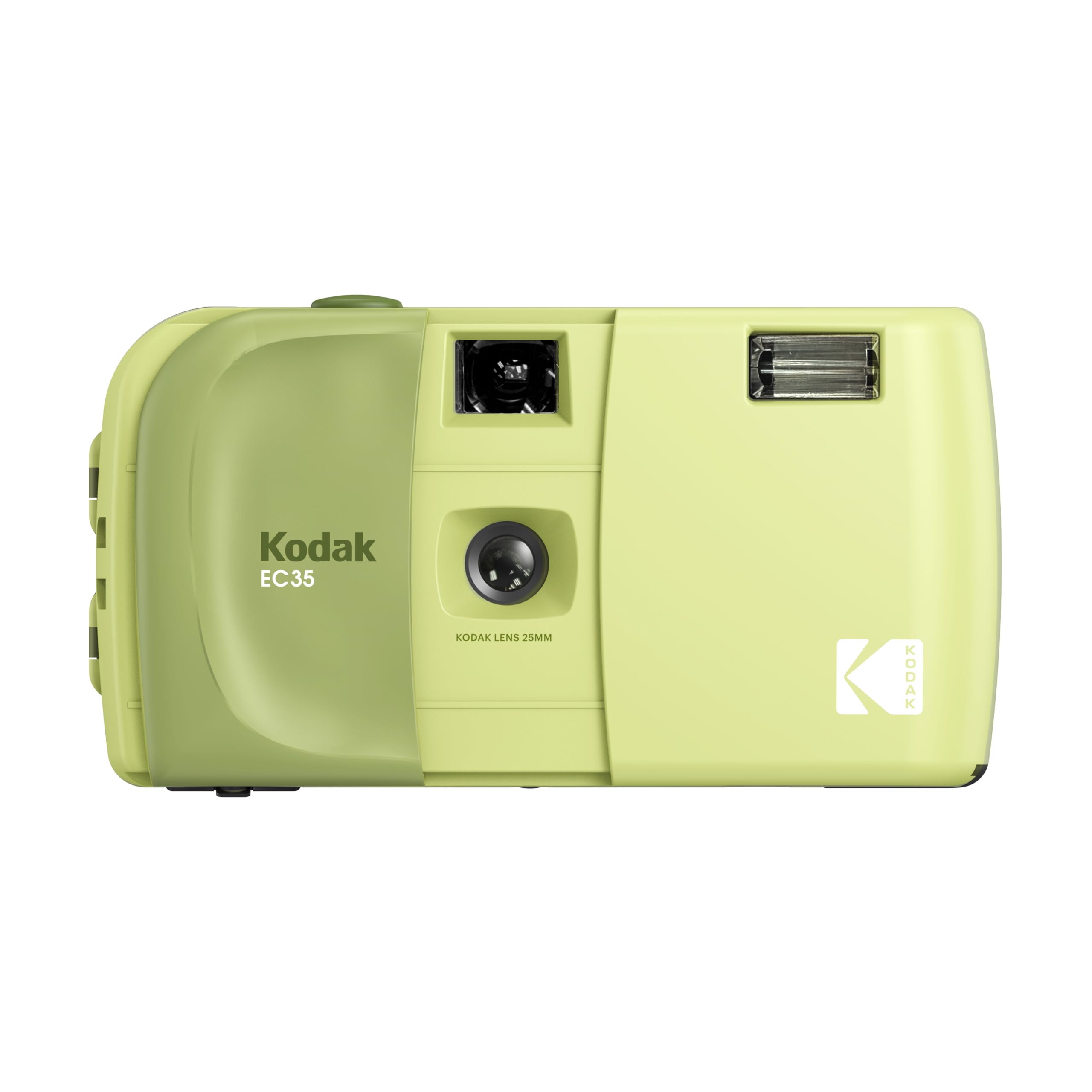
Kodak EC35

85 /100
Keeper Score Excellent

Key details

Lens
25mm wide-angle
Flash
Built-in
Battery
AA (not included)
Film Format
35mm
Check Price on Amazon

Twenty-five millimeters is wide. Wide enough to photograph a small kitchen or a group at arm's length without backing into traffic, and wide enough that a frame never feels cramped. That, plus the slide cover, is the case for this one: push the plate across and the lens is protected, so the camera can live loose in a bag instead of in a case.

Everything else is deliberately plain. There is a built-in flash for indoors, a strap in the box, and a body under five inches across. No modes to choose between, no settings to lose, and nothing to remember between shots.

We wondered whether a camera this bare would feel like a step down, and it does not: the 25mm lens gives it a different job from the half-frame Kodak, and it is the one we reach for when we want pictures rather than an experiment. It takes an AA battery, which is not included, and film you supply yourself. The strap matters more than it sounds — a camera this light hanging around your neck is one you actually carry.

Pros

  • 25mm wide lens suits groups and street shots
  • Slide cover protects the lens in a bag
  • Strap included, so it is ready to carry
  • Built-in flash for indoors

Cons

  • Film and an AA battery are not included
Our verdict

If you want pictures without a learning curve, this is the one: slide the cover open, press the shutter, and the wide lens does the rest.

Check Latest Price
4

Best Budget Option

Lomography Simple Use Reloadable

81 /100
Keeper Score Excellent

Key details

Flash
Built-in
Dimensions
4.5 x 2.4 x 1.3 inches
Film Format
35mm, reloadable
Film Included
Preloaded black-and-white 35mm film
Check Price on Amazon

You can take a picture with this before you have bought anything else: it arrives with black-and-white film already loaded, so the first frame is waiting when you open the box. What matters more is what happens after that roll runs out — it is reloadable, so the body is not waste after one go. We appreciate that more than any feature on the box. Open the back, drop in another 35mm cassette, and it keeps going.

Exposure is automatic and the shutter is fixed at 1/120 second, so the film you choose does most of the work and the built-in flash handles the rest. That fixed setting is also what makes it so easy to live with: the camera is either in your bag or it is not, with nothing to configure before you leave the house. The preloaded roll is black-and-white; after that you can load any 35mm stock, and it becomes a different camera.

Pros

  • Film already loaded, ready to shoot
  • Reloadable body, so it is not a disposable
  • Built-in flash and pocketable size

Cons

  • No manual exposure or focus control
Our verdict

The cheapest way into film: it arrives loaded, takes a flash, and reloads for the next roll instead of ending up in a drawer.

Check Latest Price
5

Learning by Building

Recesky DIY TLR Kit

77 /100
Keeper Score Very Good

Key details

Build
Assembly required
Weight
11.1 oz
Exposure
Manual
Film Format
35mm
Check Price on Amazon

The build is the product here. What arrives is a set of parts and two lenses you screw together yourself, and somewhere around the point where you fit the shutter, a camera stops being a black box. That is the value: by the time yours takes a picture you know what an aperture does and why the film path matters, which is more than any of the other cameras in this guide will teach you.

Then you shoot differently. You look down into the top lens instead of holding the camera to your eye, so people do not straighten up when they notice you, and the whole thing sits at chest height where you can frame without announcing yourself. Exposure is manual, which makes every frame a decision and every bad frame yours. It is a slow way to take photographs, and the most deliberate one here.

Two things to know before you order. The instructions can arrive as Chinese-character diagrams, so plan on assembling from the pictures, give yourself an evening, and check every part against the list before you start. And the results are properly lo-fi: soft, uneven, occasionally a write-off. What struck us is how little the second part mattered — a roll through a camera you built yourself reads differently from a roll through one you bought, and you will know exactly why each frame came out the way it did.

Pros

  • Building it teaches how a camera works
  • Twin-lens, waist-level viewing changes how you shoot
  • Manual exposure gives full control

Cons

  • Instructions may arrive in Chinese only
  • Soft, unpredictable image quality
Our verdict

For the tinkerer: a kit you build yourself, a waist-level finder, and manual exposure that makes every frame a decision rather than a reflex.

Check Latest Price

How We Shot 14 Film Cameras (and What Broke)

We started with roughly 40 35mm cameras sold in the U.S. and narrowed by what actually matters here: reloadable bodies rather than single-use bricks, standard film, no app or proprietary refills required. We kept a mix of focus-free point-and-shoots, a fisheye, a reloadable disposable-style body, and one twin-lens kit you assemble yourself, landing on 14 cameras that we then lived with for four months.

Each one was loaded with the same ISO 400 color negative film plus a roll of black-and-white, and carried through the same ordinary week: a birthday party in a dim living room, a sunny walk, a bar at night, a weekend trip. We shot the same subject at close range and across a room with the flash on, then counted how many frames per roll came back usable and whether the flash had recycled in time for the next shot or left the far side of the room dark.

Loading was timed on the first attempt using only the included instructions, and we noted which manuals bothered to explain the flash and the frame counter — several did not. Every box was checked against its parts list before shooting, since film and batteries are routinely not included, and a missing piece you discover mid-roll is a dead camera. Bodies rode loose in tote bags and jacket pockets, took one tumble off a picnic table, and we inspected the following roll for light leaks, scratches, and split seams. For the kit, we timed the build and noted which steps the diagrams skipped.

How to Choose a Lo-Fi Film Camera

Frame count and negative size come first

Half-frame cameras expose half of a standard 35mm frame at a time, so a 36-exposure roll yields around 72 pictures and every negative is half the size. That is the EKTAR H35's whole argument: twice the shots, softer detail, and twice as long before a roll is worth sending off. Full-frame cameras give you bigger negatives and a cleaner file to scan. If you post small and shoot often, half-frame is the better use of a roll; if you want the most detail the format can deliver, stay full-frame.

Choose a field of view, not a sharpness rating

Nothing in this category is sharp, and the sooner you accept that the easier the decision gets. You are picking a flavor of softness and, more importantly, how much the lens takes in. A 170-degree fisheye bends everything at the edges and only works close in; a 25mm wide lens fits a room or a group without obvious distortion; the plain plastic lenses in between land somewhere unremarkable. The common mistake is buying the fisheye for everyday snapshots, or a wide camera expecting drama.

Decide how much control you actually want

These cameras run from fully automatic to fully manual. Point-and-shoots like the EKTAR H35 and the EC35 ask you to load film, press the shutter and turn on the flash indoors. One step up, the Fisheye No.2 adds bulb and multiple exposure, which is where the strange pictures come from. At the far end, the Recesky TLR kit arrives as parts and manual everything. Be honest about whether you want an instrument or an afternoon project — most people who buy the manual one wanted the project.

Budget for the first roll, not just the camera

Film, batteries and processing outlast the purchase price, so check two things before you order: whether film is included, and whether the camera needs a battery. The Lomography Simple Use arrives loaded, which is why it is the least expensive way to take a first picture; the Kodaks need film plus an AAA or AA respectively, sold separately. A reloadable body and a few rolls of budget film usually serve better than repeatedly buying preloaded cameras.

Frequently Asked Questions

Final Verdict

Buy the Kodak EKTAR H35 unless something specific pulls you elsewhere. Half-frame halves what each picture costs in film, the flash makes it usable after dark, and at 100 grams it leaves the drawer instead of living in it.

If you want one unmistakable look rather than range, the Lomography Fisheye No.2 makes pictures nothing else in this guide can. And if the appeal is understanding the machine rather than just using it, the Recesky kit is the only camera here that shows you how a photograph happens.