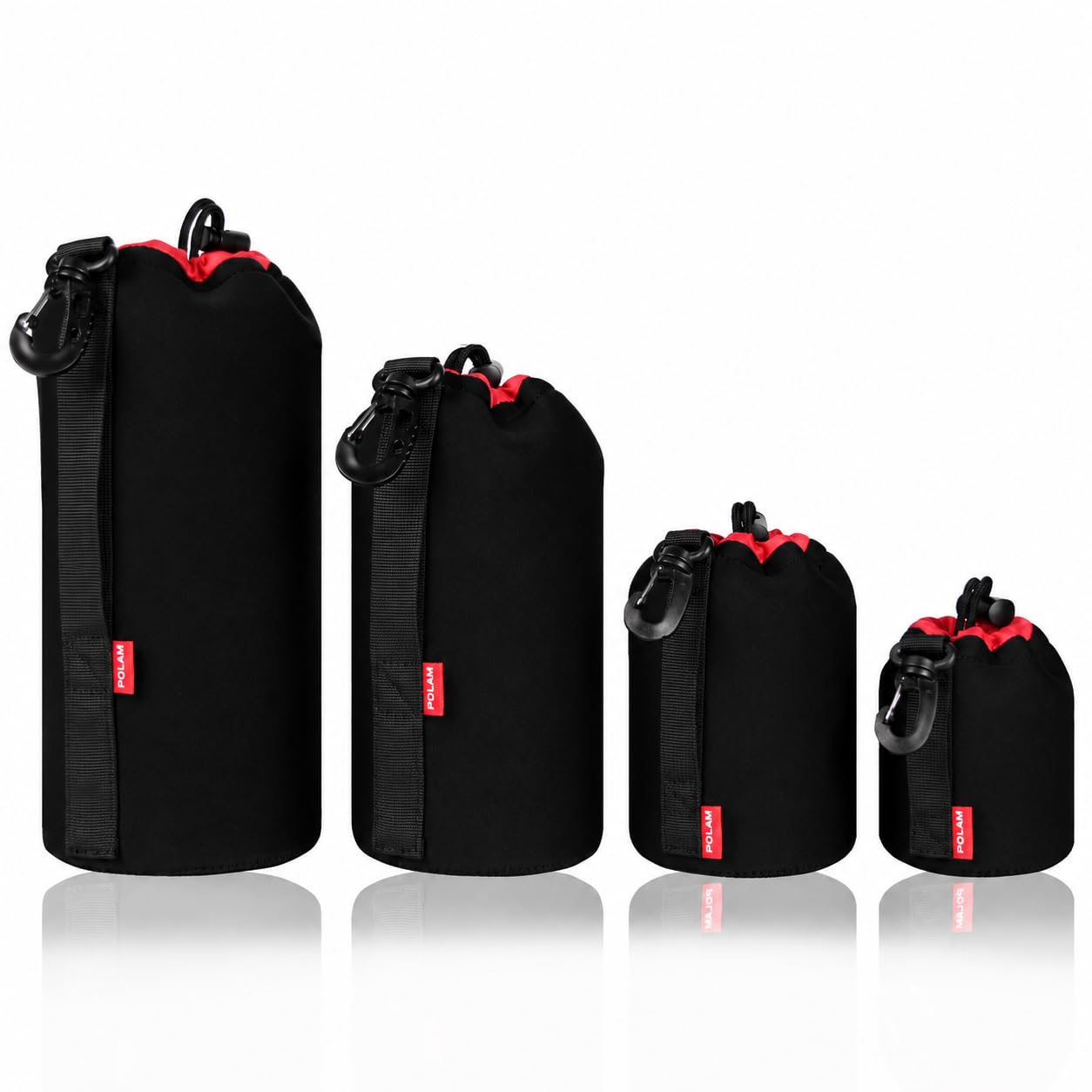
Best Lens Pouches of 2026

The sound I remember from that trip wasn't the shutter — it was a lens rolling into a water bottle at the bottom of my camera bag. Nothing broke, but it started a small habit: every lens I own now travels in its own pouch. A good one does two jobs at once, cushioning the glass when the bag gets set down hard and keeping the mount covered while a lens waits its turn.

The tricky part is fit. A pouch roomy enough to slide on easily can let a lens rattle; one snug enough to hold it still turns every lens change into a wrestling match. Padding claims are all over the map, too, and thickness on a spec sheet doesn't always match what shows up at your door. Over four months, my team and I carried 16 pouches through day hikes, a rainy weekend trip, and a lot of hurried bag-packing, testing fold-over flaps against zippers and squeezing lenses into cases that claimed to be the right size and weren't.

Multi-packs in graduated sizes look like the obvious value play, and sometimes they are — but only if the sizes line up with the lenses you actually carry. The picks below cover both routes.

Keeper Score summarizes customer ratings and review volume. Read it alongside the product details and trade-offs. How the score works.

1

Best Overall

CADeN Lens Pouch Set

88 /100
Keeper Score Excellent

Key details

Closure
Drawstring with buckle
Padding
5 mm neoprene
Buckle Rating
12 kg (26 lb)
Sizes Included
S, M, L, XL
Check Price on Amazon

One dedicated case per lens is the tidiest way to protect a kit, and also the priciest way to cover four lenses. CADeN takes the other route: four soft neoprene pouches in small, medium, large and extra large, each one a stretchy sack that pulls over a lens and cinches at the top. The 5 mm neoprene matches what most of the sets here claim, the inside is a soft plush, and the seams are reinforced zigzag rather than a straight stitch.

The grading runs small at both ends, which is the one thing to sort out before you order. The extra large is short for a long zoom, and the smallest pouch won't take a wide prime with its hood on. CADeN doesn't give dimensions for each pouch either, so measure your longest lens from the mount to the front element with the hood reversed and buy with that number in hand — the medium and large will cover most of what's left.

Coverage is what earns it the top spot. Four graded sizes handle the primes, the kit zoom and the short telephoto in a typical bag, each pouch squashes flat when it's empty, and every one has a side buckle rated to 12 kg (26 lb) for hanging off a belt or a pack strap. For a bag with three or four lenses in it, that's a better use of money than one beautiful case for one lens.

The buckle is the detail that makes the set useful outside the bag. The rating sits far above the weight of any lens you'd clip there, which means a pouch stays on your belt while both hands are busy swapping glass, and the short web tab keeps it from swinging. A one-year replacement covers the stitching if it lets go.

Pros

  • Four graded sizes cover most of a kit
  • 5 mm neoprene with a soft plush lining
  • Buckled clip rated to 12 kg on each pouch
  • Reinforced zigzag stitching

Cons

  • Drawstring cinches to a gap, not a seal
Our verdict

Our default for a bag full of lenses: four thick neoprene pouches that cover a kit, provided you measure your longest lens first.

Check Latest Price
2

Best for a Single Large Lens

JJC Deluxe Lens Case LP4II

95 /100
Keeper Score Outstanding

Key details

Closure
Zipper
Padding
Foam cushion
Carry Options
4, incl. belt loop
Interior Size
3.9 x 6.5 in
Check Price on Amazon

A 3.9 by 6.5 inch interior is the number to hold onto, and it's a generous one: the LP4II is sized for a 24-70mm f/2.8, an 85mm f/1.2 or a 70-300mm, and it takes them in a foam-lined shell rather than a stretchy sack. Of the single cases in this guide, it's the one we trust most with a lens that costs more than the case does.

Water-resistant polyester outside, foam cushion inside, and a zip that runs around three sides instead of a drawstring at the crown. The lid has a mesh pocket that swallows a cap, a body cap or a spare card — the sort of thing you stop noticing right up until you need it.

Four carrying options is more than any other pouch here gives you: a grab handle, a shoulder strap, and a belt loop sized for a proper photo belt. The belt loop is the one we came back to, because a 24-70 on your hip is out of the way, instantly reachable, and held steady by a shell that doesn't flop against your leg.

Pros

  • Foam-lined, water-resistant shell
  • Interior takes a 24-70mm f/2.8
  • Mesh lid pocket for caps and cards
  • Belt loop, strap and grab handle

Cons

  • One case covers one lens
  • Structured shell won't pack flat
Our verdict

If one lens deserves a real case rather than a stuff sack, this is it — foam-lined, water-resistant, and the best-fitting single case here.

Check Latest Price
3

Best for Hands-Free Carry

K&F Concept Lens Case XL

92 /100
Keeper Score Outstanding

Key details

Closure
Waterproof zipper
Padding
10 mm
Carry Options
Shoulder strap, belt loop
Interior Size
3.7 x 7 in
Check Price on Amazon

A shoulder strap on a lens case looks like overkill until you're carrying a long zoom and a body separately. This K&F case is built for that: an adjustable strap with an anti-slip pad, a belt loop at the back and a grab handle on top, so a heavy lens hangs off your shoulder instead of pulling on a belt loop.

The padding is the headline. At 10 mm it's the thickest stated in this group, and it's shaped into a proper case — water-resistant polyester, a reinforced base, and a zipper sealed against rain rather than a drawstring crown. We're also fond of the elastic mesh pocket inside the lid, which is where caps and cards end up instead of loose in the bag.

Interior is 3.7 by 7 inches, and that's the binding constraint. Measure your lens from the mount to the front element with the hood reversed before you order — anything longer won't go, hood or no hood.

Pros

  • 10 mm all-round padding
  • Shoulder strap, belt loop and handle
  • Sealed zipper and water-resistant shell
  • Elastic mesh pocket in the lid

Cons

  • Zip access is slower than a drawstring
Our verdict

The case to take when a long lens travels outside the bag: the most padding here and a shoulder strap to carry it on.

Check Latest Price
4

Best for Pancake Lenses

JJC Small Neoprene Pouch

93 /100
Keeper Score Outstanding

Key details

Closure
Fold-over, hook-and-loop
Padding
5 mm neoprene
Attachment
Carabiner
Fits Lens Up To
2.4 x 1.6 in
Check Price on Amazon

A 2.4 by 1.6 inch pouch is about as small as a lens case gets, and that's the point. This JJC is built for a pancake prime or a collapsed kit zoom — the Canon EF-M 22mm f/2, the Sony 16-50mm power zoom, the Fujifilm 27mm f/2.8 — and it hugs them rather than swallowing them.

The 5 mm neoprene is the same thickness as the big sets here, the flap folds over and seals with a hook-and-loop patch, and a small carabiner clips it to a belt loop or a pack strap. The flap is what makes it feel quicker than a drawstring: two fingers peel it back and the lens is out.

What keeps us coming back is how little space it takes up. A pancake lens in this pouch is barely bigger than the lens on its own, so it drops into a jacket pocket or the smallest gap in a bag — the sort of thing you actually carry rather than leave at home.

Pros

  • Sized for pancake and small kit lenses
  • One-handed hook-and-loop flap
  • 5 mm neoprene padding
  • Carabiner for belt or strap

Cons

No notable drawbacks to flag.

Our verdict

The neatest way to carry a pancake lens: a tiny neoprene pouch with a one-handed flap and a clip for your belt.

Check Latest Price
5

Best Quick-Access Pouch

OP/TECH Fold-Over Pouch 253

89 /100
Keeper Score Excellent

Key details

Closure
Attached fold-over lid
Warranty
Lifetime
Fits Length
2.1 to 3.5 in
Fits Diameter
2 to 2.5 in
Check Price on Amazon

The lid stays attached. That sounds like a small thing until you've fumbled a separate neoprene cap in the dark with a lens in each hand — OP/TECH's fold-over design keeps the cover tethered to the pouch, so there's nothing to drop and nothing to thread back on one-handed.

Style 253 fits lenses with a 2 to 2.5 inch diameter and a 2.1 to 3.5 inch length, which lands on mid-size mirrorless zooms and fast fifties. The neoprene is supple rather than stiff, it's made in the USA, and it carries a lifetime warranty against defects — a serious commitment for a pouch this simple.

Pros

  • Attached lid can't be lost
  • Fits 2 to 2.5 inch diameter lenses
  • Soft, supple neoprene
  • Lifetime warranty

Cons

  • Sold one pouch at a time
Our verdict

For mid-size mirrorless lenses, this is the least fussy pouch here: the lid stays attached, so there's nothing to lose and nothing to thread.

Check Latest Price
6

Lint-Free Padding

POLAM-FOTO Thick Pouch Set

88 /100
Keeper Score Excellent

Key details

Lining
Short-fiber plush
Padding
0.2 in neoprene
Attachment
Belt loop and carabiner
Sizes Included
S, M, L, XL
Check Price on Amazon

Lint is the quiet problem with plush-lined pouches. A fuzzy interior that sheds onto the front element means you're cleaning the glass every time you pull a lens out, and it's the sort of flaw you find out about after the return window has closed. POLAM-FOTO specifies a short-fiber plush rather than felt for this set, which is the detail that makes it interesting.

The rest is a familiar four-pack: small through extra large, 0.2 inch neoprene, a drawstring top, a belt loop and a carabiner on each pouch. The sizes are mapped to lens types — small for a 50mm prime, medium for a 24-70mm kit zoom, large for portrait glass — which is more guidance than most sets here give you.

Where it earns a place is that lining. If you've been wiping fiber off a front element after every swap, this is the set to try, and the four sizes mean you aren't buying one pouch at a time to get it. If lint has never been your problem, the thickness and the drawstring here are ordinary, and our top pick covers the same ground for less.

Pros

  • Short-fiber plush lining resists shedding
  • Sizes mapped to common lens types
  • 0.2 inch neoprene padding
  • Belt loop and carabiner on every pouch

Cons

  • Costs more than the other four-packs here
Our verdict

A four-size set with a short-fiber plush lining that shouldn't shed on your front element — the pick if lint is what bothers you.

Check Latest Price
7

Extra Bag Pouches

lightdow Neoprene Pouch Set

87 /100
Keeper Score Excellent

Key details

Closure
Pull cord
Padding
5 mm neoprene
Attachment
Snap clip
Sizes Included
S, M, L, XL
Check Price on Amazon

Every pouch in this set has a snap clip on a short tab, and that's the feature that gets used most — clip the long zoom to a belt loop while you swap to the wide, rather than setting it down in the dirt.

The 5 mm neoprene feels like protection rather than a bag, and the four sizes cover a Canon kit well: an 18-55 and a 55-250 both have a home, and the pouches squash flat when they're empty.

The part to watch is the stitched tab under each clip. A heavy lens swinging from a belt loop puts all of its load there, so it's the seam to keep an eye on if you routinely hang a zoom from it.

As a second set — the one that lives in the bag and covers whatever lens you grabbed that morning — it does the job nicely. The pull cord is quick and quiet, which counts for something when you're changing glass in a crowd.

Pros

  • Snap clip on every pouch
  • 5 mm neoprene with soft lining
  • Four sizes cover a Canon kit
  • Packs flat when empty

Cons

  • Snug on wide-aperture lenses
  • Cord top cinches to a gap, not a seal
Our verdict

A solid second set for the bag: thick neoprene, a clip on every pouch, and a close fit that suits slower zooms more than fast primes.

Check Latest Price
8

Dust and Storage

Eco-Fused Microfiber Pouches

87 /100
Keeper Score Excellent

Key details

Closure
Flap
Material
Microfiber
Cleaning Wipe
Built into flap
Pack Contents
2 large, 1 medium, 1 small
Check Price on Amazon

Four microfiber cloth pouches with a flap at the top — two large in black, one medium in gray and one small in blue — the Eco-Fused set is the lightest thing in this guide and the least like a case.

The fabric is the point. The flap has a built-in wipe on the inside, so a lens comes out of the pouch already cleaned rather than smeared, and the whole thing folds into a corner of a bag when it's empty.

Three sizes across four pouches is enough for the lenses you keep on a shelf or carry as spares, and the color coding makes it easy to know which one holds what without opening them.

Where they earn their place is storage and quick changes inside a bag that's already padded — on a shelf, in a drawer, or as the sleeve around a lens that rides in a camera bag's divider. They take up less room than any neoprene pouch here, and that's the whole argument for them.

Pros

  • Microfiber fabric doubles as a lens wipe
  • Takes up almost no bag space
  • Four pouches in three sizes

Cons

  • No padding
Our verdict

Not a case but a sleeve: microfiber pouches for lenses that already live somewhere padded and need to stay clean.

Check Latest Price

How We Tested Lens Pouches

I started by pulling every pouch that published its internal dimensions, then matched those numbers against the actual measurements of the lenses on my shelf and my team's — a mid-range zoom, a couple of fast primes, and a few small crop-sensor lenses. That alone eliminated a surprising number of cases that turned out to be generic tubes with optimistic listings. Sixteen made the cut, from single fold-over sleeves to four-packs in graduated sizes, and we lived with them for four months.

Testing happened where pouches actually get used: stuffed into camera bags on day hikes, wedged into a tote on a rainy weekend trip, and hanging off a belt loop during trailhead lens changes. For fit, I loaded each pouch with the largest lens it claimed to hold and noted whether the lens slid in without force, whether the barrel bottomed out before the closure met, and whether a smaller lens shifted when I shook the pouch. Anything that took two hands and a knee to close got marked down.

For protection, I dropped loaded pouches from waist height onto pavement, then checked the lens body and mount for scuffs and the foam for permanent compression. I measured padding with calipers rather than trusting the listing, and ran each pouch under a faucet for a minute to see whether water beaded off or soaked through to the lining.

Construction got the closest look: I opened and closed every closure dozens of times, watching for zipper teeth that caught, seams pulling at the stress points, flaps that curled instead of lying flat, neoprene that lost its snap, and plush linings that shed fibers onto the glass. Value came down to one question — cost per pouch that fit a lens someone on the team actually owns.

How to Choose a Lens Pouch

Measure the lens, not the model name

Fit is where pouch purchases go wrong, and they go wrong at both ends: the smallest pouch in a set often won't take a wide prime with its hood on, and the largest is usually shorter than a long zoom. Measure two things — the barrel diameter at its widest point with the hood reversed and a filter fitted, and the length from the mount to the front element — then allow a little slack so neoprene can stretch over it.

Sets rarely publish dimensions for each pouch. When they don't, the size labels are guesswork: buy from a listing that spells out the interior, or compare against a single case with a published interior such as the 3.9 by 6.5 inch JJC LP4II.

A neoprene sack or a foam-lined case

Neoprene pouches are bump and scuff protection. They stretch over a lens, squash flat when empty and cost little enough to buy four. A foam-lined case with a zipper holds its shape, takes a knock on a corner and is what to buy for the one lens you can't afford to replace.

Compare thickness, but don't buy on it alone: 5 mm neoprene is the standard in this group and 10 mm foam is the heaviest padding here. A loose pouch lets the lens move inside it, which undoes the padding entirely, so fit beats another millimeter.

Drawstring, flap or zip

Drawstrings are fast and one-handed, and they cinch down to a small opening at the crown rather than a seal — fine inside a camera bag, less so in weather. Fold-over flaps with a hook-and-loop patch open in a second and stay attached to the pouch, which is why the small JJC and the OP/TECH feel quicker in the field.

Zippers seal best and are the slowest of the three, and grit in the teeth is what eventually kills them. Choose by where the pouch lives: in a bag, on a belt, or out in the rain.

How it attaches to you

Nearly every pouch here has a clip or buckle, and it's the feature you use most — a lens on your belt while you swap glass beats a lens in the dirt. A rated buckle like CADeN's 12 kg matters little for a 50mm and a lot if you hang a telephoto from it.

If a lens travels outside the bag rather than in it, a case with a shoulder strap is more comfortable than anything clipped to a belt loop, and it keeps the weight off your waist.

Sets versus single cases

A four-pouch set covers a kit for roughly what one dedicated case costs, which is why a set is the right first purchase for most people. Buy a single case instead when one lens is worth more than the rest combined, when it's long enough that no pouch in a set will take it, or when it rides outside the bag.

Plenty of photographers end up with both: a set for the bag and one good case for the lens that goes everywhere. That's not redundancy, it's matching the protection to the risk.

Frequently Asked Questions

Final Verdict

The CADeN set is the one we point most people to. Four sizes of thick neoprene and a rated clip on every pouch cover a whole bag rather than one lens, and the only work you have to do is measure your longest lens before you order.

If one lens matters more than the rest — a 24-70mm you shoot every job, or anything long enough to run past 6.5 inches — the JJC LP4II is the better home for it. And when that lens has to travel outside the bag, the K&F Concept case with its shoulder strap and 10 mm of padding is the one to take.