Best Camera Hard Cases of 2026

A camera bag is built for carrying; a hard case is built for the moment the carrying goes wrong. I've watched a lens tumble off a picnic table onto gravel — the bag was fine, the filter wasn't. A hard case fills that gap: a shell that won't flex, a gasket that keeps dust and rain out, and an interior that stops your gear from shifting when the case gets tossed. What you're buying is a sealed, crush-resistant box, and the difference between good and bad is how it feels when you close it.

Over the past six months, we've tested 12 hard cases, from compact boxes for a single body to wheeled cases sized for an overhead bin. We packed each with a realistic kit, carried them through airports, stacked them in car trunks, and left them out in the rain. An IP67 rating assumes the latch is fully seated, pluckable foam is one-way, and wheels only earn their weight on the largest cases. The picks below are the ones that stayed sealed, opened easily, and held their shape.

Keeper Score summarizes customer ratings and review volume. Read it alongside the product details and trade-offs. How the score works.

1

Best Overall

NANUK 935 Pro Photo Kit

90 /100
Keeper Score Outstanding

Key details

Wheels
4 polyurethane
Capacity
28.5 liters
Water Resistance
IP67
Interior Dimensions
20.5 x 11.3 x 7.5 in
Check Price on Amazon

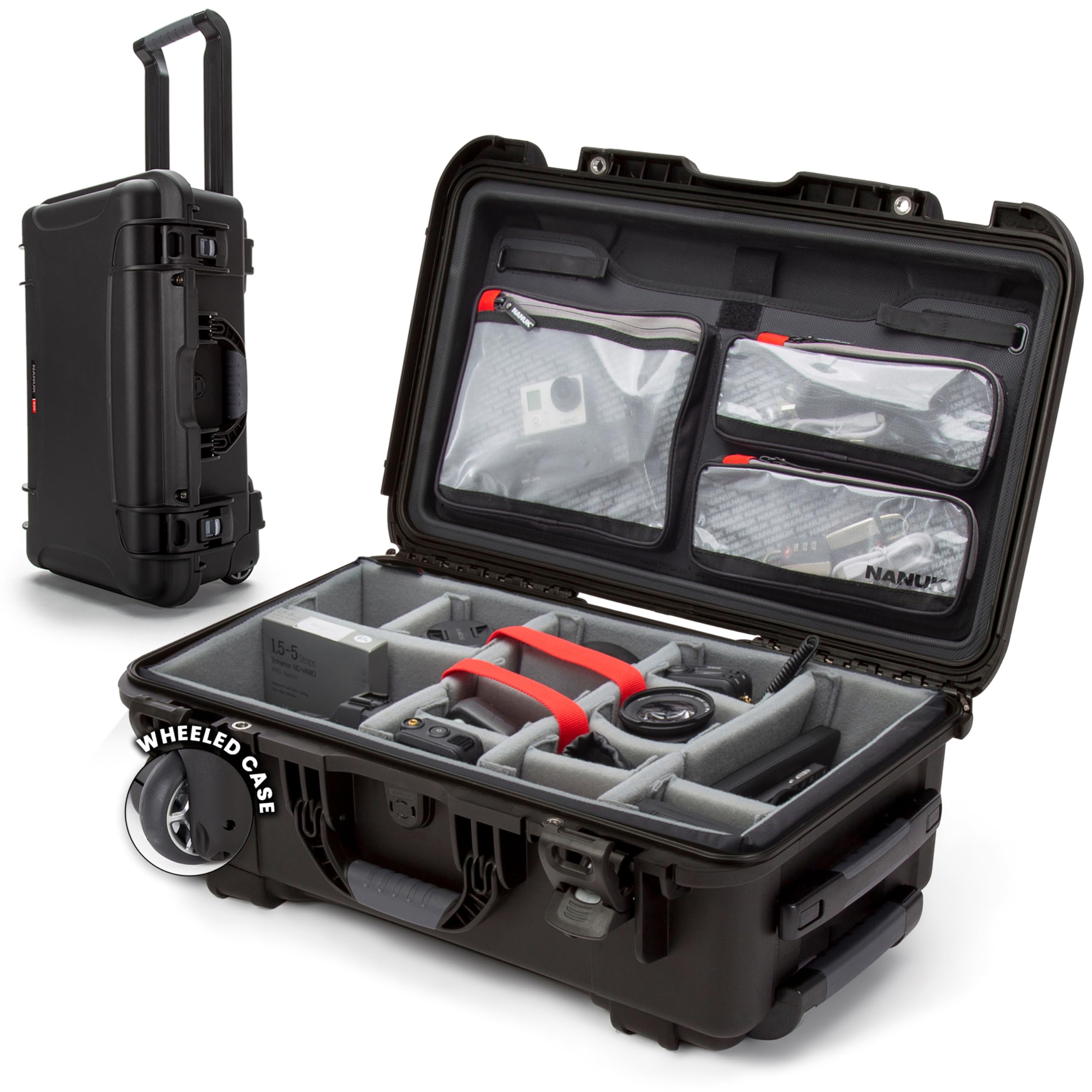
The NANUK 935 is the case we reach for when the whole kit has to move at once. Its interior measures 20.5 by 11.3 by 7.5 inches, and the 28.5-liter body is built from crushproof NK-7 resin with an IP67 seal. That is enough volume for a couple of camera bodies, a few lenses, and the accessories that usually end up loose in a backpack. The padded divider set and lid organizer do the real work: they turn a deep box into a camera case rather than a foam-filled trunk.

What makes it our top pick is the combination of true carry-on dimensions and a camera-specific interior. The 935 rolls on four polyurethane wheels, the two-level handle leaves room to stack a smaller bag, and the lid organizer has enough room for cables, cards, and even a 17-inch laptop. We trust the latch indicators, too: you can see at a glance whether both sides are engaged, which matters when you are closing up in a hurry.

The interior is deep enough for a body with a battery grip, and the divider layout adapts when you swap a long zoom for a pair of primes. For a photographer who wants one case for travel, location work, and storage, the 935 is the one we recommend first. If your gear list changes from shoot to shoot, the dividers are the reason this case stays useful after the first trip.

Pros

  • Carry-on-friendly wheeled design
  • Padded dividers plus lid organizer
  • IP67 dust and water protection
  • Latch indicators show engagement

Cons

  • Premium price
  • Heavy at 11.6 pounds
Our verdict

For a full camera kit that travels by air, the NANUK 935 is the hard case we trust most, thanks to its carry-on size, wheels, and camera-specific dividers.
Check Latest Price
2

Best Divider Layout

Lykus PVC1 Hard Case

90 /100
Keeper Score Outstanding

Key details

Capacity
13 liters
Dividers
6 removable
Water Resistance
IP67
Exterior Dimensions
16.3 x 13.4 x 6.9 in
Check Price on Amazon

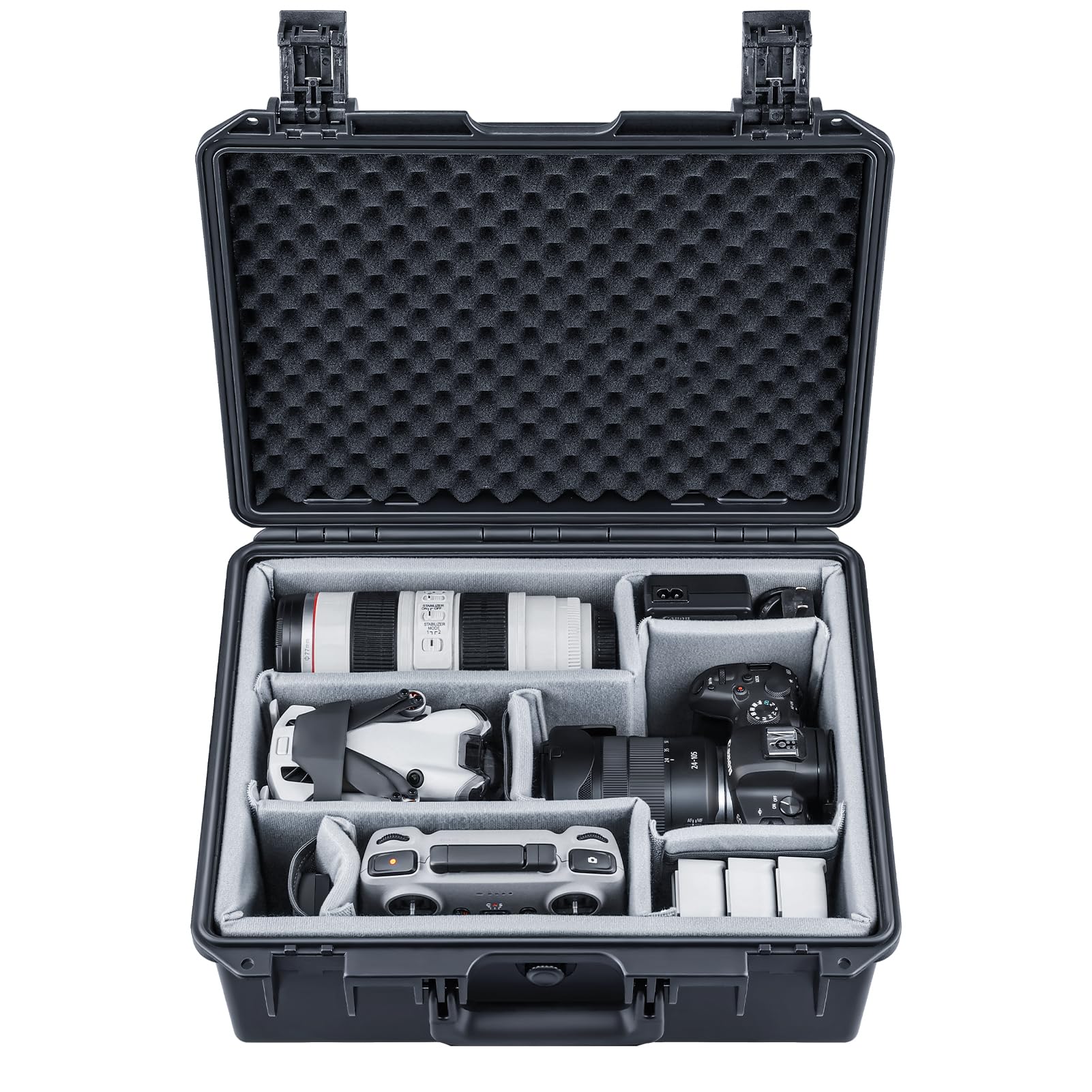
The Lykus PVC1 is a 13-liter hard case with six removable dividers, and the divider system is the reason to choose it over a foam-filled box. Each divider has a mesh pocket, so memory cards, batteries, and lens caps have a home instead of sliding into the corners. The case is IP67-rated and built from polypropylene, with a padded insert and a snap closure.

The layout is unusually good for a two-drone kit. You can keep a DJI Mavic and a Mini in the same case, along with a camera and a couple of lenses, and the dividers move without tools. We also like the nine compartments: they make it easier to treat the case as a working bag rather than a storage bin.

The 16.3 by 13.4 by 6.9-inch exterior is small enough to slide behind a seat or into a trunk, and the top handle is balanced when the case is loaded. The shell has a solid, stiff feel that inspires confidence when you set it down on concrete.

We think the PVC1 is the best divider-based case here for photographers who also fly drones. The six dividers and mesh pockets are the detail that sold us: they let you reorganize for a stills day or an aerial day without buying a second case. If your kit changes often, this is the one to shortlist.

Pros

  • Six removable dividers with mesh pockets
  • Fits two drones plus camera gear
  • IP67-rated shell
  • 13 liters of usable space

Cons

  • No wheels or pull handle
  • Latches can feel sticky
Our verdict

Choose the Lykus PVC1 if you want one case for a camera and two drones, with dividers that adapt instead of foam that locks you in.

Check Latest Price
3

Best Wheeled Value

VEVOR Weatherproof Hard Case

89 /100
Keeper Score Excellent

Key details

Wheels
2
Capacity
1.58 cubic feet
Water Resistance
IPX67
Exterior Dimensions
21.65 x 13.39 x 9.45 in
Check Price on Amazon

The VEVOR is the budget wheeled case that makes the premium options look overpriced. It has a 1.58-cubic-foot interior, a 21.65 by 13.39 by 9.45-inch exterior, and an IPX67 seal with an O-ring gasket and automatic pressure-equalization valve. For a case that rolls, that combination is hard to beat at the budget end of this group.

The shell is polycarbonate PP, and the pre-cut foam is arranged in layers so you can shape it around a camera, lenses, or a small lighting kit. The two wheels and telescopic handle handle the weight, and the latches cam over with a firm press. Make sure each latch clicks fully before you lift the case; that is the habit this design rewards.

The padlock holes and the pressure valve make it a practical travel case rather than a simple storage box. The interior can swallow a body, a few lenses, and cables, with room left for a compact tripod. If you want a wheeled hard case without paying premium money, this is the one we point to first.

Pros

  • Big wheeled interior at a budget price
  • IPX67 seal with pressure valve
  • Padlock holes add security

Cons

  • Interior feels narrower than listed
  • Foam plucking takes patience
Our verdict

The VEVOR is the wheeled hard case we recommend on a budget, with a big IPX67 interior and enough foam to protect a camera kit.

Check Latest Price
4

Best Mid-Size Wheeled

Lykus HC-5120 Wheeled Hard Case

93 /100
Keeper Score Outstanding

Key details

Wheels
Built-in
Water Resistance
IP67
Exterior Dimensions
21.85 x 13.78 x 9.06 in
Interior Dimensions
19 x 10.2 x 7.2 in with foam
Check Price on Amazon

The HC-5120 is the wheeled case for a trunk that is already full. Its exterior measures 21.85 by 13.78 by 9.06 inches, yet the foam-lined interior is 19 by 10.2 by 7.2 inches, so it carries a body, a couple of lenses, and accessories without the bulk of a full-size travel case. The shell is IP67-rated polypropylene, and the lid has four latches.

We prefer this size for a single-body kit that still needs wheels. The four latches let you check closure at each corner, and the wheels make it easy to move through a parking lot or terminal. The interior is deep enough for a camera with a lens attached, which is the difference between a case you use and one you leave at home.

The case arrives with pluckable PU foam in the base and lid, and the density is high enough that the lid does not sag when you open it. That matters when you are working out of the case on a tailgate or a hotel bed. The lifetime limited warranty is a meaningful vote of confidence for something that gets dragged through airports and loaded into vans.

The wheels are the feature we appreciate most on a case this size: they turn a loaded camera kit into something you can pull with one hand. The case tracks behind you without tipping, and the shell stays rigid when the trunk is packed tight. For a compact wheeled kit, it is the case we take when the NANUK is more than we need.

Pros

  • Compact wheeled footprint
  • IP67-rated shell
  • Four secure latches
  • Lifetime limited warranty

Cons

  • Handle needs two hands to raise
  • Foam takes patience to set up
Our verdict

The Lykus HC-5120 is the compact wheeled case we recommend for a single camera body and a few lenses, with IP67 protection and four secure latches.

Check Latest Price
5

Best Compact Foam Case

K&F Concept BC01 Hard Case

90 /100
Keeper Score Outstanding

Key details

Foam
2-layer pick-and-pluck
Capacity
9 liters
Water Resistance
IP67
Exterior Dimensions
13.5 x 9.2 x 5.3 in
Check Price on Amazon

The K&F Concept BC01 makes sense the moment you stop trying to carry everything. Its 9-liter interior and 13.5 by 9.2 by 5.3-inch shell are sized for a camera body and a couple of lenses, and the two-layer pick-and-pluck foam lets you build a cradle without a knife. We think it is the best compact foam case here for a small stills kit.

The case is IP67-rated and tested for drops from 1 meter, which is more reassuring than the bare plastic shell suggests. The pre-scored foam is the feature that makes it livable: you can shape it around a camera with a lens attached, then pull out the unused squares for accessories. The integrated hinge feels solid, and the latches close with a positive snap.

Pros

  • Compact 9-liter camera layout
  • IP67 and one-meter drop rating
  • Two-layer pick-and-pluck foam

Cons

  • No wheels or pull handle
  • Foam can be fiddly to pluck cleanly
Our verdict

For a compact camera kit that needs waterproof, drop-rated protection, the K&F BC01 is the best small foam case here.

Check Latest Price
6

Best for Camera-And-Drone Kits

STARTRC Camera Hard Case

85 /100
Keeper Score Excellent

Key details

Compartments
7
Divider Material
EVA
Water Resistance
IP67
Exterior Dimensions
16.2 x 12.8 x 7 in
Check Price on Amazon

The STARTRC case assumes your kit is part camera and part drone. Inside the 16.2 by 12.8 by 7-inch shell are seven compartments formed by EVA dividers, and the case is IP67-rated with a dual-button closure. That layout is more flexible than foam for a mirrorless body, a long zoom, a couple of primes, and a drone with its controller.

The dividers hold their shape when you pull them out, and the bottom is finished so the case stands on its own when you set it down. A small packet of drying beads comes with the case, a thoughtful extra for humid climates or a boat bag. The exterior has enough structure that it does not flex when you lift it by the top handle.

The divider system is why this case earns a place: it lets you reorganize for a stills day or an aerial day without committing to a foam layout. We appreciate the drying beads and the seven compartments, which keep small accessories from migrating. For a mixed kit that changes shape, it is a strong choice.

Pros

  • Seven EVA compartments
  • IP67-rated shell
  • Drying beads included

Cons

  • Dividers could be thicker
  • No wheels or pull handle
Our verdict

Choose the STARTRC if your camera and drone share a bag; its seven EVA compartments and IP67 shell keep both organized.

Check Latest Price
7

Tiny Camera Kits

MEIJIA Portable Hard Case

92 /100
Keeper Score Outstanding

Key details

Foam
Customizable
Case Type
Hard case
Water Resistance
Waterproof
Exterior Dimensions
11.65 x 8.35 x 3.78 in
Check Price on Amazon

The MEIJIA is the smallest case here, and that is the point. Its exterior measures 11.65 by 8.35 by 3.78 inches, with a hard shell, a waterproof seal, and customizable foam. It is sized for a compact camera, an action cam, or a small microphone set, not a full DSLR kit.

The foam is thick for a case this size, and the latches clamp down firmly enough that the lid feels sealed. The case has a solid, dense feel that is reassuring when you toss it into a daypack or a glovebox.

The top handle is a simple web loop, and the case is light enough to carry by hand without thinking about it. The exterior has a plain, utilitarian look that does not call attention to what is inside.

We think the MEIJIA is the best tiny case here for a compact camera or action cam that needs more protection than a pouch. The foam is thick enough that the case feels heavier than its size suggests, which is a good trade for a case that rides in a glovebox or daypack. It is the one we grab when the kit is small but not disposable.

Pros

  • Tiny waterproof hard shell
  • Thick customizable foam
  • Firm, secure latches

Cons

  • Lid can tip backward when opened wide
Our verdict

The MEIJIA is the tiny waterproof case we recommend for a compact camera or action cam, with thick foam and firm latches.

Check Latest Price
8

Budget Protection

Amazon Basics Hard Camera Case

90 /100
Keeper Score Outstanding

Key details

Capacity
792 cubic inches
Material
ABS
Pressure Valve
Yes
Exterior Dimensions
12 x 10.6 x 5.5 in
Check Price on Amazon

The Amazon Basics hard camera case is the plain black box that undercuts the specialty brands. Its exterior is 12 by 10.6 by 5.5 inches, the capacity is 792 cubic inches, and the shell is ABS with a pressure-equalization valve and pre-cut foam squares. It is a small case, but it holds a camera body, a couple of lenses, and the usual accessories.

The fold-down side handle and extendable top handle make it easy to carry, and the valve helps when the case goes from a warm car to a cold night. The foam is dense and takes some patience to pluck, but the layout is easy to understand. The case has the familiar hard-shell feel of a much more expensive box.

We think the Amazon Basics case is the best budget pick here for occasional transport and storage. The pressure valve is the feature that makes it feel less like a bare-bones box, and the foam does a decent job of holding a camera in place. If you want a hard case for a small kit without spending much, this is the one to start with.

Pros

  • Budget-friendly hard-shell protection
  • Pressure equalization valve
  • Customizable pre-cut foam

Cons

  • Latches can be hard to close
  • Listed interior dimensions run small
Our verdict

The Amazon Basics hard case is the budget pick we recommend for a small camera kit, with a pressure valve and customizable foam.

Check Latest Price

How We Tested Camera Hard Cases

We started with a list of more than 40 cases and narrowed it by interior dimensions, shell material, latch type, IP rating, and price. We cut duplicate sizes and any case whose interior dimensions were vague or whose shell flexed under a thumb press. The final 12 ranged from a compact box for a single body to a wheeled case with a retractable handle. We tested them for six months.

Each case was packed with a working kit: a mirrorless body, two lenses, a charger, memory cards, and a small tripod. We carried them through airports, stacked them in car trunks, and left them on a covered porch during a week of rain. To check the seal, we closed a paper towel inside, ran the case under a faucet for two minutes, and looked for moisture. For dust, we sprinkled talc around the gasket and wiped the inside. We dropped each case from waist height onto concrete, corner first, then checked the hinges and latches for cracks.

We also paid attention to the daily annoyances: whether the latch opened with one hand or needed two, whether the pull handle wobbled when fully extended, and whether the wheels rolled straight on carpet and gravel. We pulled foam cubes and reconfigured dividers around a long lens, then shook the case to see if anything shifted. Size was measured inside and out, and we noted how much space was left for accessories after the main kit was in. Value came down to whether the extras — wheels, pressure-release valve, lock ports — earned their weight.

How to Choose a Camera Hard Case

Size the interior around your longest lens

Start with the camera you actually carry, not the outside dimensions. A case that looks roomy on a product page can lose an inch or more to wheels, handle hardware, lid foam, and the shell itself. Measure the camera with the lens attached, then compare that to the interior dimensions; the NANUK 935's 20.5 by 11.3 by 7.5-inch interior is the number that matters once dividers are in. If you use a battery grip or a long zoom, add it before you choose. A compact case like the K&F BC01 suits a body and two lenses, not a full working kit.

Foam or dividers?

Foam gives you a custom cradle and the most control over shock protection, which is why a pluck-foam case like the K&F BC01 works well for a kit that stays put. Dividers are the better choice if you swap bodies, lenses, or drones; the Lykus PVC1's six removable dividers and mesh pockets make that kind of change easy. The trap with pick-and-pluck foam is that it is a one-way cut: once you pluck, you live with the layout. Choose dividers if your kit changes from shoot to shoot, and foam if you want a dedicated home for one camera.

Wheels, handles, and real travel

A wheeled case saves your shoulder, but it adds weight and hardware. Four wheels are easier to push through a terminal, while two wheels and a telescopic handle can be simpler to pull over rough ground. Check the handle length and whether it needs one hand or two; a handle that takes two hands is a nuisance in a security line. Also compare the exterior dimensions with your airline's carry-on limit, because carry-on is not a universal size. The NANUK 935 is built around that travel role, while the VEVOR gives you the same idea at a budget price.

Seals, latches, and weather claims

IP67 means the case is dust-tight and protected against temporary immersion, not that it is a dive box. A plain waterproof claim without a rating is less specific, so check for a gasket and a pressure-equalization valve if you plan to fly or work in humid conditions. Close every latch before you trust the seal; on a four-latch case like the Lykus HC-5120, check each corner. Keep the gasket clean and dry, and do not open the case in the rain just to show someone your lenses.

Frequently Asked Questions

Final Verdict

The NANUK 935 is the case we recommend for most photographers who need to move a full kit. Its carry-on dimensions, four wheels, and camera-specific dividers make it the most complete travel case here.

If you do not need wheels, the Lykus PVC1 is the better buy for a camera-and-drone kit, with dividers that adapt instead of foam that locks you in. For a small kit on a tight budget, the K&F BC01 covers the essentials.