Best Laser Distance Measures of 2026

Measuring a room by yourself used to mean hooking a tape on a nail, walking it across the floor, and watching the blade buckle around nine feet. A laser distance measure ends that: point it at the far wall, press a button, read the number. What you're buying is the measurement you couldn't take alone — ceiling height, deck span, the closet nobody can reach into — taken once, correctly, without a second pair of hands.

I've had 12 of these in my toolbox and my team's over the past six months, from pocket compacts to long-range models aimed at contractors. The range on the box turned out to be the least useful number on it; most indoor work never goes past 40 feet. What separated a good unit from a frustrating one was the display in bad light, whether the reading held steady when my hand drifted, how quickly a bad bounce off a window turned into an error code, and whether the phone app actually added something. The units below are the ones I'd hand to a friend without a caveat.

Keeper Score summarizes customer ratings and review volume. Read it alongside the product details and trade-offs. How the score works.

1

Best Overall

Bosch GLM 50 C

95 /100
Keeper Score Outstanding

Key details

App
Bosch MeasureOn
Accuracy
±1/16 in
IP Rating
IP54
Measuring Range
165 ft
Check Price on Amazon

The part of the GLM 50 C that changed how we measure isn't the laser — it's what happens after the number appears. The tool pairs with Bosch's MeasureOn app over Bluetooth, so a wall you shoot arrives on a phone screen as a line on a floor plan, with a photo and a note attached, instead of a figure scribbled on a stud that nobody can find a week later.

What makes it our top pick is the combination: 165 feet of range, ±1/16 inch accuracy, and a backlit color display that rotates with the tool so the reading stays upright whether you're shooting along a baseboard or up at a ceiling. Distance, area, volume and real-time measurement are all on the keypad, and at 3.52 ounces with a pouch, a strap and five target cards in the box, it's the one that ends up in the bag rather than the drawer.

The red dot is a red dot: fine indoors, workable in shade, gone in direct sun. That's the category rather than this model. What separates the Bosch here is that the screen stays legible when the room doesn't, and the rotating readout saves you tilting your head to a display mounted sideways in a tight corner.

Our reservations are all about the app's floor-plan tools, which are the least finished part of the package — worth using, not worth buying the tool for on their own. Pair it or don't: the buttons and modes behave identically either way, so the app never becomes a dependency.

Pros

  • Bluetooth app saves measurements with photos
  • Rotating backlit color display stays readable
  • 165 ft range at ±1/16 in accuracy
  • Pouch, strap and five target cards included

Cons

  • App's floor-plan tools feel unfinished
Our verdict

We recommend the GLM 50 C as the default: 165 feet, ±1/16 inch accuracy and a rotating color display, plus a Bluetooth app that turns a morning of measuring into a plan you keep.
Check Latest Price
2

Best for Outdoor and Long Distances

Bosch GLM400CL

90 /100
Keeper Score Outstanding

Key details

Camera
Adjustable zoom
Battery
Rechargeable 3.6V lithium-ion
Accuracy
1/16 in
Measuring Range
400 ft
Check Price on Amazon

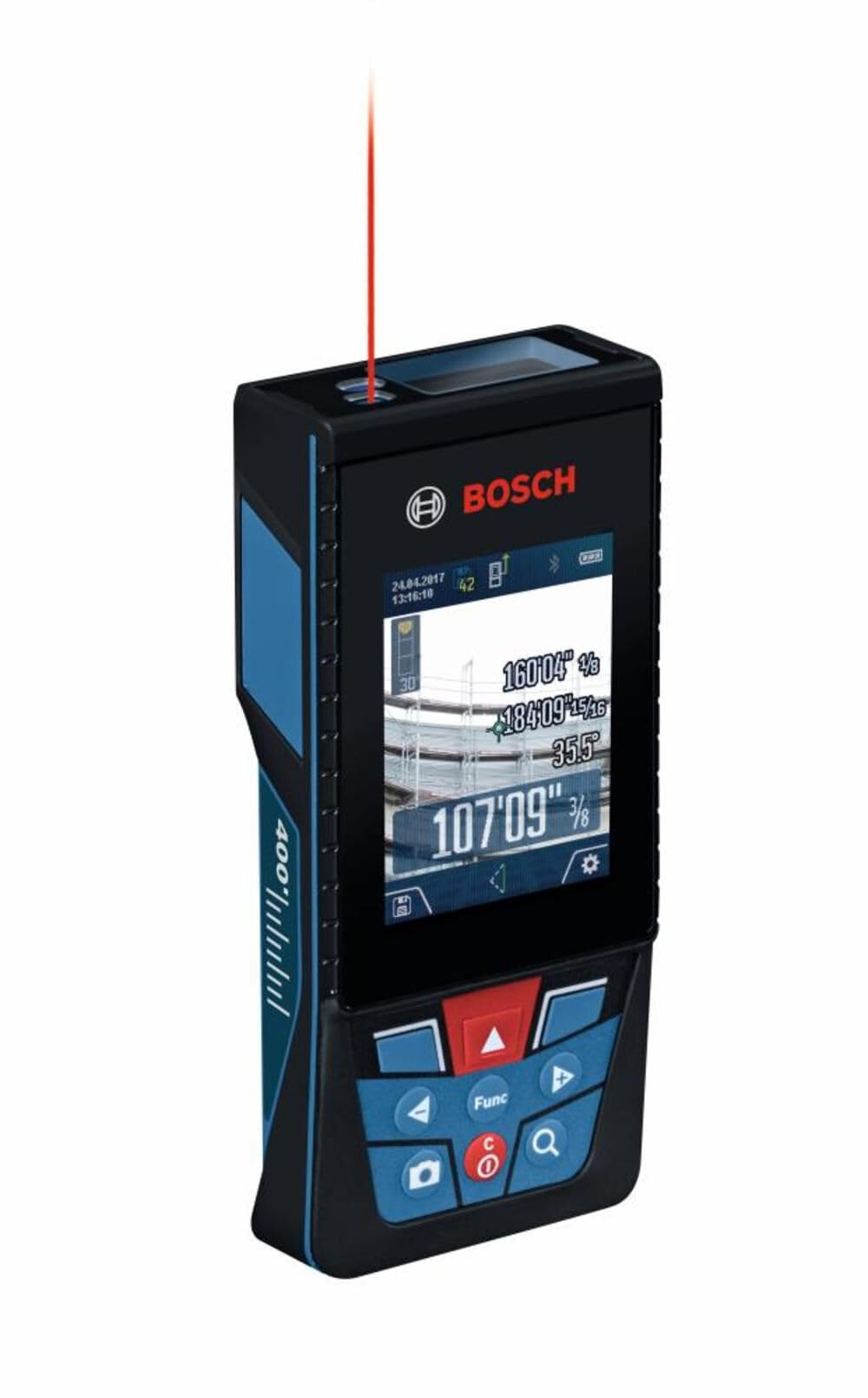
Four hundred feet of range is easy to print on a box. Seeing where the dot landed at four hundred feet is the hard part, and it's the problem this Bosch was built around: a camera with adjustable zoom shows a magnified view of the target, so you aim at a picture of the wall instead of a red speck that vanished somewhere near the far corner.

That's the shot we reach for it for — building faces, long lots, a ceiling height in a warehouse where a tape means a ladder and a second person. The measurements transfer to a phone with a photo attached, the same as the GLM 50 C, and the built-in 3.6V lithium-ion battery covers a working day of it. Indoors, in a normal house, the camera is solving a problem you don't have.

We think of it as the specialist of the set: it earns its place when your measurements start where the walls end, and it's money spent on glass and range you'll never need measuring bedrooms. It also wants charging between jobs rather than a drawer of spare AAAs, so it suits someone with a routine more than an occasional user.

Pros

  • Zoom camera locates the dot at long range
  • 400 ft range with 1/16 in accuracy
  • Rechargeable battery covers a working day
  • Bluetooth transfers measurements onto photos

Cons

  • Heavier and larger than pocket models
  • Menus take a session or two to learn
Our verdict

If your measurements run past a hundred feet or happen outdoors, the zoom camera here turns an unseeable dot into a target you can actually aim at.

Check Latest Price
3

Best for Indirect and Angled Measurements

MiLESEEY D5

91 /100
Keeper Score Outstanding

Key details

Accuracy
±2 mm
Level Accuracy
±0.3°
Measuring Range
229 ft
Stored Measurements
30
Check Price on Amazon

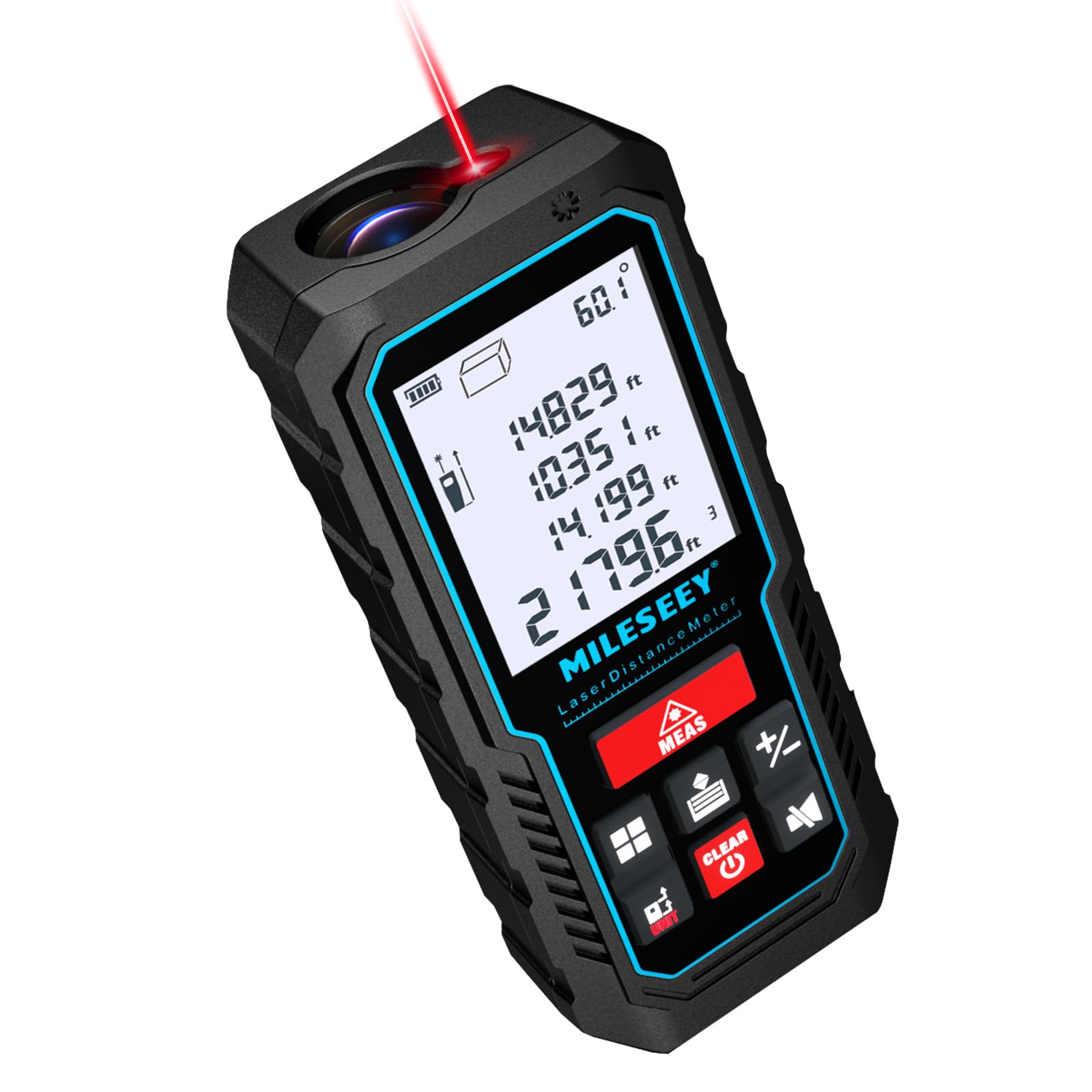
The measurement that sold us on the D5 is one a tape can't take at all: the height of a wall you can't reach, or the pitch of a ceiling you're standing under. Its angle sensor and electronic level, rated to ±0.3°, work out horizontal distance and height from a hypotenuse you can actually shoot, and the Pythagorean modes do the arithmetic. That trick is why it's here, and it's the reason to pick it over a plain 165-foot unit.

The rest of the tool holds up. Range runs to 229 feet, accuracy is ±2 mm, and 30 stored readings are more useful than they sound — walk a whole floor, then write it up sitting down. The 2-inch backlit LCD switches between meters, feet, inches and feet-plus-inches, and the box includes a pouch, batteries and a 24-month warranty.

The people who get the most from it are measuring things they can't walk to: ceiling heights for a lighting quote, gable ends, the diagonal of a room. For flat wall-to-wall work the extra modes go unused and the cheaper 165-foot tools do the same job. Where it beats them is doing the geometry on the device, with no phone involved.

Pros

  • Angle sensor and level solve heights and diagonals
  • 229 ft range with ±2 mm accuracy
  • Stores 30 readings for write-up later
  • 24-month warranty, pouch and batteries included

Cons

  • Red dot is hard to see in bright daylight
  • Chunky next to the pocket-sized picks
Our verdict

Buy the D5 if you measure heights and diagonals: the ±0.3° level and angle sensor handle geometry that a plain laser leaves to you and a notepad.

Check Latest Price
4

Best Pocket-Sized Option

Klein 93LDM100C

89 /100
Keeper Score Excellent

Key details

Weight
2.29 oz
Accuracy
±1/16 in to 30 ft; ±1/8 in to 100 ft
IP Rating
IP54
Measuring Range
2 in to 100 ft
Check Price on Amazon

Everything on the 93LDM100C runs through one button. Press it to fire the laser, press again to hold the reading, hold it to walk through modes and units — no second keypad, no menu tree. In a tool this small, that's the whole idea: nothing to look at but the target.

We think the trade is worth it for the work it's built for. Point, read, move on: 100 feet of range, ±1/16 inch through the first 30 feet and ±1/8 inch out to the full 100, a reverse-contrast display that stays readable in a dim room, and 65 grams with a pocket clip so it's on you rather than in a bag. For someone checking window openings and room dimensions all day, that's the fastest loop here.

It has a ceiling and it's honest about it. The accuracy spec steps down past 30 feet, so long shots need a pale, flat target and a steady hand, and the further you push toward 100 feet the more carefully you have to watch where the beam actually landed. The button has a snag too: press twice too quickly and you can land in the settings menu rather than holding a reading — a thing you learn once. What you get in return is a tool that never makes you think about which button does what.

Pros

  • Single-button operation is genuinely one-handed
  • 65 g with a pocket clip
  • Reverse-contrast display reads well in low light
  • ±1/16 in accuracy through the first 30 ft

Cons

  • Distance and continuous measurement only, no area or volume modes
Our verdict

For quick room and window measurements this is the one we hand people: one button, 65 grams, and accuracy that holds to a sixteenth of an inch up close.

Check Latest Price
5

Best Budget

RockSeed S2

89 /100
Keeper Score Excellent

Key details

Accuracy
±1/16 in
Warranty
2 years
IP Rating
IP54
Measuring Range
165 ft
Check Price on Amazon

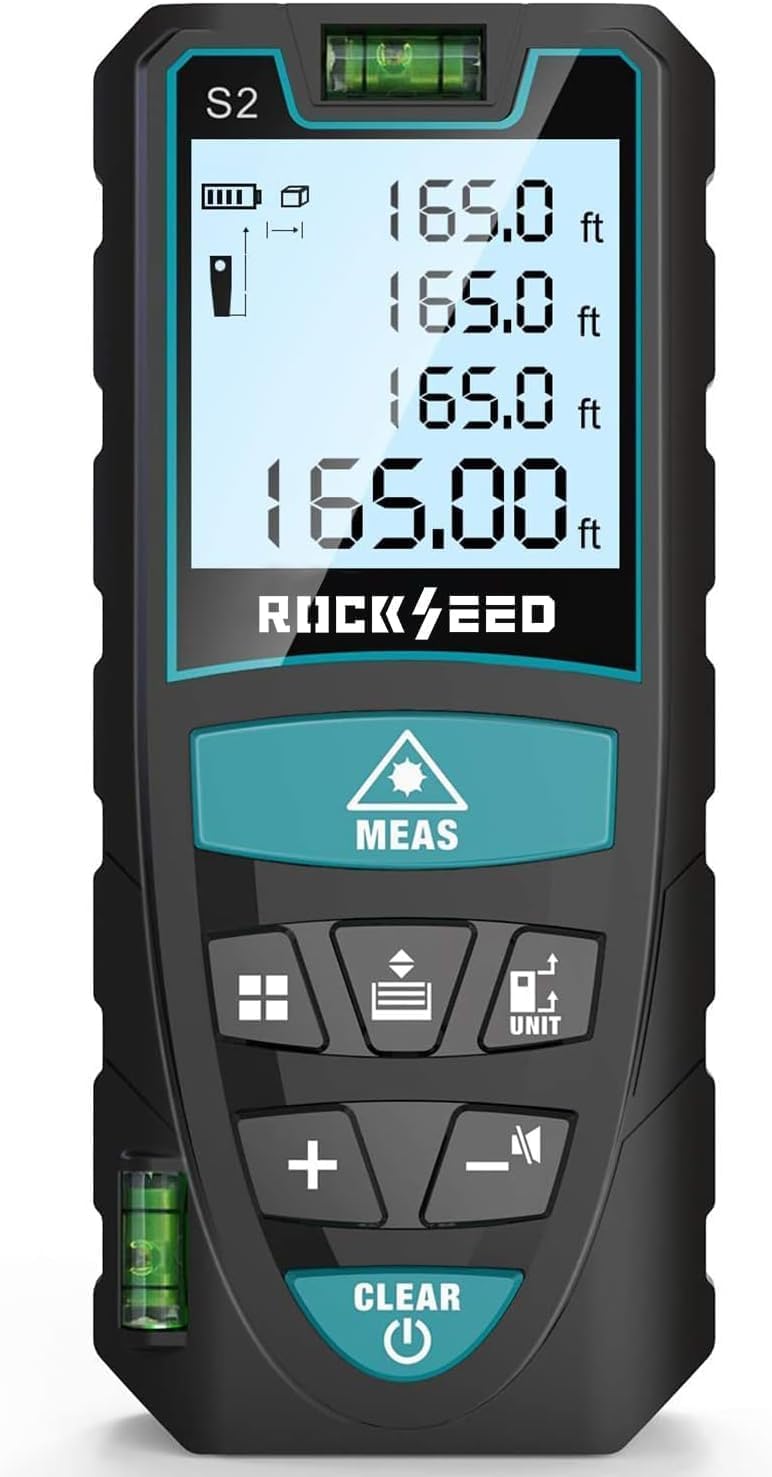
Two bubble levels is the detail that keeps the RockSeed S2 in our budget slot. A cheap laser measure loses accuracy less from its chip than from how it's held, and a second vial means you can check the tool is square before you fire — exactly the discipline a 165-foot unit needs on a tall wall or a diagonal.

The rest of the package is what a first laser measure should be: 165 feet, ±1/16 inch, distance, area, volume and Pythagorean modes, a memory for stored readings, a mute for the beep, IP54 sealing and a wrist strap. The two-year warranty is longer cover than several tools costing more, and it's the part of this package you rarely see at the bottom of the price range.

Where the savings show is over distance. Short room shots come back consistent; stretch toward the far end of the range on a dull or angled target and readings can drift by more than a tape would. Our habit with any budget unit is to check the first long shot against a tape and trust it only as far as it agrees.

Pros

  • Two bubble levels help square the tool
  • Mute setting for the measurement beep
  • Two-year warranty at a budget price
  • IP54 sealed against dust and splashes

Cons

  • Durability is the weak point at this price
  • No pouch, just a wrist strap
Our verdict

We keep the S2 as the budget pick because two bubble levels and a two-year warranty matter more at this price than a few extra feet of range.

Check Latest Price
6

Budget Long Range

ACEGMET S9

90 /100
Keeper Score Outstanding

Key details

Weight
1.76 oz
IP Rating
IP54
Measuring Range
229 ft
Stored Measurements
30
Check Price on Amazon

Two hundred twenty-nine feet of range at roughly the price of the 165-foot units is the whole argument for the S9. It weighs 50 grams, so it disappears into a shirt pocket, and it still covers distance, area, volume and Pythagorean work with a backlit LCD and 30 storable readings.

The two bubble levels are a small thing that turns out to matter: a long-range claim is worth nothing if the tool is tilted, and being able to check it against a wall before you fire is how you get a straight line down a long room. Half-second readings and the 30-reading memory mean you can walk a floor and write it up afterwards.

Call it an estimating tool rather than a layout tool, and we're comfortable with what that buys. For square footage, paint and flooring quantities, and a quick check on a room's dimensions, it does the job with the least money and least bulk in this guide. For anything that has to line up to a sixteenth — trim, cabinetry, a window that has to fit — step up to a tool with a stronger accuracy record, because this one's readings have not been as consistent as its specification suggests.

Pros

  • 229 ft range at a budget price
  • 50 g and genuinely pocket-sized
  • Two bubble levels and 30 stored readings
  • Half-second measurement response

Cons

  • Display is hard to read in bright light
  • No case included
Our verdict

We see the S9 as an estimating tool rather than a layout tool: 229 feet, 50 grams, and enough modes for square footage — just don't cut trim to it.

Check Latest Price
7

Fast Everyday Use

DTAPE DT50

91 /100
Keeper Score Outstanding

Key details

Accuracy
±1/16 in
IP Rating
IP54
Battery Life
5,000+ measurements
Measuring Range
165 ft
Check Price on Amazon

The number DTAPE leads with is 0.4 seconds — the gap between pressing the button and having a reading. On a spec sheet that looks like marketing. In a room you're pricing for flooring it changes the rhythm of the job: shoot, note, move, shoot again, with no wait between walls.

Under the speed there's a full set of modes — distance, area, volume, single and double Pythagoras, addition and subtraction, continuous measurement — plus a 2-inch backlit display, switching across feet, inches, feet-plus-inches and meters, a 165-foot range at ±1/16 inch, IP54 sealing and a claimed 5,000-plus measurements from a set of batteries. It's the smallest and least expensive thing here, and it does more than tools twice its size.

It's also the pick where error messages are part of the story. Aimed at a dark surface, glass, or something past its reach, it can throw a code and stop instead of handing back a wrong number — the better failure, if a frustrating one. Read the manual once: the front-or-back reference setting is easy to miss, and getting it wrong throws every reading off by the length of the body.

Think of it as the second measure in the bag rather than the only one. Keep it in the kitchen drawer or the glovebox, use it for the quick numbers, and reach for something with a stronger accuracy record when the number has to be right the first time. For the money, that's not a compromise so much as the split of duties we've settled on.

Pros

  • 0.4-second measurements
  • Eight modes including double Pythagoras
  • Small enough for a pocket or glovebox
  • Lowest price of the picks

Cons

  • Readings can vary between shots on the same surface
Our verdict

We treat the DT50 as a fast, cheap second measure: happiest doing quick numbers around the house rather than the ones you bet a cabinet on.

Check Latest Price

What Six Months With 12 Laser Measures Taught Us

I started by pulling every laser measure with a real customer base and sorting them into price bands, checking range, unit switching, and the modes people actually use — distance, area, volume, and the indirect height reading that gets you a ceiling without a ladder. Listings with cryptic screens or no backlight got cut. That left 12 units, from 100-foot pocket models to 400-foot connected ones.

Every unit got the same baseline first: a steel tape stretched along a 10-foot wall, a 25-foot hallway, and a two-car garage, each distance taken three times from the same mark. I compared each reading with the tape and with the other units, then ran the set again in a bright room and a dim one, because a screen that reads fine in a photo often washes out near a window.

Then they went into pockets and tool bags for six months. We sized rooms for furniture, spaced shelf brackets, laid out deck boards, and squared off paint and flooring quantities — the jobs where a bad number costs real money. I counted the button presses between power-on and a stable reading, checked whether the keypad worked one-handed, and read the display at arm's length with the backlight on.

Error codes earned their own tally. We aimed each unit at a window, a bare dark wall, and a hanging curtain to see if it recovered on the next press or forced a restart. Durability got tested the unglamorous way: waist-high drops onto concrete, a week loose in a bag with keys and screws, and an afternoon baking on a dashboard. Connected models were paired to a phone, and we asked whether the app saved a step or just repeated what was already on the screen. The units that made the list were the ones whose numbers I stopped double-checking.

How to Choose a Laser Distance Measure

Range Is a Best-Case Number

Every range figure on this page — 100 feet, 165, 229, 400 — assumes a pale, flat, reasonably perpendicular target in decent light. Indoors, 100 to 165 feet covers a whole house with room to spare; the longer numbers buy a hallway, a facade, a lot line.

Outdoors the limit isn't reach, it's whether you can see the dot at all. Red beams disappear in direct sun, which is why the long-range picks here use a camera with zoom or a much brighter green beam. Choose for the light you'll be standing in, not the number printed on the box.

Accuracy, and Where It Actually Goes Wrong

±1/16 inch is the standard claim at room distances, and a few tools step down to ±1/8 inch at the top of their range — the Klein does it past 30 feet. That figure is rarely what costs you a fit.

The reference point is. Most of these measure from either the front or the back of the body, and the wrong setting shifts every reading by the length of the tool. Set it deliberately before you start and glance at the screen icon, because it stays wrong until you change it.

What a Laser Still Can't Measure

Glass, water, dark fabric and anything shiny will either refuse a reading or return a wrong one; a sheet of white paper taped over the target fixes most of it. Very short distances, under a couple of feet, remain tape territory, and so does anything you need to run around a corner or press into a gap.

Keep a 16-foot tape in the bag alongside. Where the laser wins outright is the awkward stuff — ceiling heights, diagonals, and rooms where you'd otherwise need someone holding the other end.

Indirect Modes and Angle Sensors

Pythagorean modes derive a height from two shots you can take, and an angle sensor goes further by reading the tilt of the tool — that's how the MiLESEEY D5 returns horizontal distance and height from a single hypotenuse.

If your work involves rooflines, ceiling heights or anything you can't walk to, this is worth paying for. If every measurement is wall to wall across a level room, it's weight you'll never use.

Screens, Buttons and Records

A backlit display stops being a luxury the first time you measure under a stair, a rotating readout saves neck strain, and a mute matters in an occupied house. One-button tools are quickest in the hand and slowest to configure; multi-button tools are the reverse.

Storage is the quiet differentiator. Twenty or thirty saved readings, or an app that pins measurements to a photo, is the difference between a morning of measuring and a morning of measuring plus an evening of transcribing.

Frequently Asked Questions

Final Verdict

Most people should buy the Bosch GLM 50 C. It has the range and accuracy nearly every household job needs, a display that stays readable in the corners where measuring actually happens, and an app handoff that means the numbers survive the trip home. Nothing else here combines those three.

The exceptions are specific. Measuring outdoors or past a hundred feet, the Bosch GLM400CL's zoom camera is the difference between a reading and a guess. And if the tool is going in a drawer for occasional use, the Klein's single button and 65 grams will get picked up more often than anything with a menu.