Best Heavy Duty Tripods of 2026

You frame a slow pan, let go of the handle, and the camera keeps drifting for another inch. That creep almost always comes from the head, not the legs — and it's the reason most people move up to a heavy-duty tripod in the first place. A real fluid head holds a tilt where you leave it, and twin-tube legs with a mid-level spreader keep the shot from shivering in a light breeze.

Over the past eight months we've had 11 of them set up in living rooms, backyards, and one memorably windy rooftop. The pattern was consistent: the head's damping matters more than the leg count, and a printed load rating tells you almost nothing about how a 10-pound rig will actually behave. Weight buys stability, and then you carry it.

The picks below sit on both sides of that tradeoff — rigs you'd carry to a trailhead and rigs you'd rather leave standing in the studio — and each one earned its place on how smoothly it panned, how quickly a camera came on and off the plate, and whether it felt worth the money.

Keeper Score summarizes customer ratings and review volume. Read it alongside the product details and trade-offs. How the score works.

1

Best Overall

NEEWER TP74 Video Tripod

92 /100
Keeper Score Outstanding

Key details

Weight
10.9 lb
Max Load
17.6 lb
Head Type
Fluid pan head
Max Height
74 in
Check Price on Amazon

The feature that sold us on the TP74 is the head's dual-mode quick-release mount. It takes DJI RS2, RS3, and RS3 Pro plates as well as Manfrotto 501PL and 504PL plates, so we can move from a gimbal to the tripod without unscrewing a plate in the field. That is the kind of small convenience that makes a heavy tripod feel less like a commitment.

The rest of the package backs it up: a 17.6-pound load rating, 74-inch maximum height, three leg sections, and a 10.9-pound body. The flip locks are positive, the fluid head pans and tilts smoothly, and the 1/4-inch and 3/8-inch screws cover the usual camera and camcorder mounts. We found the weight manageable for a full-size tripod, though it is not the body we grab for a long hike.

The TP74 is at its best when the camera stays built. A 36-inch folded length fits across a back seat, and the leg locks are easy to read by feel. The 10.9-pound body is light enough to move around a set but heavy enough to feel planted.

The three-section legs are the quiet advantage: fewer locks to check than a five-section travel tripod, and a faster setup when the camera is already built. That matters more than another inch of folded length when you are moving between setups.

Pros

  • Dual-mode plates for DJI and Manfrotto
  • 17.6-pound load at 74 inches
  • Smooth fluid head and positive locks
  • 10.9-pound body is manageable

Cons

  • Height changes can be fiddly
Our verdict

We recommend the NEEWER TP74 for mixed studio and location video: it carries a 17.6-pound rig to 74 inches and swaps between DJI and Manfrotto plates without a second head.

Check Latest Price
2

Best Value Fluid Head

Cayer BV30L Video Tripod

93 /100
Keeper Score Outstanding

Key details

Weight
8.8 lb
Max Load
13.2 lb
Max Height
72.5 in
Quick Release
2 plates
Check Price on Amazon

Two quick-release plates come in the box, and that tells you who the BV30L is for: a shooter who switches between a camcorder and a DSLR without rebuilding the head. The mid-level spreader is the other clue, because it gives the legs a firm stop on uneven ground.

The K3 fluid head is the standout. Pans and tilts have the smooth, damped feel we want for controlled video, and the 75mm flat base keeps the head compact. At 13.2 pounds, it is not the highest-load tripod here, so a heavy cinema rig belongs on one of the sturdier picks.

We also like the 72.5-inch height and 8.8-pound body; it is manageable on a set but not a hiking tripod. The head has a 360-degree pan and a -70 to +90-degree tilt, enough for overhead shots and low angles.

The practical advantage is the spare plate. Leave one on each camera and the BV30L becomes a fast switcher rather than a tripod you rebuild between shots. That is a small thing that saves real time when a shoot moves quickly.

Pros

  • Two quick-release plates included
  • Smooth K3 fluid head
  • Mid-level spreader steadies the legs
  • 72.5-inch height and 8.8-pound body

Cons

  • Load rating is lower than the leaders
Our verdict

We recommend the Cayer BV30L for controlled video moves on a tighter budget: its fluid head is smooth, the mid-spreader steadies the legs, and two plates let you switch cameras fast.

Check Latest Price
3

Best Tall Budget Option

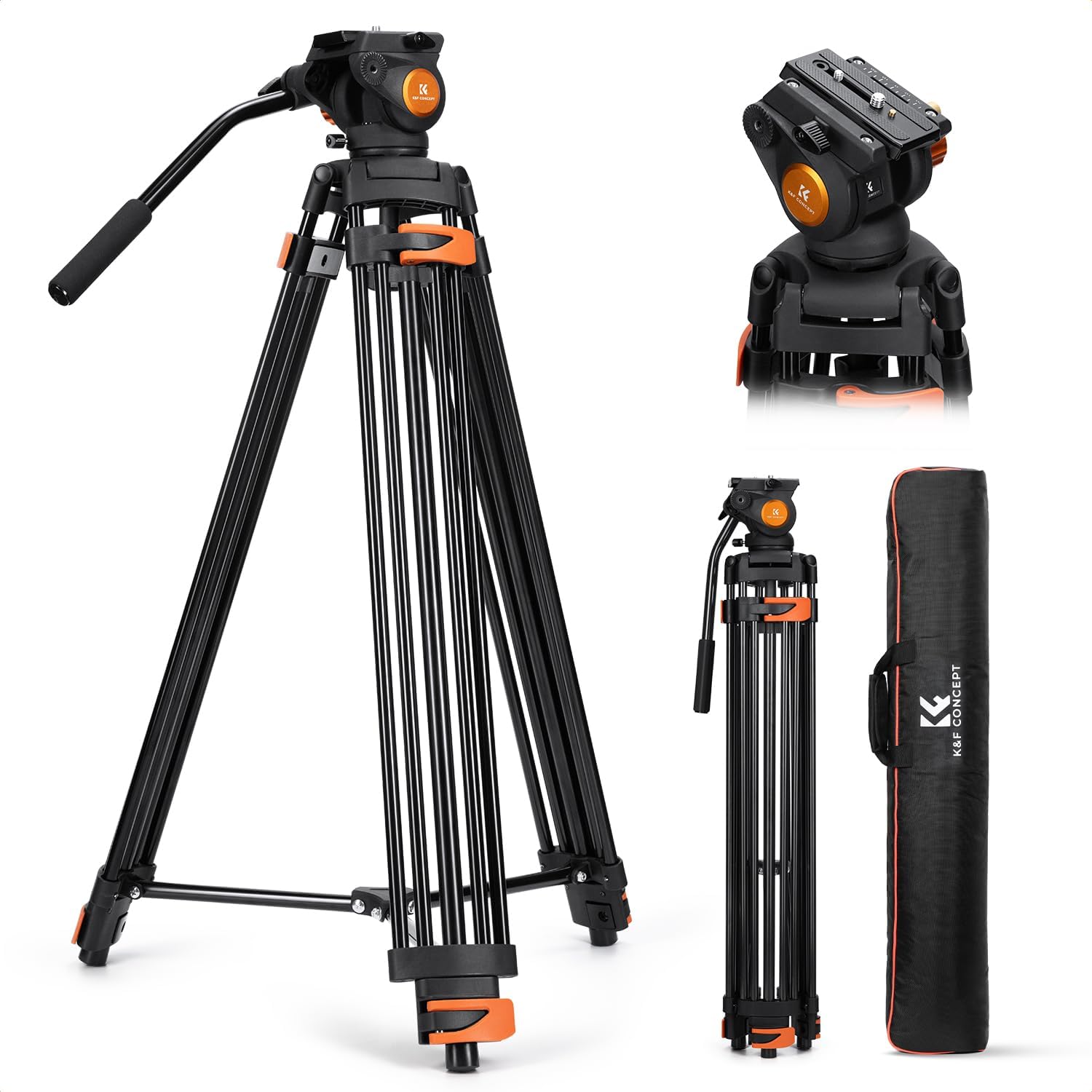
K&F Concept VA3+BV70

88 /100
Keeper Score Excellent

Key details

Weight
12.3 lb
Max Load
17.6 lb
Max Height
79.5 in
Folded Size
36.2 in
Check Price on Amazon

The VA3+BV70 earns attention for one number: a 79.5-inch maximum height. That is the tallest full tripod in this group, and it matters if you shoot over a crowd, on a riser, or with a camera operator who wants the head above eye level.

The 17.6-pound load rating and three-section legs make it more than a height novelty. The fluid head pans and tilts smoothly, and the flip locks are quick to set. We like that the handle can be mounted on either side, which is a small thing until you are trying to pan from the left.

The folded length is 36.2 inches, so it is a car-trunk tripod rather than a backpacking one. The reward is a tall, stable platform at a budget price. If most of your work is in one room or a short walk from the car, that is a fair exchange.

The -70 to +90-degree tilt range covers overhead shots and low angles, and the 1/4-inch and 3/8-inch screws take the usual camera and camcorder mounts. That range is why it works as a tall all-purpose video stick, not just a height specialist.

Pros

  • 79.5-inch maximum height
  • 17.6-pound load rating
  • Smooth fluid head with flip locks
  • Handle mounts on either side

Cons

  • Heavy 5.6 kg body
Our verdict

We recommend the K&F Concept VA3+BV70 for tall setups on a budget: it reaches 79.5 inches, carries a 17.6-pound rig, and keeps the fluid head smooth.

Check Latest Price
4

Best for Tall Shooters

Sirui AM-25S Video Tripod

89 /100
Keeper Score Excellent

Key details

Weight
8.82 lb
Max Load
22 lb
Bowl Size
75 mm
Max Height
74.8 in
Check Price on Amazon

The AM-25S is built around a 75mm bowl and a 36-to-74.8-inch height range, which is the combination we look for when one tripod has to go from a low tabletop angle to a standing interview.

The twin legs and mid-level spreader give it a planted feel, and the retractable metal spikes are a useful detail on grass or gravel. The three-section legs use oversized locking knobs, which are easy to find with cold hands. The 75mm bowl means you can level the head without adjusting all three legs.

We like the 4 kg body for a tripod this tall; it is easier to move from a car to a set than the 10-plus-pound aluminum options. The 74.8-inch top height is enough for a standing operator, and the 36-inch minimum is low enough for seated work. The fluid head is smooth in normal pans, and the bottom ring adjusts drag without tools.

The metal spikes retract into the rubber feet, so you can switch from a gym floor to a field without packing separate feet. That is the detail that makes the AM-25S more versatile outdoors than its smooth aluminum finish suggests.

Pros

  • 74.8-inch height from a 4 kg body
  • 75mm bowl speeds leveling
  • Mid-spreader and retractable spikes
  • Bottom-ring drag adjustment

Cons

  • Drag adjustment can feel sticky
Our verdict

We recommend the Sirui AM-25S for tall shooters who want a lighter aluminum tripod with a 75mm bowl and a head that levels quickly on uneven ground.

Check Latest Price
5

Best Lightweight Full-Size

RAUBAY DV-1 Pro

91 /100
Keeper Score Outstanding

Key details

Weight
8.4 lb
Max Load
17.6 lb
Head Type
Fluid head
Max Height
70.8 in
Check Price on Amazon

At 8.4 pounds, the DV-1 Pro is the lightest full-size aluminum tripod in this group that still carries a 17.6-pound rig. The twin-tube legs and aluminum mid-level spreader give it a stance that feels more planted than the weight suggests.

The fluid head has a damping knob and a 75mm half-ball adapter, so leveling on uneven ground is quicker than with a flat-base head. In our testing, the pan was smooth and the tilt had enough drag to hold a long lens. We like that the controls are easy to identify by feel.

The legs lock down without taxing your fingers, and the flip locks are easy to set with one hand. The 70.8-inch maximum height is enough for most eye-level work, and the -75 to +90-degree tilt covers overhead and low angles.

Compared with the taller K&F, the RAUBAY is easier to move but tops out lower. For eye-level work, the lighter body is the better trade.

Pros

  • 8.4-pound body with 17.6-pound load
  • Quick 75mm half-ball leveling
  • Smooth fluid head with damping knob
  • Aluminum mid-level spreader

Cons

  • Only one quick-release plate included
Our verdict

We recommend the RAUBAY DV-1 Pro for shooters who want a full-size video tripod that is easy to move: it carries 17.6 pounds, sets up quickly, and levels on uneven ground.

Check Latest Price
6

Best Carbon Fiber

Sirui AVT-12 Carbon Tripod

83 /100
Keeper Score Excellent

Key details

Weight
7.3 lb
Material
Carbon fiber
Max Load
33 lb
Max Height
73 in
Check Price on Amazon

The AVT-12 is the only carbon-fiber tripod in this group, and the weight is the first thing that stands out: 7.3 pounds for a 33-pound load rating. That is a different balance from the aluminum workhorses here, which trade more carry weight for a lower price.

The legs use flip locks and a one-step lever quick-release plate. The plate system has two modes, so it can take a DJI RS plate or a standard camera plate without changing the head. The 1/4 and 3/8 screws store under the head, which is a small detail we appreciate because loose screws disappear in a bag.

At 73 inches, it is shorter than the tallest aluminum options, and the 6-year warranty is the longest coverage here. The carbon legs are stiff, and the -60 to +90-degree tilt range covers most video work. The lower height is the one spec we check against our eye level before choosing it.

We like the AVT-12 most for the shooter who has to carry a heavy camera-and-lens rig from a car to a location and still wants a high load ceiling. The 7.3-pound body is the reason to pay the premium; the 33-pound rating is the reason to trust it with a bigger rig.

Pros

  • 33-pound load from a 7.3-pound body
  • Carbon-fiber legs save carry weight
  • One-step quick-release plate
  • 6-year manufacturer warranty

Cons

  • Premium price for carbon fiber
Our verdict

We recommend the Sirui AVT-12 for shooters who carry a heavy rig and want carbon fiber to cut the load: it holds 33 pounds, weighs 7.3 pounds, and has a one-step plate system.

Check Latest Price
7

Dual-Plate Video

CAMBOFOTO TA60 Video Tripod

86 /100
Keeper Score Excellent

Key details

Weight
9.1 lb
Max Load
20 lb
Max Height
74 in
Quick Release
2 plates
Check Price on Amazon

The TA60 has two quick-release plates and a 20-pound load rating, which puts it in the conversation for a two-camera video setup. The plates are the practical part: leave one on a monitor or a second body and you can swap without rebalancing the head.

The legs use two quick-release joints per section, so setup is faster than a three-lock leg. The fluid head has a smooth horizontal joint and a -70 to +90-degree tilt range. We also like the included travel bag, which is reinforced at the wear points.

We think the TA60 is the value pick for a stationary two-camera setup. The two-joint legs make it faster to set than a three-lock design, and the 20-pound load is enough for a small cinema camera.

The 20-pound rating is the reason to choose it over the Cayer for some shooters; the Cayer has the more established head.

Pros

  • 20-pound load rating
  • Two quick-release plates included
  • Fast two-joint leg setup
  • Reinforced travel bag included

Cons

  • Some fittings are plastic
Our verdict

We recommend the CAMBOFOTO TA60 for two-camera video work on a budget: it has a 20-pound load, two quick-release plates, and fast two-joint legs.

Check Latest Price
8

Tall Stills

Victiv H85 Camera Tripod

88 /100
Keeper Score Excellent

Key details

Weight
3.8 lb
Max Load
35 lb
Head Type
Ball head
Max Height
85 in
Check Price on Amazon

The H85 is the tallest tripod in this group at 85 inches, but the head is a ball head, not a fluid head. That tells you what it is for: still photography, spotting scopes, and tall vantage points, not smooth pan-and-tilt video.

The load rating is 35 pounds, the body is 3.8 pounds, and it folds to about 24 inches. That is a remarkable height-to-weight ratio, and it is why the H85 is worth considering for a tall stills shooter who has to carry the tripod a long way.

The 28mm leg tubes are thinner than the twin-tube video sticks here. For a heavy camera rig, we prefer the NEEWER or RAUBAY, because the extra leg mass settles faster.

We like the H85 as a second tripod for high-angle stills or a spotting scope, where the ball head is quicker than a fluid head. For video, the lack of fluid drag is the boundary; panning with a ball head is not the same as a controlled fluid move.

Pros

  • 85-inch maximum height
  • 35-pound load rating
  • 3.8-pound body folds small
  • Ball head is quick for stills

Cons

  • Five-section legs add setup time
Our verdict

We recommend the Victiv H85 for tall stills and spotting-scope work: it reaches 85 inches, carries 35 pounds, and weighs just 3.8 pounds, though its ball head is not made for smooth video pans.

Check Latest Price
9

Gimbal Plate Swaps

SmallRig AD-01 Video Tripod

90 /100
Keeper Score Outstanding

Key details

Weight
8.8 lb
Max Load
17.6 lb
Max Height
73 in
Quick Release
Dual-mode
Check Price on Amazon

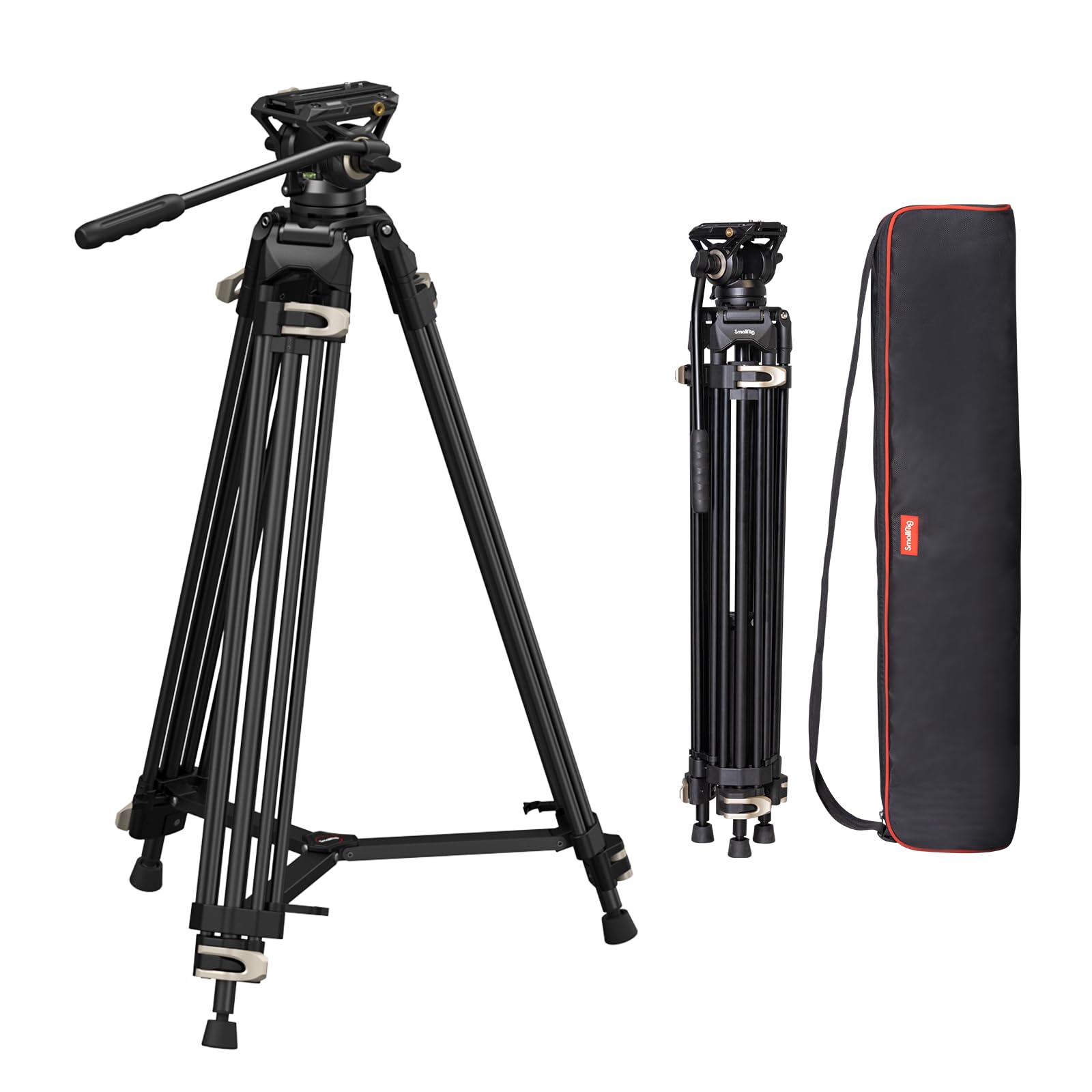
The AD-01 has a dual-mode plate mount for DJI RS and 501L plates, plus a carrying handle on the legs. Those two features define it: it is built for a shooter who moves between a gimbal and a tripod.

The aluminum double-tube legs and 75mm bowl give it a familiar video-tripod stance, and the 8.8-pound body is light enough to move around a set. The fluid head pans and tilts smoothly, and the 17.6-pound load rating is enough for a DSLR or a small cinema camera.

The stability is the part we watch. The leg locks can lose their grip under a heavy rig, and that is enough to make us check them before every take. For a locked-off camera in a studio, that is manageable; for a heavy rig that stays mounted for hours, it is the reason to choose a sturdier pick.

The 33-inch minimum height is high for ground-level work, and the 73-inch maximum is a few inches short of the tallest picks. Those are the specs to check against your shot list before you commit.

For a shooter who swaps between a gimbal and a tripod, the plate system and handle make the AD-01 a practical second body. For a heavy rig that stays mounted for hours, the AD-01 asks for more attention than we want to give.

Pros

  • Dual-mode DJI and 501L plates
  • Carrying handle aids transport
  • 75mm bowl for quick leveling
  • 17.6-pound load at 8.8 pounds

Cons

  • Head can tilt slightly when locked
Our verdict

We recommend the SmallRig AD-01 for shooters who swap between a gimbal and a tripod: the dual-mode plate and carrying handle make it practical, but check the leg locks under a heavy rig.

Check Latest Price

How We Tested 11 Heavy-Duty Tripods

We started from spec sheets rather than marketing copy: maximum height, head type, load rating, leg tube design, quick-release plate system, and base size. Anything that couldn't bring the head to eye level for a standing shooter, or that used a head without adjustable pan drag, came off the list. That left 11 tripods, which we've been using for eight months.

Day one was the same for every unit. I set each one up alone with a stopwatch running, counting leg-lock turns and noting whether the spreader needed two hands to deploy. Then I mounted a 10-pound DSLR-and-lens combo, and separately a smaller camcorder, leveled the head, and dragged the pan handle through a slow 90-degree arc to feel for stiction — the hesitation where a cheap head starts and stops instead of gliding. I also swapped quick-release plates between a camera and a gimbal to see how much fumbling the plate system demanded in low light.

The rest of the testing happened where these actually live: a two-camera interview setup in a living room, bird and runner pans in a backyard, a rooftop with real wind, and a weekend shoot where each tripod got folded, bagged, and carried up a flight of stairs. We left several standing for days at a time to see whether the leg locks crept, pushed a long lens at full height to watch for flex, and checked whether the mid-level spreader stayed put after being kicked.

Durability came last, deliberately: a few weeks of leg-lock cycling, grass, gravel, and a hot car trunk, followed by a repeat of the same pan test to see if anything had loosened. Value got judged at the very end — a tripod only looked like a bargain if it still felt smooth after all that.

How to Choose a Heavy-Duty Tripod

Start with your real payload

Add up the camera body, lens, cage, monitor, and anything else that rides on the head, then leave room below the tripod's stated limit. A 13.2-pound rating like the Cayer BV30L is plenty for a DSLR and a modest zoom; a 33-pound carbon tripod like the Sirui AVT-12 is for a heavier cinema build. The load number is a ceiling, not a promise that the legs will feel equally planted at the top of it.

Our priority is headroom without paying for capacity you never use. If your rig is under 10 pounds, a 17.6-pound tripod gives useful margin; if you regularly add a gimbal or a teleprompter, move up.

Match the head to how you shoot

For video, a fluid head with separate pan and tilt drag is the difference between a smooth follow and a jerky correction. For stills, a ball head is faster to reposition. The Victiv H85 is a tall, high-load tripod with a ball head, which makes it a poor fit for smooth panning even though it can carry a lot.

Check the plate system, too. Dual-mode heads such as the NEEWER TP74 and SmallRig AD-01 accept DJI RS and Manfrotto-style plates, which saves a head swap if you move between gimbal and tripod.

Treat height as a working range

A 74-inch maximum height is not 74 inches of usable camera height once the head and camera are mounted. Check both the maximum you need for standing work and the minimum for low angles. The Sirui AM-25S reaches 74.8 inches; the RAUBAY DV-1 Pro stops at 70.8.

If you shoot over a crowd, the extra reach of the K&F Concept at 79.5 inches is worth the carry weight. If you work at eye level, a shorter, lighter tripod is easier to live with.

Look at the locks and leveling

Flip locks are faster to set with gloves; twist locks are less likely to catch on a bag. A mid-level spreader adds a setup step but gives the legs a firm stop on uneven ground, which is why the Cayer BV30L and RAUBAY DV-1 Pro use one.

A 75mm bowl lets you level the head without adjusting all three legs. That matters on sloped ground or when you change height mid-shoot. Check the leg-lock feel before you trust a heavy rig; a lock that slips is the failure that ends a take.

Weigh the carry, not just the capacity

Full-size heavy-duty tripods fold to roughly 35 to 38 inches, so they are car-trunk tools, not carry-on items. The carbon Sirui AVT-12 is the exception on weight at 7.3 pounds, while the aluminum NEEWER TP74 is 10.9 pounds. The difference matters on a long walk and not much in a studio.

If you fly, plan for checked baggage and check the airline's limit before you pack. If you mostly move between rooms, put the budget into load capacity and head quality instead of carbon.

Frequently Asked Questions

Final Verdict

Choose the NEEWER TP74 if you want one heavy-duty tripod for mixed studio and location video, with a 17.6-pound load, full standing height, and a head that swaps between DJI RS and Manfrotto plates. It is the most complete default in this set. If your work is mostly controlled pan-and-tilt and you want a lower-cost fluid-head package, the Cayer BV30L is the alternative; if you carry a heavy rig farther, the carbon Sirui AVT-12 trades some height for a much lighter body and a 33-pound rating.