Best Carbon Fiber Tripods of 2026

Carbon fiber's whole pitch is simple: it shaves pounds off your shoulder without giving up stiffness. The catch is that the words "carbon fiber" on a spec sheet don't guarantee either one. A light tripod that shivers in a gust is worse than the aluminum one you left in the car, and I've babysat enough long exposures to be picky about which legs I trust.

My team and I have spent the past eight months shooting on nine carbon fiber tripods, from five-section compacts that disappear into a daypack to three-section stands built for heavier glass. The differences rarely live in the weave. They show up in how the leg locks feel in cold fingers, how much the legs wind up when you nudge the head, and whether the folded length is genuinely carry-on friendly. Two specs get overrated: the load rating on the box, which says nothing about torsion, and the included head, which on several of these is the first thing you'll want to replace.

The picks below are the ones that stayed steady, packed small, converted cleanly when we needed a monopod, and still felt worth the money after months of real use.

Keeper Score summarizes customer ratings and review volume. Read it alongside the product details and trade-offs. How the score works.

1

Best Overall

NEEWER LITETRIP LT32

88 /100
Keeper Score Excellent

Key details

Weight
2.6 lb
Max Height
62 in
Folded Length
17 in
Load Capacity
22 lb
Check Price on Amazon

Two and a half pounds of tripod holding up to 22 pounds of camera: that ratio is why the LITETRIP LT32 is the one we recommend to most people. It packs to 17 inches, stands 62 inches, and it does the two things that separate a travel tripod you use from one you leave at home — it goes up fast and it comes down small. The spring flip buckles are the best leg locks in this group: a half-open flick releases a section, and the lever snaps back to a stop you can feel.

The head is the compromise. It's a leveling head first — a flip lock on the base gives 15 degrees of correction either way, which straightens a horizon in a second instead of three — and the dual U slots drop the camera 90 degrees for verticals. Between those positions the tilt range is narrow, and that's the one thing keeping this from being a universal answer. For landscape, architecture, and portrait work it costs you nothing. Point a long lens at the sky and you'll want a different head.

Two details we appreciated: the plate is Arca-type and shaped to work in Peak Design clamps, so existing plates and L-brackets carry over, and there are two quarter-inch threads on the body for accessories. The buckles are light to the touch, so run a hand down all four before you walk away from the camera. Midrange money, and the tripod we take when we only take one.

Pros

  • 2.6 lb body with a 22 lb load rating
  • Flip buckles set and confirm lock fast
  • Arca plate works in Peak Design clamps
  • Leveling base speeds up horizon correction

Cons

  • Narrow head tilt limits steep up and down angles
Our verdict

We recommend it to most photographers: 2.6 pounds, 62 inches, and a leveling base that saves time on every setup. Just know the head's tilt is narrow before you point a long lens skyward.

Check Latest Price
2

Best for Heavy Lenses

SIRUI AM-324

88 /100
Keeper Score Excellent

Key details

Weight
3.1 lb
Max Height
57.1 in
Leg Diameter
32 mm
Load Capacity
39.8 lb
Check Price on Amazon

What the AM-324 doesn't have is a center column, and that absence is the reason to buy it. With nothing sliding through the middle, the legs carry the load straight down, and SIRUI builds the top section from 32 mm carbon — within a hair of the widest tube here. Fewer joints and wider tubes are the two things that make a tripod feel dead under a long lens, and this one has both.

The trade is height. Maximum is 57.1 inches, several inches under the K&F and more than a foot below the INNOREL, so a tall photographer works with the camera around chest height. Three leg angles at 22, 55, and 85 degrees and a 3.1-inch minimum go some way toward making up for it: for low-angle, macro, and ground-level work this is the most capable tripod in the group, and that's what makes it the useful one when the shot is close to the ground.

If you already own a ball head you trust, this is where it belongs — the AM-324 is priced as legs rather than as a kit, so plan accordingly. The rated load is 39.8 pounds and the whole tripod is about three, with silica gel sleeves on two of the legs that make cold-morning carries less unpleasant and a six-year warranty, the longest coverage in this roundup. Heavy glass, a fixed position, and a camera close to the ground: that's the job description.

Pros

  • 32 mm carbon legs, the stiffest top section here
  • 39.8 lb load rating handles long glass
  • Three leg angles down to a 3.1-inch minimum
  • Six-year warranty, the longest in this group

Cons

  • 57.1-inch maximum sits below eye level for tall users
  • 20.5-inch folded length is long for a daypack
Our verdict

Buy it if your heaviest lens is the reason you own a tripod: 32 mm legs and no center column make it the stiffest support here, as long as 57 inches is tall enough for you.

Check Latest Price
3

Best for Tall Photographers

INNOREL KT324C

91 /100
Keeper Score Outstanding

Key details

Weight
3.4 lb
Max Height
71 in
Folded Length
20.3 in
Load Capacity
55 lb
Check Price on Amazon

Standing 71 inches tall puts the KT324C above every other tripod here, more than a foot over the SIRUI. That's the whole argument: shooting over a crowd, working a slope where your feet won't sit level, or framing something you can't crouch to. It holds up there, too — the load rating is 55 pounds and the 32.5 mm tubes are the widest in the roundup.

Height from a 3.4-pound tripod has a catch, and INNOREL builds the answer into the design: a hook under the column for hanging a bag. Take it seriously. At full extension this tripod is top-heavy, and the difference between a sharp frame and a blurred one in a breeze is often a camera bag swinging underneath. The two-section center column adds 16 inches when you want the reach and comes out completely when you don't.

What it doesn't do is pack small. At 20.3 inches folded it's nearly three inches longer than the top pick, so it lives in a car, a studio, or a pack with an outside strap rather than in a daypack. It also arrives without a head, which means the head you put on it decides whether you get the stiffness those legs are paying for.

Pros

  • 71-inch maximum height, the tallest here
  • 55 lb load rating from a 3.4 lb tripod
  • Removable two-section center column adds 16 inches
  • Hook, spikes, and bag included

Cons

  • 20.3-inch folded length is long for travel
Our verdict

Our pick when height decides the shot: 71 inches and a 55-pound rating, with a hook that earns its keep in wind.

Check Latest Price
4

Best Full-Height Travel Tripod

K&F Concept O255C4+BH-28L

88 /100
Keeper Score Excellent

Key details

Weight
2.9 lb
Max Height
68 in
Folded Length
16.5 in
Load Capacity
22 lb
Check Price on Amazon

Five leg sections get this K&F to 68 inches and down to 16.5 inches packed, at just under three pounds. That's a lot of range in one bag, and it's the reason to look at it. The arithmetic is worth understanding first: the fifth section is the thinnest tube on the tripod and only comes into play in the last stretch of height. Below 60 inches with the column down, this is a steady tripod. At the top of its range in a breeze, it's the least settled of the picks here.

The rest of the package is generous. Twist collars on five sections are slower than flip levers but they don't snag on straps, the column unscrews so a leg becomes a monopod, the 28 mm ball head pans a full 360 degrees, and there's a phone mount in the box. Folded, it's daypack territory at 16.5 inches rather than pocket territory.

Our advice is to treat 68 inches as a ceiling rather than a working height: raise the column last, hang a bag on the hook, and it behaves like a much more expensive tripod. If wind and long exposures are your normal conditions, the extra for the SIRUI's legs is money well spent. If you want height and reach without paying premium money, this is the best value in the group at full stretch.

Pros

  • 68-inch reach from a 2.9 lb tripod
  • Leg converts to a monopod without tools
  • Folds to 16.5 inches
  • 22 lb load rating with a 28 mm ball head

Cons

  • Thinnest leg section gets shaky at full height in wind
Our verdict

The best value at full height here, provided you treat 68 inches as a ceiling and keep the column down when the wind picks up.

Check Latest Price
5

Best Budget Pick

NEEWER N55C

90 /100
Keeper Score Outstanding

Key details

Monopod
One leg detaches
Leg Locks
Quick-release levers
Max Height
66 in
Load Capacity
26.5 lb
Check Price on Amazon

Sixty-six inches and a 26.5-pound load rating for less than any other tall tripod in this group: that's the N55C's case, and it's a good one. It's the pick for someone who wants height and payload without paying midrange money, and the hardware is honest rather than placeholder — eight-layer carbon tubes and a two-lock ball head with a 360-degree pan dial.

We appreciate the leg locks most. They're quick-release levers rather than twist collars, so a leg extends with a flick and locks without you hunting for a collar in the dark. One leg unscrews to become a monopod, which is what makes this useful for video and sport as well as stills, and there's a carry bag in the box.

Where it gives ground is refinement. The head has two locks and a pan dial but no leveling base, so setting a horizon takes longer than on the LT32, and the tubes are built from eight layers rather than the thicker walls on the SIRUI. Neither matters much with a normal lens. Both matter with a heavy zoom and a slow shutter, and that's the honest boundary of what this tripod is for.

Pros

  • 66-inch height and a 26.5 lb rating
  • Quick-release lever legs set up fast
  • One leg converts to a monopod
  • Costs less than the midrange picks here

Cons

  • No leveling base, so horizons take longer to set
Our verdict

We point value hunters here first: 66 inches and a 26.5-pound rating for less than the midrange picks, with a monopod in the deal.

Check Latest Price
6

Best for Studio and Macro

Manfrotto MT055CXPRO3

86 /100
Keeper Score Excellent

Key details

Weight
4.4 lb
Max Height
66.9 in
Center Column
90° horizontal
Load Capacity
19.8 lb
Check Price on Amazon

The Q90 column is why this tripod exists. Pull one lever and the center column swings 90 degrees to horizontal, so the camera hangs over a table, a document, or a product from directly above — a copy stand in a couple of seconds. Nothing else in this group does that, and if you shoot flat-lay or tabletop work regularly, it's worth the rest of the compromises.

Three leg sections rather than four or five is a deliberate choice: fewer joints, thicker tubes, fewer locks to release before the tripod is up. It goes from bag to standing faster than the five-section picks here. The rotating bubble level sits in the top casting where you can read it from above while you adjust, and the Easy Link port takes a light, a monitor arm, or a clamp off the side.

The compromises are weight and price. At 4.4 pounds and 30 inches folded it's the heaviest and longest-packed tripod in the roundup, which rules out hiking and most travel, and it's the most expensive here by a wide margin. If you make top-down frames once a month rather than once a week, a cheaper tripod and a macro rail get you the same view for a lot less.

Pros

  • Q90 column swings to horizontal for top-down work
  • Three-section legs set up quickly
  • Rotating bubble level readable from above
  • Easy Link port for accessories

Cons

  • 4.4 lb and 30 inches folded rule out travel
Our verdict

The one we recommend for tabletop and copy work: the 90-degree column does what no other tripod here can, and the weight is the price of it.

Check Latest Price
7

First Carbon Tripod

K&F Concept O254C2+BH-36

86 /100
Keeper Score Excellent

Key details

Weight
2.5 lb
Ball Head
36 mm
Max Height
64 in
Load Capacity
17.6 lb
Check Price on Amazon

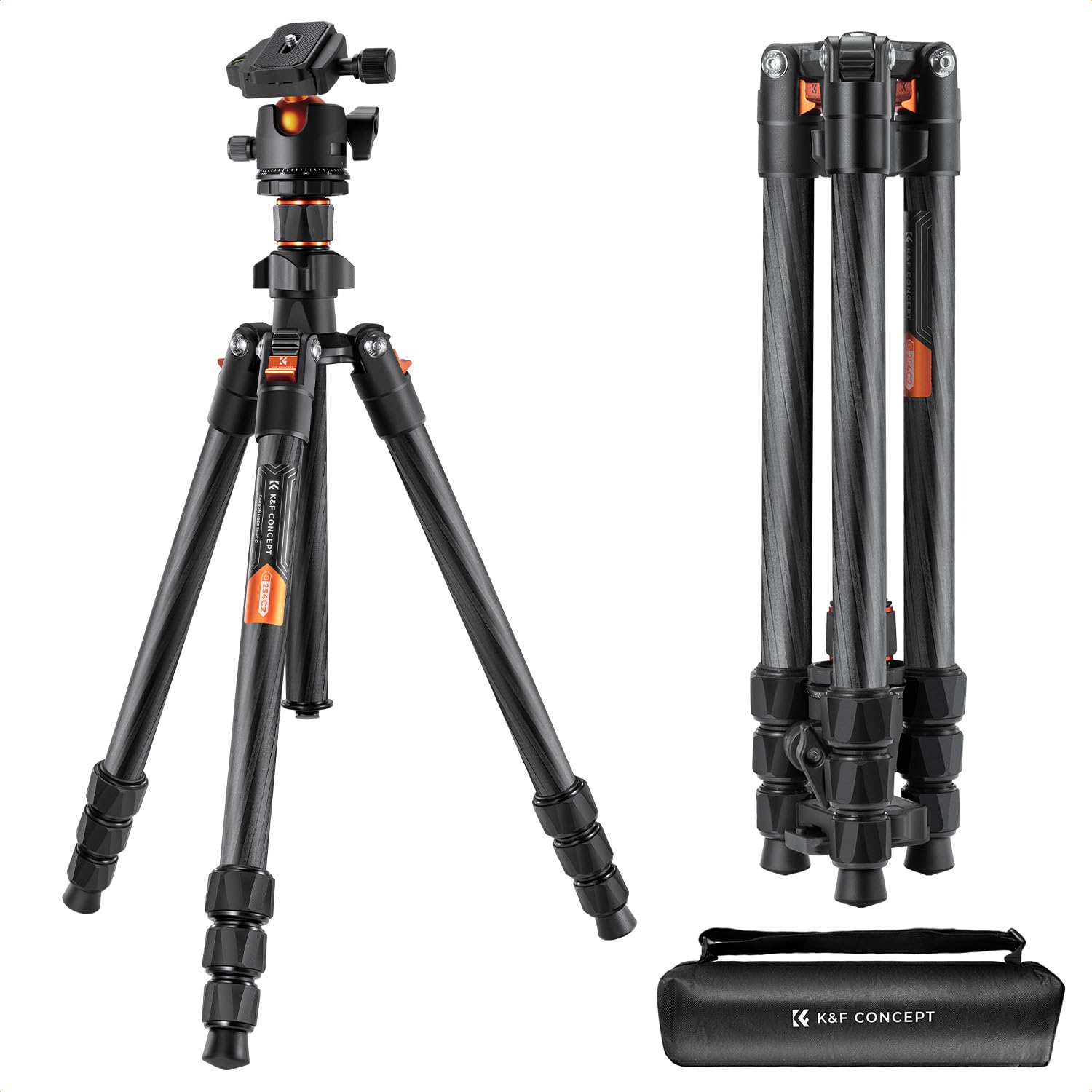
If this is your first carbon tripod, the O254C2 is the sensible place to start. It's the least expensive carbon kit with a head attached in this group, and nothing about it reads as a starter tripod: two and a half pounds, 64 inches of reach, a 17.6-pound load rating, and a 36 mm ball head that's larger than several more expensive picks carry.

That ball head is the part we like most. It's a size up from the 28 mm head on the 68-inch K&F, and a bigger ball holds small framing adjustments where you put them instead of drifting as you lock down. The center column inverts and a short column comes in the box, so you can drop the camera to ground level without hunting for an accessory.

It gives ground in speed and polish rather than capability. Four twist collars per leg take longer to raise than flip levers, the working minimum is 21.2 inches before you invert the column, and the 4.4-star average sits below the leaders here. None of that changes a photograph. If you want carbon, a head, and a tall working height without stretching the budget, this is the one.

Pros

  • 36 mm ball head, larger than most here
  • 2.5 lb with a 64-inch maximum
  • Inverts for low work with a short column included
  • Least expensive carbon kit with a head here

Cons

  • Twist locks deploy more slowly than flip levers
Our verdict

A sensible first carbon tripod: 2.5 pounds, 64 inches, and a 36 mm ball head, with slower twist locks the main thing you give up.

Check Latest Price
8

Light Travel Kits

Cayer CH35

88 /100
Keeper Score Excellent

Key details

Ball Head
42 mm
Max Height
53.6 in
Folded Length
17.7 in
Load Capacity
11 lb
Check Price on Amazon

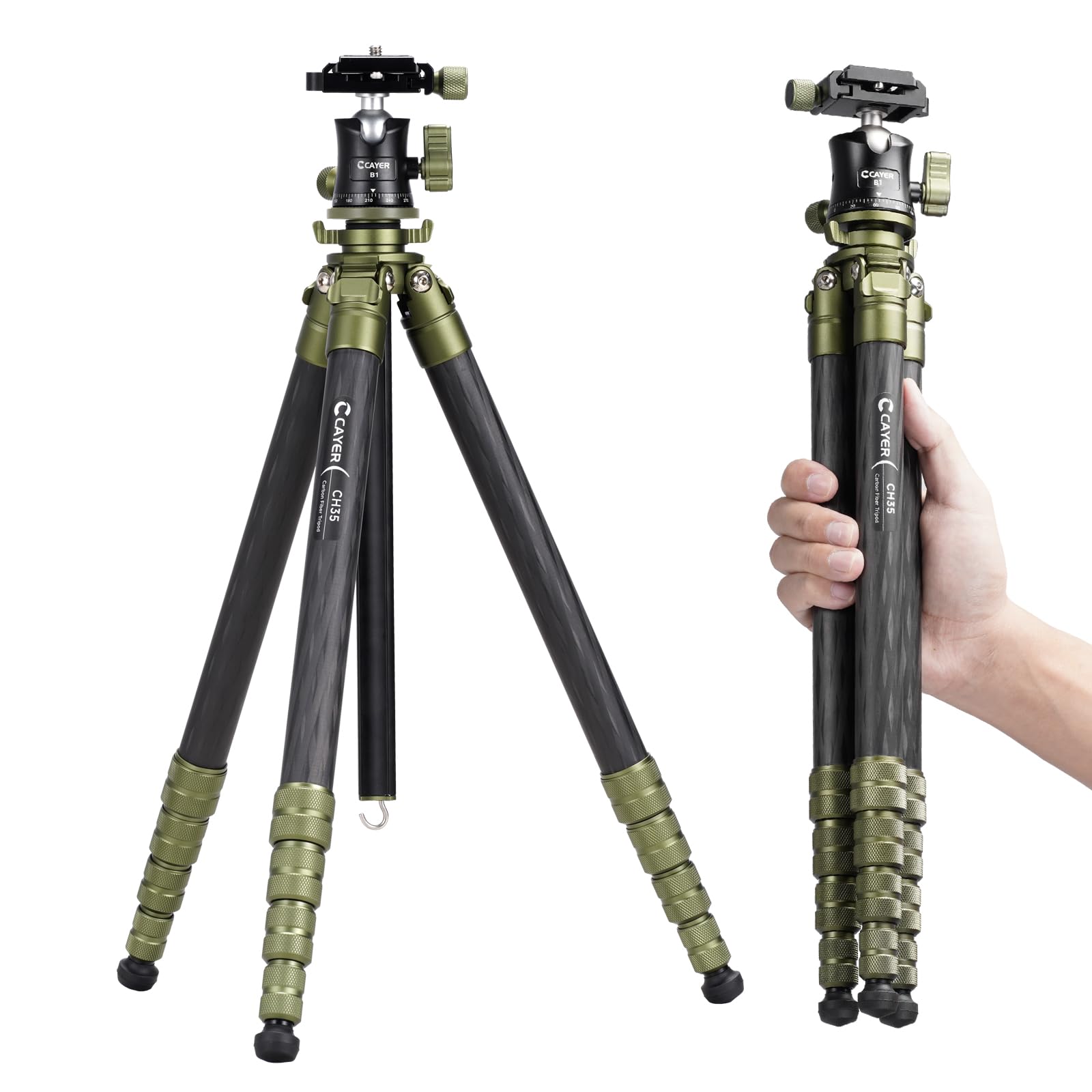
Fifty-three and a half inches is the number to start with, because it decides whether the rest matters to you. That's eye level for a shorter photographer and chest height for a tall one, and no amount of clever design changes it. If you're happy working at that height — travel, hiking, street, a spotting scope on a ridge — the CH35 is a well-sorted little tripod with a genuinely good head.

The Y-shaped center column is the clever bit: it lets the legs fold around the column instead of alongside it, so the tripod packs to 17.7 inches. The 42 mm ball head is enormous for a tripod this size — 45 degrees of tilt, a full 360 pan, and 90 degrees of side tilt — and the included short column takes the camera down to 6.1 inches. Nothing else here gives you that head on a body this small.

Where it stops is the load rating. Eleven pounds covers a mirrorless body with a mid-range zoom comfortably and a full-frame DSLR with a 70-200 with less margin than we like; if that's your kit, the SIRUI or the INNOREL carry it with room to spare. For everything lighter, the CH35 earns its place on packability and that head, and the two-year warranty is longer than most here.

Pros

  • 42 mm ball head on a compact tripod
  • Folds to 17.7 inches via the Y-column
  • Short column drops to 6.1 inches
  • Two-year warranty and a case in the box

Cons

  • 11 lb load rating limits it to lighter kits
Our verdict

We like it for light kits and long walks: it packs to 17.7 inches and carries a 42 mm ball head, as long as 53.6 inches of height suits how you shoot.

Check Latest Price
9

Hiking and Backpacking

Fotopro X-go Carbon E2

80 /100
Keeper Score Excellent

Key details

Weight
2.2 lb
Max Height
62 in
Folded Length
14.2 in
Load Capacity
17.6 lb
Check Price on Amazon

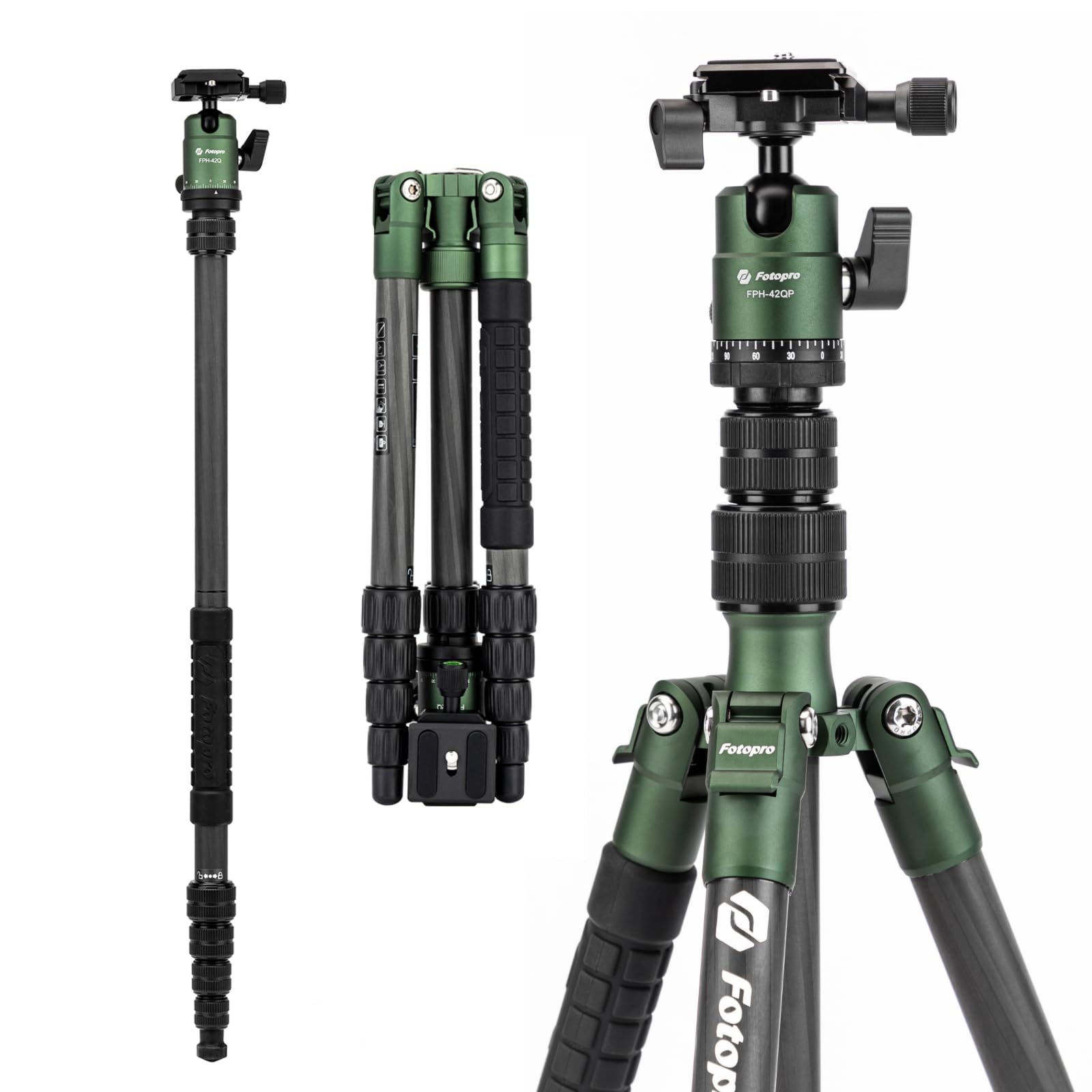
Fourteen and a quarter inches folded makes the X-go the smallest-packed tripod here by a clear margin — small enough to sit inside a daypack beside a water bottle rather than strapped to the outside of it. Two pounds and a 17.6-pound load rating go with that, which is a good ratio at any price in this group.

The features are the right ones for a hiking tripod: three leg angles at 25, 50, and 80 degrees for uneven ground, a leg that detaches into a 42.7-inch monopod, an Arca-Swiss plate that works with clamps you already own, and a center column that reverses for low shots. The ball head is metal rather than plastic, which is the detail that decides whether a head survives a few seasons in a pack.

Where it gives ground is stillness at the top of its range. A two-pound tripod standing 62 inches will move in a breeze with the column up, and a load rating tells you what the legs will hold, not how still they'll hold it. Keep the column down, hang a bag on the hook, and it does everything a hiker bought it for. It's the pick here for a light kit on the move, not for long exposures at dusk.

Pros

  • 14.17-inch folded length, the smallest here
  • 2 lb carrying a 17.6 lb load rating
  • Detachable leg becomes a 42.7-inch monopod
  • Arca-Swiss plate works with existing clamps

Cons

  • Loses steadiness with the center column raised
Our verdict

Our pick for hiking with a light kit: it folds to 14 inches and weighs two pounds, and it stays steady as long as you keep the column down.

Check Latest Price

How We Tested the Best Carbon Fiber Tripods

We built a shortlist of about 40 tripods from manufacturer specs and retailer listings, then cut it down on three points: legs that are carbon fiber rather than a fiberglass blend, a maximum height that reaches eye level without raising the center column, and a head that can be swapped or removed. Nine finalists, eight months.

Each one got weighed on a kitchen scale three ways — legs alone, with its head, and packed in its carry bag — then strapped to a pack for a day on the trail to see whether the savings showed up in my shoulders. For stability, I mounted a telephoto zoom and made eight-second exposures at dusk while wind pushed across an open ridge, then repeated the shot on a hardwood floor, pressing a finger against the head to watch how far the leg tips crept. Gravel and a sloped lawn got the same treatment, plus a fully raised center column to judge flex.

Adjustability was tested in the dark, literally: I set each tripod up and broke it down without a light, counting the turns needed to lock every leg section. I ran each convertible model as a monopod, checked how many leg angles it offered for low shots, and whether the panorama base turned smoothly under a loaded head. After months of use I looked at lock internals, the aluminum collars, and whether the feet stayed where I put them. Portability came down to folded length against a carry-on and a daypack side pocket; value to whether the head, plate, bag, and phone mount actually came in the box.

How to Choose a Carbon Fiber Tripod

Buy stiffness, not just grams

Carbon costs more than aluminum at the same stiffness, so the question is what the savings buy you. Two things decide it: the diameter of the top leg section and how many sections there are. A 32 mm tube resists the twist a long lens applies; a 25 mm five-section leg is lighter and gives up some of that resistance at full height. If your kit is a mirrorless body and a small prime, buy light. If it ends in a 70-200, put tube diameter at the top of your list and accept the extra weight.

Read the height claim carefully

A quoted maximum height usually assumes the center column is raised, and the column is the least stiff part of any tripod. The NEEWER N55C shows the gap plainly: 47.2 inches on the legs alone, 63.8 with the column's second section extended. That difference is standing comfortably versus stooping. Work out the height you need — eye level, minus a couple of inches for the head and camera — and check the leg-only figure as well as the headline one.

Match packed length to the bag it travels in

Compact in a tripod description often means it fits a car trunk. Packed lengths in this group run from 14.2 to 30 inches, and that range is what decides whether the tripod rides inside your daypack or on a strap outside it. Measure the inside of your pack, including the space the lid eats, before you fall for a folded figure. Diameter counts too: a 2.6-inch folded body slides into a side pocket that a wider one won't.

Treat the load rating as a ceiling

A 22-pound rating means the legs won't fail at 22 pounds. It says nothing about how still the setup stays, which depends on the weight up top against the weight at the feet. Long lenses on light tripods move for exactly that reason. Hang your bag on the center hook, leave the column down, and work well under the rating when your lens is long — the hook is there because the designers know it.

Budget for the head and check the plate

The head is half the tripod and it's where budget models economize. A leveling head like the LT32's corrects a horizon fast but tilts little; a big ball head like the 36 mm on K&F's O254C2 holds framing better under a heavy lens. Check the plate standard before you buy, because Arca-Swiss compatibility means your existing clamps, plates, and L-brackets carry over. And check what's in the box: the INNOREL ships as legs alone, so a head is a separate line in the budget.

Frequently Asked Questions

Final Verdict

We recommend the NEEWER LITETRIP LT32 to most photographers. At 2.6 pounds it disappears into a daypack, it stands 62 inches with a 22-pound rating, and the leveling base saves a minute on every setup. The head's narrow tilt is the one compromise to accept going in.

If most of your frames come from a long lens on solid ground, the SIRUI AM-324's 32 mm legs and 39.8-pound rating are the better spend. If height is the thing that keeps costing you shots, the INNOREL's 71 inches settles it.