Best Headphones for Kids

The first time my kid asked for headphones, my worry wasn't sound quality — it was how fast she'd find the volume button. That's the push and pull of this category: the headphones have to sound good enough that a kid actually keeps them on, and be built and capped so you can hand them over without hovering. A good pair does three things at once: it holds a safe ceiling on volume, fits a head that's still growing, and survives being shoved into a backpack at the end of the school day.

There's also a real choice hiding in the specs. Wired pairs are cheaper, never need charging, and can't be pushed past their limiter — but the cord is usually the first thing to give out. Bluetooth pairs cut the cord and often let you set the ceiling yourself, at the cost of charging and pairing headaches. We've spent four months with 12 pairs across both formats, and the gap between an inexpensive set and a pricier one shows up in the hinges and the strain relief, not the drivers. The picks below run from a school-day wired set to a wireless pair built for long flights.

Keeper Score summarizes customer ratings and review volume. Read it alongside the product details and trade-offs. How the score works.

1

Best Overall

noot K11

95 /100
Keeper Score Outstanding

Key details

Cord
5 ft, braided
Warranty
24 months
Age Range
3 to 16 years
Volume Limiting
None built in
Check Price on Amazon

No battery, no pairing, no app, no buttons. The noot K11 asks nothing of a kid beyond pushing a plug into a jack, and that is most of why it's our default for school. The cord is 5 feet of braided, tangle-resistant cable — long enough that a tablet can sit in a seat pocket or on a lap desk while the headphones stay on a head.

The earcups fold up into the headband, so the whole thing flattens into a backpack pocket next to a lunch box. The headband adjusts from preschool well into the tween years, though the clamp is firm: a 12-year-old will feel the pressure after an hour, and the listed 3-to-16 range is optimistic at the top end.

There's no microphone and no in-line control, so a kid talks into the tablet's own mic and changes volume on screen. At a desk in front of a Chromebook that's fine; with the tablet propped across the room it isn't, and that's the point where the iClever HS19 or the Acer becomes the better buy. The 24-month warranty is the unusually generous part of this package.

Nothing here limits the volume — the ceiling comes from whatever it's plugged into. That's a two-minute job on most devices: switch on the system volume limit, set a passcode, and the K11 behaves like a capped pair. Families who don't want to depend on that should start with a dual-mode set instead.

Pros

  • Works with any school tablet, no charging or pairing
  • Braided 5-foot cord resists tangling
  • Folds flat into a backpack pocket
  • 24-month warranty, the longest here

Cons

  • Durability is uneven after months of school use
Our verdict

We start most families here: a wired pair that works with any school tablet, folds flat in a backpack, and carries a two-year warranty.

Check Latest Price
2

Best Wireless Value

JoySpark T5

92 /100
Keeper Score Outstanding

Key details

Weight
6 oz
Battery
Up to 60 hours
Connection
Bluetooth 5.3 + 3.5 mm cable
Volume Modes
85/94 dB
Check Price on Amazon

The listing promises up to 60 hours of playtime and then mentions 40 in a different field, so plan for somewhere between the two. Either way this is a headphone that gets through a week of bedtime stories and a long weekend away from a charger, and 2.5 hours on the cable refills it.

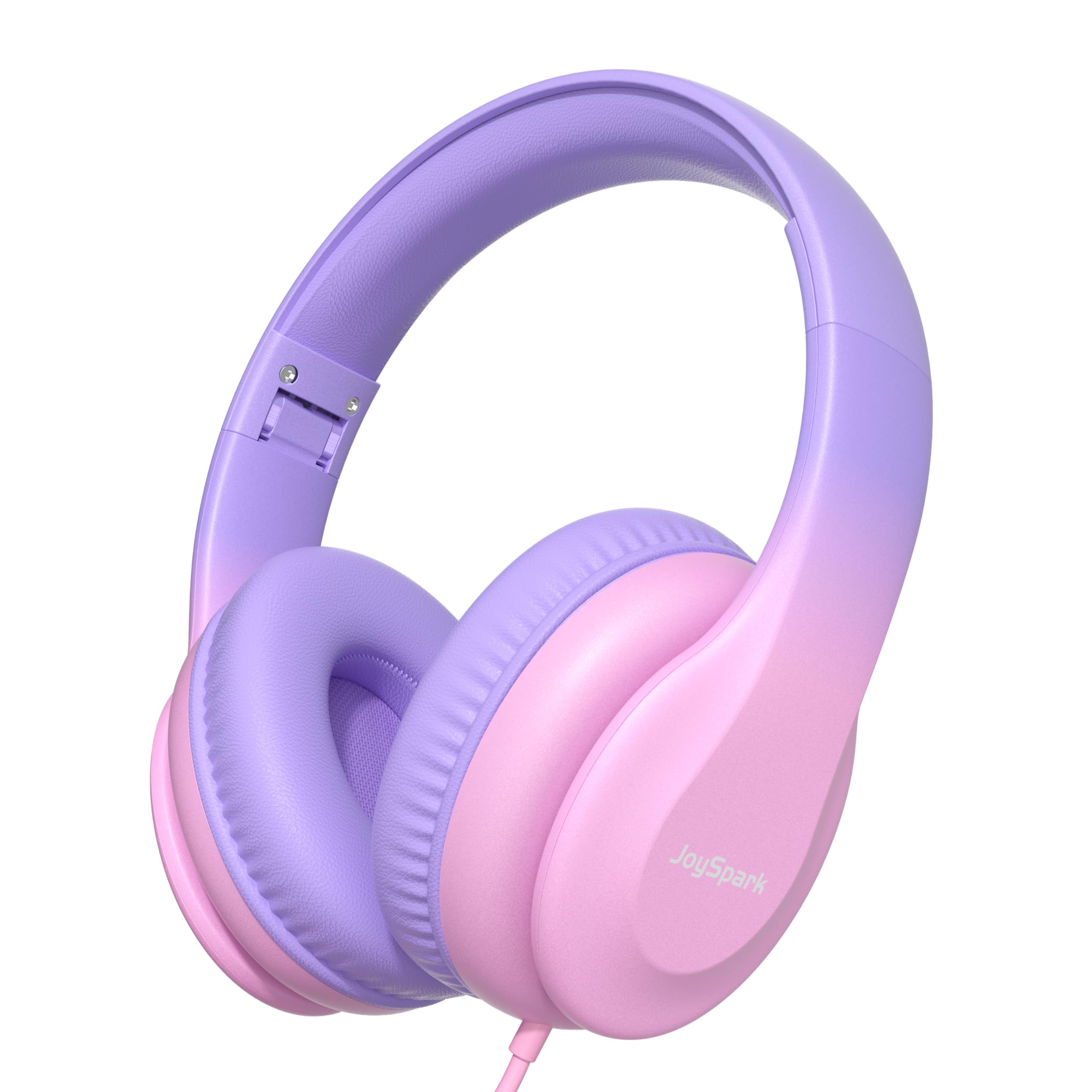
Two caps — 85 dB for everyday and 94 dB for a noisy cabin — plus Bluetooth 5.3 that pairs from a single held button make it the wireless pair we hand to a kid who isn't careful with things. The memory foam cushions are the part that matters on a long drive: soft, breathable, and still comfortable after a couple of hours. At 170 g it doesn't slide down a small head.

The detachable 3.5 mm cable is what makes this a travel pair rather than a toy. Battery flat and the seat-back screen still needs headphones? Plug in. It covers a school day in a pinch too, though a classroom that wants a plain wired set is better served by the noot. Eighteen months of warranty is decent for this price bracket, and worth registering.

Pros

  • Two volume caps for home and travel
  • Up to 60 hours per charge
  • Detachable cable works when the battery dies
  • Memory foam cushions stay comfortable

Cons

  • Charging is the weak point over time
  • Sound is adequate rather than rich
Our verdict

For a first wireless pair we keep coming back to the T5: two volume caps, easy pairing, and a cable that keeps a dead battery from ruining the trip.

Check Latest Price
3

Best for Sharing

iClever HS19

93 /100
Keeper Score Outstanding

Key details

Weight
6.1 oz
Microphone
In-line
Share Port
Yes, FunShare
Volume Limit
85 dBA
Check Price on Amazon

The FunShare jack is the reason this pair stays in the car. It's a second 3.5 mm socket on the earcup: two kids, one tablet, two pairs of headphones, one shared movie. It removes an entire species of back-seat argument, and of the two sets here with the feature it's the better-established of them.

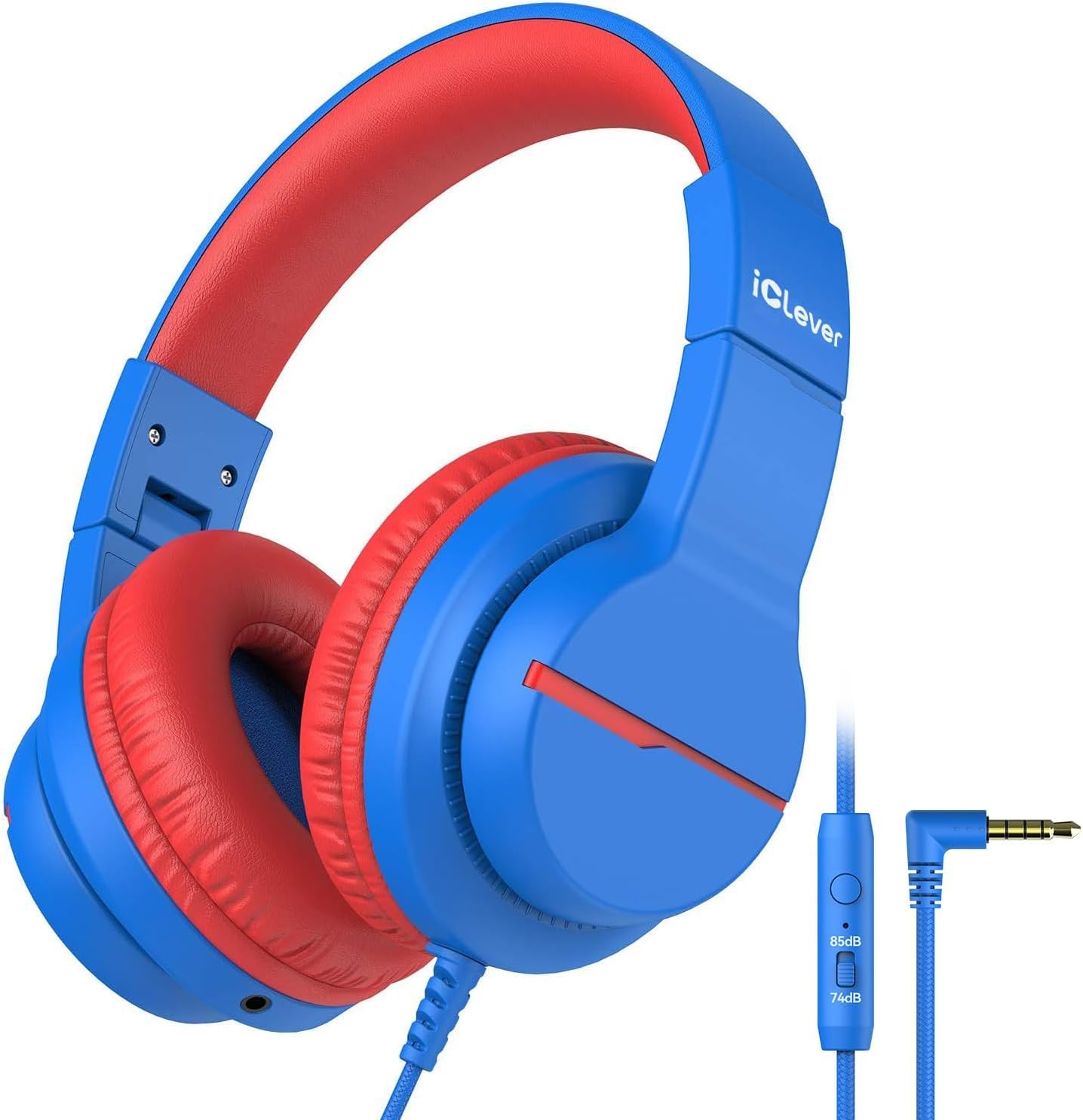
Around that jack sits a sensible package: an 85 dBA cap, 40 mm drivers, soft over-ear cushions, an in-line mic with a play/pause button, and a fold-flat hinge. At 173 g it stays put on a small head, and the 12-month replacement warranty covers the usual first-year risk.

The cap is the thing to think about. At 85 dBA a kid on a noisy bus or in a plane will say it's too quiet, and they're right — that's the limiter doing its job, and it's why we point travel-heavy families to the Acer's 94 dB mode instead. For a classroom, a kitchen table and a quiet car, 85 is exactly where you want it.

Pros

  • Share port lets two kids watch one tablet
  • 85 dBA cap for everyday listening
  • In-line mic for online classes
  • 12-month replacement warranty

Cons

  • Durability is the weak spot over a school year
Our verdict

We reach for the HS19 whenever two kids have to share one screen — the second headphone jack settles more arguments than any volume feature.

Check Latest Price
4

Best for School and Travel

Acer HK03

90 /100
Keeper Score Outstanding

Key details

Weight
5.2 oz
Warranty
2 years
Connection
3.5 mm wired
Volume Modes
85/94 dB
Check Price on Amazon

Two numbers and a switch: 85 dB for the classroom, 94 dB for a cabin at altitude. That's the pitch, and it's a better one than it sounds, because a single 85 dB cap is right for a quiet room and genuinely too quiet at 30,000 feet — which is exactly when a kid gives up and takes the headphones off.

The rest is school-supply practicality: 5.2 ounces, an adjustable headband, over-ear cushions that cover the whole ear, a fold-flat hinge, and an in-line mic for Google Meet. The two-year warranty matches the longest here, and the materials against the ear are listed as CPSIA-approved, which counts for more than usual on something a child wears for hours.

For a family doing school five days a week and a flight twice a year, we think this is the most sensible single purchase in the group — you aren't choosing between a classroom pair and a travel pair. The purple-and-green finish is loud in the way kids tend to like and classrooms tend not to mind.

Pros

  • Switchable 85/94 dB caps for school and travel
  • Two-year warranty
  • Covers the whole ear at 5.2 ounces
  • CPSIA-approved materials against the skin

Cons

  • Durability is hit or miss past a few months
Our verdict

Acer's HK03 is the single pair we suggest when a child does school five days a week and flies twice a year, because the volume ceiling can switch.

Check Latest Price
5

Best Premium

JBL Junior 470NC

89 /100
Keeper Score Excellent

Key details

Weight
6.91 oz
Battery
Up to 50 hours
Volume Limit
85 dB, app-adjustable
Noise Cancelling
Active
Check Price on Amazon

This is the only pair here you manage from your phone. The JBL app sets the ceiling — 85 dB or lower — and caps daily listening time, so a kid who is happy to wear headphones from breakfast to bedtime runs out of allowance instead. That's the feature most parents end up using every day.

It's the most expensive pick in this group by a margin, and the money buys two things: active noise cancelling and 50 hours of playback from a two-hour USB-C charge. At 196 g with oval cups that cover the whole ear, it's the one that makes sense for a child who flies often, or for one who needs quiet to get homework done in a loud house.

Sound is the compromise. With a hard ceiling and 32 mm drivers, music sounds polite and thin next to an ordinary pair of headphones. For audiobooks, Meet calls and cartoons on a plane that's a fair trade for the protection. A kid who has started caring about music will notice the difference.

Pros

  • App sets volume ceiling and daily time limits
  • Active noise cancelling for flights
  • Up to 50 hours per charge
  • Cups cover the whole ear

Cons

  • No case or pouch in the box
  • Noise cancelling and app limits only work over Bluetooth
Our verdict

The 470NC is the one to buy if headphones are for flights and homework, where noise cancelling and app-set time limits actually change the day.

Check Latest Price
6

Best Battery Life

iClever BTH12

93 /100
Keeper Score Outstanding

Key details

Weight
7.04 oz
Battery
Up to 85 hours
Connection
Bluetooth 5.2 + cable
Volume Modes
74/85 dB
Check Price on Amazon

Eighty-five hours is the sort of claim we take with salt — even at a fraction of it, this pair gets through a transatlantic flight and a week of car rides, and three hours on USB-C refills it. The detachable 3.5 mm cable means a flat battery is an inconvenience rather than the end of the trip.

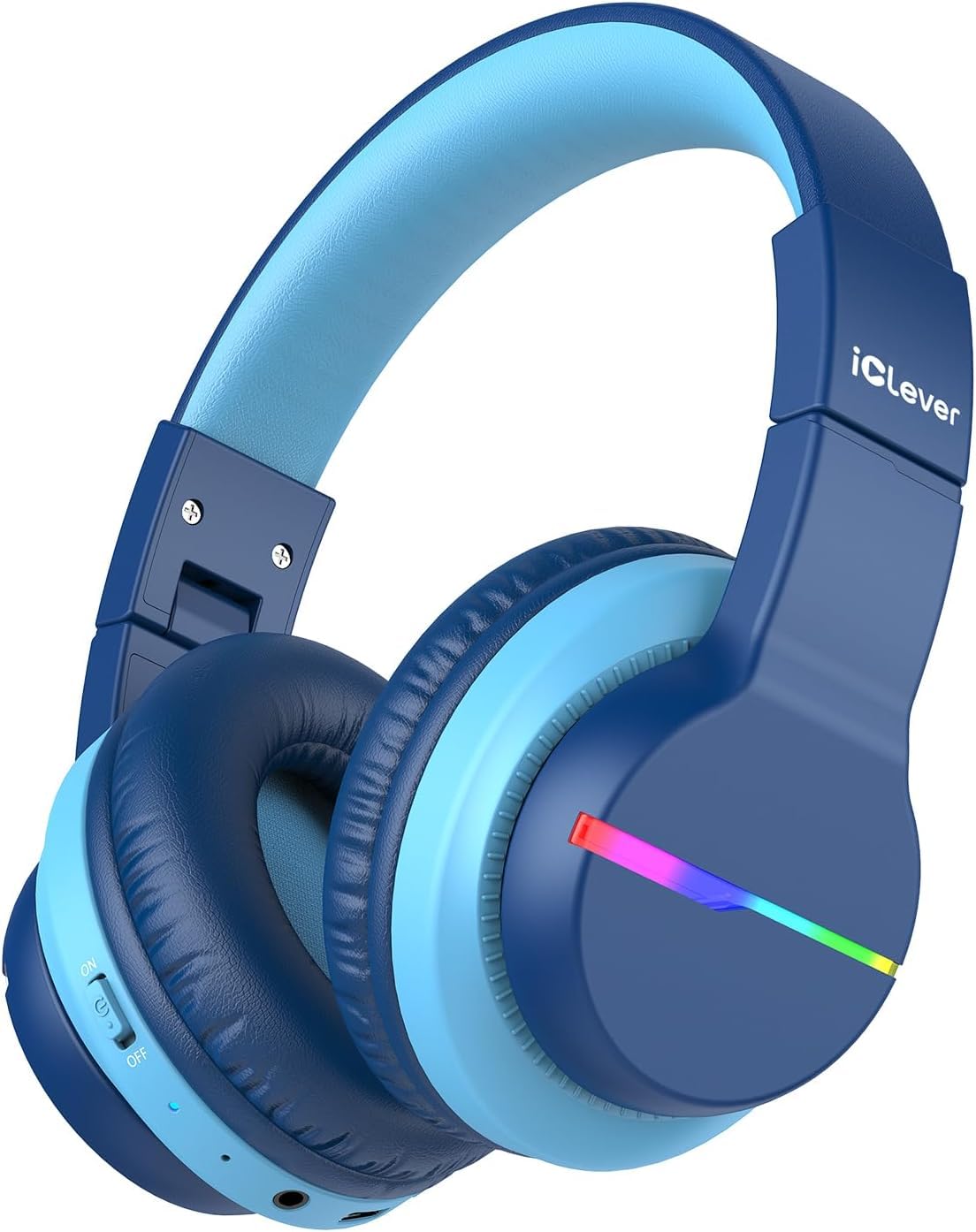
Bluetooth 5.2 pairs from one held button, the 40 mm drivers are the same size as the wired picks here, and the LED rings on the earcups are why a lot of kids pick these out of a lineup. In a house where headphones get refused on aesthetic grounds, that counts for something.

Where it earns its place over the JoySpark T5 is the range of its limits: the quiet mode drops to 74 dB, low enough for bedtime stories in a car, and 85 dB handles everything else. Just over 7 ounces with a bigger cup than the wired sets, it's the pair that feels substantial rather than toy-like in the hand.

Pros

  • Up to 85 hours of playtime
  • 74 dB mode for quiet listening
  • Detachable cable for a dead battery
  • LED rings kids actually want

Cons

  • Durability is uneven at the headband slider
  • Runs large on toddlers
Our verdict

For long trips the BTH12 is the wireless pair we pack: huge playtime, a genuinely quiet 74 dB mode, and a cable in the box for the return leg.

Check Latest Price
7

Best Budget

POWMEE P20

92 /100
Keeper Score Outstanding

Key details

Ear Cups
90° swivel
Warranty
12 months
Connection
3.5 mm wired
Volume Limit
94 dB
Check Price on Amazon

Not much is asked of the cheapest pair here, and the POWMEE P20 doesn't overreach. One 94 dB ceiling, a 3.5 mm plug, soft over-ear pads, and earcups that swivel 90 degrees so the whole thing lies flat in a pencil case or a backpack front pocket.

This is the pair we buy three at a time: one for the backpack, one for the classroom spares box, one for grandma's house. At 0.22 kg it's light on a small head, the padding doesn't need breaking in, and the 12-month warranty is proportionate to what's being spent.

The single 94 dB limit is the catch: there's no quieter mode for a kid who pushes the volume up, so if that's a running battle in your house, spend a little more on a dual-mode set like the Acer. Everyone else gets a perfectly serviceable classroom headphone that you won't grieve over when it comes home cracked.

Pros

  • Lowest price in this group
  • Swivel cups fold flat for storage
  • Soft over-ear pads need no breaking in
  • 12-month warranty

Cons

  • Durability is a gamble at this price
Our verdict

The cheapest pair here is also the easiest to lose without grief, so we'd stock the classroom spares box with these rather than anything pricier.

Check Latest Price
8

Online Classes

EarFun K1

93 /100
Keeper Score Outstanding

Key details

Drivers
40 mm
Materials
CPC and CPSIA rated
Connection
3.5 mm wired
Share Port
Yes
Check Price on Amazon

The most useful line on the EarFun K1 box isn't the driver size — it's the CPC and CPSIA compliance, the U.S. children's product standards the materials are checked against. For something a child wears against their head for hours at a time, we care about that more than another gram of bass, and it's rare to see it stated this plainly at this end of the market.

There's also a share port on the earcup, an in-line mic and controls for online class, 40 mm drivers, a braided nylon cord and a fold-flat hinge — the whole feature list of a good school headphone, plus recycled material in the build.

What's missing is a published dB figure for the limiter. Every other capped pair here names 85 or 94; EarFun just says volume limited. That's not a reason to avoid it, but if you want a number you can check against a school's requirements, the Acer or the iClever HS19 is the safer call.

Pros

  • CPC and CPSIA-rated materials
  • Share port for a second pair
  • In-line mic and controls
  • Braided cord and fold-flat hinge

Cons

  • No published dB figure for the volume limit
Our verdict

We like the K1 for the line most listings bury: CPC and CPSIA compliance, on a headphone that also shares a screen between two kids.

Check Latest Price
9

Backup School Pair

Botesty Ivy

90 /100
Keeper Score Outstanding

Key details

Cord
4.9 ft, braided
Warranty
24 months
Microphone
In-line
Volume Modes
85/94 dB
Check Price on Amazon

The cord is the first thing we noticed: 4.9 feet of braided nylon, longer than most in this group, which sounds like a small thing until the tablet is on a seat-back tray and the kid is in the middle seat. The cups swivel 90 degrees and the whole set folds; at 0.18 kg it sits lightly on a small head.

Add dual 85/94 dB modes, an in-line mic with call and pause buttons, and 24 months of warranty, and this is a lot of headphone for the bottom of the price range. It's one of the very few budget sets here that we think pairs both volume modes with a two-year safety net in one box.

Sound is the modest part: the 40 mm drivers handle cartoons, audiobooks and Meet calls cleanly, and music sounds flat next to the JBL. Nobody at this end of the market is buying for the bass, and if your kid has started listening to actual albums, that's the moment to spend more.

Pros

  • 24-month warranty at the budget end
  • Dual 85/94 dB volume modes
  • 4.9-foot braided cord
  • In-line mic with call controls

Cons

  • Long-term reliability is uneven
Our verdict

The Ivy gets a place because it pairs dual volume modes with a two-year warranty at the bottom of the price range, which almost nothing else does.

Check Latest Price

How We Tested Kids' Headphones

We started with roughly 40 pairs and narrowed by things we could check before a box arrived: whether the listing stated an actual decibel ceiling, whether the smallest headband setting would fit a preschooler, whether the jack was standard 3.5mm, and whether there was a share port or a built-in mic. Twelve pairs made the cut and lived with us for four months.

Every pair went into a real household routine — the school commute, homework at the kitchen table, a four-hour drive, the pre-bed wind-down. We set each headband to its smallest and largest positions against a 4-year-old and a 9-year-old and noted whether kids could adjust them alone or needed an adult every time. Earcups were checked for clamping and for sliding out of place when a kid looked down at a tablet.

Durability was the least gentle part. Cords got yanked out of tablets by the cable rather than the plug, headphones were folded and unfolded daily and buried in backpacks, and each pair took a few falls onto kitchen tile; we noted which hinges loosened and which cords frayed at the strain relief. For volume, we pushed every control to maximum with a meter at ear position and watched whether a child could defeat the limiter, then listened for whether road noise pushed kids to want more.

We handed each Bluetooth pair to a kid who had never paired anything and timed the setup, then walked out of range to see whether it reconnected on its own. Two kids shared one tablet to test the share ports, batteries ran from full to dead on long trips, and noise cancelling got judged on a busy sidewalk and in the car. Sound was scored on school videos, pop songs, and game audio, and we weighed whether the extra money bought sturdier construction or just packaging.

How to Choose Headphones for Kids

Wired for School, Wireless for Travel

Most elementary and middle-school classrooms still ask for a 3.5 mm plug: nothing to pair, nothing to charge, nothing to reconnect in the middle of a lesson. Bluetooth is a home and travel convenience, and it comes with a charger to keep track of. If one pair has to do both jobs, look for wireless with a detachable cable in the box — the JoySpark T5 and the iClever BTH12 both include one.

Two traps sit here. A tablet with only a USB-C port needs an adapter before the first day, and some schools lock down pairing entirely, so ask before you buy wireless for class.

What a Volume Limit Actually Does

A limiter caps how loud the headphones can play. It doesn't quiet a loud recording and it doesn't shorten a listening session. 85 dB is the everyday number and the right one for a classroom; 94 dB modes exist for cabins and road noise, where an 85 dB ceiling makes dialogue inaudible. That's why dual-mode sets like the Acer and the Botesty earn their place.

If you buy a pair with no limiter at all — as with our top pick — the ceiling comes from the source, so set the device's maximum volume and lock it with a passcode. It takes two minutes and it works on phones, tablets and laptops alike.

Fit Is Where Age Ranges Fail

Almost every pair here claims a span from toddler to teen, and almost none truly covers it. The useful questions are how much travel the headband has for your child's head right now, how firm the clamp is, and whether the cups sit on the ear or around it. Over-ear cushions spread pressure and keep working as kids grow; on-ear designs start to feel tight around age 10.

If your child sits at the top of a stated age range, assume the fit will be snug and choose an over-ear model with generous slider travel.

Where They Break, and What to Pay For It

Three parts fail: the cord at the plug, the plastic slider inside the headband, and the earpads. A braided cord and a fold-flat hinge help with the first, and nothing helps with the second except a warranty — which is why 12 or 24 months of cover is worth more on a kids' pair than an extra millimetre of driver.

Our practical advice is to spend as little as you can on the pair that goes to school and put the money into the one that travels. Two cheap wired pairs outlast one expensive set that lives in a backpack.

Frequently Asked Questions

Final Verdict

For most families the noot K11 is the whole answer: plug it in, fold it up, and let a two-year warranty absorb the school year. It has no limiter, so spend two minutes setting the device's maximum volume and it does everything a classroom asks.

Step up to the JBL Junior 470NC if the headphones will spend real time on planes, or if you want volume and daily listening time managed from your phone — the noise cancelling and app limits are worth the extra spend for those two jobs and not much else. In between, the JoySpark T5 covers everyday wireless listening with a cable in the box for when the battery runs down.