Best Hat Heat Presses of 2026

The first time you press vinyl onto a structured cap, you understand why so many good hats end up creased across the front and unevenly transferred. A flat platen and a curved bill are natural enemies. A hat heat press solves that by wrapping heat around the cap's shape, holding it steady, and giving you separate temperature and time controls. I've spent the past seven months with 12 different machines, pressing soft trucker caps and stiff structured hats, and the gap between a smooth transfer and a scorched mess comes down to a few small design choices.

The features that matter most aren't the flashiest. Interchangeable platens, a cap stretcher that holds the hat taut, and precise temperature and time controls are worth more than a long list of presets. I also checked how each press heats up and recovers between hats, since a plate that runs cool at the edges shows it in the final design. The picks below handled curved seams, thick fronts, and back-to-back pressing without making me babysit every cap.

Keeper Score summarizes customer ratings and review volume. Read it alongside the product details and trade-offs. How the score works.

1

Best Overall

Delclynee Hat Heat Press

90 /100
Keeper Score Outstanding

Key details

Power
550W, 110V
Heating Plate
6.7" x 3.8" curved
Lower Platens
Two, 6.7" x 3.8" and 6.7" x 2.5"
Temperature Range
32–455°F
Check Price on Amazon

The cap stretcher is what sold us. Most hat presses hold a cap with a spring-loaded stretcher that snaps back the moment you let go, which leaves you pinning the crown with one hand and hauling the handle down with the other. Delclynee's stretcher stays exactly where you set it, so a cap sits square while you line up a patch, and both hands stay on the press. That detail never makes it onto a spec table, and it decides whether a run of a dozen hats feels like a job or a fight.

Around that stretcher is a capable machine: a curved 6.7-by-3.8-inch upper plate, two lower platens at 6.7 by 3.8 and 6.7 by 2.5 inches, and a 550W element that runs on standard household current. That pair of cradles covers anything from a shallow dad cap to a deeper six-panel front. The layout also leaves real clearance between the loading area and the base, so you can turn a cap without rapping your knuckles, and the temperature runs 32 to 455°F with a countdown timer and a gauge you can read from standing height.

It stands 26 inches tall with the handle up, so measure the air above your shelf before you claim a corner of the bench; the footprint itself is a modest 16.15 by 9 inches. What keeps us coming back is the warranty — the heating element is covered for life and the press for a year, a real commitment on the part most likely to fail. Ours stays set up and switched on, whether we're running one hat or twenty.

Pros

  • Stretcher holds the cap without a second hand
  • Two platens cover shallow and deep crowns
  • Heating element covered for life
  • Digital control is simple to set

Cons

  • Plate can run hotter than the dial setting
  • Coating can wear and mark light caps
Our verdict

We recommend this one first for cap work: the stretcher holds the crown hands-free and two platens cover shallow and deep crowns.
Check Latest Price
2

Best Manual Press

HTVRONT Hat Press Machine

86 /100
Keeper Score Excellent

Key details

Base
Silicone suction cups
Platens
Two, 6.5" x 3.3" and 6.5" x 2.5"
Heating Plate
One-piece cast aluminum
Temperature Range
140–464°F
Check Price on Amazon

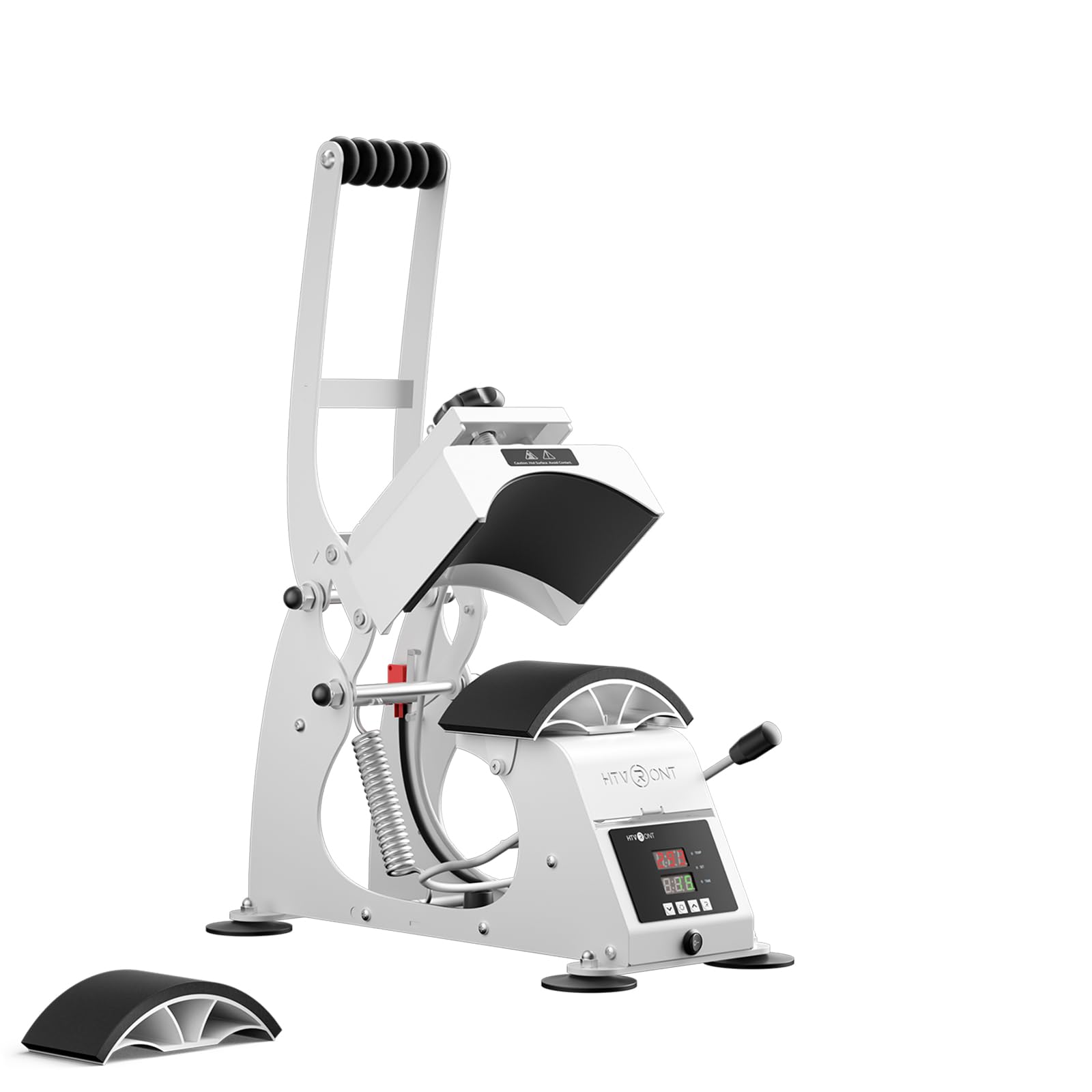
If the Delclynee's stretcher is the feature we miss when it's gone, the HTVRONT's heating plate is the one we notice on every press. It's a single cast aluminum plate rather than the silicone pad a lot of hat presses use, and the difference shows up as heat arriving across the whole curve instead of a hot middle that fades at the edges. On a cap, where the panel bends away from the plate at both sides, that flat spread is most of the battle.

The rest of the machine is built around getting a cap flat. A four-bar linkage gives the lever a longer arm, so the pull takes noticeably less hand strength than a short direct handle, and silicone suction cups keep the base planted on a smooth bench. Two platens at 6.5 by 3.3 and 6.5 by 2.5 inches, with a revised curvature, cover most six-panel and five-panel fronts, and the pressure is adjustable — the thing we miss most on the automatic machines.

Where we'd push back is size. A 6.5-inch plate is a good all-rounder, but it isn't the 8.5-inch VEVOR, and designs that run edge to edge across a cap front will show it. For patch work, DTF transfers and standard HTV logos, this is the manual press we reach for, and the control you get over pressure is worth more day to day than an extra inch of plate.

Pros

  • Cast aluminum plate spreads heat evenly
  • Four-bar lever takes less hand strength
  • Suction feet keep it planted
  • Adjustable pressure for thick and thin caps

Cons

  • 6.5-inch plate is small for wide designs
Our verdict

Buy this one if you want heat that arrives evenly and a lever you can lean into — it's the most controlled manual press here.

Check Latest Price
3

Best for Batch Work

HTVRONT A300 Auto Hat Press

89 /100
Keeper Score Excellent

Key details

Platens
Two, adult and kids' sizes
Pressure
176 lb (80 kg)
Operation
One-touch automatic
Temperature Range
104–410°F
Check Price on Amazon

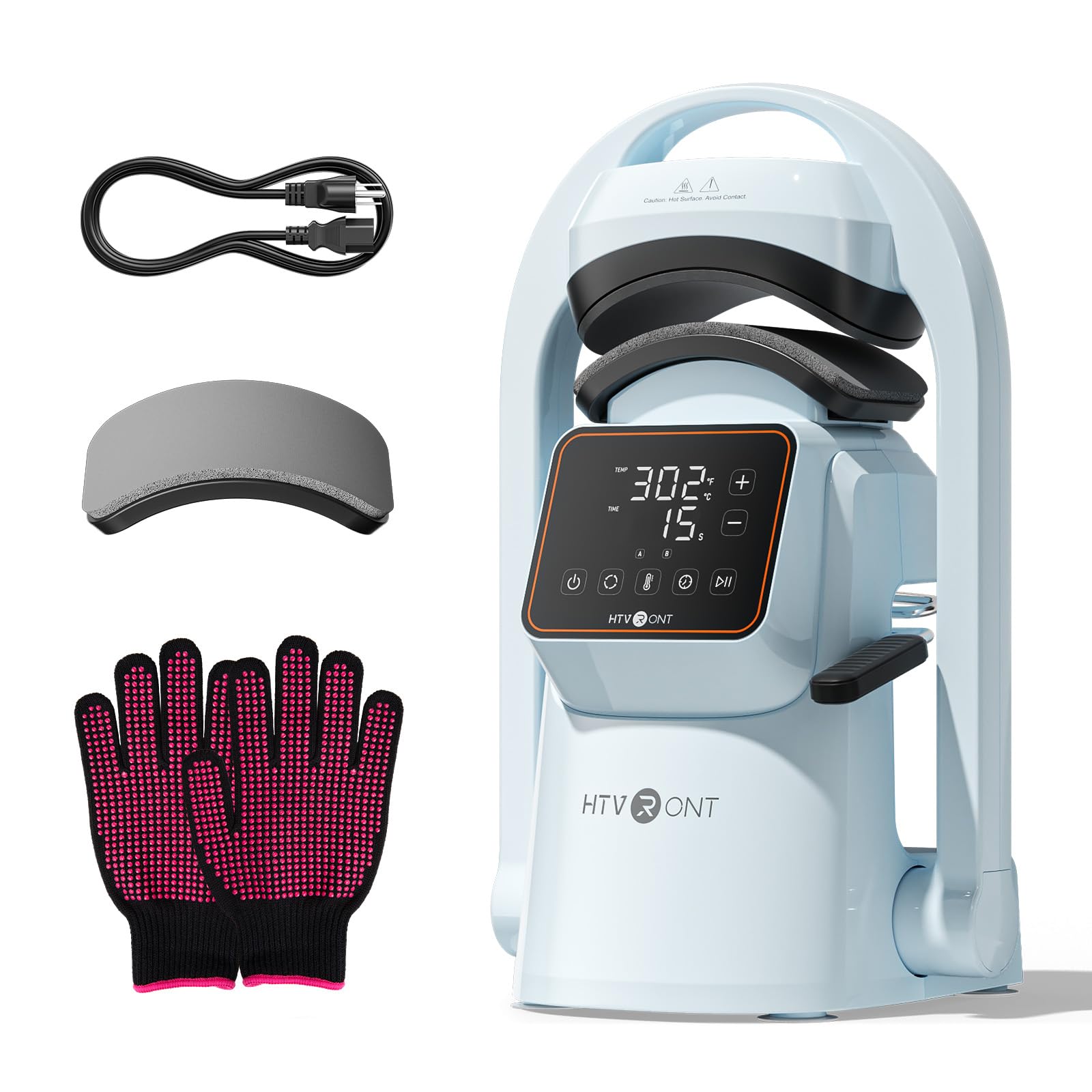
At the top of this group's price range, the A300 is the press that asks you to decide what your time is worth. Touch the screen and the head lowers itself, holds pressure for the set time, and lifts clear. The difference shows on repeat work: with a manual press you stand over every hat, and with this one you're trimming the next cap while the current one presses.

The 176 pounds of pressure is why it's here rather than one of the manual machines. DTF film and embroidery patches need real force to sit flat on a curved crown, and that much squeeze pushes a transfer into seams and around eyelets where a lighter press skips over them. Two platens cover adult and kids' caps, two presets store your standard settings, and the touchscreen runs 104 to 410°F with a timer.

What you give up is control. Pressure is set by the machine, not by you, so a thick crown and a thin unstructured cap end up at the same squeeze — you work around that by choosing the platen rather than easing off a handle. The 17.72-by-12.4-inch footprint is also the largest here and needs a level table; on an uneven surface the base can ride up with the platen and lift a cap out of position.

Pros

  • One-touch head frees both hands
  • 176 lb of pressure for DTF and patches
  • Two saved presets for repeat orders
  • Heats fast and evenly

Cons

  • Pressure is fixed, not adjustable
  • Largest footprint in this group
Our verdict

Worth the splurge if hats are a business rather than a hobby; the one-touch head pays you back in caps per hour.

Check Latest Price
4

Best for Wide Designs

VEVOR Hat Heat Press 8.5 x 4

88 /100
Keeper Score Excellent

Key details

Weight
15 lb
Timer Range
1–999 seconds
Heating Plate
8.5" x 4"
Temperature Range
32–449°F
Check Price on Amazon

Eight and a half inches is the number that matters here. This VEVOR's heating plate is the widest in the group — 8.5 by 4 inches against the 6.5- and 6.7-inch plates on most of the others — and that extra width is where full-front slogans, wide trucker panels and long back-of-cap prints stop being a squeeze.

We'd choose it for coverage, not for refinement. The dual heating tubes come up to temperature quickly and the gas spring makes the closing pressure feel smooth rather than snappy, but heat across the plate is where this one is least convincing: when a unit goes wrong it goes wrong patchily, with hot and cool spots across the element. Press a scrap cap first and watch the transfer rather than the display.

The practical touches are better than the price suggests. A 30-minute auto shut-off with a buzzer is genuinely useful on a machine that's heating while you lay out the next cap, the timer counts down from 1 to 999 seconds, and four suction feet hold it down. At 15 pounds with a 14.2-by-8.5-inch base it sits on a shelf without a dedicated table, and at the budget end of this group it's the most plate you can buy.

Pros

  • Widest heating plate here at 8.5 x 4 inches
  • 30-minute auto shut-off with alarm
  • Gas spring keeps pressure smooth
  • Lowest price in this group

Cons

  • Heat across the plate can drift
  • One platen only, unlike the two-platen picks
Our verdict

Choose it when your designs run wide — 8.5 inches of plate covers fronts the 6.5-inch presses can't reach.

Check Latest Price
5

Small Workshops

UOKRR Hat Press

89 /100
Keeper Score Excellent

Key details

Platens
Two
Footprint
12.99" W x 8.07" D
Lower Platen
Custom molded, rounded edges
Temperature Range
Up to 482°F
Check Price on Amazon

If your press lives on a shelf and comes out for a dozen hats at a time, this is the machine in the group built for that. The UOKRR is 12.99 inches wide and 8.07 deep, closes down to 12.2 inches in height, and is light enough to move from closet to table without a second trip.

The molded lower platen is the part we rate. Its rounded edges cradle a structured cap front instead of leaving it balanced on a flat plate, which is exactly the shape that stops a six-panel from rocking while the head comes down. The cast aluminum plate heats fast, the timer starts when you pull the handle and beeps when it ends, and the silicone suction base keeps the whole thing from walking across a smooth table.

The 482°F ceiling is the highest in this group, which buys headroom for polyester sublimation, and the finish is nice enough to sit on a display table at a craft fair rather than tucked in a workshop. Where it lands is small batches: a light press is fine for a season of market hats and less suited to all-day production, and that's the trade you're making for the footprint.

Pros

  • Molded cradle grips structured cap fronts
  • Folds down to 12.2 inches for storage
  • Heats fast from a 500W element
  • Suction base holds it steady

Cons

  • Cap-holding spring is the weak point
Our verdict

A smart buy for market sellers who need a press that stores small and cradles a structured cap properly.

Check Latest Price
6

Small Cap Fronts

EENOUR Hat Heat Press

85 /100
Keeper Score Excellent

Key details

Platens
2.75" x 4.9" and 3.55" x 5.5"
Footprint
15" x 10" x 17"
Timer Range
0–999 seconds
Temperature Range
46–400°F
Check Price on Amazon

The platens are small here — 2.75 by 4.9 inches and 3.55 by 5.5 inches, well under the 6.5- and 8.5-inch plates on the rest of this list — and that single fact decides who should buy it. If you're pressing a logo, a name, a patch or a small sublimation panel onto a cap front, small isn't a compromise; it's a tighter press with less plate to overshoot the crown.

The rest of the package is tidy. The timer starts by itself when you pull the handle down and sounds an alarm when it finishes, so you can set a cap and step away instead of watching a clock. The cap stretcher holds the crown flat, the LCD shows temperature and time at a glance, and the 46-to-400°F range covers heat transfer vinyl comfortably.

Four hundred degrees is the lowest ceiling in this group, though, and polyester sublimation often wants the top of a press's range, so this isn't the one for someone planning to work at the hot end. For patch work, HTV and small-batch trucker caps at the budget end of the list, it earns its place — and it takes up less bench than anything else here.

Pros

  • Timer starts automatically and alarms at the end
  • Cap stretcher holds the crown flat
  • Small platens suit patches and names
  • LCD shows temperature and countdown together

Cons

  • 400°F ceiling is the lowest here
Our verdict

For patches, names, and small sublimation panels, this budget press does the job without asking for bench space.

Check Latest Price

How We Tested Hat Heat Presses

We started with a shortlist of more than 30 hat presses, then narrowed it by platen size, whether a second platen or cap stretcher was included, temperature and timer controls, and price. We brought in 12 machines and used them for seven months.

Most testing happened on a kitchen counter and a garage workbench, not in a lab. I pressed heat transfer vinyl and sublimation designs onto soft trucker caps, mid-crown caps, and stiff structured hats, often three or four in a row, then checked the front panel, bill seam, and back closure for creases and lifted edges. I timed how long each machine took to reach temperature and recover after a press, and used a heat gun to map the plate at the center and corners. I also swapped platens, adjusted pressure and height for different crown shapes, and loaded hats on each stretcher to see whether they stayed taut.

To judge ease of use, I set temperature and time, started a cycle, and changed settings one-handed while holding a cap. I ran repeat cycles to see whether the controls held their settings between hats, and checked whether non-slip bases stayed put on a smooth counter. For build quality and durability, I carried each press between rooms, opened and closed the handle dozens of times, and watched for handle play, housing heat, and cord strain. Finally, I compared what came in the box, including extra platens and stretchers, against the price to see which machines earned their spot.

How to Choose a Hat Heat Press

Size the platen to the caps you actually press

Platen width is the first thing to check, because it sets what you can sell. An 8.5-by-4-inch plate like the VEVOR's takes a full-front slogan from edge to edge; the 6.5- and 6.7-inch plates on the Delclynee and both HTVRONTs handle a standard logo with room to spare; the 2.75-by-4.9-inch platens on the EENOUR are for patches, names and small panels.

Cap size matters as much as design size. If you press kids' caps or low-profile truckers, a second smaller platen saves you folding and padding, and that is exactly where a two-platen machine earns its keep over a single-plate one.

Curved plates, cradles, and the crease problem

Creases are the complaint we hear most about hat presses, and they almost never come from too much heat. They come from a crown that isn't pulled tight over the platen, or a plate curve that doesn't match the cap's. Pull the cap down hard so the front panel is flat and slightly stretched, then check that the plate meets the fabric evenly before you lock the handle.

Structured six-panel caps and stiff trucker fronts are the ones that punish a loose load; soft dad caps forgive almost anything. A molded lower cradle, like the rounded platen on the UOKRR, does part of that work for you.

Manual, spring-assisted, or automatic

Every extra hat costs you a handle pull, and that's the whole argument for automation. A manual press is fine for a dozen hats in an evening. If you're filling orders, the HTVRONT A300 drops and lifts its own head, which lets you set up the next cap while the current one cooks.

What a manual press gives back is control. You feel the pressure as you pull, and on machines with an adjustable lever you can ease off a thin crown and lean on a heavy one. Automatics set that pressure for you, so thick and thin caps get the same squeeze.

Heat you can trust, and the parts that wear

A 400°F ceiling and a 480°F ceiling both sound like plenty until you're running polyester sublimation, which wants the top of the range. More important than the maximum is whether the plate holds what the display says — a press running hot will scorch a light cap while the dial reads fine. Press one scrap cap at your usual setting and look for scorching or a patchy transfer before you commit a real order.

Check the coating too: plates wear, and a chipped PTFE surface marks caps. One last measurement before you buy — the handle swings up, so clear space above the shelf. The Delclynee stands 26 inches tall with the lever raised.

Frequently Asked Questions

Final Verdict

The Delclynee is the press we point people to first. The stretcher holds a cap exactly where you set it, so a two-handed load becomes a one-person job, and the pair of platens covers both shallow and deep crowns without a swap. The heating element carries a lifetime warranty, which is the sort of commitment you want on the part that actually fails.

If you'd rather feel the pressure in your hand and want the evenest plate here, the HTVRONT manual is the better press for about the same money. And if your designs run edge to edge, the VEVOR's 8.5-inch plate is the only one here that covers the whole front.