Best Heat Press Machines of 2026

A heat press does three things at once: heat, pressure, and time. Flub one of them and the vinyl lifts in the second wash — usually after you've already pressed two dozen shirts for someone's birthday. I've scorched a blank tee through sheer optimism with an iron, and I've learned that "even heat" on the box doesn't always mean even heat across the plate.

The tradeoff in this category is size against control. A compact press tucks into a cabinet and comes out for one tote bag, but you supply the pressure with your own body weight, and that's where results start to wander. Full-size clamshells are heavy and hungry for table space, yet they hold pressure in a way the little ones rarely do. Over six months we've worked through a dozen of them — in a basement craft room, on a kitchen counter, and in a small shop pressing team orders — and the gap between a machine that holds its settings and one that quietly drifts is the whole story. It's also what decided every pick below.

Keeper Score summarizes customer ratings and review volume. Read it alongside the product details and trade-offs. How the score works.

1

Best Overall

HTVRONT Auto Heat Press 2

91 /100
Keeper Score Outstanding

Key details

Pressure
Adjustable
Warranty
1 year
Platen Size
15 x 15 in
Max Temperature
210 °C
Check Price on Amazon

The obvious hole in an automatic press is pressure. The platen comes down on its own, at whatever tension the factory set, and you either learn to live with the result or shim the base. HTVRONT's second-generation auto press puts that setting on the menu: you dial in a number for a cotton tee, back it off for a thick sweatshirt or a layered blank, and the machine repeats the same press without you leaning on a handle.

That is why this is the press we kept set up. A 15 x 15 inch plate covers a full adult front in one pass, and the head closes and lifts itself on the timer, so the machine does the leaning. We could load a shirt, walk to the cutting mat, and come back to a finished press, which is the sort of small freedom that changes how many shirts you get through in an evening.

The detail we appreciated more than expected is the control screen, which tilts through seven positions so you read it standing at the table rather than crouching beside it. Heat across the plate has been even, and it comes up to temperature quickly enough that the first shirt is not a waiting game.

What it will not do is press harder than the top of its range. On a thick stack, or a transfer that wants real force, a manual clamshell can out-muscle it, so plan a second pass rather than a heavier press. It also wants a table of its own, around 21 by 17 inches of footprint, and it stays put once it is there.

Pros

  • Pressure you set once and repeat
  • Platen closes and lifts itself on the timer
  • 15 x 15 plate covers a full adult front
  • Tilting screen and raised heating height

Cons

  • Sliding tray can stick in the pressed position
Our verdict

The most complete press here: a 15 x 15 platen, pressure you set and it repeats, and a head that lifts itself when the timer ends. Buy it if you press regularly and have a table to give it.
Check Latest Price
2

Best for Small Spaces

HTVRONT H10 V2

90 /100
Keeper Score Outstanding

Key details

Pressure
Live pressure display
Warranty
1 year
Dimensions
12 x 12 x 6.1 in
Platen Size
10 x 10 in
Check Price on Amazon

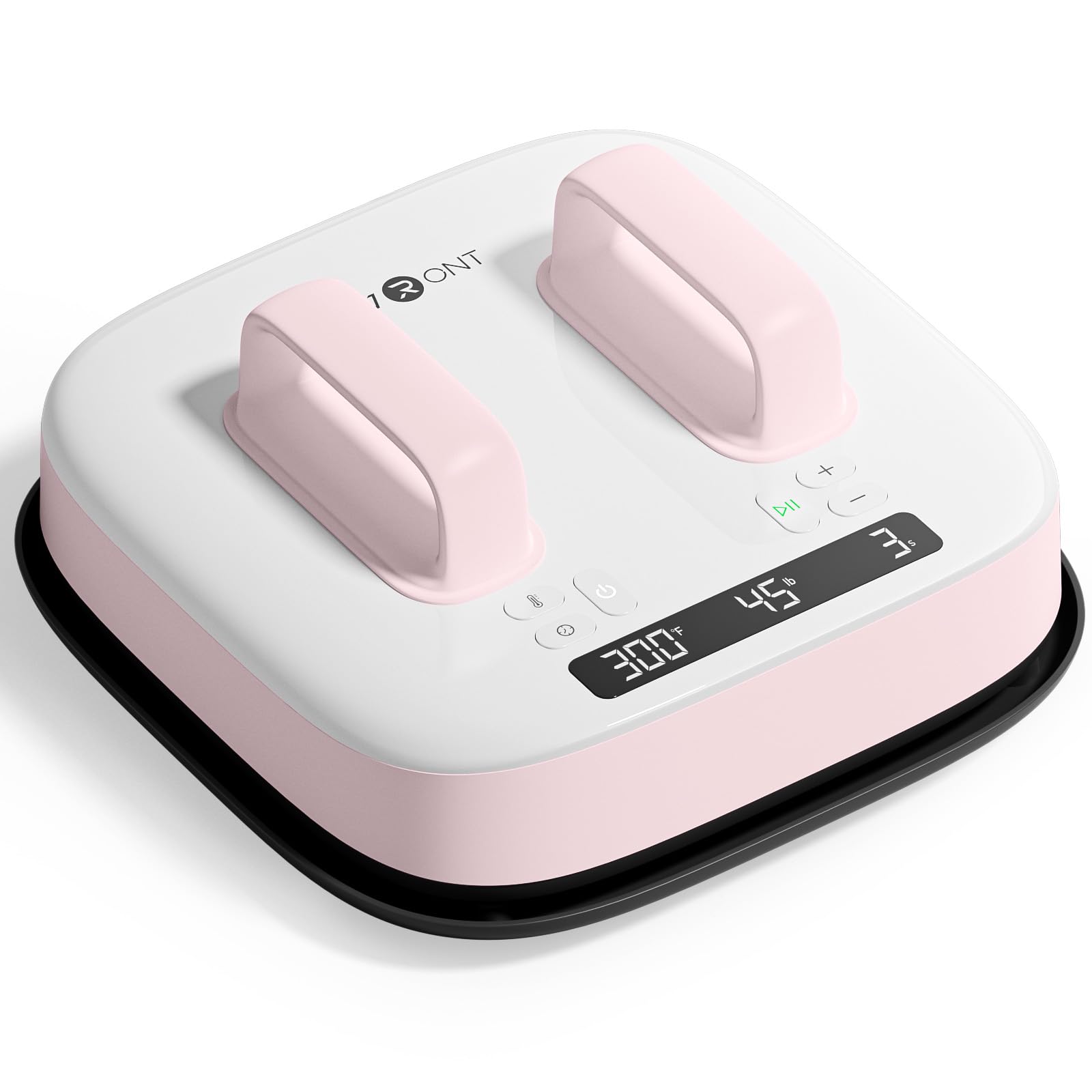
If your craft space is a shelf rather than a room, this is the press built for you. The H10 V2 is a 10 x 10 machine that measures 12 inches square and six inches tall, so it goes back in the cupboard when the table needs to be a table again, and unlike most small presses it does not ask you to guess at pressure.

A sensor reports what the platen is applying, live, on the display. We found that genuinely useful: instead of counting turns on a knob, you press a scrap, note the number that gave you a clean edge, and match it on the next shirt. The two handles push down evenly, one in each hand, which presses more level than a single central handle on a plate this size.

Ten inches square is the trade-off. A kids' shirt, a tote, a sleeve, a left-chest logo and a set of coasters all fit in one press; a full adult front does not, so you press it in halves and line the second one up carefully. Warm-up is quick, reaching 212 °F inside the first minute, and the timer beeps when it is done. Ours arrived in pink, which is either the best or the worst thing about it depending on your craft room.

Pros

  • Live pressure readout takes out the guesswork
  • Stows on a shelf at 12 inches square
  • Dual handles press evenly across the plate

Cons

  • Two passes needed on a full adult front
Our verdict

Buy this one if your craft space is a shelf: a 10 x 10 plate, real pressure feedback on the display, and a footprint that stows in a cupboard.

Check Latest Price
3

Best Handheld for Shirts

Cricut EasyPress SE

95 /100
Keeper Score Outstanding

Key details

Pressure
Hand-applied
Warranty
1 year limited
Platen Size
12 x 10 in
Max Temperature
400 °F
Check Price on Amazon

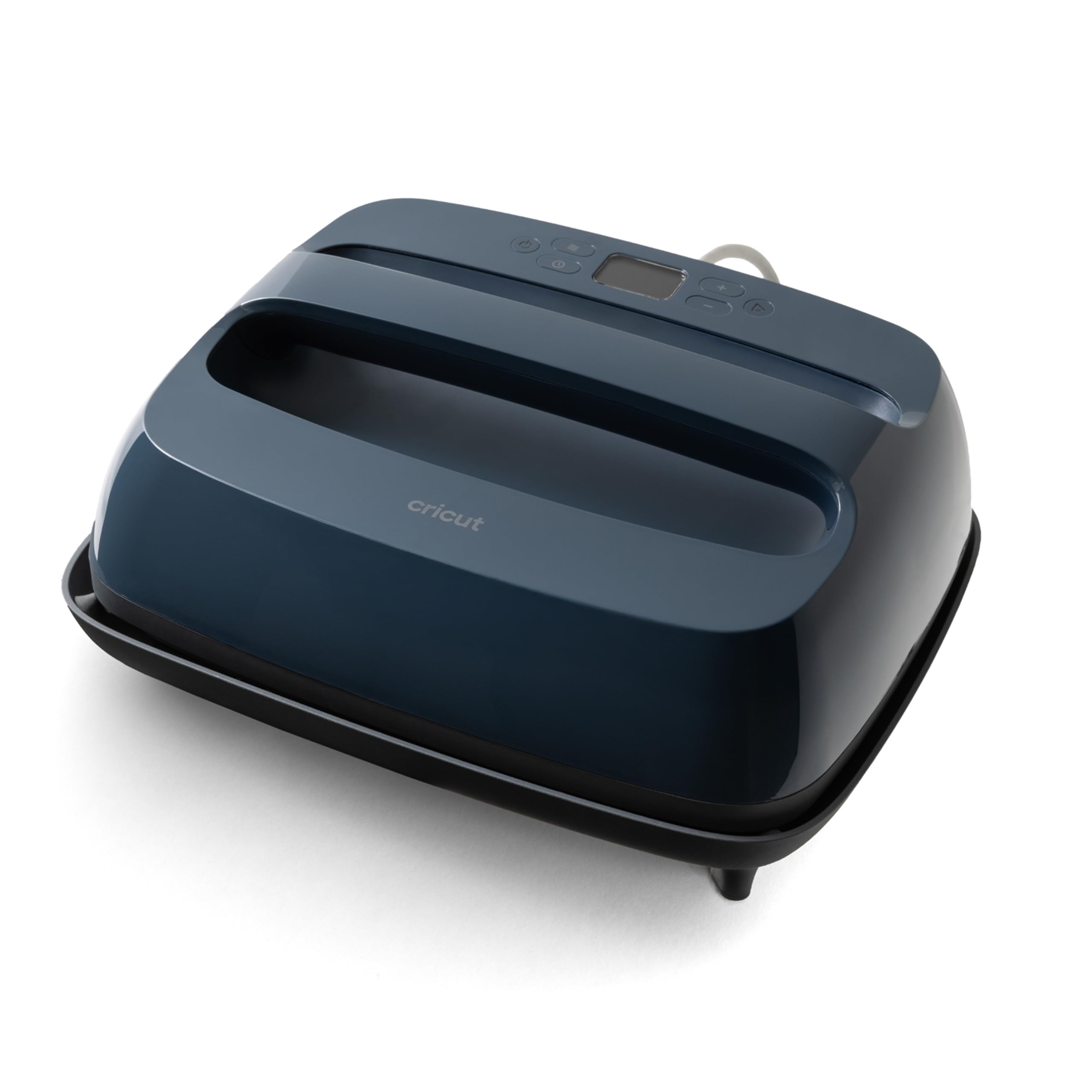
We pressed a tote bag on a kitchen counter with a towel underneath, and the whole job took less time than clearing a space for a clamshell. That is the EasyPress pitch: a hot ceramic plate on a handle, a countdown, and nothing to thread, swing, or clamp.

The 12 x 10 inch plate is the version to buy. It is wider than the 9 x 9 EasyPress 2 and it is the cheaper of the two Cricut presses here, which is a rare case of the bigger model also being the better value. Twelve inches across covers most adult front prints in one press, and the 400 °F ceiling handles heat transfer vinyl, Infusible Ink, and sublimation blanks.

Where it earns its place is for people who do not want a press living in the room. It goes on a shelf, travels to a friend's house, and works on any surface you can protect. The Cricut Heat Guide does real work too: look up the material and the blank, get a time and a temperature, and stop guessing.

The catch is that you are the pressure. Both hands, your weight, a steady count: that is the mechanism, and it means two people pressing the same shirt can get two different results. For a handful of shirts a month that is a fair trade; for anyone selling them, the repeatability of a clamshell earns its footprint. Longevity is the other thing to weigh, and the one-year limited warranty is the cushion.

Pros

  • 12 x 10 plate covers most adult front prints
  • Stores on a shelf, no table required
  • Heat Guide gives settings by material

Cons

  • Plate can run hotter than the set temperature
Our verdict

The pick when the press has to disappear between projects: a 12 x 10 plate, simple controls, and results that depend on how steadily you lean.

Check Latest Price
4

Best for Finished Shirts

Delclynee 15 x 15

91 /100
Keeper Score Outstanding

Key details

Pressure
Auto-floating platen
Platen Size
15 x 15 in
Lower Platen
Threadable
Max Temperature
455 °F
Check Price on Amazon

Slide a shirt over the Delclynee's lower platen and the back of the garment drops below the pressing surface, so the plate heats one layer of cotton instead of two with a side seam folded into the middle. That is the reason to choose it over the other clamshells here: press a shirt the ordinary way and a seam can print itself across the chest.

The upper platen floats on its mounting, so it settles into thick seams, collars, and uneven stacks instead of pressing the high spot and skipping the rest. It climbs to 455 °F, which leaves headroom for sublimation, and it beeps five times at temperature and again when the countdown ends, so you can work with your back turned.

Pressure is a knob you turn by feel, so set it with a test shirt and leave it alone. And like every 15 x 15 clamshell, it wants a firm table and room for the arm to swing up, which is a permanent claim on a work surface rather than something you put away.

Pros

  • Threadable platen keeps the shirt back out
  • Floating platen follows seams and thick stacks
  • 455 °F ceiling covers sublimation
  • Beeps at temperature and at the end

Cons

  • Plate can run above the set temperature
Our verdict

For pressing finished shirts in quantity, the threadable platen is the reason: the back of the garment stays out of the press and seams stop printing through.

Check Latest Price
5

Best for Small Projects

Cricut EasyPress 2

96 /100
Keeper Score Outstanding

Key details

Warranty
1 year
Platen Size
9 x 9 in
Safety Base
Included
Max Temperature
400 °F
Check Price on Amazon

Nine inches square is the number that decides this one. It covers a kids' T-shirt, a tote, a left-chest logo, a sleeve, or a set of coasters in one press, and it stops well short of a full adult front, which becomes two presses and a careful lineup.

What it does, it does with very little fuss. The ceramic plate heats dry and edge to edge to 400 °F, there is a countdown on the unit, it shuts itself off when you forget, and the safety base means the hot plate has somewhere to sit that is not the table. It also remembers the last temperature and time you used, which turns a repeat job into two button presses, a small thing we came to rely on.

This is the press we hand to someone who has never pressed anything: no arm to swing, no pressure to set, and the Cricut Heat Guide turns a material into a time and temperature. The plate runs dry, too, so there is no steam to work around the way there is with an iron and a damp cloth.

Pros

  • Remembers your last time and temperature
  • Dry ceramic heat to 400 °F
  • Safety base and auto shutoff included

Cons

  • Plate temperature can drift from the set point
Our verdict

For kids' clothes, totes, and small designs, this is the easiest press to pick up and use; nine inches square is simply too small for a full adult front.

Check Latest Price
6

Hats and Patches

Calogy Mini Heat Press

95 /100
Keeper Score Outstanding

Key details

Pressure
Hand-applied
Platen Size
2.87 x 4.43 in
Auto Shutoff
15 minutes
Heat Settings
Three, 284 to 356 °F
Check Price on Amazon

A patch on the crown of a cap. A name on a tote pocket. A repair on a sleeve that is already sewn into a shirt. None of those fit under a 15-inch platen, and all of them are a short job with the Calogy: a 2.87 x 4.43 inch plate on a handle you can hold in one hand.

Three heat levels cover the ground at 284 °F, 320 °F and 356 °F, with a live readout on the front, one button that cycles up, down, and between Fahrenheit and Celsius, and an automatic shutoff after 15 minutes of sitting idle. The insulated base means it can go down on the table while it is still hot, and it is small enough to keep in a drawer instead of dedicating bench space to it.

You will still want a full-size press for anything larger than a pocket, and that is the honest framing: this is a companion tool. The one-button control is the only genuinely fiddly part, since one press goes up, two go down and three switch units, and that is easy to forget between projects.

Pros

  • Reaches caps, sleeves, and small seams
  • Three heat levels with a live readout
  • Shuts off after 15 minutes idle

Cons

  • 356 °F maximum rules out sublimation work
Our verdict

A companion press rather than a main one: it reaches caps, patches, and seams that a 15-inch platen cannot touch, for the least money here.

Check Latest Price

How We Tested a Dozen Heat Presses

To build the shortlist, we combed through craft forums and heat-transfer groups for the brands that get recommended over and over, then filtered for a published temperature range and a pressure setup you can actually control — a dial, a knob, or an auto-press. That narrowed it to 12 machines, from palm-size units to 15-inch clamshells, and we bought every one at full price.

For six months they lived where pressing actually happens: a basement craft table, a kitchen counter that gets cleared for dinner, and a small shop working through shirt and tumbler orders. We ran heat-transfer vinyl onto cotton tees and sweatshirts, sublimation blanks onto polyester, and stacks of totes and onesies, logging the temperature, time, and pressure for each material.

Heat was measured, not assumed: we timed each machine from cold to target, read the plate with an infrared thermometer at the center and four corners, then read it again after 20 back-to-back presses to see whether it drifted, sagged, or overheated under load. Pressure got the same treatment — repeated presses at one setting, then a warm peel, a cold peel, and five trips through the wash to see if the bond held. We noted footprint on the table and whether a machine could be lifted and stowed in a closet, timed full cycles including clamping and adjustments, and checked how hot the housing and handles got during a long session. Value came at the end: how much machine a price bought, and how often we had to stop and fiddle with settings mid-project.

How to Choose a Heat Press Machine

Size the platen to the design you actually press

An adult front print usually runs 10 to 12 inches wide, so a 15 x 15 or 12 x 10 plate presses it in one go while a 9 x 9 needs two passes and a careful lineup in the middle. Kids' shirts, totes, sleeves, and coasters all fit a 10 x 10.

The trap is buying big for the idea of big: a 15 x 15 clamshell needs a firm, dedicated table and clearance for the arm to swing, and it holds that space whether you are pressing or not. If your work is finished shirts rather than flat panels, look for a threadable lower platen, which lets the back of the garment hang below the board.

Pressure is the setting nobody checks

Too little pressure and heat transfer vinyl lifts at the first wash; too much and you press seam marks and a shine into the fabric. A clamshell gives you a knob or a screw to set, an automatic press gives you a number on a screen, and a handheld gives you your own arm and body weight.

If you press the same shirt more than once, buy the version where pressure is set and repeatable. It is the single strongest argument for an automatic machine, and the reason our top pick has a pressure setting instead of a factory spring.

Heat that holds beats a higher number

Every press here reaches heat transfer temperatures; what separates them is whether the plate stays there when cold fabric lands on it. A platen that sags under a shirt and climbs back slowly under-cures the first press of a session and overcooks the fifth.

Press a scrap and check the corners as well as the middle, and leave a minute between shirts on a run so the plate recovers before the next one.

Handheld, clamshell, or auto-open

A handheld goes on a shelf, travels to a friend's house, and never needs a table, but your arms are the press and the timer is the only thing keeping you honest. A clamshell presses harder and more evenly and wants a permanent home.

An auto-open machine lifts the platen itself when the countdown ends, so you can lay out the next shirt while the current one finishes. That is the difference between an evening hobby and a small production run.

Buy for the element, not the badge

The part that fails on a heat press is almost always the heating element or the control board, not the frame, so warranty coverage matters more than the name on the lid. A year is the norm among the presses here that state one.

Find out what is covered and for how long before you buy, keep the receipt, and treat a short warranty as information about how long the maker expects the machine to last.

Frequently Asked Questions

Final Verdict

There is a clear default here: the HTVRONT Auto Heat Press 2. A full 15 x 15 platen, pressure you set once and it repeats, and a head that lifts itself at the end of the countdown make it the machine that gets shirts finished instead of babysat, which is worth a premium if you press regularly and can give it a table.

If a press cannot live on a table, the Cricut EasyPress SE 12x10 presses the same shirts by hand and goes back on the shelf. You trade repeatability for space, and for a few shirts a month that is a fair trade.